 Skip to content

Airbag Computer Reset: Denton Guide
Direct answer: An airbag computer reset clears crash data and SRS fault codes from the vehicle’s airbag control module so the airbag system can return to normal operation. It’s a safety procedure — not a cosmetic fix — and should be done by a trained technician who preserves crash data when required by law.
Key Takeaways
- An airbag computer reset clears crash data and SRS (airbag) fault codes so the system can function and stop the airbag warning light.
- Not every reset is appropriate: crash data may be legally required or needed for accident repair and insurance.
- Resets can be done on-site (mobile) or via a nationwide mail-in service depending on your situation.
- Common DTCs are explained in plain language and a reset won’t fix physical damage — it clears the code and stored crash events.
What is the “airbag computer”?
The airbag computer — often called the SRS control module, airbag control unit (ACU) or airbag module — is the small electronic brain that monitors crash sensors, seat-belt pretensioners, and decides when to deploy airbags. It stores fault codes and crash event data (sometimes called “crash data” or “event data recorder”) when the system detects a problem or a collision.
Why would you need an airbag computer reset?
- After a collision: the module stores crash data and may permanently disable the airbag until cleared or replaced.
- After repairs: if components (sensors, seat belts, clockspring) were replaced or reconnected, stored faults may need clearing.
- When the SRS warning light is on: the light means the system detected a fault; a reset may clear the light but only after the root cause is fixed.
Is a reset safe and legal?
Safety first: clearing a module does not repair damaged sensors or a damaged airbag. If the module holds crash data from an actual collision, that data can be important for insurance, legal, and repair records. Some states and repair shops require preserving or documenting crash data before clearing. A qualified technician will explain whether data must be retained, whether the module should be replaced, and will verify the system is safe after reset.
How the reset process works (plain steps)
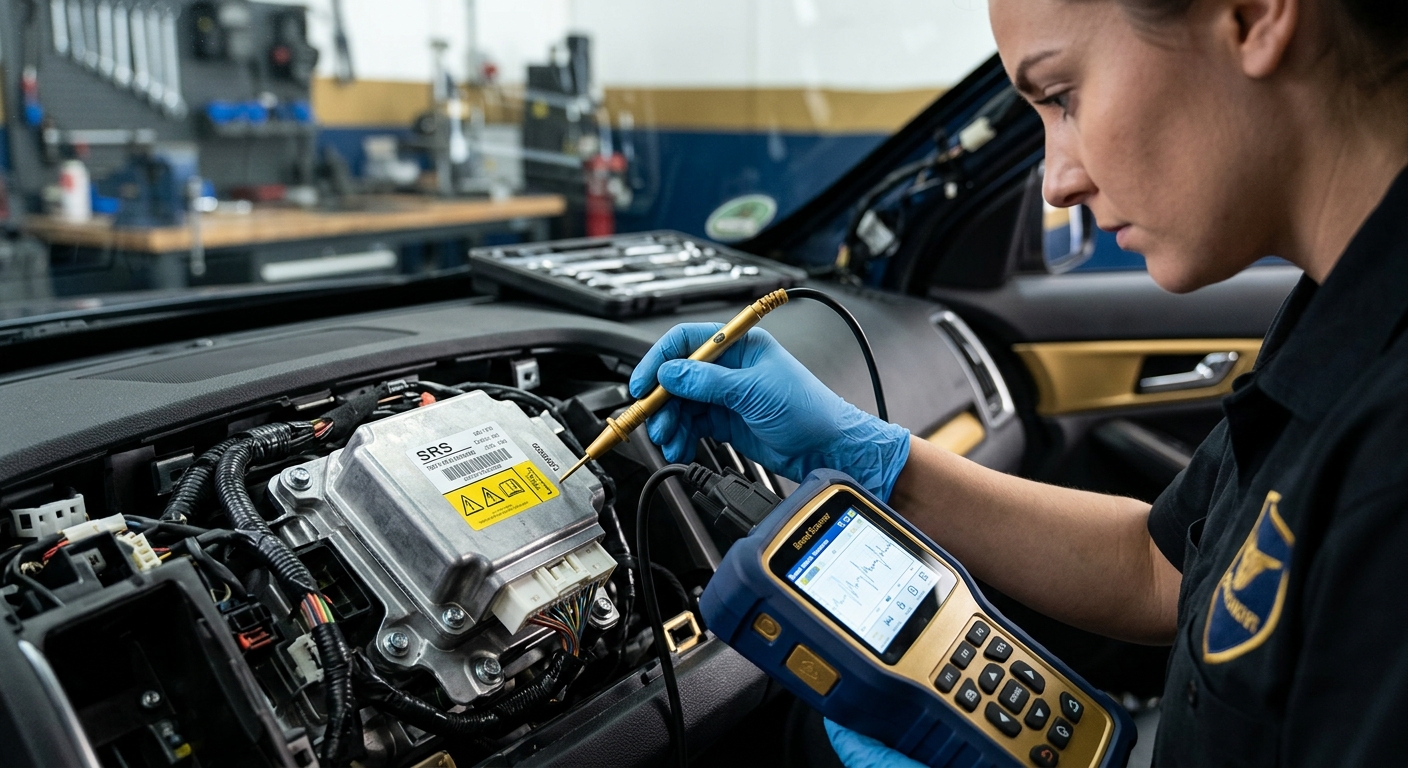
- Diagnostic scan: the technician reads SRS diagnostic trouble codes (DTCs) with a scan tool to see what’s stored.
- Visual inspection and repairs: damaged wiring, sensors, clock springs, or modules are repaired or replaced first.
- Data review: if crash data exists, the tech documents it and advises on legal or insurance implications.
- Module reset or reflash: using manufacturer-grade tools or a controlled reset service, the module’s stored faults and crash flags are cleared and the module is returned to a normal state.
- Verification: the system is scanned again and test-driven to confirm the SRS light stays off and the system reports OK.
Common SRS DTCs — what they mean and what to do
Below are typical codes you might see. DTCs are short codes the airbag computer stores when it detects a problem. The table explains them in plain English and the common next steps.
| Example DTC | Plain-English meaning | Typical action |
|---|---|---|
| B0100 / U1xxxx | Fault with the airbag control unit or internal communication fault. | Inspect module power/ground and vehicle CAN wiring; may require module reset or replacement. |
| B0281 / Bxxxx | Counters or crash event flag set — module recorded a deployment or severe event. | Document crash data; module often needs professional reset or replacement depending on vehicle rules. |
| U0121 / U0xxx | Communication lost with another control unit (e.g., ABS, airbag). | Check network wiring, connectors, and related modules; clear codes once root cause fixed. |
| B1A00 / B1Bxx | Seat belt pretensioner or occupant classification sensor fault. | Inspect seat wiring and sensors; replace or repair faulty parts before reset. |
Note: code naming varies by maker. A technician will translate the exact DTC on your vehicle and explain the necessary repairs. Clearing a code without fixing the underlying issue will usually cause the fault to return and the SRS light to come back on.
Mobile vs. mail-in reset — which is right for you?
If your vehicle won’t move safely or you prefer onsite service, a mobile reset technician can come to you and perform diagnostics and many types of module resets. For modules that can be removed and shipped, a nationwide mail-in option can be convenient: you send the module, the technician resets it in a controlled environment, and the module is returned.
We offer both convenient choices: mobile airbag module resets and a nationwide mail-in program with free shipping. Learn more about our mobile option at mobile airbag module reset or our mail-in details at mail-in airbag module reset.
What a professional check includes
- Full SRS system scan and reading of all stored data (not just active codes).
- Inspection of wiring, connectors, steering column clock spring, seat sensors, and pretensioners.
- Documentation of any crash event data before clearing.
- Reprogramming or module reset using manufacturer-grade tools and procedures.
- Final verification drive and re-scan to confirm the system is healthy.
How much does an airbag computer reset cost?
Pricing varies by vehicle, module type, and labor needed. Because this is a safety-critical service, costs depend on whether repairs or parts are required and whether the module can be safely reset. For a clear quote, call us at (469) 277-7277 — we’ll ask about your vehicle make and the SRS codes you’re seeing.
When a reset isn’t the right answer
- If the module is physically damaged or sensors/airbags have deployed, replacement is usually required.
- If crash data must be preserved for legal reasons, do not clear the module until instructed by your insurer or authorities.
- If communication faults persist after a reset, the issue may be wiring, a separate control module, or a software mismatch requiring programming.
How to prepare before you call a technician
- Note any SRS warning light behavior (steady, blinking, started after a repair, or after a collision).
- Gather any accident or repair records and the vehicle’s VIN if available.
- Write down any codes from a shop or a scan tool if you already have them.
FAQ
Q: Will resetting the airbag computer delete crash data?
A: It can. Many modules store crash event flags and data. A proper service documents the data first and follows legal and safety guidelines before clearing the module.
Q: Can I clear the SRS light with a consumer OBD-II reader?
A: Most basic OBD-II readers can’t safely clear SRS crash data. Clearing the light without fixing the problem or preserving crash data may be unsafe or non-compliant with regulations.
Q: How long does a reset take?
A: The time varies. A module that can be reset on-site may only take an hour or two for diagnosis and verification. Mail-in services depend on shipping time and complexity. We’ll give an estimated timeline once we know your vehicle and the codes.
Q: Will a reset affect other vehicle systems?
A: A proper reset should not harm other systems. However, some modules are networked with other control units and a technician will re-scan all related systems and perform any required reprogramming.
If you’re in Denton and need a safe, documented airbag computer reset or just want expert advice on the next step, our team can help. Learn more about our vehicle safety services at vehicle safety system services. To schedule mobile service, visit our appointment page or call (469) 277-7277. We’ll explain options (mobile or mail-in) and provide a clear next step without pressure.


