 Skip to content

Toyota Pre Collision System Malfunction Reset: Causes, Diagnostics, and Safe Next Steps
If you’re searching for “toyota pre collision system malfunction reset”, you’re likely staring at a warning on your dash and wondering: Is it safe to drive, is this just weather or a weak battery, or is something really wrong with my Toyota Safety Sense system?
LockNCal provides mobile ADAS calibration — front camera, radar, and sensor calibration — at your location across DFW. Book mobile ADAS calibration or call (469) 277-7277.
Pre-collision system needs recalibration? After a windshield replacement, bumper repair, or front-end work, your Toyota’s pre-collision cameras and radar usually need recalibrating to function correctly. That’s exactly what our mobile ADAS calibration service across Dallas–Fort Worth handles.
As an ADAS and safety-systems specialist in the Richland Hills / DFW area, I’ll walk you through what that warning really means, what you can safely check yourself, when a simple reset may work, and when your vehicle needs Vehicle Diagnostic, ADAS Calibration, or Module Programming.
This is an information-first guide, not a generic repair pitch. If your own checks don’t clear the warning, LockNCal in Richland Hills TX can handle the scan-based diagnosis, calibration, and programming for most American & Japanese vehicles.
What the Toyota Pre-Collision System Warning Actually Means
What Toyota’s PCS is designed to do
Toyota’s Pre-Collision System (PCS) is part of Toyota Safety Sense. It uses a forward-facing camera (usually near the rear-view mirror) and a radar sensor (typically behind the front grille emblem or lower bumper) to:
- Detect vehicles, pedestrians, and sometimes cyclists in front of you.
- Warn you with visual and audible alerts if a collision is likely.
- Apply or assist braking to help reduce speed and impact severity.
When PCS is working correctly, it’s constantly monitoring the road. When it’s not, the system will warn you instead of operating blindly.
What “malfunction” means vs “temporarily unavailable”
It’s important to distinguish between two common messages:
- “Pre-Collision System Unavailable” or “Pre-Collision System Unavailable Check Surroundings” – Often a temporary interruption. Common with heavy rain, fog, snow, direct sun glare, or if the camera/radar view is blocked by dirt, ice, or a car-wash film.
- “Pre-Collision System Malfunction Visit Your Dealer” – Points to a persistent fault stored in the system. This can be electrical, sensor-related, calibration-related, or software-related.
Both messages mean the system is not fully reliable at that moment. The “malfunction” wording is your cue that simple conditions like weather may not be the only issue.
Which features may stop working when this warning appears
Depending on your model (Camry, Corolla, RAV4, Tacoma, etc.), a PCS warning may partially or fully disable related driver-assist features, including:
- Automatic emergency braking / Pre-collision braking assist
- Forward collision warning
- Adaptive cruise control / Dynamic radar cruise control
- Lane departure assist / lane keeping (in some conditions)
Safety note: Your basic mechanical brakes still work, but automatic intervention may not. You should drive as if you have no electronic backup until the issue is resolved.
Common Symptoms That Appear With a Toyota Pre-Collision System Malfunction
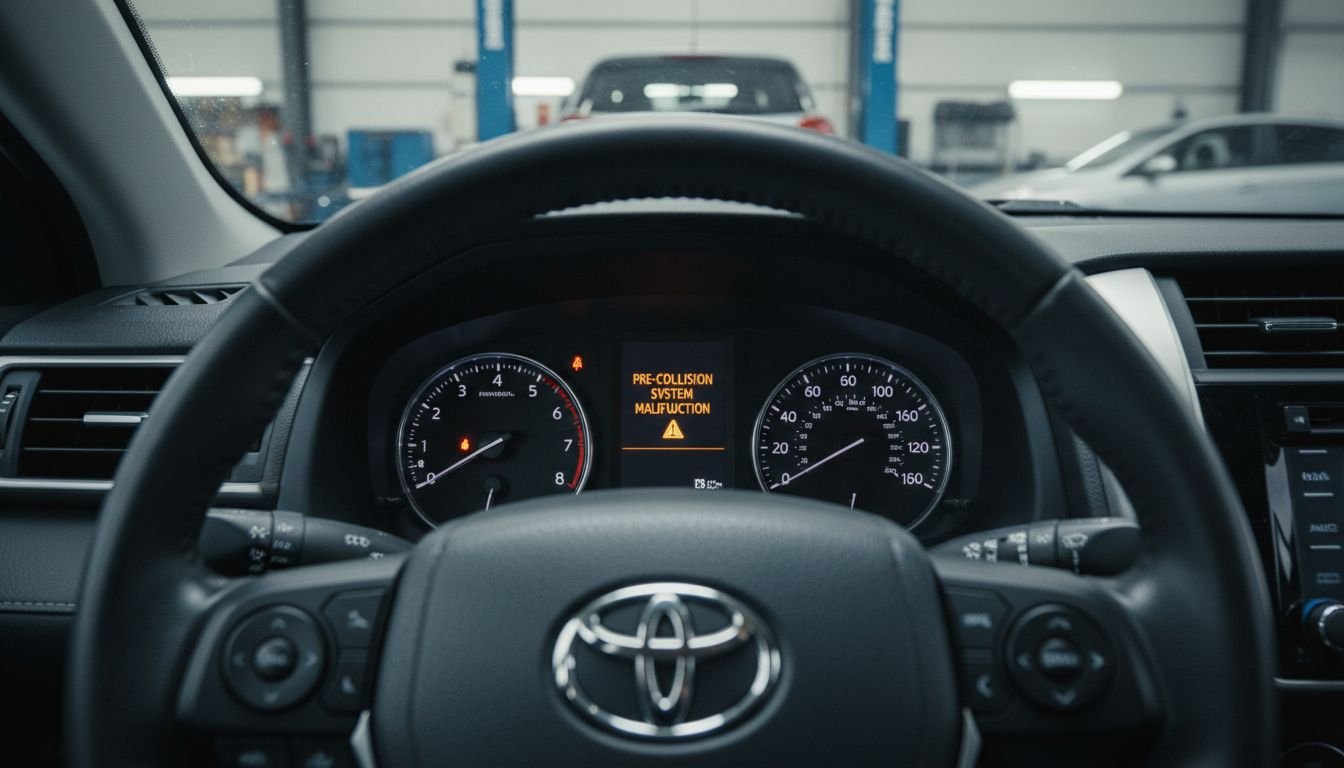
The exact message on your Toyota’s dash may vary, but most issues share a few common symptoms.
Dashboard messages and warning lights
You may see one or more of the following:
- “Pre-Collision System Malfunction Visit Your Dealer”
- “Pre-Collision System Unavailable”
- “Radar Cruise Control Unavailable” or similar wording
- Master warning light (triangle with exclamation)
- PCS indicator light on or flashing
Cruise control or driver-assist features becoming unavailable
On vehicles with dynamic radar cruise control, you may notice:
- Adaptive cruise control not engaging.
- System dropping out and showing a warning mid-drive.
- Need to use standard, non-radar cruise (if available) or no cruise at all.
Other Toyota Safety Sense features may also show separate or related messages.
Warnings after rain, fog, dust, car washes, or minor impacts
Many drivers report Toyota pre-collision system malfunction or “unavailable” warnings appearing:
- After a car wash or driving through heavy rain with road grime.
- In dense fog, dust storms, or heavy snow.
- Right after a minor bump, parking lot tap, or curb strike.
These are clues. Weather and dirt tend to cause temporary interruption. Impact and repairs often point to calibration-required or component movement.
Describe causes of pre-collision system malfunctions, stepwise diagnostics, when a simple reset might work vs when sensor/camera recalibration or module programming is required, and safety considerations.
Temporary causes: dirty emblem, blocked camera, weather, glare
These are the most common, least serious causes of a Toyota pre-collision warning:
- Dirty front emblem or bumper cover blocking radar.
- Bug splatter, tree sap, or road film over the radar area.
- Dust, water spots, or car-wash residue over the forward-facing camera on the windshield.
- Heavy rain, dense fog, or blowing snow limiting sensor visibility.
- Low sun glare directly into the camera.
These typically trigger “unavailable” or intermittent PCS warnings and sometimes clear on their own once conditions improve.
Electrical causes: weak 12V battery, poor voltage, blown fuse, wiring issues
Modern Toyotas are voltage-sensitive. A weak 12V battery or unstable voltage can set PCS and other ADAS faults, especially after:
- Jump-starts
- Battery replacement
- Leaving lights on or multiple short trips
Other electrical causes include:
- Blown fuse for the radar or camera circuit.
- Wiring damage near the front bumper or radiator support.
- Poor grounds or corroded connectors.
These can create a persistent fault that will not go away with a simple restart.
Impact-related causes: bumper repairs, windshield replacement, alignment shifts
Any time the radar or camera is removed, replaced, or its mounting surface is disturbed, the system may require a precise ADAS calibration before PCS will function correctly again. Common triggers:
- Windshield replacement (camera removed/reinstalled).
- Front bumper repair or replacement (radar moved or bracket bent).
- Minor collision damage or fender benders where the front structure or camera bracket is slightly out of position.
- Suspension or alignment changes that alter the vehicle ride height or angle.
If your Toyota Camry, Corolla, RAV4, Tacoma, or other model had recent front-end work and now shows a PCS malfunction, a reset alone will not fix a camera or radar that is aimed incorrectly. That’s where ADAS Calibration comes in.
Electronic causes: stored trouble codes, module communication faults, software issues
The PCS uses multiple modules that talk to each other over data networks inside the car. Problems can include:
- Stored diagnostic trouble codes (DTCs) in the PCS, brake system, or ABS modules.
- Network / communication faults between modules (CAN communication errors).
- Software configuration or initialization issues after a module has been replaced.
These situations usually require a professional scan tool, analysis of live data, and potentially Module Programming or initialization routines – not just clearing codes.
When a simple reset may work
A basic toyota pre collision system malfunction reset might work when:
- The warning appeared in extreme weather and conditions have now improved.
- You found and cleaned obvious dirt or blockage on the emblem, bumper, or windshield camera area.
- The battery was weak but has been properly charged or replaced, and system voltage is now stable.
In these cases, cycling the ignition off for a few minutes, then restarting and going for a short, careful test drive may allow the system to re-check itself and clear the warning.
When ADAS Calibration is required
Calibration is usually required when:
- The windshield was replaced.
- The front bumper, grille, or radar bracket was removed, repaired, or replaced.
- The vehicle had a front-end collision, even if it seemed minor.
- There are calibration-related DTCs stored, indicating camera/radar aim out of range.
No amount of key cycling or battery disconnect will properly re-aim a camera or radar. It must be done with ADAS Calibration equipment under controlled conditions, often using specific targets and measurements defined by Toyota.
When Module Programming may be required
Module Programming becomes a likely need when:
- A related control module was replaced (e.g., radar sensor module, camera module, brake/ABS module).
- The vehicle had software updates or a module swap that now requires configuration to match your exact options.
- Scan data shows configuration, coding, or variant mismatch faults.
Programming sets up the module with the correct software and settings so it can communicate correctly with the rest of the car. Again, this is not something a simple DIY reset can accomplish.
When to stop driving and schedule a Vehicle Diagnostic
You should stop DIY attempts and schedule a Vehicle Diagnostic as soon as possible if:
- The PCS warning comes back immediately after every restart.
- You see multiple ADAS-related warnings (PCS, lane departure, cruise, ABS, etc.).
- The vehicle just had front-end repairs, windshield replacement, or collision work.
- You experience braking or stability control behavior that feels abnormal.
A proper diagnostic uses a professional scan tool to read codes, check live data, and identify whether the root cause is blockage, calibration, or programming – not guesswork.
How to Try a Toyota Pre Collision System Malfunction Reset Safely

Here is a safe, step-by-step way to try a basic reset without special tools.
1. Park safely and inspect the radar emblem and camera area
- Park on a level surface in a safe location.
- Turn the engine off and set the parking brake.
- Inspect the front emblem / bumper area where the radar is located for mud, bugs, stickers, license-plate frames, or damage.
- Look at the upper windshield in front of the rear-view mirror (camera zone) for heavy dirt, tint film, suction cup mounts, or dash cams blocking the view.
2. Clean the front emblem, bumper area, and windshield camera zone correctly
Use the right technique:
- Use a soft microfiber cloth and mild, non-abrasive cleaner.
- Do not use aggressive chemicals or sharp tools that can scratch the emblem or windshield.
- Remove any stickers, badges, or aftermarket covers blocking the radar area.
- Clean both the inside and outside of the windshield around the camera, if accessible and safe to do.
3. Restart procedure and short drive verification
- After cleaning, leave the vehicle off for a few minutes.
- Restart the engine and wait to see if the PCS warning clears.
- If it does not clear immediately, drive carefully at low to moderate speed (when safe) so the system can self-check.
- If the message disappears and does not return, it was likely a temporary interruption.
- If it comes back quickly or stays on, you are likely dealing with a persistent fault, calibration-needed condition, or programming issue.
4. Why disconnecting the battery is not a guaranteed fix
Some drivers try to reset the system by disconnecting the 12V battery. Be aware:
- This may clear stored codes temporarily, but it does not repair the underlying problem.
- You can also create new issues such as lost radio presets, window initialization issues, or additional fault codes.
- Certain modules need proper shutdown procedures to avoid corruption – simply yanking the battery cable is not recommended.
5. Why clearing codes without diagnosis can hide the real issue
Even with a basic OBD-II scanner, just clearing codes is risky:
- Codes provide a history that helps a professional pinpoint the failure.
- Wiping them without documenting can make troubleshooting harder and more expensive later.
- If the warning comes right back, that confirms a persistent fault that needs proper diagnostic steps.
At LockNCal, our Vehicle Diagnostic focuses on reading and interpreting those codes and data instead of guessing.
Step-by-Step Diagnostics Before You Pay the Dealer
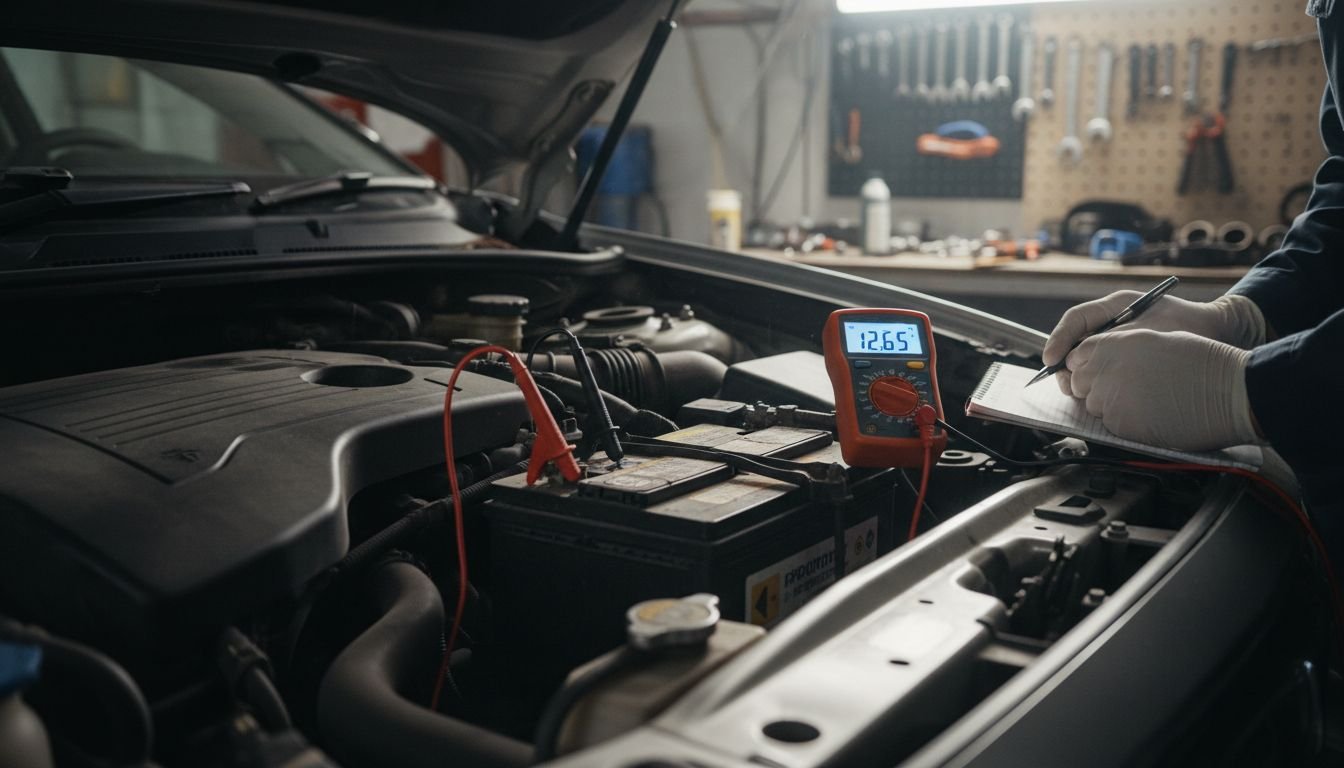
Before you commit to a dealership visit, you can follow a logical diagnostic path. This is where most competitor articles fall short—they skip the structured approach.
1. Check battery condition and voltage stability
A weak battery can absolutely cause a Toyota pre-collision system malfunction. You can:
- Have the battery load-tested at a reputable shop or parts store.
- Use a multimeter: after sitting overnight, a healthy battery should be around 12.4–12.6 volts at rest.
- Check for loose or corroded terminals.
If the battery is borderline or failing, replace it first, then see if the PCS warning returns.
2. Look for windshield damage, bumper damage, aftermarket accessories, or recent body work
Walk around the vehicle and ask yourself:
- Has the windshield been replaced recently?
- Is there any front bumper, grille, or emblem damage – even small?
- Did a shop recently perform front-end or collision repair?
- Have you added bull bars, grille guards, custom emblems, or front-mounted accessories near the radar?
Any “yes” answer pushes the cause toward a calibration-required condition rather than a simple reset.
3. Scan for fault codes instead of guessing
The next step is to scan for diagnostic trouble codes in the PCS, ABS, and related modules:
- Basic parts-store scanners are often limited; they may only see engine codes.
- A professional scan tool reads manufacturer-specific ADAS codes and live data from camera and radar modules.
This is where a Vehicle Diagnostic at a shop like LockNCal in Richland Hills TX pays off. We don’t just plug in a generic scanner; we use ADAS-focused tools to see the whole picture.
4. Identify whether the issue points to blockage, calibration, or programming
Once codes and data are captured, a professional can determine whether the PCS issue is:
- Blockage-related – sensor or camera view obstructed.
- Calibration-required – camera/radar aiming or mounting is out of specification.
- Programming-required – module replacement or configuration/initialization problem.
This targeted approach helps avoid unnecessary parts replacement and ensures the right next step: Vehicle Diagnostic → ADAS Calibration → Module Programming, in that order when needed.
When a Reset Will Not Work
After windshield replacement or front-end impact
If your Toyota Camry, Corolla, RAV4, Tacoma, or other model had a windshield replaced or a front-end impact, a reset will not realign the camera or radar. The vehicle will typically require a Toyota Safety Sense calibration procedure.
After sensor removal or bumper repair
Anytime a body shop, glass shop, or DIY project involves removing or shifting the radar sensor, camera, bumper, or grille, the sensor’s aim can change by millimeters—enough to confuse PCS. Only a proper ADAS Calibration can restore accurate alignment.
If warning returns immediately after restart
If the PCS malfunction warning reappears as soon as you restart or within the first minute or two of driving, you are likely dealing with a persistent fault. That means it’s time for:
- Vehicle Diagnostic to read codes and data.
- Then, if needed, ADAS Calibration or Module Programming based on findings.
If multiple ADAS or communication warnings are present
When you see a mix of warnings – PCS, lane departure, cruise control, ABS, traction, or “communication error” messages – the issue often goes beyond a dirty sensor. It may be:
- A network/communication issue between modules.
- An internal module failure or configuration problem.
- A more significant post-collision electronic fault.
In these cases, chasing a “reset” is not only ineffective; it can be unsafe.
Toyota PCS Diagnostics and ADAS Calibration in Richland Hills TX
When LockNCal recommends Vehicle Diagnostic
At LockNCal in Richland Hills TX, we usually start with a Vehicle Diagnostic when:
- The PCS warning is persistent or keeps returning.
- The vehicle has a history of battery issues, jump-starts, or recent module replacements.
- You suspect there’s been collision or body work, but you’re not sure what was recalibrated.
This diagnostic includes full system scanning and data review, not just code clearing.
When LockNCal recommends ADAS Calibration
We move to ADAS Calibration when diagnosis or vehicle history clearly indicates:
- Windshield replacement with a camera-mounted unit.
- Front bumper, grille, emblem, or radar bracket work.
- Front-end collision or suspension changes affecting ride height and alignment.
- Calibration-related DTCs are present in the PCS or camera/radar modules.
Proper calibration brings your Toyota Safety Sense features back into specification so they respond correctly on the road.
When LockNCal recommends Module Programming
Module Programming is recommended when:
- A safety or ADAS-related control module was replaced.
- The scan shows configuration or coding errors.
- The system requires software updates or initialization to function correctly.
Programming ensures the new or existing module is correctly set up for your specific vehicle configuration.
Service area mention: DFW, Richland Hills, and nearby drivers
LockNCal provides Vehicle Diagnostic, ADAS Calibration, and Module Programming for most American & Japanese vehicles in:
Richland Hills TX, North Richland Hills TX, Haltom City TX, Fort Worth TX, Hurst TX, Euless TX, Arlington TX, Dallas TX, Plano TX, Frisco TX, McKinney TX, and across Tarrant County, Dallas County, Denton County, Collin County, and Rockwall County, including cities such as Addison, Allen, Anna, Burleson, Carrollton, Cedar Hill, Celina, Colleyville, Coppell, Denton, DeSoto, Duncanville, Farmers Branch, Flower Mound, Garland, Grand Prairie, Grapevine, Highland Park, Hutchins, Irving, Kennedale, Lake Dallas, Lake Worth, Lancaster, Lewisville, Little Elm, Mansfield, Melissa, Mesquite, Pantego, Prosper, Richardson, Rockwall, Saginaw, Seagoville, Southlake, The Colony, Trophy Club, University Park, Watauga, White Settlement, and Wilmer.
If you’re nearby and your Toyota’s PCS warning keeps returning, we can help you diagnose, calibrate, and program the system correctly the first time.
DIY Risks and Safety Warnings You Should Not Ignore
Why guessing at ADAS faults can leave safety features disabled
PCS is directly tied to braking and crash-avoidance. Guessing at the cause or repeatedly trying DIY resets can leave you driving with:
- No automatic emergency braking
- No forward collision warning
- Reduced or disabled adaptive cruise
That might seem fine in clear weather—until you need those systems in an emergency.
Why calibration requires proper equipment and conditions
Proper Toyota Safety Sense calibration is not a “park in an empty lot and eyeball it” process. It requires:
- Professional targets and measuring tools.
- Controlled lighting, level floor, and specific distances.
- Manufacturer-defined procedures and software.
Improper calibration can be worse than a disabled system, because the vehicle may react too early, too late, or in the wrong situations. For more background on how collision repairs and safety electronics interact, see our article on ADAS system ready after a fender bender.
Important note about SRS components and professional handling
Modern safety systems are deeply connected. PCS data is often shared with SRS (airbag) modules and other safety controllers. Those SRS components include explosive devices such as:
- Airbags
- Seatbelt pretensioners
Never casually probe, power, or disassemble SRS-related connectors or modules. Incorrect handling can cause accidental deployment or damage that may only show up in a future crash. To understand why proper resets and module handling matter, review our posts on the critical airbag reset check when buying a used car and the dangers of skipped airbag module resets in DIY rebuilds.
Final Takeaway: Reset First, Diagnose Correctly, Calibrate or Program When Needed
Simple reset summary
A toyota pre collision system malfunction reset can be safely attempted by:
- Cleaning the radar emblem/bumper and windshield camera area.
- Ensuring the 12V battery is healthy and connections are secure.
- Restarting the vehicle and taking a short, careful drive to allow self-check.
If the warning goes away and stays away, the cause was likely temporary obstruction or weather/voltage-related.
Signs the problem needs professional help
You should move beyond DIY once:
- The warning returns quickly after cleaning and restart.
- The vehicle recently had a windshield, bumper, or front-end repair.
- You see multiple ADAS or communication warnings.
- Your vehicle was jump-started or had a module replacement and now shows PCS faults.
At that point, guessing is risky. A structured path—Vehicle Diagnostic → ADAS Calibration → Module Programming when indicated—is the safest and most cost-effective way forward.
CTA to book Vehicle Diagnostic
If your Toyota’s pre-collision warning keeps coming back, LockNCal in Richland Hills TX can help you figure out whether you’re dealing with a simple blockage, a Toyota Safety Sense calibration need, or a deeper software configuration issue.
Next step: Book a Vehicle Diagnostic so we can scan your PCS, identify if you need ADAS Calibration or Module Programming, and get your collision-avoidance features safely back online. We serve drivers across DFW with a focus on American & Japanese vehicles.
Not sure exactly which model or package you have? Use our VIN decoder to pull detailed build information before you call—that helps us plan the right diagnostic path for your vehicle.
FAQs About Toyota Pre-Collision System Malfunction and Reset
1. Can I keep driving with a Toyota pre-collision system malfunction warning?
You can physically drive the vehicle because the basic mechanical brakes still work, but you may have reduced or no automatic emergency braking and collision warnings. Treat the car as if it has no driver-assist backup and schedule a Vehicle Diagnostic as soon as possible, especially if the warning is persistent.
2. How do I do a Toyota pre collision system malfunction reset?
Start by cleaning the front radar emblem and windshield camera area, checking that the battery is healthy, then restarting the vehicle and taking a short, careful drive. If the warning clears and stays off, it was likely a temporary issue. If it returns, you need professional diagnostics to determine whether ADAS Calibration or Module Programming is required.
3. Why did my Toyota pre-collision warning come on after a car wash or heavy rain?
Water, soap film, and road grime can temporarily block the radar or camera view, triggering a “Pre-Collision System Unavailable” or malfunction message. Once the surfaces are clean and dry and the system re-checks itself, the warning often clears. If it does not, moisture intrusion or another fault may be present and should be checked.
4. Can a weak battery cause a Toyota pre-collision system malfunction?
Yes. A weak 12V battery or unstable voltage is a common cause of PCS and other ADAS warnings. Have the battery tested and terminals checked. If the warning remains after the battery is corrected, a Vehicle Diagnostic can confirm whether any modules need recalibration or programming.
5. When does a Toyota pre-collision warning need ADAS calibration instead of a reset?
You likely need ADAS Calibration if the warning appeared after a windshield replacement, bumper or grille repair, front-end collision, or suspension change. Those events can knock the camera or radar out of alignment; no reset can fix aim that is physically off. Calibration realigns the sensors to Toyota’s specifications.
6. Will clearing the code fix the problem permanently?
No. Clearing codes simply erases the symptoms, not the cause. If the underlying issue remains, the warning will return—sometimes quickly. It’s better to document and diagnose the codes, then repair or recalibrate as needed.
7. Do I need module programming if the warning came back after calibration or battery replacement?
If a proper ADAS Calibration was completed and your battery is now healthy but the PCS malfunction returns, your vehicle may have a module configuration or software issue. In that case, Module Programming or initialization may be needed to get all systems communicating correctly.


