
Is My Rebuilt Car Safe? What Rebuilt Really Means and How to Check It
A rebuilt car can be safe, but only if the damage was repaired correctly and the safety systems were properly restored and verified. If you’re in Irving TX or anywhere in DFW wondering, “is my rebuilt car safe?” this guide will walk you step by step through what to look for before you trust it with your family.
This is an educational safety guide, not a sales page. I’ll explain how rebuilt titles work, what a salvage safety inspection does (and doesn’t) cover, and the specific checks that matter most on modern American and Japanese vehicles.
For local safety-system support in Irving TX and the DFW area, you can learn more about LockNCal’s location-specific services here: LockNCal Irving TX.
What does “rebuilt” mean on a car title?
Before you can decide if a rebuilt title car is safe to drive, you need to understand the difference between salvage, rebuilt, and clean titles—and what those labels do and don’t tell you about current safety.
The difference between salvage, rebuilt, and clean titles
- Clean title
A clean title means the vehicle has not been declared a total loss by an insurance company. It does not guarantee the car has never been in a serious accident; it only means it wasn’t written off as totaled. - Salvage title
A salvage title usually means an insurer decided the car was a total loss due to crash damage, flood, theft recovery, or other severe events. In this status, the vehicle is generally not legal to drive on public roads until it’s repaired and passes the required inspections for your state. - Rebuilt (or “reconstructed”) title
A rebuilt title means a previously salvage vehicle was repaired and then passed a required state or insurance-level inspection. After that, it can usually be titled, registered, and driven again—but the rebuilt brand stays on the title permanently.
In simple terms: Salvage = too damaged to drive. Rebuilt = repaired after salvage. Clean = never branded as total loss.
What a salvage safety inspection usually tells you — and what it may not
Many states require a salvage safety inspection or some form of vehicle salvage inspection report before a previously totaled car can be retitled as rebuilt. This inspection is helpful, but limited.
Typically, a salvage inspection will:
- Verify the vehicle’s identity (VIN) and that major parts were not stolen.
- Check that obvious, major repairs were completed (for example, that the car is structurally intact enough to drive and has working lights, glass, and basic functions).
- Review receipts or documentation for big replacement parts (airbags, bumpers, body panels, etc.).
What a salvage safety inspection often does not fully verify:
- Whether all airbags are present, genuine, and properly connected.
- Whether seat belts and pretensioners were replaced after a crash or just re-used.
- Whether SRS modules still have crash data locked inside.
- Whether advanced driver-assistance systems (ADAS) were properly calibrated after structural or glass repairs.
- Whether every stored electronic fault code has been diagnosed vs. simply cleared.
That’s why many owners follow the initial salvage inspection with a more detailed post collision repair inspection focused on safety systems, alignment, and structural quality.
Why a rebuilt title does not automatically mean a car is unsafe
A lot of people hear “rebuilt” and assume the car is junk forever. That’s not accurate.
A rebuilt title car can be:
- Unsafe, if the repairs were rushed, done with counterfeit or used safety parts, or electronically “patched” by just clearing codes.
- Reasonably safe for daily use, if the repairs were done correctly, using the right parts and procedures, then verified with proper diagnostics and test drives.
Title status is history. Safety is about current condition. To really answer “is my rebuilt car safe,” you must go beyond the word “rebuilt” on the paper and look at the vehicle, paperwork, and electronics in detail.
Informational article explaining what ‘rebuilt’ means, common safety concerns (airbags, seat belts, structural repair), how to interpret inspection reports, recommended post-rebuild checks, and questions to ask sellers/repair shops

On modern American and Japanese vehicles, “rebuilt” goes far beyond body panels and paint. The biggest safety questions involve airbags, seat belts and pretensioners, structural repair quality, and sensor/module communication—especially where ADAS calibration after collision repair is required.
Airbags and SRS warning signs after a rebuild
Your airbag system (SRS – Supplemental Restraint System) is your last line of defense in a serious crash. On a rebuilt vehicle, you need to be certain it was repaired correctly.
Watch for these rebuilt title airbag safety red flags:
- Airbag warning light stays on after startup or comes on while driving.
- Airbag light never comes on at all during key-on self-test (possible bulb or cluster tampering).
- Dash, steering wheel, or side-curtain airbag covers with misaligned gaps, mismatched textures, or obvious glue/overspray.
- Used or off-brand airbags listed on receipts without clear part numbers.
Critical warning: Airbag and SRS components can involve explosive devices. DIY handling of deployed or suspect SRS components is dangerous. Do not probe them with test lights, apply battery power, or try to remove modules and inflators without proper training and safety procedures.
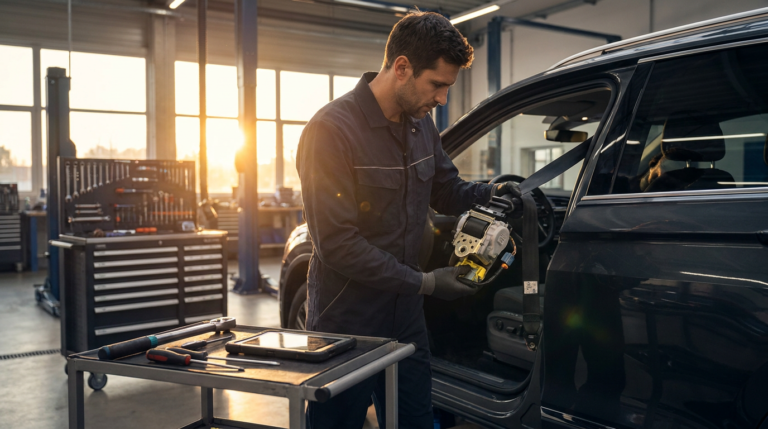
On many rebuilt cars, the SRS control module still contains crash data from the original wreck. In those cases, a professional SRS Airbag Module Reset or Airbag Module Programming may be required to restore the system to proper operation after legitimate repairs.
Seat belts, pretensioners, and occupant protection concerns
Even if your airbag light is off, your seat belts and pretensioners might still be compromised from the original crash.
Seat belt safety after crash repair depends on:
- Whether retractors and pretensioners that fired in the crash were replaced, not just re-used.
- Whether belts fully retract and latch smoothly every time.
- Whether there’s frayed, cut, or melted webbing from heat or airbag deployment.
If you see slow-retracting belts, frayed webbing, or belts that won’t latch or release properly, you may need Seat Belt Replacement or Pre-Tensioner Replacement. For more detail on choosing the right belts, you can review this OEM replacement seat belts buyer’s guide.
Structural repairs, alignment clues, and hidden collision damage
LockNCal does not perform frame or body repair, but from a safety standpoint you still need to be aware of basic structural signs:
- Uneven gaps between hood, fenders, and doors.
- Doors that need to be slammed to close or don’t line up with body lines.
- Visible creases, ripples, or welds in the engine bay or trunk floor.
- Vehicle that pulls to one side or feels unstable at highway speeds.
These issues may affect airbag sensor timing, crash energy paths, and how well your safety systems work in a future crash. A separate post collision repair inspection focused on structural and alignment quality (usually performed by a qualified body or alignment shop) is wise if you see these signs.
Why ADAS features may need recalibration after repairs
Modern American and Japanese vehicles frequently come with ADAS features such as:
- Lane keep assist / lane departure warning
- Automatic emergency braking
- Adaptive cruise control
- Blind-spot monitoring
These systems rely on cameras, radar, and sensors mounted to the windshield, front bumper, rear bumper, mirrors, and more. After collision repair, glass replacement, or structural work, many OEMs require precise ADAS Calibration.
If ADAS isn’t calibrated, you may experience:
- Random warnings or beeps when nothing is there.
- No warning when there is a vehicle in your blind spot.
- Automatic braking that triggers late—or not at all.
For a deeper dive into this topic, see: hidden ADAS calibration errors in used cars.
Common signs your rebuilt car may not be safe
Here are practical signs that should make you question whether your rebuilt car is truly safe, especially for daily family use around DFW.
Dashboard lights, stored codes, and electronic faults
On newer vehicles, the dash cluster and electronic modules are your early warning system.
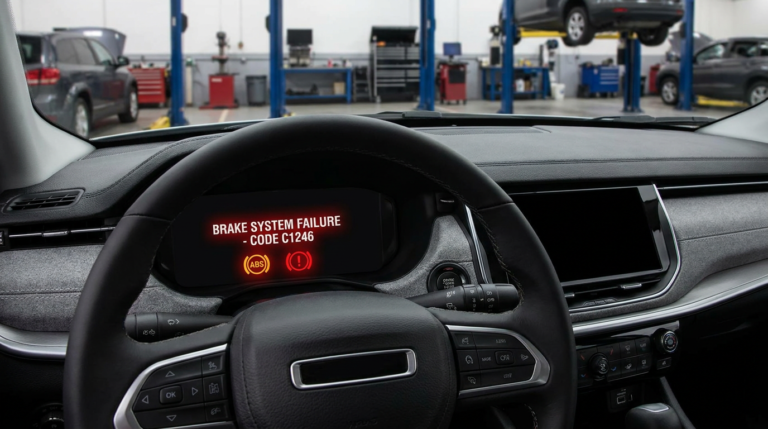
- Warning lights that stay on: airbag/SRS, ABS, traction control, or check engine.
- Multiple warning lights that come and go together—often a sign of module communication issues.
- Strange behavior like gauges dying and coming back, or messages like “service safety restraint system.”
Important: Clearing codes without fixing the underlying fault does not make the vehicle safe. It only hides evidence. A professional Vehicle Diagnostic is the right way to read live data, stored codes, and history so you know what’s really going on inside each module.
Uneven gaps, poor panel fit, and signs of rushed repairs
Quick walk-around clues:
- Mismatched paint shades or texture between panels.
- Hood, trunk, or doors that rub, scrape, or don’t close smoothly.
- Cheap fasteners, missing clips, or visible screws where they shouldn’t be.
These can indicate structural pulls, distorted mounting points, or simply rushed cosmetic work after a serious collision.
Pulling, vibration, water intrusion, or unusual tire wear
On the test drive, pay attention to:
- Pulling to one side when driving straight or braking.
- Steering wheel off-center when the car is going straight.
- Vibrations in the steering wheel or seat at highway speeds.
- Wet carpets, fogged windows, or moldy smells—possible signs of poor seals or flood history.
- Odd or uneven tire wear (cupping, one shoulder worn badly), which can point to alignment or suspension damage.
Missing repair records or incomplete parts documentation
When you ask for repair records and only get a vague verbal story—or nothing at all—that’s a red flag.
You should see:
- Itemized invoices for airbags, seat belts, pretensioners, and sensors.
- Alignment printouts if suspension or frame work was done.
- Calibration reports for ADAS where applicable.
Without paperwork, it’s much harder to answer “how to tell if a rebuilt car is safe” with confidence.
How to read a vehicle salvage inspection report and post-repair paperwork

Paperwork doesn’t fix cars, but it tells you a lot about how seriously the rebuild was handled. Learn how to scan a vehicle salvage inspection report and related documents for safety clues.
What to look for in a vehicle salvage inspection report
Key sections to review:
- Reason for salvage – front impact, side impact, flood, theft, etc.
- List of major components replaced – does it specifically mention airbags, seat belts, modules, and sensors?
- Pass/fail notes or remarks – look for mentions of SRS, ABS, or ADAS.
- VIN and mileage – confirm they match the car you’re looking at.
If the report only focuses on cosmetics and basic roadworthiness and says very little about safety restraints or electronics, that’s your sign to dig deeper.
How a post collision repair inspection can uncover missed issues
A post collision repair inspection is a more detailed review performed after the body shop says the vehicle is “done.” It may include:
- Checking previous repair areas for proper welding and structural alignment.
- Verifying that all airbags, seat belts, and pretensioners are correctly installed and not reused when they should have been replaced.
- Road-testing for alignment, noise, vibration, and ADAS behavior.
- Electronic scans to confirm modules see all required sensors and inputs.
LockNCal does not provide body or frame inspections, but we can support the safety-electronics side with Vehicle Diagnostic, ADAS Calibration, SRS Airbag Module Reset, Airbag Module Programming, Seat Belt Replacement, and Pre-Tensioner Replacement on many American and Japanese models.
Questions to ask if the paperwork is incomplete or unclear
When documents raise more questions than answers, ask the seller or rebuilder directly:
- “Which airbags deployed, and which ones were replaced with new OEM parts?”
- “Were any seat belts or pretensioners replaced? Can I see the invoices?”
- “Was an SRS Airbag Module Reset or Airbag Module Programming done after the crash repairs?”
- “Was any ADAS calibration performed? Do you have printouts or reports?”
- “Do you have the original vehicle salvage inspection report from the state or insurance?”
If the seller becomes defensive, vague, or refuses to share documents, assume there are issues you can’t see.
Post-rebuild checks you can do before you keep driving or buy the car

Here is a rebuilt car inspection checklist in Irving TX you can use at home or on a test drive before deciding whether to keep driving or buy the car.
Visual checks around airbags, trim, belts, and seats
Walk around and sit inside the vehicle with the engine off, then key-on:
- Confirm the airbag light comes on briefly with the key, then goes out and stays out.
- Look closely at the steering wheel, dash, A-pillars, and headliner for signs of patched seams or mismatched grain.
- Inspect seat belts for fraying, cuts, burn marks, or discoloration.
- Pull each belt fully out and let it retract—ensure it retracts promptly and latches securely.
- Check under seats for loose connectors or wiring that looks stretched, taped up, or out of place.
Anything that looks like a “cover-up” around airbags or belts is a reason to pause.
Road-test clues that suggest deeper safety issues
On your test drive:
- Check the steering wheel is straight when the vehicle is going straight.
- Listen for rattles or clunks in corners or over bumps.
- Lightly tap the brakes at different speeds and feel for pulling or vibration.
- Watch for any warning lights that appear under acceleration, braking, or on rough roads.
- Test ADAS features in a safe area—do they behave as expected, or act erratically?
Why scanning modules matters on newer vehicles
On late-model American and Japanese vehicles, you simply cannot judge safety with eyes and ears alone. Hidden faults may only show up in the data.
A professional Vehicle Diagnostic can:
- Scan all modules (SRS, ABS, body control, ADAS, etc.) for stored or pending codes.
- See if crash data is still stored in an SRS module.
- Confirm that sensors and cameras are communicating properly.
- Identify if someone just cleared codes before sale.
If your rebuilt vehicle has warning lights, module communication issues, or uncertain crash-history repairs, a Vehicle Diagnostic is a smart next step before you rely on the car daily.
To decode the vehicle’s build data and options before inspection, you can also use the LockNCal VIN decoder.
When DIY checking is not enough
DIY checks are a good start, but there are clear lines you should not cross without professional tools and training.
The risk of guessing with airbag modules and crash data
If a car has been in a major crash, the SRS module often stores event data and can disable future deployment until properly reset or replaced.
Do not try to:
- Open an airbag module or inflator.
- Short pins or apply power to SRS circuits as a test.
- Swap in a junkyard SRS computer without proper Airbag Module Programming or SRS Airbag Module Reset.
Again: airbag and SRS components can involve explosive devices, and DIY work here is extremely dangerous. This is where a qualified safety-system specialist is essential.
Why seat belt and pretensioner faults should not be ignored
A seat belt or pretensioner fault may not stop the car from driving, but it can drastically change the outcome in a serious crash.
Ignoring issues like:
- Seat belt warning chimes that never work.
- Belts that lock randomly or fail to lock in a sudden stop.
- “Restraint system” warnings on the dash.
…means you are gambling that you won’t need that system when it counts. If these issues appear on a rebuilt vehicle, you should consider Seat Belt Replacement or Pre-Tensioner Replacement after a proper diagnostic.
Why ADAS cameras and radar can be unsafe if not calibrated
ADAS is not just convenience tech; it’s integrated into how the vehicle manages collision risk.
After collision repairs, windshield replacement, or front/rear bumper work, many OEMs require ADAS Calibration on American and Japanese models. Skipping this can cause:
- Lane keep assist steering you the wrong way.
- Forward collision warning that fails to trigger in time.
- Adaptive cruise following distance that’s shorter than requested.
If you want a deeper look at real-world risks, you can also review this article for parents: check your vehicle’s airbags, seatbelts, and ADAS.
Rebuilt car safety checks in Irving TX: when to get professional help
If you’re in Irving TX or the greater DFW area—Dallas, Arlington, Grand Prairie, Carrollton, Plano, Frisco, Fort Worth, and surrounding communities—here’s when it makes sense to bring in a safety-system specialist like LockNCal.
When a Vehicle Diagnostic makes sense
Consider a professional Vehicle Diagnostic if:
- You see any airbag, ABS, or traction control lights.
- You suspect modules were swapped, reprogrammed, or tampered with.
- ADAS features behave oddly, even if there are no lights.
- You’re about to purchase a rebuilt title car and want an electronic health check.
When you may need ADAS Calibration
ADAS Calibration is often necessary on American and Japanese vehicles after:
- Front or rear collision repair.
- Windshield replacement.
- Suspension, steering, or ride-height changes.
If the seller or rebuilder can’t show calibration reports for a car with lane-keeping, adaptive cruise, or forward collision systems, plan on having ADAS checked.
When SRS Airbag Module Reset, Airbag Module Programming, Seat Belt Replacement, or Pre-Tensioner Replacement may be needed
These services may be appropriate on a rebuilt car when:
- The airbag light stays on or you have SRS-related messages.
- Your seat belts show damage, don’t retract properly, or were clearly involved in a crash.
- Crash data is locked in the SRS module, preventing proper system readiness.
- Modules were replaced and now need correct Airbag Module Programming or other Module Programming.
LockNCal focuses on the electronic and restraint side of collision repairs—not body or frame work—so you can have more confidence that the systems meant to protect you are functioning as intended.
Mail-In Airbag Module Reset for customers outside DFW
If you’re outside the DFW area but dealing with a rebuilt title car that needs SRS work, a Mail-In Airbag Module Reset option can let you ship your module for reset instead of replacing the entire unit, depending on the vehicle and condition.
Questions to ask the seller, rebuilder, or repair shop before you say yes
Here’s a quick, copy-and-use list of questions you can bring to any seller, dealer, or rebuilder.
Questions about airbags, seat belts, and crash-event parts
- Which airbags deployed in the original crash?
- Were all deployed airbags replaced with new OEM units, or used parts?
- Were any seat belts or pretensioners replaced? Can I see the receipts?
- Has the SRS light ever come on since the rebuild?
Questions about module programming and calibration
- Did any electronic modules (SRS, ABS, body control, ADAS) get replaced or reprogrammed?
- Was an SRS Airbag Module Reset or Airbag Module Programming performed after repairs?
- Were ADAS cameras or radar sensors moved or replaced, and if so, who handled ADAS calibration?
- Do you have printouts or reports from any Vehicle Diagnostic or calibration sessions?
Questions about repair records, photos, and parts sourcing
- Do you have before-and-after photos of the damage and repairs?
- Were OEM or aftermarket parts used for structural and safety repairs?
- Can I see the vehicle salvage inspection report and any post collision repair inspection documents?
- Who performed the repairs and how many similar rebuilds have they completed?
Direct, specific questions make it harder for a seller to hide shortcuts.
Final answer: is my rebuilt car safe?
Putting it all together, here’s how to think about the risk level of a rebuilt vehicle in practical terms.
When the answer is probably yes
Your rebuilt car is probably safe if:
- You have clear documentation of which airbags, belts, and modules were replaced.
- There are no warning lights on the dash, and a recent Vehicle Diagnostic shows no hidden SRS or ADAS faults.
- ADAS features behave normally, and there are calibration reports on file where required.
- Test drives show no pulling, vibration, or odd noises.
- Independent inspections (including any needed post collision repair inspection) match the paperwork story.
When the answer is maybe — get it checked
Your answer is “maybe” and you should get it checked if:
- There’s any uncertainty about which safety parts were replaced vs. re-used.
- The airbag, ABS, or other safety lights have come on, even once.
- ADAS acts inconsistent or was never calibrated after known collision repairs.
- Paperwork is missing, partial, or conflicts with what you see on the vehicle.
In this situation, a Vehicle Diagnostic plus focused restraint/ADAS checks in Irving TX or the DFW area is a smart, relatively low-cost way to protect yourself and your family.
When to walk away
Consider walking away from a rebuilt car when:
- The seller refuses to share the vehicle salvage inspection report or repair records.
- You see obvious signs of airbag or seat belt tampering or missing components.
- The dash cluster behaves strangely or appears modified to hide lights.
- The test drive reveals major pulling, severe vibration, or unpredictable braking.
- Your gut says the story doesn’t add up, even after asking detailed questions.
At that point, no discount is worth the risk.
Next steps if you’re in Irving TX or DFW
If you’re driving or considering a rebuilt title American or Japanese vehicle in Irving TX or the wider DFW area—Dallas, Fort Worth, Arlington, Plano, Frisco, Grand Prairie, Carrollton, Grapevine, and nearby cities—your best move is to get clear, objective data.
LockNCal focuses on post-rebuild safety systems, not body work. Depending on what you find, it may make sense to schedule:
- Vehicle Diagnostic – to scan modules, check for hidden crash data, and identify underlying faults.
- ADAS Calibration – after collision repair, windshield, or bumper work on ADAS-equipped vehicles.
- SRS Airbag Module Reset or Airbag Module Programming – when crash data or module issues are preventing safe operation.
- Seat Belt Replacement or Pre-Tensioner Replacement – when belts have visible damage or related faults.
For owners outside DFW, a Mail-In Airbag Module Reset option may help resolve certain SRS module issues without a full replacement, depending on the vehicle and damage.
Before you decide, you can always start by decoding the car’s VIN with the LockNCal VIN decoder and reviewing the build and safety options it left the factory with.
Used correctly, this information helps you stop guessing and start making informed decisions about whether your rebuilt vehicle is safe enough for daily life in Irving and the rest of DFW.
FAQs: Is My Rebuilt Car Safe?
1. Is my rebuilt car safe to drive every day?
It can be, but only if crash damage was repaired correctly, airbags and seat belts were properly replaced, and all modules and ADAS systems have been checked and verified. A clean title isn’t safer by default than a properly rebuilt car—it all comes down to current condition and verification.
2. What does a rebuilt title mean in plain English?
In plain English, a rebuilt title means the car was once considered a total loss (salvage) but has since been repaired and passed the required inspections, so it can be registered and driven again. It’s a permanent mark that says, “This vehicle had major damage in the past.” It does not guarantee the car is safe today.
3. What should I look for in a vehicle salvage inspection report?
Check why the car was totaled, which major components were replaced, and whether the report mentions airbags, seat belts, modules, and ADAS. Confirm the VIN and mileage match the actual car. If the report is vague on safety systems, plan on additional inspections and a professional Vehicle Diagnostic.
4. Can airbags and seat belts still have hidden problems after a rebuilt title inspection?
Yes. A basic salvage or rebuilt inspection may focus on identity, major repairs, and basic roadworthiness, not detailed SRS function. Airbags could be counterfeit, missing, or improperly installed, and seat belts or pretensioners may have been re-used when they should have been replaced. That’s why focused checks and, if needed, SRS Airbag Module Reset, Airbag Module Programming, Seat Belt Replacement, or Pre-Tensioner Replacement are so important.
5. Do ADAS features need calibration after collision repairs?
Often, yes. Many American and Japanese vehicles require ADAS Calibration after front or rear collision repair, windshield replacement, or suspension changes. Without calibration, systems like lane keep assist and automatic emergency braking may not work correctly, even if there are no warning lights.
6. What is the difference between a salvage safety inspection and a post collision repair inspection?
A salvage safety inspection or state-level rebuilt inspection focuses on verifying the vehicle’s identity and basic roadworthiness so it can be retitled. A post collision repair inspection goes deeper, reviewing repair quality, structural alignment, safety restraints, and sometimes electronic systems. Both are useful, but neither replaces a detailed Vehicle Diagnostic on modern cars.
7. When should I get a Vehicle Diagnostic for a rebuilt car?
You should consider a Vehicle Diagnostic if you see any warning lights, notice strange behavior from ADAS, suspect past module swaps, or simply want to verify a rebuilt car before purchase. It’s especially important on late-model American and Japanese vehicles where safety and driver-assistance functions depend heavily on correct coding, communication, and calibration.