 Skip to content

How to Program a Body Control Module: BCM Basics, Tools, Steps, and Risks
As a technician who works on American and Japanese vehicles every day in the DFW area, I can tell you that most online guides about how to program a body control module blur an important line: they treat a simple battery reset like full BCM programming. Those are very different procedures with very different risks.
LockNCal does mobile module programming, coding, and relearns — BCMs, OEM modules, and ECUs — at your home or shop across DFW. Book mobile module programming or call (469) 277-7277.
Need a BCM programmed on your vehicle? Body control module programming takes the right tools and know-how. Our mobile module programming service across Dallas–Fort Worth handles BCM and other module programming.
This article is an educational guide for DIY-minded vehicle owners and local shops in and around Addison TX. We’ll walk through what a BCM does, when it truly needs programming, which tools are required, and when a Vehicle Diagnostic and professional Module Programming are the safer next step.
What Is a Body Control Module and What Does It Control?
The body control module (BCM) is the main controller for many of the “body” functions in modern American and Japanese vehicles. Depending on the platform, it may handle:
- Power door locks and keyless entry
- Power windows and sometimes sunroof operations
- Exterior and interior lighting (headlamps, tail lamps, dome lights, courtesy lights)
- Wipers and washers
- Retained accessory power (radio and windows working for a short time after key off)
- Alarm and anti-theft communication with the immobilizer or engine control module (ECM/PCM)
- Remote start and other convenience features on some models
- Network gateway functions between different CAN buses in the vehicle
Because the BCM sits on the vehicle’s communication network (CAN bus), it also talks to other modules. A BCM problem can look like an instrument cluster fault, a door module issue, or even a transmission or engine fault when you only look at surface symptoms.
That’s why a structured Vehicle Diagnostic is usually step one before anyone jumps to BCM programming or replacement.
When Does a BCM Need Programming Instead of a Reset?
One of the biggest gaps in online information is the difference between a body control module reset vs programming. Many DIY posts show a battery disconnect trick and call it “reprogramming.” In real-world shop terms, that’s just a reset.
Reset vs programming vs configuration
- Battery reset / power reset
Disconnecting the battery or pulling fuses to clear temporary logic issues. This may clear certain learned values or temporary glitches, but it does not load new software, change VIN coding, or perform anti-theft relearn. - BCM configuration / adaptation / module configuration
Setting feature options and adaptations inside an existing BCM using a scan tool. Examples: turning on/off fog light support, setting door lock behavior, initializing power windows, or performing module adaptation after replacement. This often requires a professional scan tool and sometimes OE software. - Full BCM programming / reflash / coding
Writing software or firmware to the BCM, often including VIN coding, calibration updates, and sometimes anti-theft relearn or immobilizer relearn. This typically needs an engine diagnostic tester or OE-level tool, a stable power supply, and access to manufacturer servers or calibration files.
A battery reset is low risk but limited. Full BCM programming is high risk if done with the wrong tools or poor power supply.
Common scenarios that require BCM programming
- Replacement BCM (new unit)
Most new BCMs arrive “blank” or partially configured. They must be programmed to your vehicle’s VIN, options, and anti-theft system. - Salvage/used BCM questions
On many platforms, a used BCM may carry over the previous vehicle’s VIN and security coding. Some can be reprogrammed; others cannot, or only with certain procedures. Never assume a used BCM will drop in and work. - Software corruption
Low voltage events, jump-start damage, or previous failed programming can corrupt BCM software, causing odd electrical behavior. Correcting this may require a full software reflash. - Option mismatch
Installing a BCM from a differently optioned vehicle (with/without remote start, fog lamps, etc.) may require configuration to match your build sheet. - Immobilizer/theft relearn after module replacement
On vehicles where the BCM is tied into the immobilizer, replacing the BCM often forces immobilizer relearn, anti-theft relearn, or key registration so the engine will crank and start.
Symptoms that may point to BCM issues
- Intermittent electrical problems – random flashing lights, chattering locks, wipers that cycle without input, interior lights that never shut off.
- No crank/no start with security light involvement – especially after body or electrical work, module replacement, or a battery event.
- Locks/windows/lights acting erratically – multiple body functions acting up together often point more to a BCM or network problem than a single bad switch.
- Communication DTCs (U-codes) – codes for “lost communication with BCM” or related modules. These may also be tied to network issues; see our guides on understanding CAN communication faults on Chevrolet vehicles and loss of communication code diagnostics on Pontiac.
Any of these symptoms should trigger a proper Vehicle Diagnostic before deciding on BCM programming.
A technical walkthrough covering what a BCM is, prerequisites (scan tool, vehicle-specific software), step-by-step programming/adaptation process, common pitfalls, security/anti-theft precautions, and when to hire a specialist.
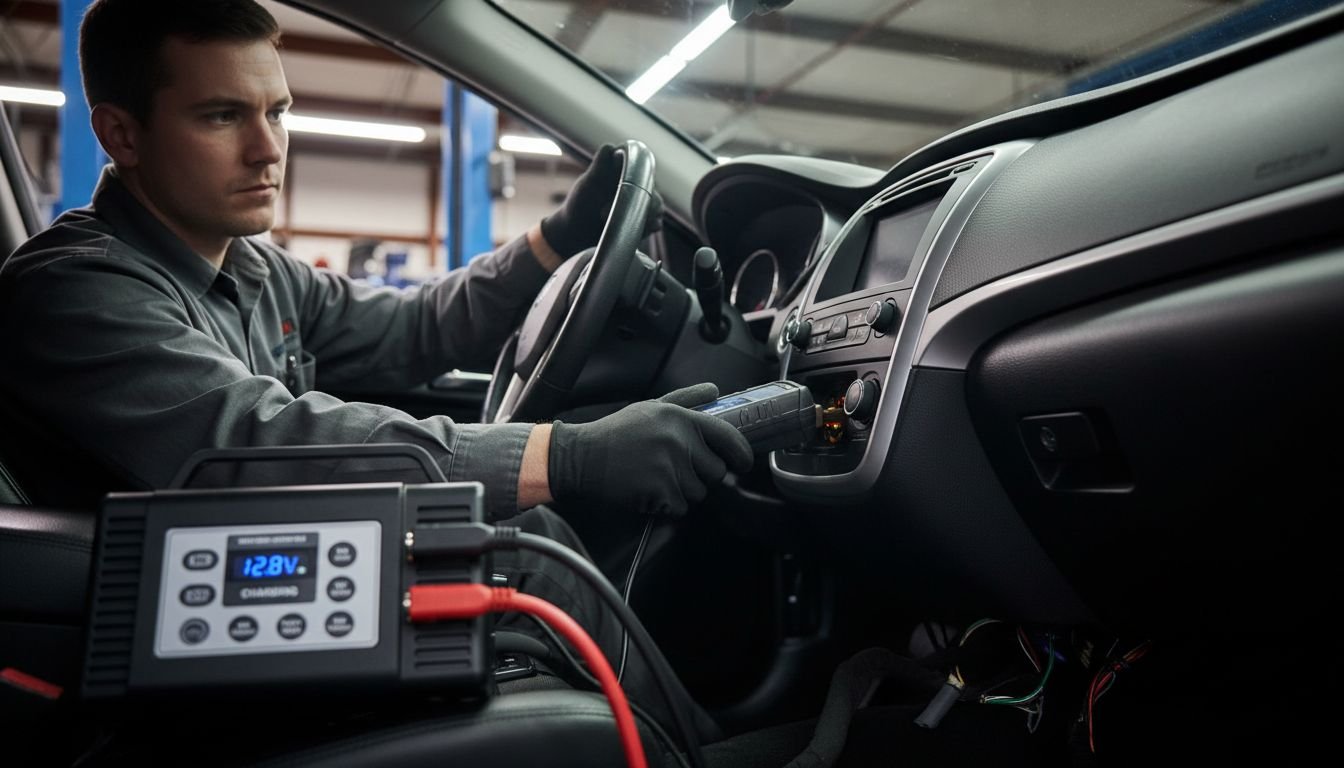
This section gives you a structured view of how BCM programming and configuration are handled in a professional environment for American and Japanese vehicles. It’s not a click-by-click recipe (those steps are vehicle-specific), but it will help you decide whether this is realistic as a DIY project.
Prerequisites before you begin
- Verify battery voltage and clean power supply
Voltage should generally be in the 12.5–13.5V range with a stable battery maintainer or power supply rated for programming. Low or unstable voltage during flashing can brick a BCM. - Confirm correct part number / calibration compatibility
The BCM must match the vehicle’s year, make, model, and option level. Incorrect part numbers or incompatible calibrations are a common cause of no-start after BCM replacement. - Gather VIN and all keys/remotes if required
Many BCMs tie into the immobilizer. You may need all keys and key fobs present for security learning. If the vehicle only has one key or all keys are lost, you may be looking at Transponder Key Programming, Smart Key Programming, or even a Vehicle All Keys Lost scenario. - Identify whether OE software or pass-thru support is necessary
Some American and Japanese platforms support J2534 pass-thru programming with a subscription. Others require a specific factory tool. Knowing this up front helps you avoid half-finished programming attempts.
Tools commonly required
- Engine diagnostic tester
An OE or OE-level engine diagnostic tester is usually what the manufacturer expects you to use for BCM programming and module configuration. - Diagnostic car computer scanner
A professional-grade diagnostic car computer scanner with full-system access is needed to read all modules, perform adaptation routines, and confirm that BCM programming completed correctly. - Battery maintainer/power supply
A programmable power supply or high-quality maintainer is mandatory. This is one of the most critical pieces of equipment for any reflash. - Manufacturer-compatible software or pass-thru device
Many procedures require logging in to the manufacturer’s service site with a subscription. A J2534 pass-thru device or factory tool serves as the bridge between the laptop and the vehicle. - Reliable internet connection
For online calibrations or security access, a dropped connection in the middle of a flash can be expensive. - OBD scanner for check engine – with limits
A basic obd scanner for check engine can read and clear codes in some modules, but it usually cannot handle BCM initialization, VIN coding, or security functions. This is where many DIY attempts stall.
Step-by-step BCM programming/adaptation overview
- Verify the fault with a full-system scan
Read codes from all modules, not just the engine. Look for U-codes (communication DTCs), B-codes (body), and any security-related faults. - Check battery voltage and network health
Confirm good battery and charging system health. Check fuses and any relevant grounds. Investigate existing communication faults before programming. - Confirm replacement module compatibility
Verify part numbers and software level compatibility. For used modules, check whether they are even reprogrammable on your platform. - Connect approved scan/programming equipment
Hook up your programming interface and power supply. Disable high-current loads (HVAC on high, seat heaters, etc.) unless the procedure says otherwise. - Enter VIN or confirm VIN write procedure if applicable
Many BCMs require VIN coding. Some write the VIN automatically from the scan tool; others prompt for manual entry or use a guided function. - Load correct calibration/configuration
Using OE software or a supported pass-thru, select and download the correct calibration. This is where a good internet connection and subscription matter. - Perform immobilizer/security or key relearn if required
On vehicles where the BCM participates in starting authorization, you’ll run an immobilizer relearn or anti-theft relearn. All registered keys and fobs generally need to be present. If the car doesn’t recognize them, you’re in Transponder Key Programming or Smart Key Programming territory. - Initialize options and adaptation routines
Perform window relearns, steering angle adaptation, remote lock setting configuration, and any required BCM option coding. This is the module configuration phase. - Clear DTCs and run function checks
Clear codes, cycle power, and re-scan. Test functions the BCM controls: locks, windows, lights, wipers, horn, alarm, and start authorization. - Road test / recheck systems
Drive the vehicle, then perform a final scan to confirm no new communication DTCs or security faults appeared.
Common pitfalls during BCM programming
- Low voltage during flash – leads to incomplete writes and potentially a dead (unrecoverable) BCM.
- Wrong software level or wrong module – creates option mismatches, no-starts, or persistent warning lights.
- Assuming a used BCM will always accept reprogramming – some platforms permanently lock learned values, including VIN and security data.
- Skipping key learning or theft-deterrent routines – can cause a no crank/no start after BCM replacement.
- Ignoring CAN/U-code faults from other modules – unresolved network problems can cause new BCMs to fail to communicate correctly.
Security and anti-theft precautions
- BCM programming can affect starting authorization – a misconfigured BCM can leave you with a permanent no-start, even though the engine and fuel system are fine.
- Alarm behavior and key recognition depend on proper coding – improper settings can cause false alarms or failure to recognize valid keys.
- All available keys may be needed – forgetting one key at home can mean that key no longer starts the car after a full relearn.
When to hire a specialist
- No communication with the BCM – if your scanner can’t talk to the BCM at all, this often requires advanced network diagnostics.
- Immobilizer/security lockout – flashing security lights, “key not recognized” messages, or repeated failed relearn attempts.
- Replacement BCM not accepted – new or used unit won’t complete programming or keeps throwing VIN mismatch or configuration errors.
- Multiple module/network faults – clusters of U-codes across multiple modules, as seen in many modern American vehicles. Our article on why electrical faults matter for Dodge owners in Texas shows how one area of the system can affect others.
- Airbag/ADAS warnings present alongside BCM faults – you should not experiment here; the risk level is high.
When one or more of these apply, a professional Vehicle Diagnostic and, if confirmed, Module Programming is usually the most cost-effective path in the long run.
Can You Program a BCM with a Basic Scan Tool?
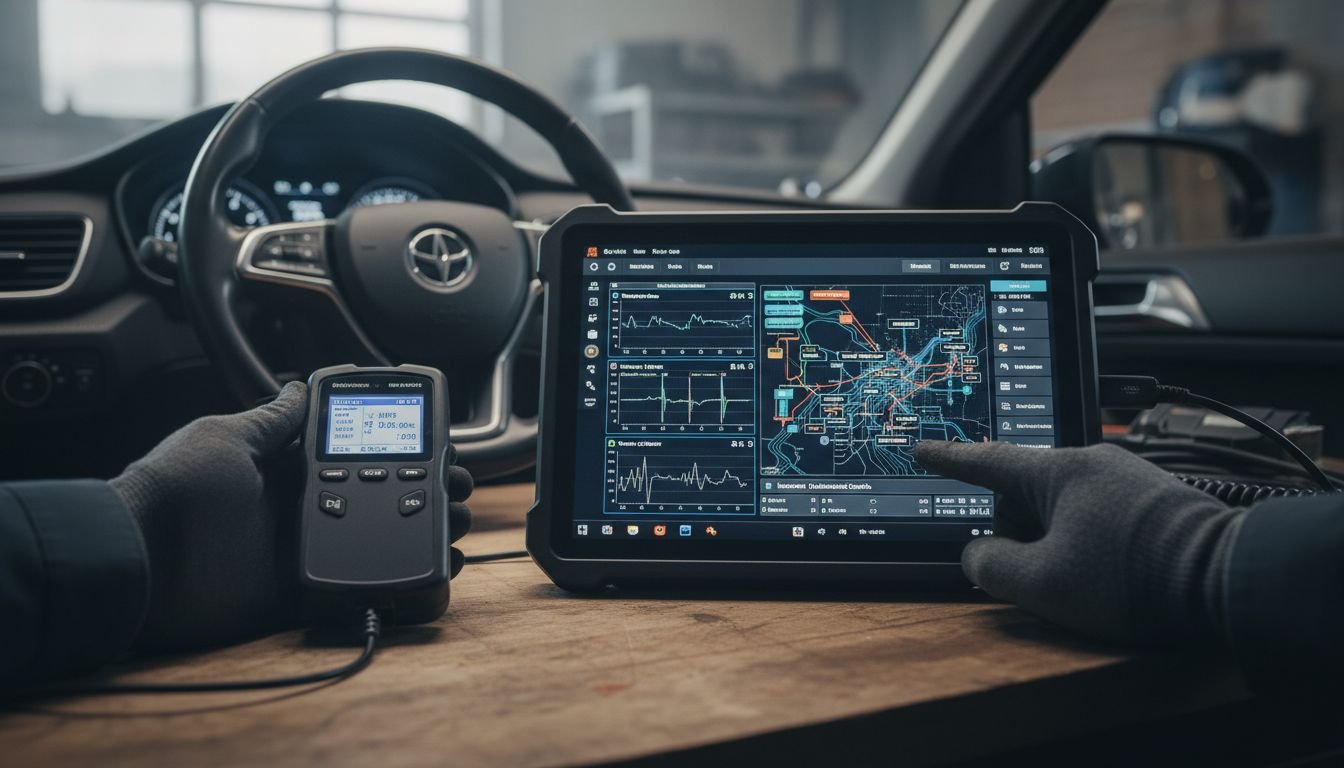
In most American and Japanese vehicles, the answer is no. A basic consumer OBD tool is designed as an obd scanner for check engine use: it reads and clears generic engine and emission codes, maybe some basic live data.
True BCM programming needs:
- Access to body and security modules, not just the engine
- Support for guided functions such as module initialization, configuration, and security/key relearn
- The ability to write software and calibrations to the BCM
- In some cases, online access to manufacturer servers
A basic code reader or low-cost Bluetooth dongle does none of this. Even many mid-level tools marketed as a “diagnostic car computer scanner” may only support reading and clearing BCM codes, not full programming.
If all you want to do is confirm whether a code exists, your basic tool can help. If you’re serious about how to program a body control module, you either need OE-grade equipment or you need to involve a shop that already has it.
Common BCM Programming Mistakes DIYers Make
From the field, here are the mistakes that cost DIYers and small shops the most time and money:
- Misdiagnosis
Assuming “BCM is bad” because of weird electrical symptoms, when the real cause is a failing battery, corroded ground, shorted wiring in a door, or water intrusion at a connector. A structured Vehicle Diagnostic catches these before you buy a module you don’t need. - Low-voltage flashing
Trying to reprogram with a weak battery, no charger, or a cheap maintainer. This is one of the fastest ways to kill a BCM. - Used module assumptions
Grabbing a BCM from a salvage yard and assuming it can be “wiped” and re-used on all platforms. Some American and Japanese vehicles allow limited reuse; others do not. Even when it’s possible, you often still need OE software and security access. - Skipping post-programming testing
Programming the module, seeing the original problem gone, and calling it done. Without a full-system scan and functional tests, it’s easy to miss new communication DTCs or partially configured features. - Ignoring related warning lights
Treating new ABS, airbag, or traction control lights as “no big deal” after BCM work. These can indicate serious safety issues or missing network messages.
Safety Warning: Why BCM Work Can Affect More Than Locks and Lights
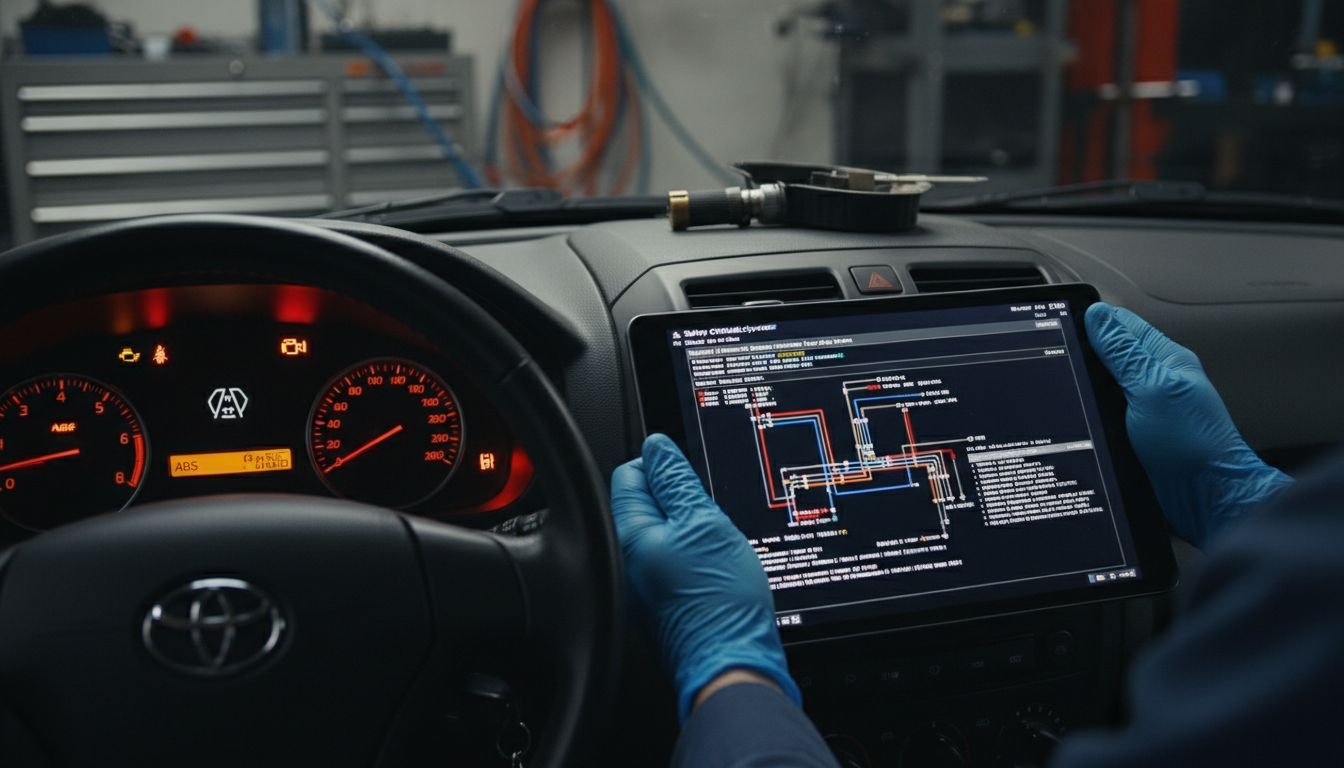
On modern American and Japanese vehicles, the BCM doesn’t live in isolation. It shares data and power paths with other critical systems. That means mistakes in BCM programming or wiring can affect:
- Airbag/SRS control (timing of warning lights, readiness monitoring)
- ABS and stability control (communication signals and brake lamp logic)
- Power steering and powertrain behavior in networked architectures
Important safety warning: Many vehicles contain SRS components with explosive devices such as airbags, seatbelt pretensioners, and inflators. Careless electrical or module work can:
- Trigger faulty SRS warning lights that mask real readiness problems
- Disable critical safety features without obvious symptoms until they’re needed
- Risk unintentional deployment if wiring is shorted or incorrectly modified
You should never ignore new warning lights that appear after BCM or electrical work. A fresh airbag, ABS, or brake warning after a DIY module attempt is a clear sign to stop and schedule a professional Vehicle Diagnostic immediately.
When a Vehicle Diagnostic in Addison TX Is the Smarter First Step
If you’re in or around Addison TX or the greater DFW area, the most cost-effective starting point for BCM-related issues is usually a Vehicle Diagnostic, not jumping straight to module replacement or programming.
Professional diagnostics can pinpoint problems that look like BCM failures but aren’t, including:
- Weak or failing battery causing network instability
- Blown fuses or damaged fuse boxes feeding the BCM
- Corroded grounds or power feeds
- Damaged wiring in doors, pillars, or under carpets (especially after water leaks)
- Gateway or ignition switch issues preventing proper wake-up of the BCM
- Software issues in other modules that mimic BCM failures
Once diagnostics confirm that the BCM actually needs programming or configuration, then Module Programming becomes the logical next step.
If your situation also involves lost or replaced keys, or if the vehicle will not recognize your keys after a BCM swap, related services such as Transponder Key Programming or Smart Key Programming may be required to complete the job safely.
For any American or Japanese vehicle within our coverage area (Addison, Dallas, Plano, Carrollton, Frisco, and the wider DFW metro), starting with a structured diagnostic often saves money over guessing and swapping parts.
To identify your exact vehicle build, you can also use this VIN decoder before discussing options with a professional.
Final Takeaway: BCM Programming Is Precise Work, Not Just a Battery Reset
When you read about how to program a body control module online, remember that a body control module reset vs programming are not the same thing. A quick battery reset may clear a quirk; true BCM programming involves software, VIN coding, security, and networked systems that can affect far more than just locks and lights.
For DIYers in Addison TX and DFW, the safe approach is:
- Use your basic obd scanner for check engine codes as a starting point only, not the final word.
- When symptoms or codes point to a possible BCM issue, schedule a Vehicle Diagnostic to confirm the root cause.
- If software or configuration is confirmed as the issue, rely on professional Module Programming with proper tools, power support, and security procedures.
This approach protects your safety systems, avoids bricked modules, and usually costs less than trial-and-error programming attempts at home.
If you’re in Addison or the surrounding DFW cities and dealing with BCM-related communication faults, security problems, or a no-start after BCM replacement, start with a Vehicle Diagnostic. From there, we can determine whether Module Programming and, if needed, Transponder Key Programming or Smart Key Programming are required to safely get your American or Japanese vehicle back on the road.
FAQs About BCM Programming
1. What does a body control module do?
The BCM manages most of the “body” functions on the vehicle: power locks, windows, interior and exterior lights, wipers, retained accessory power, and often alarm/anti-theft communications. On many American and Japanese models, it also serves as a communication hub between other modules on the network.
2. How do I know if my BCM needs programming or just a reset?
If cycling the battery or pulling the BCM fuse temporarily clears a symptom but it returns, that suggests more than a simple glitch. BCM replacement, option mismatches, software corruption, and security relearns all require actual programming or configuration, not just a reset. A professional Vehicle Diagnostic is the best way to tell the difference.
3. Can I program a body control module with a basic OBD scanner?
No, not in any meaningful way. A basic OBD tool works mainly as an obd scanner for check engine codes. It rarely has access to BCM programming or security functions. True BCM work needs a professional engine diagnostic tester or OE-level diagnostic car computer scanner with programming support.
4. Can a used BCM be programmed to another vehicle?
Sometimes, but not always. Some platforms allow reprogramming of a used BCM, including VIN and immobilizer data. Others lock this information after first installation. Even when it is possible, you usually need OE-level tools and security authorization. There is no guarantee every used BCM will work in every vehicle.
5. Do I need all my keys to complete BCM programming?
In most cases where the BCM is involved with security, yes. Many immobilizer relearn procedures require every existing key or fob to be present during programming. Any key not present may stop working afterward, which is why it’s important to bring everything you have to the appointment.
6. What happens if BCM programming is done wrong?
Incorrect BCM programming can cause a no-start condition, erratic electrical behavior, inoperative locks or windows, false alarm triggering, or new warning lights (including ABS or airbag). In severe cases, the BCM can be rendered unusable and must be replaced.
7. When should I get a professional vehicle diagnostic in Addison TX?
If you see repeated body-related electrical issues, communication DTCs involving the BCM, a no-start after BCM replacement, or new warning lights after DIY electrical work, it’s time for a professional Vehicle Diagnostic in Addison TX. Identifying the real cause before attempting Module Programming usually saves money and prevents further damage.


