 Skip to content

Jeep P1610 Code — Lock Mode Immobilizer Fix
Direct answer: P1610 on a Jeep indicates the vehicle’s immobilizer has locked the engine start function. The verified definition is: Lock Mode – the Nissan NATS immobilizer has locked the engine start function. Resolving it requires diagnosing key-to-immobilizer communication and usually reprogramming keys or the immobilizer module with a qualified automotive locksmith or module programming service.
Key Takeaways
- P1610 reports a lock mode: the immobilizer has blocked engine start (verified meaning: “Lock Mode – the Nissan NATS immobilizer has locked the engine start function”).
- Common causes are failed key transponder, weak key battery, damaged key, poor antenna/read circuit, or module/communication faults.
- Accurate diagnosis uses a full OBD-II scan, immobilizer/key tests, and targeted wiring/connectivity checks.
- The correct fix is key reprogramming or module programming/replacement — work for an automotive locksmith or module programming service.
- LockNCal handles keys, key programming, and module programming; book mobile assistance or schedule mail-in programming where available.
What the Jeep P1610 code actually means
The P1610 code points to the vehicle’s anti-theft / immobilizer system entering a protective state that prevents the engine from starting. Use the exact verified definition: “Lock Mode – the Nissan NATS immobilizer has locked the engine start function.” That wording comes from the code definition provided for this diagnostic trouble code; always confirm the exact meaning for your model year with a full scan and OEM code lookup.
Plain-English explanation
Modern ignition systems use a transponder inside the key (or fob) that talks to an immobilizer control unit. If the immobilizer doesn’t recognize the transponder or detects a communication fault, it can put the engine into a locked state so the car won’t start. P1610 is the system saying it’s in that locked state.
Common causes
- Dead or weak key/fob battery preventing transponder transmission.
- Damaged or worn key transponder (physical damage, water intrusion).
- Faulty key/fob — cloned, missing, or incompatible key.
- Immobilizer antenna or read coil problem (usually around the ignition lock or steering column).
- Immobilizer module communication errors or internal faults.
- Bad wiring or connectors between the ignition cylinder, read coil, and immobilizer module.
- Aftermarket alarm or modification disrupting immobilizer signals.
Symptoms drivers will notice
- Car cranks normally but won’t start, or no crank/no start at all depending on system behavior.
- Security/immobilizer dash light steady or flashing.
- Key not recognized messages on the dash.
- Intermittent startability — sometimes the car starts, other times it won’t.
- Other electrical oddities around the ignition or dash at the time of the error.
Tools and parts a technician will use
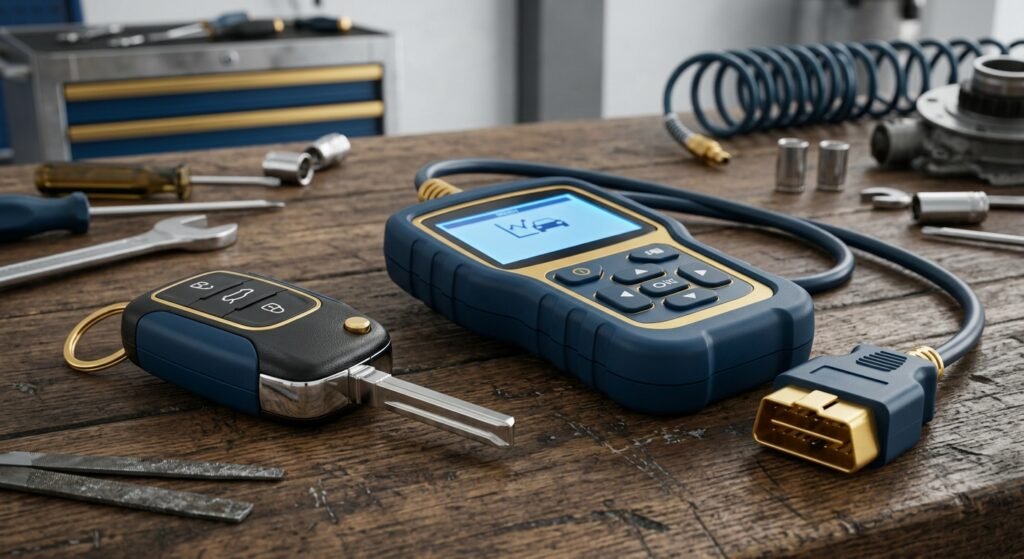
- Full-function OBD-II scan tool that reads manufacturer body/immobilizer codes and can clear them.
- Key programmer compatible with the vehicle’s immobilizer (dealer-level or professional locksmith tool).
- Digital multimeter (DMM) for voltage, continuity and signal checks.
- Service manual or OEM wiring diagrams for connector and antenna locations.
- Replacement key/fob or fresh key battery when required.
Step-by-step technician diagnosis (recommended order)
- Check for confirmed code: connect an OBD-II scanner and record P1610 and any related codes. Save freeze frame if present.
- Inspect obvious issues: try a second known-good key (if available), verify key battery, and check fob LED/response.
- Check dash immobilizer light behavior — note steady vs flashing patterns (useful for OEM diagnostics).
- Use a key programmer or immobilizer diagnostic tool to attempt to read the transponder ID and test communication with the immobilizer module.
- Verify power, ground, and data bus connections to the immobilizer module and read coil/antenna with a DMM; inspect connectors for corrosion or damage.
- If antenna/read coil is suspected, test continuity and signal when the key is inserted or fob held near the reader.
- If the key is unreadable or programmer cannot communicate, try reprogramming an existing key or programming a new key per OEM procedure.
- If the module shows internal faults or will not accept programming, immobilizer module programming or module replacement (followed by programming) is the correct next step.
- Clear codes and road-test; if P1610 returns, escalate to deeper module-level diagnostics or compare to OEM TSBs.
Quick diagnosis table
| Observed symptom | Likely cause | Recommended first action |
|---|---|---|
| Key recognized intermittently | Weak key battery or intermittent antenna read | Replace key battery; test with known-good key |
| No start, dash shows security light | Key transponder not recognized | Attempt key reprogramming or use spare key |
| Scanner shows module communication fault | Wiring/connectors or module failure | Inspect connectors; test power/ground; try module programming |
| P1610 returns after key swap | Immobilizer module fault or mismatch | Module programming/replacement by qualified technician |
The correct fix — what actually resolves P1610
Because P1610 is an immobilizer lock state, the resolution focuses on restoring valid key-to-module communication. That means one of the following, depending on diagnosis:
- Key battery replacement or using a known-good spare key when the transponder is fine but not transmitting reliably.
- Key reprogramming or cloning with a professional key programmer when the transponder ID needs to be taught to the vehicle.
- Repairing or replacing a damaged read coil/antenna if it cannot detect the transponder properly.
- Module programming (reflash) or module replacement when the immobilizer control unit is defective or corrupted. This must be done with OEM-grade programming tools and authenticated procedures.
Note: some online “repair kits” or unapproved board-level fixes for immobilizer modules are unsafe or not OEM-approved. The right approach is programming or replacement performed by a qualified locksmith or module programming service; LockNCal provides key programming and module programming services.
Is it safe to keep driving?
If P1610 is active and the immobilizer has locked the engine start, the vehicle may not start at all — so it’s not safe to rely on driving. If the car is running now and the code appears intermittently, you might be able to drive short distances to a safe location, but there’s a real risk the vehicle will fail to restart. The safest choice is to get the vehicle diagnosed and have keys or module programming handled promptly.
How LockNCal can help
We handle automotive locksmith services including key copy, all-keys-lost solutions, and key/fob programming for immobilizer issues like P1610. If diagnostics point to module programming, our mobile module programming services can perform OEM-style programming on-site where supported. Learn more about our mobile car key copy and programming options at mobile car key copy services and our module programming offerings at module programming. You can also schedule a visit using our appointment tool at Schedule an appointment.
Typical timeline
Simple fixes — replacing a key battery, using a spare key, or reprogramming a single key — can often be done the same day. Module-level programming or replacement may take longer depending on parts and vehicle access. A qualified locksmith or module programmer will give an estimated time after the initial scan.
FAQ
Q: Can I clear P1610 myself with a scanner?
A: Clearing the code may turn off the dash light temporarily, but it doesn’t fix the underlying immobilizer lock. If the transponder still isn’t recognized, P1610 will return and the vehicle may refuse to start. Proper diagnosis and key/programming work are required.
Q: Will replacing the key battery fix P1610?
A: If the problem is a weak key battery preventing the transponder signal from being sent, replacing the battery can fix the issue. However, if the transponder itself, the antenna, or the immobilizer module is faulty, a battery change won’t be enough.
Q: Can a dealer-only tool be required?
A: Some vehicles require OEM-level programming tools for module programming or certain key registrations. Many professional locksmiths have compatible tools; if OEM-only access is necessary, a dealer or certified module programmer will be required.
Q: What if I lost all my keys and now have P1610?
A: If all keys are lost, the immobilizer will not recognize any transponder until a new key is programmed. This is a standard locksmith job: a qualified locksmith will verify ownership, program new keys, and clear lock mode. LockNCal offers mobile car key copy and programming services to address all-keys-lost situations.
Q: Will an aftermarket alarm cause P1610?
A: Yes — poorly installed aftermarket alarms or bypass modules can interfere with immobilizer communications and trigger P1610. If an aftermarket device was recently installed, include that in the diagnostic notes.
If you see Jeep P1610 and need professional help with key programming or module programming, our mobile technicians can diagnose and restore proper immobilizer function — book mobile car key copy services online at https://lockncal.com/mobile-car-key-copy-services/ or call (469) 277-7277 to arrange service.


