 Skip to content

Direct answer: The Honda P0420 code stands for Catalyst System Efficiency Below Threshold (Bank 1). It means the downstream oxygen sensor is reporting the catalytic converter isn’t working efficiently. Fixes range from replacing a failed downstream O2 sensor or exhaust leak repair to replacing a damaged or clogged catalytic converter — start with a full scan and targeted diagnostics.
Key Takeaways
- P0420 = Catalyst System Efficiency Below Threshold (Bank 1) — confirmed by a stored trouble code and freeze-frame data.
- Common causes: failed downstream O2 sensor, exhaust leaks, rich/lean running or a degraded catalytic converter.
- Diagnosis order matters: confirm code, inspect for exhaust leaks, test O2 sensors and heater circuits, check fuel trims and misfires, then check converter performance.
- You can often drive to a shop if no misfire or major performance loss, but get it scanned and fixed promptly to avoid emissions failure or converter damage.
What P0420 actually means
The exact code meaning is Catalyst System Efficiency Below Threshold (Bank 1). In plain English: the engine control module (ECM/PCM) compares the upstream and downstream oxygen sensor signals to judge how well the catalytic converter is cleaning exhaust gases. If the downstream sensor response is too similar to the upstream sensor, the PCM decides the converter isn’t doing its job and sets P0420.
Common causes of P0420 on a Honda
- Faulty downstream oxygen sensor (sensor 2) or its heater circuit
- Exhaust leaks upstream of the downstream O2 sensor or near the catalytic converter
- Engine misfires, oil or coolant contamination, or a persistent rich/lean condition that degrades converter efficiency
- Physically damaged, melted, or internally clogged catalytic converter (age, contamination, or impact)
- Incorrect or modified exhaust components, including aftermarket pipes or high-flow cats that confuse the PCM
Symptoms you’ll notice
- Check Engine Light (CEL) illuminated — usually steady, sometimes flashing if other codes present
- Poor fuel economy or a slight loss of power if the underlying cause affects engine operation
- Failed emissions test
- Rattling from undercarriage (if converter substrate is damaged), or sulfur/rotten-egg smell if converter contaminated
Tools a technician will use
- OBD-II scan tool (records freeze-frame data and live PID logs; bidirectional capability helpful)
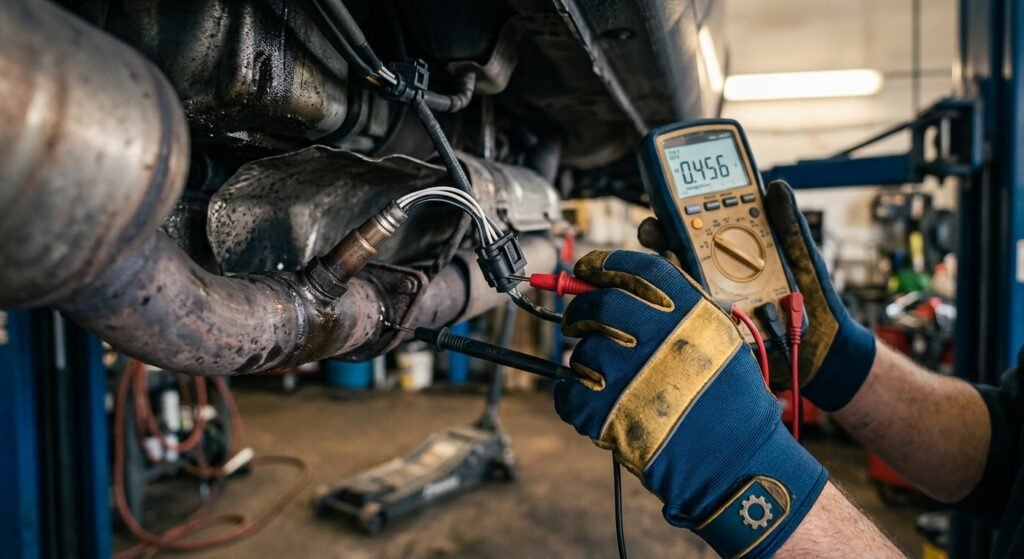
- Digital multimeter (DMM) for testing O2 sensor heater circuits and wiring continuity
- Backpressure gauge or vacuum gauge for exhaust restriction checks
- Infrared thermometer to measure converter temperature differential
- Smoke machine or visual inspection tools to find exhaust leaks
- Fuel pressure gauge and compression tester if misfire or fueling issues are suspected
Step-by-step diagnosis (recommended order)
Follow this sequence for an efficient, evidence-based diagnosis — it separates true converter failures from the easier-to-fix sensor or exhaust problems.
| Step | Action | What to look for |
|---|---|---|
| 1 | Read codes and freeze-frame with an OBD-II scanner | Confirm P0420, note fuel trims, O2 sensor voltages, and engine conditions when fault set |
| 2 | Visual inspection for exhaust leaks or damaged hardware | Cracks, loose clamps, gasket leaks near manifold, or holes upstream of downstream O2 |
| 3 | Check for related engine codes (misfires, fuel trims, temp sensor issues) | Pending misfire or fuel control codes can cause false P0420 |
| 4 | Test downstream O2 sensor and heater circuit with DMM | Open heater, short, or slow response indicates sensor replacement |
| 5 | Temperature test across catalytic converter | Significant temp rise from front to rear indicates catalyst working; little or no delta suggests failure |
| 6 | Backpressure test / inspect catalytic internals | High backpressure or rattling indicates restriction or broken substrate |
| 7 | Road test and verify readiness monitors after repairs | Ensure PCM sees improved converter efficiency before clearing P0420 permanently |
How to test the downstream O2 sensor (practical tips)
- Use a scan tool to watch live downstream O2 voltage: the downstream sensor should be relatively steady near 0.4–0.9V only after the cat is warm; it will be less responsive than the upstream sensor.
- With the engine warmed and steady, a healthy converter makes downstream sensor voltages much less volatile than upstream; if both sensors mirror each other closely, the PCM will log P0420.
- Test the heater circuit resistance with a DMM and verify 12V and ground at the sensor connector with key on engine off.
When the catalytic converter is the problem
If testing and inspections point to a physically damaged, contaminated, or clogged converter, replacement is the correct fix. Catalytic converters are a consumable emissions component — cleaning or aftermarket “fixes” rarely restore OEM efficiency. A technician will also confirm the root cause (misfire, oil burning, or contamination) before installing a new converter so the replacement isn’t ruined quickly.
Repair vs. replacement: what to expect
Many DIY guides talk about “cat cleaning” or repair kits. Those are usually temporary or ineffective. For Hondas showing true converter failure, the correct approach is proper diagnosis, then replacement with an OEM or high-quality direct-fit catalytic converter when required. If the issue was a failed downstream O2 sensor or exhaust leak, those are far less costly fixes and should be done first.
Is it safe to keep driving with P0420?
- If the vehicle runs normally (no misfires, no loss of power, no overheating), you can usually drive to a repair shop, but don’t delay long — unresolved issues can reduce fuel economy and damage the converter further.
- If you have misfires, rough running, or a flashing CEL, stop driving and have it scanned by a mechanic to avoid catalytic converter overheating or other damage.
Typical costs and inspection notes
Costs vary widely depending on whether the fix is a sensor, pipe/gasket, or a catalytic converter. Ask your shop to show test data (live O2 traces, temperature delta, or backpressure numbers) that support the recommendation. If you’re buying a used car, a P0420 history is a legitimate negotiation point; use a professional inspection such as a pre-purchase vehicle inspection to document concerns.
Quick troubleshooting checklist for DIYers
- Scan and save live O2 sensor data — upstream vs downstream
- Inspect for exhaust leaks near manifolds, gaskets, and flanges
- Check for pending misfire codes and monitor fuel trims
- Test downstream O2 heater resistance and connector voltage
- If no wiring or sensor faults, have a shop measure converter temperature delta or backpressure
When to seek professional help
Diagnosing P0420 requires both live data interpretation and components testing. If you don’t have a capable OBD-II scanner, a digital multimeter, or the experience to interpret O2 traces and fuel trim behavior, get it scanned and diagnosed by a trusted shop. A qualified technician will follow the same diagnostic order above and avoid unnecessary catalytic converter replacement.
Note: LockNCal focuses on vehicle safety and security systems — airbags, SRS modules, ADAS calibration, keys and immobilizers — so if you ever need those services we can help. For emissions and engine codes like P0420, see a reputable emissions or exhaust specialist.
FAQ
Q: How accurate is a P0420 code at diagnosing a bad catalytic converter?
A: P0420 only tells you the PCM detected reduced converter efficiency. It is a reliable flag that there’s a problem, but it does not prove converter failure by itself. Always confirm with sensor tests, exhaust leak checks, temperature differential or backpressure measurement before replacing the converter.
Q: Will clearing the code make the Check Engine Light stay off?
A: Clearing the code temporarily will turn the light off, but if the underlying issue remains the PCM will re-run readiness tests and set P0420 again. Clearing without fixing can mask the problem but won’t solve emissions failure.
Q: Can a bad O2 sensor cause P0420?
A: Yes. A failing downstream O2 sensor or a bad heater circuit can make the PCM think the converter isn’t working. Test the sensor and wiring before replacing the catalytic converter.
Q: Is it safe to drive with P0420 on a Honda?
A: If the car runs normally, short trips to a shop are usually safe. If you experience misfires, loss of power, or a flashing CEL, stop driving and have it inspected to prevent converter damage or safety issues.
Q: Will replacing the downstream O2 sensor fix the problem every time?
A: Not always. Replacing a faulty downstream sensor will fix P0420 if the converter itself is still functioning. If tests show the converter is degraded or contaminated, the converter must be replaced after correcting root causes like misfires or oil burning.
If you need professional diagnostics or want to schedule a thorough inspection, book an appointment and we’ll direct you to the right specialist: Schedule an appointment or call (469) 277-7277.


