 Skip to content

Direct answer: The Toyota P0420 code — Catalyst System Efficiency Below Threshold (Bank 1) — means the engine computer has detected the catalytic converter is not reducing emissions as expected on bank 1. The code is a symptom, not a diagnosis: common causes include a failing catalytic converter, bad upstream/downstream oxygen sensors, exhaust leaks or engine problems (misfire/fuel trims) that damage the cat.
Key Takeaways
- P0420 is an emissions efficiency trouble code for the catalytic converter (Bank 1).
- Common causes: worn catalytic converter, faulty O2 sensors, exhaust leaks, rich/lean engine conditions or misfires.
- Start diagnosis with a live-data OBD-II scan, fuel-trim and O2 sensor tests, then check for exhaust leaks and backpressure.
- The final fix is replacing the failed component (often the catalytic converter) after confirming root cause.
What the code actually means
The exact code definition is: Catalyst System Efficiency Below Threshold (Bank 1). Your vehicle’s powertrain control module (PCM) compares signals from the upstream (pre-cat) and downstream (post-cat) oxygen sensors. If the downstream sensor’s readings are too similar to the upstream sensor over time — indicating the catalytic converter is not changing exhaust composition — the PCM sets P0420.
Common causes
- Worn or contaminated catalytic converter (age, oil or coolant contamination, overheating from pre-cat misfire).
- Faulty upstream or downstream O2 (oxygen) sensors or damaged wiring/connectors.
- Exhaust leaks (especially between the engine and the upstream O2 sensor) that skew readings.
- Long-term engine issues producing rich/lean mixtures or repeated misfires that destroy catalytic substrate.
- ECU software issues or rare cases of an intermittent sensor communication fault.
Symptoms drivers notice
- Check Engine Light (CEL) illuminated — usually steady, sometimes flashing only if misfire exists too.
- Reduced fuel economy or a subtle loss of performance.
- Failed emissions test or high tailpipe emissions.
- Rotten-egg (sulfur) smell if converter is contaminated or failing.
- Rarely: rattling from under the vehicle if the converter’s substrate has broken apart.
Is it safe to keep driving?
Short answer: usually yes for short trips, but it depends. If the CEL is steady and there are no misfires or drivability problems, you can often drive cautiously to a shop. If the light is flashing, you likely have a severe misfire that can overheat and damage the catalytic converter — stop driving and get it checked. Also avoid long drives if you smell sulfur or notice severe loss of power.
Tools and data you’ll need for accurate diagnosis
- Full OBD-II scanner that shows live data and freeze-frame (recommended: a scan tool that graphs O2 sensors and fuel trims).
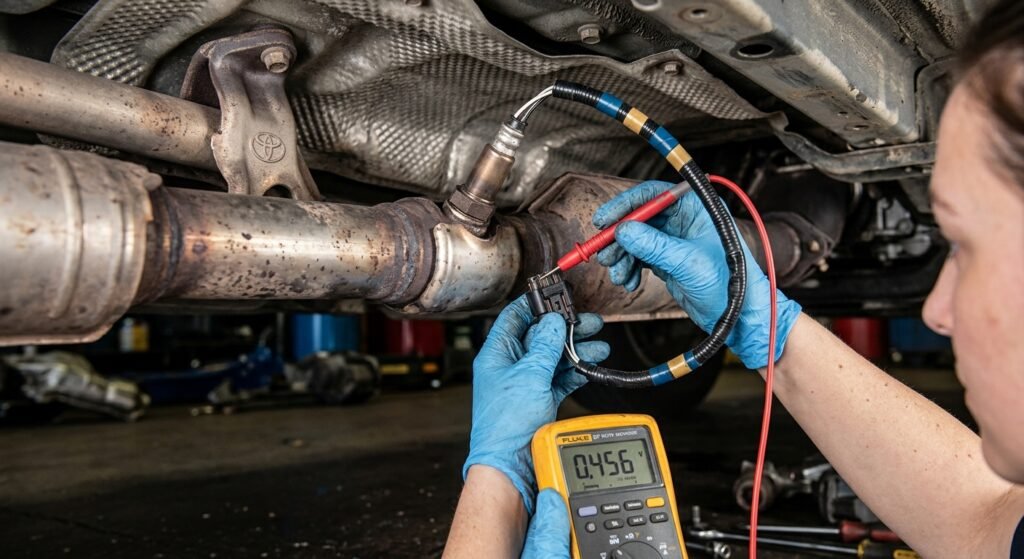
- Digital multimeter (DMM) and backprobe leads for sensor voltage checks.
- Oscilloscope (optional but very helpful) for clean O2 waveforms.
- Exhaust backpressure gauge or vacuum/pressure gauge.
- Infrared thermometer (pyrometer) to compare pre- and post-cat temperatures.
- Smoke machine or propane torch for finding exhaust leaks.
Step-by-step technician diagnosis (practical order)
- Read trouble codes and freeze-frame data with an OBD-II scanner. Confirm P0420 and note pending codes and fuel trims.
- Check for related codes: misfires (P0300–P0306), fuel trim or O2 sensor codes. Fix any active misfires or fuel control faults first — they commonly cause P0420.
- Inspect the exhaust from manifold to converter for leaks, rusted flanges or broken gaskets. Small leaks ahead of the upstream O2 sensor can mimic a bad converter.
- Use live-data to watch upstream (bank 1 sensor 1) vs downstream (bank 1 sensor 2) O2 voltages while warm. The upstream sensor should switch rapidly; the downstream should be much steadier if the cat is working.
- If both sensors match closely or the downstream follows the upstream too tightly, suspect a failing catalytic converter or a bad downstream sensor.
- If the upstream sensor shows slow or no switching, test/replace the upstream O2 sensor first.
- Measure heater circuit and sensor voltages with a DMM per the factory chart. Check wiring and connectors for corrosion or damage.
- Compare exhaust temperatures: the post-cat should be noticeably hotter than the pre-cat under load. Use an infrared thermometer to confirm. Near-equal temps can mean a clogged or inactive converter.
- Perform a backpressure test: excessive backpressure at idle or under load indicates a clogged converter.
- For intermittent faults, check fuel trims (short-term and long-term). Persistent rich or lean trims point to upstream engine issues that can poison or overheat the converter over time.
- If diagnostics point to the converter but O2 sensors look questionable, swap a known-good downstream sensor or replace sensors before condemning a catalytic converter (sensors are cheaper and easier to replace).
Quick diagnostic table
| Observed Problem | Likely Cause | Recommended Test |
|---|---|---|
| Downstream O2 mirrors upstream | Bad catalytic converter or downstream sensor | Live-data O2 comparison; temp differential; backpressure |
| Upstream O2 slow/no switching | Bad upstream O2 sensor or wiring | Sensor voltage/wiring check; resistance/heater test |
| High fuel trims / misfires | Fuel system issue or misfire damaging cat | Spark/coil/compression tests; injector inspection |
| Exhaust leak near sensor | False O2 readings | Smoke test or visual inspection |
Common fixes (what actually solves P0420)
- Replace a failed catalytic converter once diagnostics confirm it is the root cause. Ensure the replacement meets local emissions rules (OEM or CARB where required).
- Replace faulty upstream or downstream oxygen sensors and repair wiring or connectors if they’re damaged.
- Repair exhaust leaks between the manifold and upstream O2 sensor, including gaskets and flanges.
- Address underlying engine problems: fix misfires, correct fuel delivery issues, and resolve oil or coolant leaks that contaminate the converter.
- In rare cases, an ECU reflash or software update from the dealer may resolve false triggers after software corrections are published.
Note: replacing the catalytic converter before fixing upstream causes (misfire, rich running, oil burning) often results in the new converter failing prematurely. Always correct root causes first.
Costs and compliance
Replacing a catalytic converter can be expensive and in many states requires an emissions-compliant unit. Prices vary widely by vehicle and region, so get written quotes from trusted shops. If you’re buying a used Toyota, consider a professional pre-purchase vehicle inspection to catch existing emissions issues early: mobile pre-purchase vehicle inspection.
When to involve a professional
- You don’t have a scan tool that shows live O2 data and fuel trims.
- There are active misfire codes, or the engine runs poorly.
- Backpressure or temperature tests suggest a clogged converter.
- You need guidance on emissions-compliant replacement parts.
For unrelated safety or security systems — airbags, SRS modules, seat belts, key programming or ADAS calibration — LockNCal provides specialized reset, replacement and programming services. See our vehicle safety system services for details: vehicle safety system services.
Preventive tips
- Fix engine misfires, oil or coolant leaks, and fuel-control problems promptly.
- Use the correct spark plugs and ignition parts and replace O2 sensors at recommended intervals.
- Avoid running the engine hard with a known misfire — it overheats the catalytic converter.
FAQ
Q: Will clearing the P0420 code make the light stay off?
A: Clearing the code without fixing the cause will usually make the light return once the system runs its checks. Always diagnose and repair the root cause before erasing codes.
Q: Can a bad O2 sensor cause P0420?
A: Yes. A faulty upstream or downstream O2 sensor or damaged wiring can trigger P0420 because the PCM relies on those sensors to measure catalyst efficiency.
Q: How do I tell if the catalytic converter is clogged or just inefficient?
A: A backpressure test and pre/post-cat temperature comparison under load are the best ways to detect a clogged converter. Excessive backpressure or little to no temperature rise across the converter indicates clogging.
Q: If I replace the catalytic converter, will that fix P0420 for good?
A: Only if the converter was the root cause and upstream issues (misfires, fuel trims, oil leaks) are fixed. Replacing the cat without addressing underlying faults can lead to the code returning.
Q: Is it illegal to remove or bypass the catalytic converter?
A: Yes. Tampering with or removing emissions equipment is illegal in many jurisdictions. Always use compliant replacement parts and follow local rules.
If you want help scheduling a professional inspection or service to investigate emissions and safety systems, book an appointment online: Schedule an appointment or call (469) 277-7277.


