 Skip to content

Toyota U1000 — CAN Bus Fault: Causes & Fix
Direct answer: The Toyota U1000 code means a CAN communication bus fault – a general controller area network communication error. It points to a problem where one or more control modules aren’t talking on the vehicle’s CAN network; the correct fix is a methodical diagnosis and then module programming or wiring correction, not guesswork.
Key Takeaways
- U1000 = CAN communication bus fault – a general controller area network communication error.
- It can be caused by a failing module, poor ground/power, damaged wiring, or a gateway/module software mismatch.
- Start diagnosis with a full scan (Techstream or professional scan tool), check battery/fuses, inspect connectors, then test CAN signals with an oscilloscope.
- Fixes are module programming, module replacement, or wiring repair; LockNCal offers module programming and SRS module reset services when airbags or restraint modules are involved.
What “Toyota U1000” actually means
The verified message for this code is: “CAN communication bus fault – a general controller area network communication error.” In plain English, one or more control units on the vehicle’s CAN network are not exchanging data correctly or are reporting a communication error to the vehicle’s diagnostic system.
How modern CAN networks are structured
Most Toyotas use multiple modules (ECM/PCM, ABS, airbag/SRS ECU, instrument cluster, gateway/body ECU, steering-angle sensor, ADAS units) connected on one or more CAN buses. Each module broadcasts and listens for messages. If messages are missing, garbled, or repeatedly error out, the vehicle logs a U1000-style fault.
Common causes of U1000
- Faulty control module (internal electronics or failed network transceiver).
- Low battery voltage or intermittent power/ground to a module.
- Damaged CAN wiring or corrosion at a connector (open, short to ground, short to battery).
- Blown fuse or poor ground connection affecting the network master/gateway.
- Incorrect or mismatched software in a recently replaced or reprogrammed module (module programming needed).
- Aftermarket electronics (alarms, stereo, tracking devices) accidentally connected to the CAN wiring.
Symptoms you may notice
- Multiple unrelated warning lights on the dash (ABS, SRS/Airbag, check engine, traction control).
- Loss of features tied to a module (no ABS function, airbags disabled, nonworking instrument cluster items).
- Intermittent or permanent no-start if critical modules aren’t communicating with the powertrain computer.
- Systems that worked before a recent collision repair, module replacement, or battery disconnect now showing faults.
Step-by-step technician diagnosis (practical order)
Diagnosing U1000 is a systems job. Follow this order to avoid wasted time and swapped parts.
- Full scan with a professional tool: Use Toyota Techstream or an advanced OBD-II scanner that shows module status and manufacturer codes. Record all active and historical codes and freeze-frame data.
- Note which modules report COMM faults: If the ABS, SRS, or gateway module shows communication errors, write them down — that points to the bus segment or a specific module.
- Check battery voltage and charging: Low or fluctuating voltage causes CAN errors. Verify battery >12.4V at key-off and stable at key-on/engine running.
- Inspect fuses and grounds: Look for blown fuses tied to control modules, and clean/secure main engine/transmission/body grounds.
- Visual wiring check: Inspect harnesses and connectors for corrosion, pin damage, rodent chewing, or water intrusion — especially where wiring routes through doors, firewall, and under dash.
- Wiggle/connect test: With a scan tool connected, gently wiggle connectors and harness sections to reproduce the fault — this finds intermittent opens or bad pins.
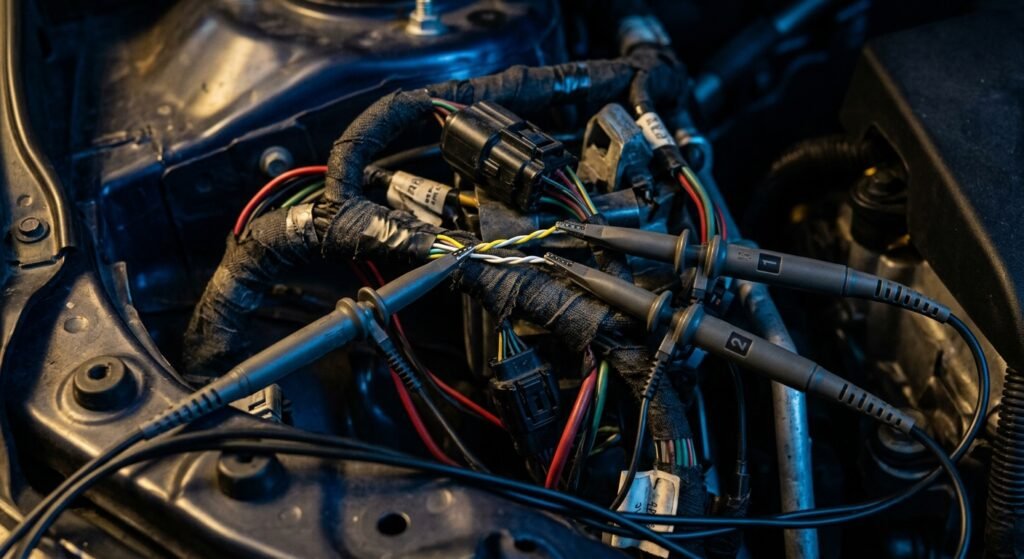
- Measure CAN bus signals: Use an oscilloscope or CAN bus tester to look at CAN High and CAN Low waveforms. Healthy CAN waveform is a square-ish differential signal; excessive noise, missing frames, or DC offsets indicate wiring or transceiver failure.
- Isolate the bad node: If an oscilloscope shows abnormal activity when a particular module is connected, disconnect that module (if safe) to see if the bus returns to normal. Follow manufacturer safe-disconnect procedures — don’t disconnect SRS modules lightly without professional precautions.
- Software and VIN checks: Confirm that any recently replaced module has the correct software/calibration and the vehicle VIN programmed where required. Mismatched modules can be invisible electrically but fail at the protocol level.
- Repair or program as needed: Fix wiring faults, correct power/ground problems, then perform module programming or reprogramming and clear codes. Verify system operation with a re-scan and a road test.
How a technician decides the correct fix
Two realities guide the repair path: (1) many U1000 faults are wiring or power-related and are fixed by restoring clean voltage/ground or repairing a damaged wire, and (2) some faults come from a failed module or incorrect software and require module programming or replacement.
If the issue is an SRS/airbag module showing communication errors, resetting the airbag module or reprogramming is often the correct next step after electrical issues are resolved. LockNCal provides module programming and diagnostics and offers both mobile and mail-in SRS module reset options where appropriate, described at our vehicle safety system services page.
Common fixes summarized in a table
| Observed problem | Likely cause | Typical next step |
|---|---|---|
| Multiple modules show comm errors after battery disconnect | Voltage spike or software mismatch after a battery event | Check battery/charging, then reflash/program modules |
| Single module isolated on scan tool | Failed module transceiver or internal fault | Confirm with oscilloscope, then program/replace module |
| Intermittent codes triggered by door movement or weather | Corroded connector or damaged wiring harness | Inspect connectors, repair wiring, clear codes |
Is it safe to keep driving with U1000?
Not always. U1000 itself is a communication-level fault — the safety of driving depends on which systems are affected:
- If the code coincides with SRS/Airbag warnings, do not ignore it. Airbag disabling means the restraint system may not deploy correctly in a crash.
- If ABS or traction control lights are on, braking performance is degraded in low-traction conditions.
- If only a noncritical module (e.g., some convenience feature) shows a fault and the engine runs normally, short trips are usually possible, but get it diagnosed soon.
When in doubt, have the vehicle scanned and inspected by a technician who starts with electrical checks rather than swapping parts.
Why avoid guesswork or ‘‘parts swapping’’
Modules are expensive. Replacing a control unit without verifying wiring, grounds, and software often wastes money and leaves the real problem unresolved. Proper diagnosis relies on a scan tool, voltage checks, waveform analysis, and correct module programming. If a restraint module (SRS) or airbag module is involved, a certified reset or programming step is required — LockNCal offers those services by mail-in and mobile where available, see our mail-in airbag module reset details.
FAQ
Q: What does Toyota U1000 mean?
A: U1000 means “CAN communication bus fault – a general controller area network communication error.” It indicates modules are not communicating correctly on the vehicle CAN network.
Q: Can a low battery cause U1000?
A: Yes. Low or unstable battery and charging system issues can create communication faults. Always check battery voltage and charging first.
Q: Will clearing the code fix U1000?
A: Clearing codes can make the symptom disappear temporarily, but if the underlying wiring, power, or module problem remains, the code will return. Proper diagnosis is required.
Q: Could aftermarket electronics cause this code?
A: Yes. Incorrectly wired alarms, stereos, or trackers that tap into vehicle power or CAN wiring can introduce noise or shorts that trigger U1000.
Q: Who should I call to fix a U1000 on my Toyota?
A: Start with a qualified diagnostic technician. If the fault points to module software or SRS/module communication, LockNCal offers professional module programming and diagnostics and SRS module reset services.
If your Toyota shows U1000 and it points to module communication or an SRS restraint module, schedule professional module programming and diagnostic help at https://lockncal.com/mobile-module-programming-services/ or call (469) 277-7277 for fast, expert service.


