 Skip to content

Chevrolet U0121 Code — Lost Comm with ABS (Fixes)
Direct answer: The Chevrolet U0121 code means the vehicle’s main network has lost communication with the ABS control module. That usually points to wiring, connector, power/ground, or module failure — and the correct fix is a focused diagnostic and module programming or replacement (not guesswork). A professional module programming and diagnostic service will identify the root cause and restore proper communication.
Key Takeaways
- U0121 = Lost Communication With ABS Control Module (Chevrolet).
- Common causes: wiring/connectors, blown fuses, bad grounds, or a failed ABS module.
- Diagnose with a proper scan tool, wiring checks, and CAN-bus tests in a specific order.
- The correct fix is targeted diagnostics and module programming or replacement + relearn.
- If you need professional help, module programming and diagnostics restore vehicle safety systems correctly.
What U0121 actually means (plain English)
U0121 is a communication error: the vehicle’s network (often the CAN bus) expected to hear from the ABS control module but didn’t. It doesn’t itself say the ABS module is broken — it means the module and the rest of the car aren’t talking. Restoring that conversation is what returns ABS, traction and some stability systems to normal operation.
LockNCal does mobile module programming and diagnostics across Dallas–Fort Worth. On-site: $0 today, pay after the job. Book mobile module programming or call (469) 277-7277.
Common causes of a Chevrolet U0121 code
- Power or ground loss to the ABS control module (blown fuse, corroded ground).
- Damaged or corroded wiring or connectors on the ABS module harness.
- Faulty ABS control module (internal failure) or a control module that needs programming after replacement.
- Intermittent CAN-bus faults from other modules creating network errors.
- Aftermarket electronics or recent bodywork that disturbed wiring or grounding points.
Symptoms drivers notice
- ABS warning lamp and/or traction control light on the dash.
- Loss of ABS or traction-control functionality under braking or slippery conditions.
- Stability control disabled messages.
- Possible odd behavior from other modules that share the network (e.g., airbag or instrument cluster warnings).
- Intermittent or persistent lights — may come and go depending on connector movement or temperature.
Tools and parts a technician will use
- OEM-grade scan tool with module communication and CAN-bus diagnostics (e.g., dealer-level or equivalent).
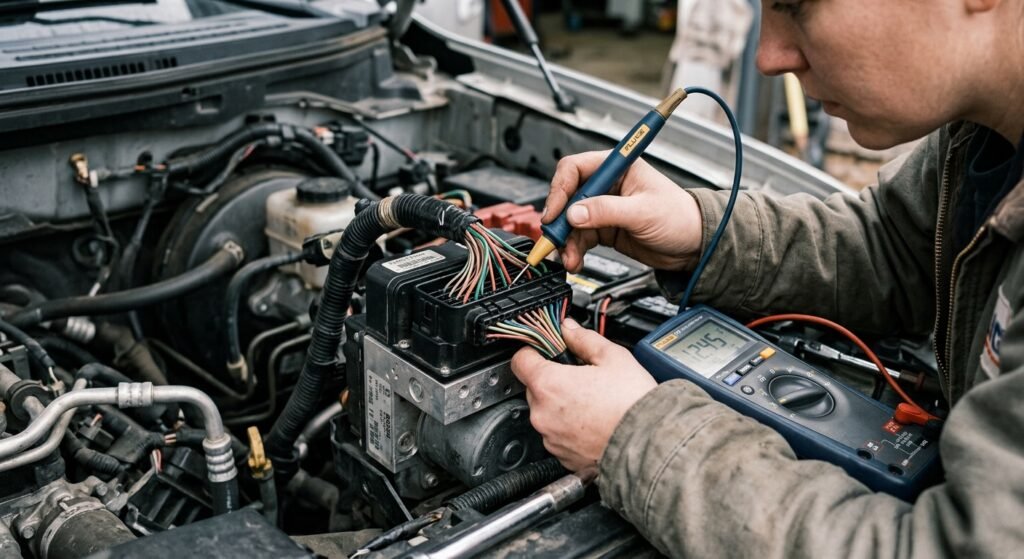
- Multimeter and lab-grade test light for voltage/ground checks.
- Backprobe pins, wiring charts and connector pinouts for the specific Chevrolet model and year.
- Oscilloscope (when needed) to view CAN differential signals and noise.
- Replacement ABS module or harness parts only if diagnostics prove them faulty — plus module programming hardware/software.
Step-by-step technician diagnosis (recommended order)
Follow this order; skipping steps can waste time or lead to wrong conclusions.
- Confirm the code with a full OBD-II scan and save the freeze frame and related codes — note any airbag or other network codes.
- Check battery voltage and engine/chassis grounds. Low or unstable battery voltage can cause module comms to fail.
- Inspect fuses and fuse box connectors related to the ABS module (power and ignition-switched power circuits).
- Visually inspect the ABS module connector and the harness: look for corrosion, bent pins, water intrusion, chafing, or recent bodywork splice points.
- Backprobe power and ground circuits at the ABS module while cranking/under load to confirm stable supply.
- Scan the CAN-bus: check for other modules reporting COMM faults. Use an oscilloscope to verify differential CAN-H and CAN-L waveforms if needed.
- Wiggle test the harness and connectors while watching the scan tool to catch intermittent faults.
- If a wiggle recreates the fault, repair or replace the harness/connector before considering a new ABS module.
- If wiring, power, and grounds are good and the ABS module still doesn’t communicate, evaluate the module itself. Some modules can be reset or reprogrammed to clear COMM faults — this requires proper programming equipment.
- If replacement ABS modules are used, they must be correctly coded/programmed and sometimes require a VIN-specific configuration or network relearn.
How the correct fix differs from guessing
Replacing the ABS module without a proper diagnostic is a common mistake. If the root cause is a wiring fault or a bad ground, swapping the module won’t fix the network error and can lead to repeated failures and unnecessary parts expense. The correct approach is diagnosis first, then either module programming/reset or replacement plus programming and a final communication verification.
Quick reference table: cause, test, and expected action
| Probable cause | Quick test | Correct action |
|---|---|---|
| Blown fuse / no power | Check fuse panel; backprobe module power pin | Replace fuse, trace short; confirm stable power |
| Bad ground | Measure resistance between module ground and battery negative | Clean/secure ground point; test again |
| Damaged harness/connector | Visual inspect & wiggle test while scanning | Repair/replace harness or connector, then verify |
| ABS module internal failure or config mismatch | All wiring OK but no comm, module fails bench tests | Program or replace module and perform network relearn |
When is it safe to keep driving?
Technically, the vehicle may still drive with a U0121 code if the engine and brakes function, but safety systems like ABS, traction control, and electronic stability control may be disabled. That increases stopping distance and reduces stability during emergency maneuvers or on slippery roads. If you see the ABS or traction lamps, drive cautiously and avoid high-speed or hazardous conditions until the issue is diagnosed. If braking feels compromised, stop driving and have the vehicle towed.
What a professional service will do (and what LockNCal provides)
A professional diagnostic will not guess at the fix — it follows the steps above, uses proper scan tools, and confirms the repair by proving the module communicates on the network afterward. LockNCal offers module programming and vehicle diagnostic services, which include targeted diagnostics and VIN-specific programming when a module must be reset or reprogrammed. For safety system work like ABS communication faults, that programming and diagnostic capability is often the final step to restore normal function.
If the ABS module itself must be replaced, source an OEM or correctly-configured module; then have it programmed and the network verified. If the problem is wiring or a ground, address that first — programming alone won’t help a bad circuit.
For related vehicle safety systems and procedures, see our vehicle safety system services at https://lockncal.com/vehicle-safety-system-services/. If your vehicle needs a mobile or on-site service, learn more about our on-site mobile services. For module-specific programming, see our module programming page at https://lockncal.com/mobile-module-programming-services/.
DIY checks you can perform safely
- Check that the battery is fully charged and that terminals are tight and clean.
- Look at the ABS module connector for obvious corrosion or water entry; don’t open sealed modules or attempt board repairs.
- Check fuses related to ABS and powertrain control.
- Note when symptoms occur (after rain, when hot, on rough roads) — that detail helps a technician find intermittent wiring faults.
When to call a pro
- If the ABS light is on with U0121 and you cannot find a simple blown fuse or loose connector.
- If wiring inspection or wiggle tests show intermittent faults you can’t access or safely fix.
- When a module replacement is needed — modules often require VIN-specific programming and network relearn.
- When other network modules show related communication errors.
FAQ
Q: What does Chevrolet U0121 mean?
A: U0121 means the vehicle lost communication with the ABS control module — a network communication fault, not necessarily a failed ABS unit.
Q: Can I drive with a U0121 code?
A: You can usually drive short distances, but ABS and traction systems may be disabled, increasing risk in slippery or emergency braking situations. Avoid high speeds and get the issue diagnosed promptly.
Q: Will replacing the ABS module always fix U0121?
A: No. If the root cause is wiring, power, or grounding, replacing the module alone won’t help. Proper diagnosis first, then module programming or replacement if needed, is the correct approach.
Q: Can I clear U0121 myself with a scanner?
A: Clearing the code may turn off the light temporarily but won’t fix the underlying communication problem. The code will likely return until the root cause is addressed.
Q: What service should I book to fix U0121?
A: Book a professional module programming and diagnostic service to identify the cause, perform any needed programming or reset, and verify network communication.
For a reliable, professional resolution to a Chevrolet U0121 code — including targeted diagnostics and module programming — book our module programming and diagnostic service online or schedule an appointment and call (469) 277-7277 for questions.


