 Skip to content

Subaru EyeSight Calibration: When It’s Needed, How It Works, and Where to Get Help in Lewisville TX
Windshield just replaced on your Subaru, and now you see an EyeSight warning light on the dash? Or maybe your adaptive cruise doesn’t feel quite right on I-35 or the George Bush Turnpike. In modern Subarus, those signs can point to one thing: your Subaru EyeSight calibration may be off.
LockNCal calibrates cameras and radar on-site across Dallas–Fort Worth. See what ADAS calibration costs. On-site: $0 today, pay after the job. Book mobile ADAS calibration or call (469) 277-7277.
Driver-assist systems usually need recalibration after a repair — our professional ADAS calibration comes to you across Dallas–Fort Worth.
This guide explains, in plain language, when Subaru EyeSight calibration is required, what happens during the process, how long it typically takes, what can go wrong if it’s skipped, and how to find the right shop for ADAS calibration in Lewisville TX and the DFW area.
What Is Subaru EyeSight and Why Calibration Matters
Subaru EyeSight is the brand’s camera-based driver assistance system. It uses one or two forward-facing cameras mounted near the top of the windshield to monitor what’s happening ahead of your vehicle.
Depending on model and year, EyeSight supports features such as:
- Pre-Collision Braking – helps apply braking if a frontal impact is likely.
- Pre-Collision Throttle Management – may reduce engine power if you accelerate toward an obstacle.
- Adaptive Cruise Control – maintains a set following distance in DFW highway traffic.
- Lane Departure Warning & Lane Keep Assist – alerts you if you drift and may help with steering input.
- Lead Vehicle Start Alert – lets you know when traffic ahead moves.
All of these depend on the cameras seeing the road correctly. That means:
- The camera angle must be set within tight specifications.
- The distance from the camera to calibration targets must be precise.
- The system software must know exactly how the camera is oriented relative to the vehicle.
If something changes – such as a windshield replacement, camera bracket disturbance, or body repairs – a fresh Subaru EyeSight calibration is often required so the system can measure distance, lane position, and obstacles accurately again.
How Subaru EyeSight Works Behind the Windshield
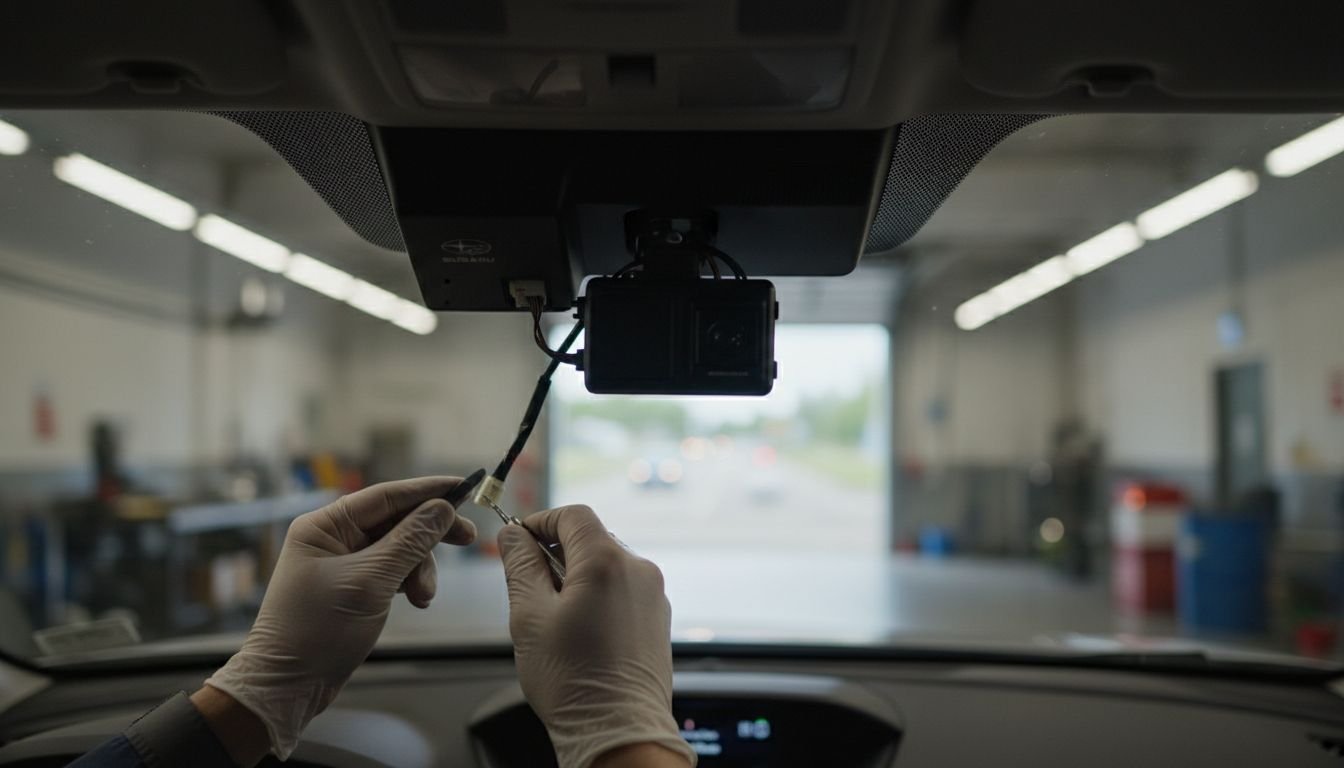
On most Subaru models equipped with EyeSight, the core components sit just behind the windshield near the rear-view mirror. The forward-facing cameras watch lane markings, vehicles, and obstacles ahead of you.
Several factors affect how well EyeSight can do its job:
- Visibility through the glass – Chips, cracks, heavy pitting from Texas hail, or distorted aftermarket glass can interfere with the camera’s view.
- Mounting angle – Even a slight tilt in the camera’s position can change how far away the system thinks vehicles or lane lines are.
- Windshield position – The glass must sit at the correct height and angle; small differences can throw off aiming.
- Vehicle alignment and ride height – Big changes in suspension geometry can affect where the camera is “looking.”
Because of this, Subaru specifies when camera recalibration has to be done after certain service operations. Skipping this step can leave EyeSight operating on bad assumptions about what’s in front of you.
Describe Subaru EyeSight (how it works), common triggers for recalibration (windshield replacement, camera/sensor replacement, windshield alignment), walk through the calibration process, estimated time and safety implications, and tips for finding qualified shops.
Common Reasons Subaru EyeSight Needs Recalibration
You should consider Subaru EyeSight calibration whenever something happens that might change the camera’s view or position. Common triggers include:
- Windshield replacement
Any time the windshield is replaced – whether due to rock chips from DFW highways, hail damage, or cracks that spread – the relationship between the camera and the glass can change. Subaru generally calls for recalibration after windshield replacement on EyeSight-equipped vehicles. - Camera or related sensor replacement
If the forward camera module, bracket, or mounting hardware is replaced, disturbed, or removed for any reason, the system should be recalibrated. - Windshield alignment or mounting changes
If the glass had to be reset, adjusted, or remounted after a poor installation or repair, that’s another trigger. - Front-end impact or body work near the camera area
Collisions, even low-speed, can twist structural points and mounting brackets. After body work, bumper repairs, or frame pulls in DFW collision shops, the cameras may no longer be pointed exactly where the car thinks they are. - Suspension or alignment changes affecting vehicle geometry
Major suspension repairs, lift kits, lowering springs, or severe alignment changes can alter the vehicle’s pitch or ride height. On some vehicles, that can require recalibration so EyeSight “re-learns” the new geometry.
For a deeper look at why post-repair sensors can mislead drivers, see how post-collision ADAS sensors can create false safety.
What Happens During Subaru EyeSight Calibration
At a dedicated ADAS calibration facility like LockNCal in Lewisville TX, the goal is to restore EyeSight to factory-accurate operation. While exact procedures vary by model and year, the general workflow looks like this:
- 1. Pre-scan / system check
A trained technician connects a scan tool to your Subaru’s diagnostic port to check for stored trouble codes, current EyeSight status, and related system faults. - 2. Physical inspection
The camera housing, mounting bracket, and windshield condition are inspected. The tech looks for cracks, chips, heavy pitting, glass distortion, loose trim, or anything that could interfere with calibration. - 3. OEM-guided setup and target positioning
The shop sets up calibration targets and measurement tools in front of the vehicle according to the vehicle manufacturer’s procedures. Distances, heights, and angles are measured precisely, often on a level calibration bay. - 4. Calibration procedure
Using a compatible scan tool and OEM-specified steps, the technician runs the EyeSight calibration routine. The cameras learn the position of the targets and reset their internal reference points. - 5. Verification and post-checks
After calibration completes, the system is checked for successful completion flags, and a post-scan is performed. Depending on the situation, a short test drive may be performed to verify driver assistance functions.
This process ensures the camera is not just bolted in place, but electronically aligned with the real world.
How Long Does Subaru EyeSight Calibration Take?
Drivers often ask, “How long does Subaru EyeSight calibration take?” The honest answer is: it varies.
In many straightforward cases – clean installation, no additional issues, proper space available – a typical calibration visit may be completed in roughly one to a few hours. However, time can increase if:
- Pre-scan reveals other diagnostic trouble codes that must be addressed first.
- The windshield has defects or distortion that interfere with the process.
- Vehicle ride height or suspension issues need further investigation.
- Multiple ADAS systems (not just EyeSight) require calibration.
Because each Subaru and situation is different, it’s safest to plan for some flexibility in your schedule and confirm expectations when you book your ADAS calibration appointment.
Why Driving Without Proper Calibration Is a Safety Risk
Driving around the DFW area with a disturbed or uncalibrated EyeSight system can lead to:
- Incorrect distance judgment – Adaptive cruise may follow too closely or leave more space than expected.
- Missed detection – The system might not recognize vehicles or obstacles in time for pre-collision functions to help.
- False alerts – Lane departure or collision warnings may trigger when nothing is wrong, making you more likely to ignore them.
- Disabled features – The vehicle may shut certain EyeSight features off completely if it detects calibration problems, leaving you with fewer safety supports than you think you have.
EyeSight is designed as a support system, not a replacement for attentive driving, but when it’s out of calibration, it can provide either false confidence or reduced protection. That’s not a risk worth taking in heavy DFW traffic, construction zones, or during sudden hailstorms when visibility is already compromised. If you’re not sure whether your Subaru is safe to drive, scheduling a Vehicle Diagnostic is a smart first step.
How to Choose a Qualified ADAS Calibration Shop
Not every shop that installs windshields or does body work is equipped for Subaru ADAS calibration. When you search for an EyeSight calibration shop in DFW, ask these questions:
- Do you perform OEM-guided ADAS calibration in-house? Or do they outsource it?
- What calibration equipment and scan tools do you use? Are they capable of Subaru EyeSight procedures?
- Do you follow documented factory procedures and keep records? You should be able to receive proof that calibration passed.
- Do you perform pre- and post-scans? This confirms the system’s status before and after the work.
- Is the calibration done in a controlled space? Proper lighting, level floor, and setup space are important.
At LockNCal in Lewisville TX, our focus is on ADAS Calibration and related Vehicle Diagnostic services for Subaru and many American/Japanese vehicles. We use purpose-built calibration equipment, follow manufacturer procedures, and provide documentation of completed calibrations for your records.
Signs Your Subaru May Need EyeSight Calibration
You don’t have to be a technician to spot potential EyeSight issues. Pay attention to these signs, especially after recent work on your vehicle:
- EyeSight or ADAS warning lights on the dash.
- Messages like “EyeSight disabled” or similar system alerts.
- Adaptive cruise control acting differently than you’re used to (following distance feels off).
- Lane departure warning or lane keep assist triggers too often, too late, or not at all.
- Recent windshield replacement or glass repair, especially after rock chips or hail damage.
- Recent front-end impact, bumper repair, or body work in the area of the camera or front sensors.
- Suspension or alignment changes (lift/lower) that changed how the vehicle sits.
Quick checklist – You may need calibration if:
- You see a new EyeSight or ADAS warning light after service.
- You’ve had a windshield replaced in the last few days or weeks.
- Your Subaru feels “different” when using adaptive cruise in DFW traffic.
- You’ve recently been in a collision or had body work done.
- You’ve modified suspension or had major alignment work performed.
If any of these apply and you’re unsure what’s going on, a Vehicle Diagnostic at a shop that understands ADAS is a smart next move before driving long distances around Lewisville, Dallas, or Fort Worth.
Do I Need Calibration After Windshield Replacement or Camera Service?
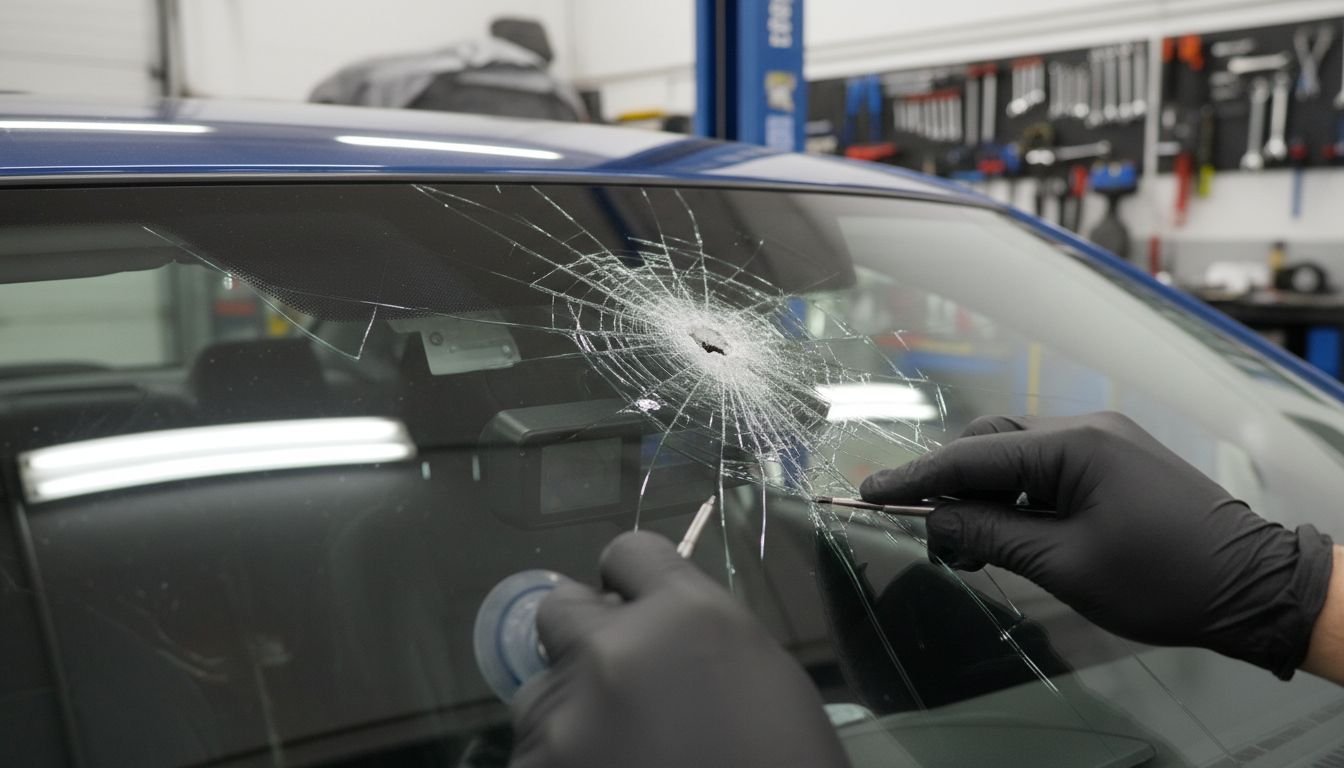
In most EyeSight-equipped Subarus, yes – Subaru EyeSight calibration after windshield replacement is required or strongly recommended by the manufacturer.
Here’s why:
- Glass thickness and clarity: Not all glass behaves the same optically. Even small differences affect how the camera “sees.”
- Mounting tolerance: The new windshield may sit slightly differently than the original, even if it looks perfect to the naked eye.
- Camera bracket movement: Removing and reinstalling the camera or mirror assembly can shift the camera’s exact aim.
This is especially important in DFW, where hail-damaged cars can hide disabled safety systems. If your Subaru went through a major storm, was repaired quickly, or had glass replaced, make sure the safety systems behind that glass were checked. You can learn more in our article on how hail-damaged cars can hide disabled safety systems.
If the EyeSight warning light comes on after windshield replacement, that’s an immediate sign to schedule an ADAS Calibration appointment. Even if there is no warning light, best practice is to confirm calibration anytime the camera or glass in front of it is disturbed.
The same logic applies after camera or sensor service. Any time hardware is replaced, adjusted, or removed and reinstalled, calibration should be checked and performed as needed.
Can You Drive Without Subaru EyeSight Calibration?
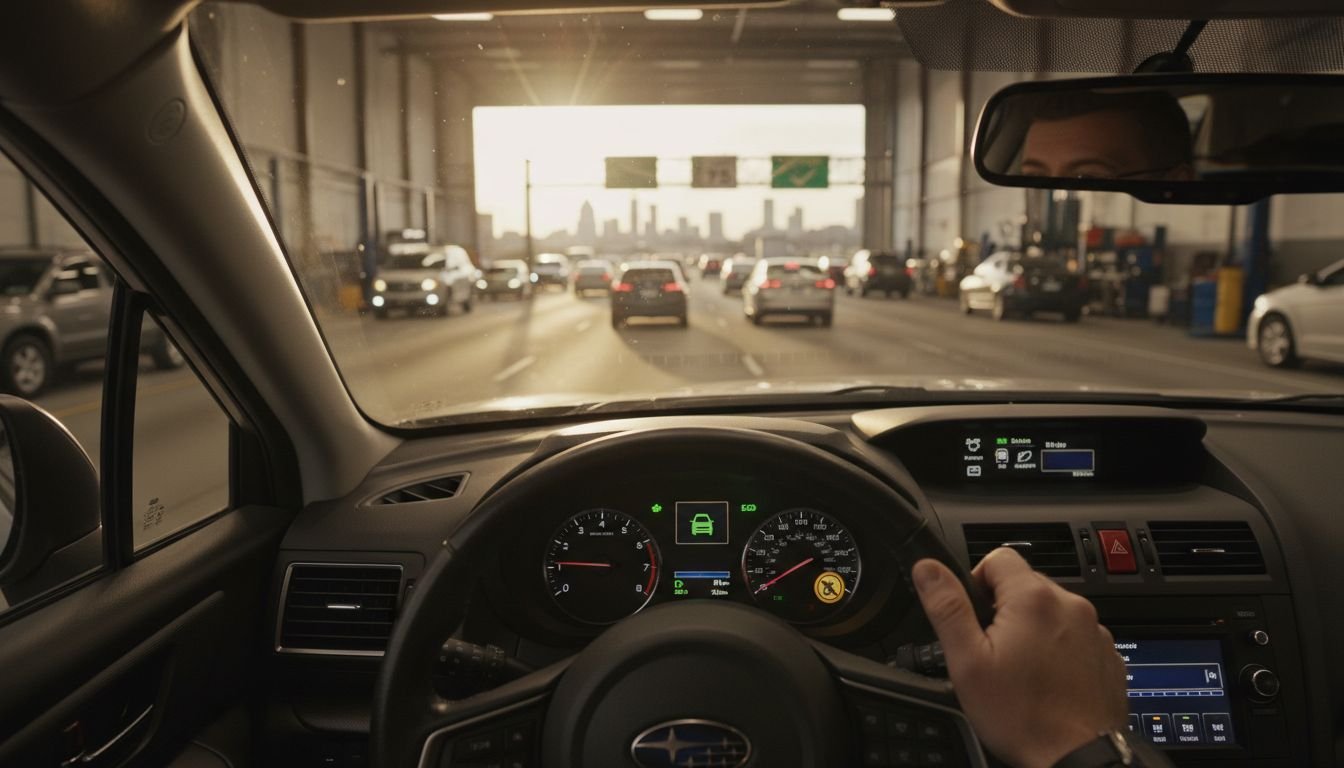
Many drivers in Lewisville and across DFW ask this right after glass or collision work: “Can I still drive if my Subaru EyeSight hasn’t been calibrated yet?”
From a practical safety standpoint:
- If the system has disabled itself (you see warning messages and features are unavailable), you’re driving without those assistance features. The car can still move, but you’ve lost a layer of safety you may be relying on.
- If the system is still active but out of calibration, EyeSight may misjudge distances or lane positions. That can create unpredictable braking, false alerts, or late warnings.
Because of this, the safest choice is:
- Avoid long highway trips or heavy-traffic commutes until EyeSight is checked.
- Schedule a Vehicle Diagnostic with an ADAS-capable shop to confirm system status.
- Complete ADAS Calibration as soon as it’s confirmed necessary.
While we’re not providing legal advice, from a safety and liability perspective it’s best not to ignore EyeSight issues. Treat them with the same caution you would any other significant warning light.
DIY Subaru EyeSight Calibration Risks
Because calibration involves cameras and software, some owners wonder if they can do it themselves with a generic scan tool or a YouTube guide. As an ADAS-focused shop, our position is clear: Subaru EyeSight calibration is not a DIY-friendly job.
Reasons include:
- Precise measurements are required – Target boards must sit at exact distances and angles from the vehicle. “Close enough” is not acceptable for safety systems.
- Controlled conditions – The calibration bay should be level, with controlled lighting and sufficient space. Driveways and parking lots rarely meet these requirements.
- Correct tools and software – You need compatible calibration equipment, ADAS-capable scan tools, and access to current vehicle procedures.
- Verification and documentation – Professional shops verify and document successful calibration, something DIY situations rarely achieve.
Important safety warning: Modern vehicles – including Subaru, Toyota, Honda, and many American and Japanese brands – contain SRS/airbag components with explosive elements. DIY disassembly around the dash, A-pillars, steering column, and windshield area can put you at risk of unintentional airbag deployment, electrical damage, or hidden system failures. EyeSight calibration itself doesn’t usually require direct SRS work, but many of the trim panels and areas owners might remove to “get to” the camera or wiring run close to critical safety components.
If you’re not set up as a professional ADAS facility, it’s safer and more cost-effective long-term to let a trained shop handle both Vehicle Diagnostic and ADAS Calibration.
Finding Car Calibration Near Me in Lewisville TX
When you search for car calibration near me after a windshield replacement or collision repair in DFW, you’ll see a mix of glass shops, body shops, and general repair garages. Not all of them specialize in Subaru ADAS calibration.
For drivers in Lewisville TX and surrounding communities (including Carrollton, Flower Mound, Denton, Plano, Frisco, and much of Dallas/Fort Worth), look for a shop that offers:
- Dedicated ADAS calibration equipment capable of Subaru EyeSight procedures.
- Technicians trained in driver assistance systems, not just basic mechanical work.
- Pre- and post-calibration scans with documentation you can keep.
- Clear communication about what’s being calibrated and why.
LockNCal focuses on ADAS Calibration and Vehicle Diagnostic services for Subaru and other American/Japanese vehicles throughout the DFW region we serve, including Lewisville TX and many nearby cities. You can explore our Lewisville-specific service information at https://lockncal.com/Lewisville-TX.
If you’re not sure what systems your Subaru has, you can quickly decode your VIN here: https://lockncal.com/vin-decoder/.
Subaru EyeSight Calibration in Lewisville TX: When to Call LockNCal
If you drive a Subaru in Lewisville TX or the broader DFW area, consider contacting LockNCal for ADAS Calibration or a Vehicle Diagnostic when:
- You’ve had a windshield replacement or glass repair, especially from hail or rock damage on local highways.
- You see a Subaru EyeSight warning light after windshield replacement or other service.
- Your vehicle has been in a collision or received front-end body repairs.
- You’ve had camera, sensor, or bracket replacement near the windshield or mirror.
- You’ve changed suspension ride height or had major alignment work done.
- ADAS features feel different than before, even if no warning is displayed.
Our process is straightforward:
- Discuss your recent repairs or symptoms so we understand the full picture.
- Perform a Vehicle Diagnostic if needed to confirm calibration requirements.
- Carry out ADAS Calibration to restore your EyeSight system to proper operation.
- Provide documentation of completed calibrations for your records and for any future insurance or service needs.
This keeps the focus on safety and clarity, not guesswork.
Final Takeaway: Don’t Guess on EyeSight Safety
Subaru EyeSight is a powerful safety tool – but only when it’s properly calibrated. Events like windshield replacement, camera service, front-end collisions, and major suspension changes can all require fresh Subaru EyeSight calibration to keep your driver assistance features working as intended.
If you’re seeing warning lights, noticing odd behavior from adaptive cruise or lane functions, or you’ve just had glass or body work done on your Subaru in the Lewisville TX or greater DFW area, don’t guess. Schedule a Vehicle Diagnostic and, if needed, a professional ADAS Calibration with a qualified shop.
For local Subaru owners in Lewisville and the surrounding DFW communities we serve, LockNCal is available as a focused resource for Subaru ADAS calibration Lewisville TX. You can review our local service information at https://lockncal.com/Lewisville-TX and use our VIN decoder tool to better understand your vehicle’s safety systems before you call.
FAQs About Subaru EyeSight Calibration
1. What is Subaru EyeSight calibration?
Subaru EyeSight calibration is the process of electronically aligning the forward-facing cameras so they correctly understand distance, lane position, and obstacles ahead. It uses specialized targets, measurement equipment, and scan tools to “teach” the system exactly how the cameras are positioned on your vehicle after repairs or changes.
2. When is Subaru EyeSight calibration required?
Calibration is typically required after windshield replacement, camera or bracket replacement, front-end collision or body repairs near the camera area, and sometimes after major suspension or alignment changes. If you see an EyeSight or ADAS warning light, or notice unusual behavior from your driver assistance features, schedule a Vehicle Diagnostic to determine whether calibration is needed.
3. Do I need Subaru EyeSight calibration after windshield replacement?
In most cases, yes. Subaru generally specifies EyeSight calibration after windshield replacement on EyeSight-equipped models. Small changes in glass position, thickness, or clarity can affect what the camera sees, so it’s best practice to have ADAS Calibration performed any time the front glass is replaced or remounted.
4. How long does Subaru EyeSight calibration take?
Time can vary by model, condition, and what other issues are found. Many straightforward calibrations may be completed in roughly one to a few hours, but additional diagnostic needs, glass issues, or multiple ADAS systems can extend that. A good shop will explain expectations when you schedule and keep you updated during the visit.
5. Can I drive if my EyeSight warning light is on?
Your Subaru may still move, but an EyeSight warning light usually means one or more driver assistance functions are reduced or unavailable. For safety, limit driving as much as possible and schedule a Vehicle Diagnostic and, if needed, ADAS Calibration promptly. Driving in heavy DFW traffic without properly functioning safety systems is not recommended.
6. Can Subaru EyeSight be calibrated outside the dealership?
Yes, Subaru EyeSight can be calibrated outside the dealership, as long as the shop has proper ADAS calibration equipment, compatible scan tools, and follows OEM procedures. Not every repair or glass shop is equipped for this, so always ask about their calibration capabilities and documentation process.
7. How do I find car calibration near me in Lewisville TX?
Search for car calibration near me and look specifically for shops that list ADAS Calibration and experience with Subaru or Japanese vehicles. Confirm they perform pre- and post-scans, use dedicated ADAS equipment, and provide printed or digital proof of successful calibration. In Lewisville TX and much of DFW, LockNCal offers ADAS Calibration and Vehicle Diagnostic services focused on modern safety systems.


