 Skip to content

Salvage Title Airbag Module — What to Do Next
Direct answer: A “salvage title airbag module” usually means the vehicle was in an incident that might have deployed airbags, or its SRS (airbag) module recorded crash data. That module can often be reset or reprogrammed if it’s intact, but a deployed airbag or fired pretensioner requires replacement. Always scan and verify crash data before buying or driving.
Key Takeaways
- Salvage title vehicles often have SRS modules that contain crash event data — that data must be cleared or acknowledged before the airbag system is reliable.
- A deployed airbag or fired seatbelt pretensioner must be replaced, not “repaired.”
- SRS module reset or programming can restore the module to service if the module itself is not physically damaged.
- Use a full diagnostic scan and VIN history to confirm what’s needed; certified reset services exist nationwide by mail-in.
What people mean by “salvage title airbag module”
When a vehicle carries a salvage title, it often means the insurer declared it a total loss after some level of damage. Buyers and sellers then look closely at the Supplemental Restraint System (SRS) — the airbag module, pyrotechnic devices (airbags and pretensioners), and associated sensors. “Salvage title airbag module” typically refers to the SRS control module that may store crash data or show DTCs (airbag codes) from the incident.
Not near Dallas–Fort Worth? Mail us your airbag / SRS module.
We reset most airbag control modules by mail — free 2-way shipping and a fast turnaround. We clear the crash data, restore factory settings, and ship it right back, anywhere in the U.S.
Why the airbag module matters for safety and legality
The airbag module is the brain of the restraint system. If it reports crash data or DTCs, the vehicle’s airbags and seatbelt pretensioners may be disabled or unsafe. For safety and for many state inspections and insurance requirements, the SRS system must be returned to a fully operational, error-free state before the vehicle is roadworthy.
Deployed vs. non-deployed: two very different paths
- Non-deployed SRS with crash data: The module recorded an event but airbags did not deploy (or were replaced). Often the module can be reset/cleared and reprogrammed to work correctly.
- Deployed airbags or fired pretensioners: These are single‑use pyrotechnic devices and must be replaced. Clearing data alone is not an acceptable fix.
How to inspect a salvage-title vehicle’s airbag system (step-by-step)
Whether you’re a buyer or owner, follow a clear diagnostic path before driving or closing a sale:
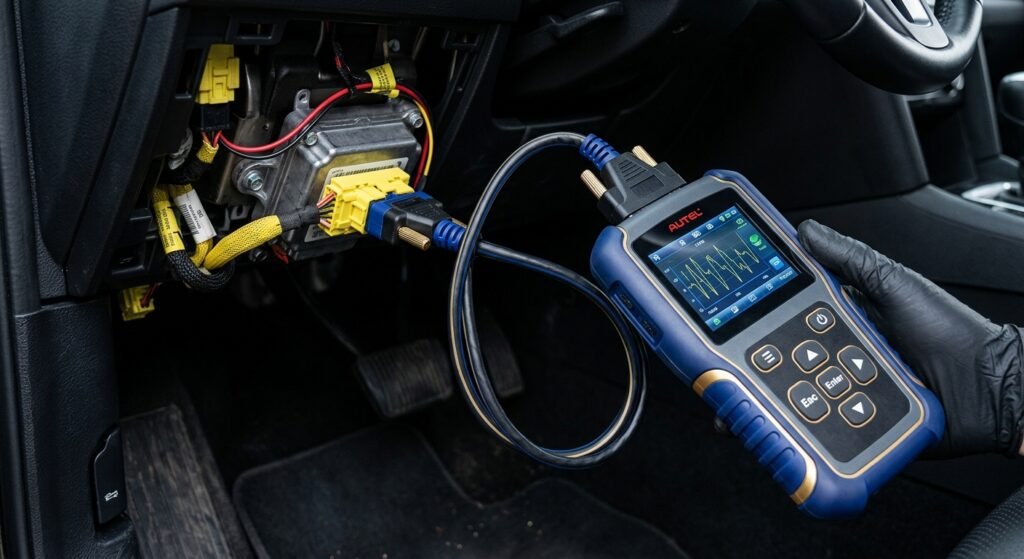
- Get a full SRS scan with a professional-grade scanner that reads crash data and event logs (not just stored DTCs).
- Check for visible evidence of deployment: torn airbag covers, replaced panels, new bolts or seats with new stitching, or replaced seatbelt buckles/pretensioners.
- Confirm VIN history and repair records — did the shop replace airbags and pretensioners? Were new modules programmed?
- If the module shows crash data but airbags and pretensioners are intact (or already replaced), consider a certified SRS module reset or reprogramming service.
- Don’t accept vague statements like “module repaired” without documentation. LockNCal does not repair modules or airbags; our services are resets, programming, and replacements where applicable.
Common salvage airbag module scenarios and the correct action
The right fix depends on what actually happened during the incident. The table below summarizes typical cases and recommended steps.
| Situation | Likely Module State | Correct Action |
|---|---|---|
| Module logged crash data, airbags not deployed | Event stored, DTCs present but no physical damage | SRS module reset/clear event; confirm sensors and wiring; reprogram if required |
| Airbags deployed, pretensioners fired | Module may also show crash data; airbags & pretensioners are expended | Replace airbags and pretensioners, then replace or reprogram module as required |
| Module physically damaged (water, impact, burned) | Module hardware compromised | Replace module and program to vehicle; do not attempt repair |
| Used module swapped from another salvage vehicle | May contain previous vehicle crash data or immobilizer pairing | Clear crash data or reprogram immobilizer; ensure vehicle-specific programming |
Why a reset or programming is often the right next step
An intact SRS module that simply contains crash event logs or DTCs usually needs a professional reset or reprogramming to clear history and restore normal SRS operation. Resetting clears the stored crash event and error codes while keeping the module functional; programming ensures module calibration and VIN/immobilizer data are correct for that vehicle. LockNCal provides nationwide mail-in SRS airbag module resets and DFW mobile services for on-site work.
What a professional SRS scan will show
A qualified scan will list:
- Stored crash event(s) with timestamps
- Airbag and pretensioner deployment status
- Sensor and wiring faults (e.g., clock spring, seat occupancy sensor)
- Module part number and whether it’s VIN-matched or an aftermarket/used unit
Tools and terms to expect during diagnosis
Technicians use manufacturer-level OBD scanners capable of reading SRS event logs, module programming tools, and wiring checks. You should hear terms like “event data,” “DTC,” “clock spring,” “occupant classification module (OCM),” and “pretensioner.” If a scan shows a deployed device, the correct fix is replacement of the pyrotechnic component plus any required module programming.
How salvage-title issues affect inspections, insurance, and resale
Many states and insurance companies require a functioning SRS system. A vehicle that retains crash data or has unresolved airbag codes can fail a safety inspection or be denied coverage until corrected. For resale, full documentation that airbags, pretensioners, and the SRS module were properly serviced and programmed increases buyer confidence and can prevent title/registration hurdles.
What to watch for if you see “module repaired” or “kit used” in records
The market contains aftermarket repair kits and board-level services marketed as “repair.” Be cautious: manufacturers treat airbags and SRS modules as safety-critical. Board-level repairs and DIY kits are not manufacturer-approved solutions for deployed airbags or fired pretensioners. If you encounter those terms, insist on documentation showing proper replacement of pyrotechnic devices and professional module reset/programming. LockNCal does not perform repairs; we reset, program, replace modules, and replace airbag or seatbelt components when needed.
How LockNCal’s services fit salvage-title situations
If the SRS module only contains stored crash event data and the airbags/pretensioners are intact or already replaced, a certified module reset can restore SRS system readiness. For physical replacements or VIN/programming needs, our module programming and vehicle safety system services apply. See our nationwide mail-in option for airbag module resets and learn more about other safety work.
Useful links:
- Nationwide mail-in SRS resets: mail-in airbag module reset
- Overview of vehicle safety services we offer: vehicle safety system services
- If a module must be reprogrammed or replaced on-site, see our module programming page
Checklist before you buy a salvage-title car
- Obtain a full SRS scan report from a qualified technician.
- Confirm airbags and pretensioners have been replaced if deployed; ask for receipts and photos.
- Ask whether the module was cleared and reprogrammed or simply replaced with a used unit.
- Check whether ADAS sensors or steering-angle calibration is required after repairs.
- If in doubt, use a trusted mail-in module reset service or a mobile technician for an on-site diagnostic.
FAQ
Can a salvage-title airbag module be reset?
Yes — if the module is intact and only contains stored crash event data, a professional SRS module reset can clear the event and restore normal operation. If airbags or pretensioners were deployed, the pyrotechnic parts must be replaced first.
Is it legal to clear crash data from an SRS module?
Clearing crash data is legal when done by a qualified service as part of returning the vehicle to a safe, roadworthy condition. However, you must disclose salvage history when required and follow state and insurance rules for repairs and inspections.
What if the module was swapped from another salvage vehicle?
Used modules can contain previous event data or immobilizer pairings. The correct process is to clear crash data and reprogram VIN/immobilizer settings as required so the module correctly matches the vehicle.
Are aftermarket “repair kits” a safe option?
No. Board-level repairs and DIY kits for airbags or SRS modules are not manufacturer-approved and can be unsafe. The proper safety-first approach is replacement of pyrotechnic devices or certified reset/programming of modules.
How do I get a reliable reset if I’m not local?
Use a nationwide mail-in SRS module reset service that offers fast turnaround and free shipping. LockNCal provides mail-in resets and will return most modules quickly after certified clearing and verification.
For help clearing crash data, confirming whether a module needs replacement, or scheduling a professional reset, start a mail-in SRS module reset at https://lockncal.com/mail-in-airbag-module-reset-service-free-shipping/ or call (469) 277-7277.


