 Skip to content

Lexus B1000 Airbag Code — Causes & Fix
Direct answer: The Lexus B1000 DTC means an ECU internal fault – an internal malfunction inside the airbag/SRS control module itself. That usually requires a proper diagnostic scan and either a module reset/reprogram or replacement and programming; many owners choose a certified SRS module reset or programming service rather than DIY board-level attempts.
Not near Dallas–Fort Worth? Mail us your airbag / SRS module.
We reset most airbag control modules by mail — free 2-way shipping and a fast turnaround. We clear the crash data, restore factory settings, and ship it right back, anywhere in the U.S.
Key Takeaways
- B1000 = ECU internal fault inside the airbag/SRS control module.
- Confirm with a professional SRS-capable scanner before any action.
- Common causes include module corruption, voltage events, poor connectors, or crash data.
- Correct fixes: SRS module reset/programming or module replacement and programming — never unsafe board-level ‘repairs’.
- LockNCal offers nationwide mail-in SRS airbag module reset and mobile services in DFW.
What B1000 Actually Means (Plain English)
The verified meaning for Lexus B1000 is: ECU internal fault – an internal malfunction inside the airbag/SRS control module itself. In plain terms, the microcontroller or internal circuitry inside the SRS module is reporting a fault condition it cannot reconcile. The module is the brains that decides whether to deploy airbags and pretensioners; when it reports an internal fault, the restraint system’s readiness is uncertain and the airbag warning light will likely be on.
How B1000 Shows Up — Typical Symptoms
- Airbag warning light (SRS) illuminated continuously on the dash.
- Possible combination with other codes (comm errors, occupant classification faults).
- Sometimes cruise/traction or other systems linked to the airbag module may flag related communication errors.
- In rare cases, modules can log crash data or be in a secured/locked state after an event.
Common Causes
- Internal module corruption or failed internal components (memory, CPU, clock).
- Voltage spikes, a recent dead battery or jump-start that damaged internal electronics.
- Water intrusion or physical impact to the module housing.
- Damaged connectors, broken ground or short circuits causing communication errors.
- Previous crash event leaving crash data stored or the module in a recovered/fault state.
How to Read B1000 Correctly
Always confirm the exact definition for the vehicle’s year and model with a full SRS scan from a reliable scan tool or the dealer database. Different manufacturers sometimes use similar code numbers for different subsystems, so if you also see codes like b0010 13 chrysler or chrysler dtc b0010 2b on other vehicles, treat them as separate issues and look them up per make/model.
Step-by-Step Technician Diagnosis (what a pro will do)
Use these steps to understand the correct diagnostic order. The sequence checks safety first and narrows the cause efficiently.
- Visual safety check: confirm no deployed airbags, no exposed pyrotechnics, and disconnect battery per manufacturer procedure with 10–15 minutes rest to remove stored power if required. Use proper PPE.
- Full SRS scan: connect a professional SRS-capable scan tool (OEM or high-end aftermarket) and read all SRS codes, freeze frame, and crash data. Record codes and timestamps.
- Verify vehicle battery and charging system: measure battery resting voltage and system voltage under load with a multimeter; unstable voltage can cause module faults.
- Inspect wiring and connectors: remove the SRS control module cover if needed and check the module connector pins, ground points, and seat/occupant module connectors for corrosion or damage.
- Check related modules: if the scan shows communication errors, check CAN/LIN bus health and any modules that share communications with the SRS ECU.
- Review crash data: if crash data is present, determine whether the module recorded an event that requires replacement or reset depending on OEM guidance.
- Attempt a controlled reset or reflash: if the module is not physically damaged and the scan tool supports it, a module reset/reprogramming can clear internal faults—but only with the correct vehicle-specific procedure and a professional tool.
- If reprogramming fails or module hardware is confirmed bad, plan for module replacement plus OEM programming and configuration of crash data if needed.
Tools and equipment a technician uses
- SRS-capable scan tool (OEM dealer tool or a professional aftermarket scanner that supports airbag modules).
- Digital multimeter and battery tester.
- Manufacturer wiring diagrams and pinout references.
- Service information for correct battery disconnect and module location procedures.
- Dedicated module programming hardware or dealer-level access for programming if replacement is required.
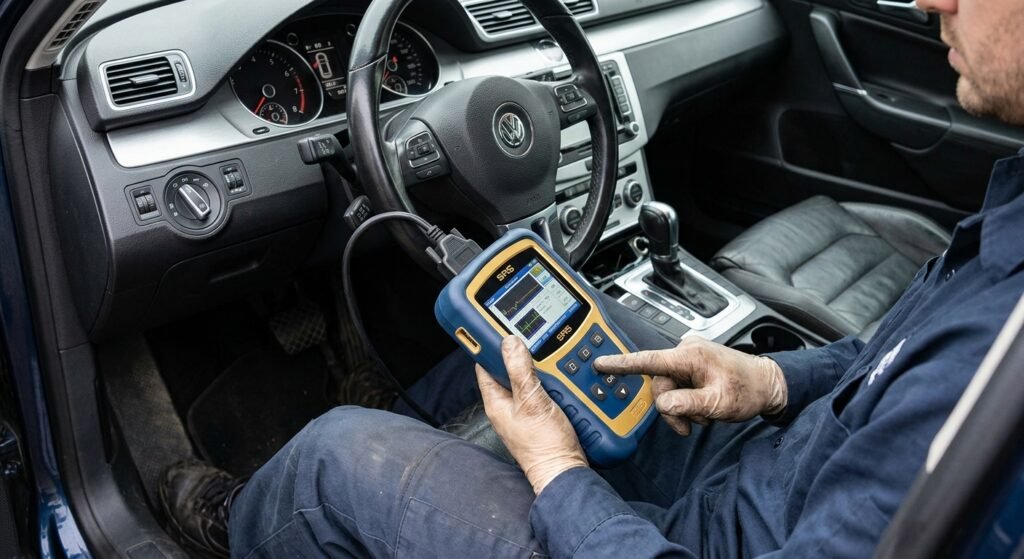
Table: Quick Triage for B1000
| Observed | Likely cause | Immediate action |
|---|---|---|
| Only B1000 present, no crash data | Internal module fault, possible corruption | Run full SRS scan, check battery, connectors; attempt professional module reset or reflash |
| B1000 + crash data stored | Module recorded an impact event | Follow OEM guidance: often replacement and programming or secure reset if permitted |
| B1000 after battery event or jump-start | Voltage spike damaged module internals | Verify charging system, test/replace module as needed; avoid DIY board fixes |
| B1000 with connector or corrosion found | Poor contact or intermittent signals | Repair harness/clean connectors and retest; if codes persist, reset/program module |
Correct Fixes — What Actually Works
Because B1000 indicates an internal ECU fault, the fixes are either a correct, manufacturer-aware module reset/reprogram or module replacement and programming. Board-level component swaps or “repair kits” are not manufacturer-approved for SRS ECUs and are unsafe. If crash data is present, OEM rules may require replacement. LockNCal provides certified SRS airbag module reset and module programming services — nationwide via mail-in and mobile in DFW.
When a reset is possible
If the module’s internal logs and self-tests show recoverable corruption (no irreversible hardware failure and no prohibitive crash data), a professional module reset or reflash can restore normal operation. These operations require a capable SRS tool and an experienced technician who follows OEM procedures.
When replacement is required
If the scan shows hardware failure, memory corruption that the tool cannot clear, or OEM policy dictates replacement after a crash event, the module must be replaced and programmed to the vehicle. That programming and configuration step ensures airbags, pretensioners, and occupant classification function correctly.
Is it Safe to Drive?
An illuminated SRS light means the restraint system might not function as intended in a crash. If the light is on, the car is legally drivable in many places, but it is not fully safe. Avoid long trips and see a qualified technician promptly. If the vehicle has visible deployment damage or other safety system warnings, do not drive it—have it towed to a shop.
How LockNCal Can Help
If you have a Lexus showing B1000, LockNCal can verify the code with a professional scan and, when appropriate, perform a secure SRS airbag module reset by mail or provide mobile service in DFW. For nationwide customers, our mail-in airbag module reset is a streamlined option; for on-site needs in the Dallas–Fort Worth area, see our mobile airbag module reset page.
Related notes for other codes
Codes that look similar, such as B0010 series entries you might find on a Chrysler (searches like b0010 13 chrysler or chrysler dtc b0010 2b), are manufacturer-specific. Always pull a full SRS report and confirm each code against the exact vehicle’s service information rather than assuming the meaning across makes.
FAQ
Q: What exactly does Lexus B1000 mean?
A: Verified meaning: ECU internal fault – an internal malfunction inside the airbag/SRS control module itself. It indicates an internal issue with the SRS ECU that needs professional diagnosis.
Q: Can I clear B1000 with a cheap OBD-II reader?
A: No. Generic OBD-II readers typically lack SRS-specific protocols and cannot safely reset or reprogram airbag modules. Use a professional SRS-capable scanner or an experienced service.
Q: Will a module reset always fix B1000?
A: Not always. If the module has an internal hardware failure or OEM rules require replacement after crash data, a reset won’t work. A full diagnostic will determine whether reset, programming, or replacement is required.
Q: Is it safe to drive with the airbag light on?
A: The car may be legal to drive, but the safety restraint system could fail in a crash. Minimize driving and get a qualified SRS diagnosis promptly.
Q: What if my scan also shows B0010 or Chrysler-specific codes?
A: Those are make-specific. Confirm each code’s precise definition with the vehicle’s service information. Treat each code individually and follow the correct SRS diagnostic steps.
If you want help diagnosing or resolving a Lexus B1000 code, schedule our mail-in airbag module reset service or speak with our techs at (469) 277-7277 for guidance and to arrange service.


