 Skip to content

BMW U0100 — Lost Communication With ECM/PCM (Causes & Fix)
Direct answer: BMW U0100 means “Lost Communication With ECM/PCM – the network cannot reach the engine control module.” Fixing it starts with a clear scan and network diagnosis (power, ground, fuses, and data bus health) and usually requires module programming or module-level diagnostics to restore proper CAN communication.
Key Takeaways
- The U0100 code reports lost communication with the ECM/PCM — the car’s brain is not reachable on the network.
- Common causes: blown fuse, bad power/ground, damaged connector, CAN bus fault, or a failing ECM/PCM.
- Start with a full scan, check fuses and power/grounds, inspect connectors and wiring, then verify CAN bus integrity.
- Correct fixes include restoring power/grounds, repairing wiring, or module programming/replacement by a qualified technician.
What U0100 Means in Plain English
U0100 is a network communication diagnostic trouble code. It simply says: the vehicle’s control network (usually CAN) cannot communicate with the Engine Control Module (ECM or PCM). The ECM may be off the network because it lost power, has a bad ground, a physical connector problem, or because the network itself (wiring, terminators, or another module) is failing.
Common Causes
- Blown or corroded fuse supplying the ECM/PCM
- Loose, corroded, or damaged power or ground connections at the ECM
- Damaged CAN bus wiring, chafed harness, or poor splices/repairs
- Faulty CAN transceiver inside the ECM/PCM
- A different module on the network pulling the bus down (short to ground, failed transceiver)
- Aftermarket electronics, poor-quality jump starts, or a recent shop repair that disturbed wiring
Symptoms You Might Notice
- Reduced performance or limp-home mode
- Engine won’t start, or stalls but cranks
- Multiple network modules throwing faults simultaneously
- Intermittent starts or random faults that clear and come back
- Dashboard warning lights (check engine light, network-related warnings)
Quick Diagnostic Checklist
Use this checklist to prioritize the most likely, high-impact items first.
| Step | What to check | Why it matters |
|---|---|---|
| 1 | Full OBD-II scan (manufacturer-level scanner) | Confirms all codes and which modules are offline |
| 2 | Check ECM fuses and relays | An easy, common cause of total loss of communication |
| 3 | Verify +12V power and engine ground at ECM connector | ECM with no power/ground can’t talk |
| 4 | Inspect ECM connector & harness for corrosion or damage | Physical damage is common near engine heat or steering column |
| 5 | Measure CAN bus voltages and resistance | Detects shorts, opens, or missing terminator resistance |
| 6 | Disconnect suspect modules one at a time (if safe) | Find module that drags the bus down |
How a Technician Diagnoses U0100 (Step-by-step)
Technicians follow a logical order: confirm, isolate, and then fix. Below is a typical, practical order of operations that an experienced shop will use.
1. Confirm the code and capture freeze frame
Start with a full OEM-capable scan tool. Note any related U-codes or B-codes and which modules show “no response.” Freeze-frame data and recent events help prioritize checks (for example, a crash event, low voltage, or jump start).
2. Check fuses, relays, and obvious power/ground
Inspect the ECM/PCM power feed fuse(s) and relay. Small, corroded fuse-box terminals or a missing relay can make the module disappear from the network instantly.
3. Verify power and ground at the ECM
With the key on, measure battery voltage at the ECM power pin(s) and verify a solid ground to chassis. Intermittent grounds are common where harnesses rub or connectors are water-damaged.
4. Inspect connectors and wiring harness
Look for bent pins, corrosion, water intrusion, or previous splices. Pay attention to areas that flex or run near heat sources: firewall, engine mounts, or steering column. Factory connectors that have been unplugged and re-installed poorly are a frequent cause.
5. Test the CAN bus
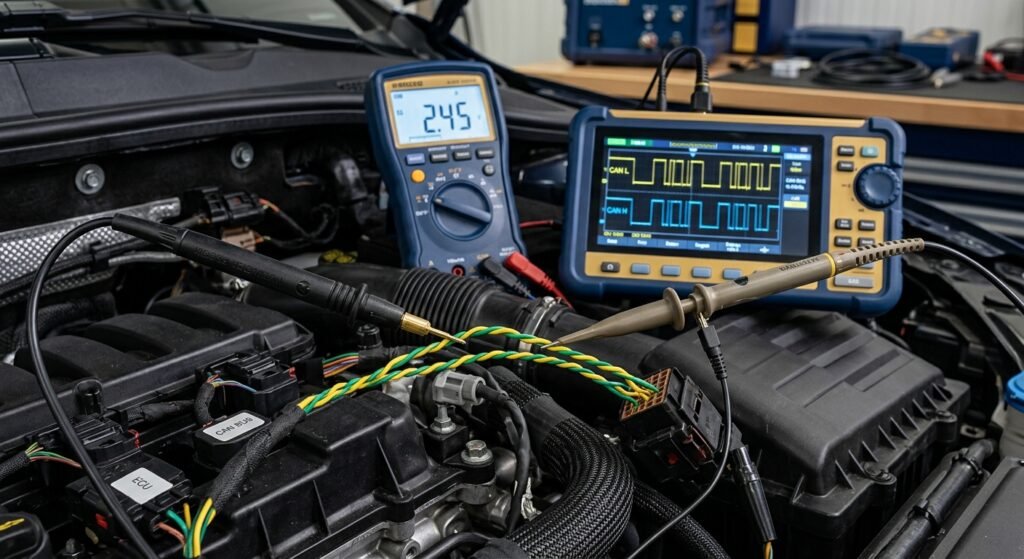
Using a multimeter and/or oscilloscope, check CAN High/Low differential voltages and bus idle voltages (typical ranges depend on the vehicle; consult factory data). Measure terminator resistance across CAN high and low — an open or shorted terminator will stop communication for the whole network.
6. Isolate modules
If the bus shows a fault but individual module wiring checks are clean, isolate by disconnecting suspect modules (when safe to do so) and retest bus integrity. This can reveal a failed module pulling the bus down.
7. Reprogram or replace the module when required
If the ECM itself has failed, it will usually require replacement or factory reconditioning and then programming to the vehicle. Sometimes a module simply needs a correct software flash or reinitialization to rejoin the network. This is where professional module programming and diagnostics matter.
When Is It Safe to Drive?
U0100 affects the engine control module, so safety depends on symptoms. If the engine runs normally and you only see a stored U0100 with no drivability issues, short trips may be possible. But because the ECM controls emissions, safety features and drivability, many vehicles will enter limp mode or stall — in those cases, do not drive long distances. If you notice stalling, loss of power, or unexpected behavior, stop driving and get it diagnosed.
What NOT to Do
- Don’t guess wiring pinouts or splice into the CAN bus without factory data — bad fixes can make the network worse.
- Don’t buy a used ECM and install it without proper programming; immobilizer or VIN mismatch will cause more network errors.
- Don’t let anyone claim a simple “module reset” will always fix a physical wiring or power problem — only correct diagnosis will.
When You Need Professional Help
If you don’t have factory-level scan tools, an oscilloscope, or wiring diagrams, a qualified shop should handle this diagnosis. Module-level issues often require reprogramming or bench verification with OEM tools.
Quick Troubleshooting Table
| Symptom | Likely Cause | Priority Action |
|---|---|---|
| No response from ECM on scan | Blown fuse, bad power/ground | Check fuses and measure battery at ECM connector |
| Multiple modules showing no communication | CAN bus short or open | Measure bus resistance, inspect harness |
| Intermittent comms, car stalls | Intermittent ground or connector fault | Wiggle test harness, inspect connector seals |
| New fault after module swap | Immobilizer/VIN mismatch or missing programming | Perform proper module programming |
For more context on related vehicle safety systems (airbags, seat belts, and SRS modules) see our vehicle safety system services overview.
Where appropriate, a mail-in service exists for some module work, but most ECM/PCM programming and network diagnostics are performed on the vehicle or with the module bench-tested and then programmed with OEM tools.
FAQ
Q: What exactly does “Lost Communication With ECM/PCM” mean?
A: It means the vehicle’s network cannot reach the engine control module. The module isn’t responding on the communication bus because of power loss, wiring fault, a failed transceiver, or similar causes.
Q: Will clearing the code fix U0100?
A: Clearing the code only erases its memory. If the underlying cause (power, ground, wiring, or failed module) isn’t fixed, the code will return. Proper diagnosis is required.
Q: Can I jump-start or reset the battery to clear the code?
A: Battery resets or jump-starts can temporarily clear codes but may mask the real fault. If an ECM lost power due to a weak battery, replace or properly charge the battery and then run a diagnostic sequence.
Q: Do you need to replace the ECM to fix U0100?
A: Not always. Many U0100 issues are wiring, fuse, or connector related. The ECM is replaced only if bench tests show internal failure; replacement requires correct programming to the vehicle.
Q: Can LockNCal help with this code?
A: LockNCal’s on-site services (keys, module programming, diagnostics, seat belts and ADAS) are for American and Asian vehicles, model year 2008 and newer. For BMW owners, the service we offer is our nationwide mail-in airbag module reset for 2008 and newer vehicles.


