 Skip to content

P0513 Code — Proven Fix for Incorrect Immobilizer Key (Safe)
Direct answer: The p0513 code means “Incorrect Immobilizer Key – the key presented was not recognised by the immobilizer system.” In most cases the fix is key recognition or reprogramming (or replacing the key/transponder) rather than engine or transmission work. A trained locksmith or dealer can reprogram immobilizer keys and restore normal starting.
Not near Dallas–Fort Worth? Mail us your airbag / SRS module.
We reset most airbag control modules by mail, with free 2-way shipping and a fast turnaround. We clear the crash data, restore factory settings, and ship it right back, anywhere in the U.S. Book online and you’ll see your firm price in about 60 seconds.
Key Takeaways
- P0513 code indicates the immobilizer didn’t recognize the presented key.
- Common causes include an unprogrammed key, a faulty transponder, or antenna/module communication faults.
- Diagnosis follows a clear order: confirm code, try a known-good key, scan related modules, inspect antenna & wiring, then reprogram or replace the key/module as needed.
- Locksmiths can handle most key reprogramming and immobilizer provisioning in the field (DFW) with proof of ownership.
P0513 code — What it means
Exactly: “Incorrect Immobilizer Key – the key presented was not recognised by the immobilizer system.” That is the verified meaning for the p0513 code. It tells you the immobilizer (anti-theft) system did not accept the key or transponder ID it saw when the driver tried to start the vehicle.
Plain-English explanation
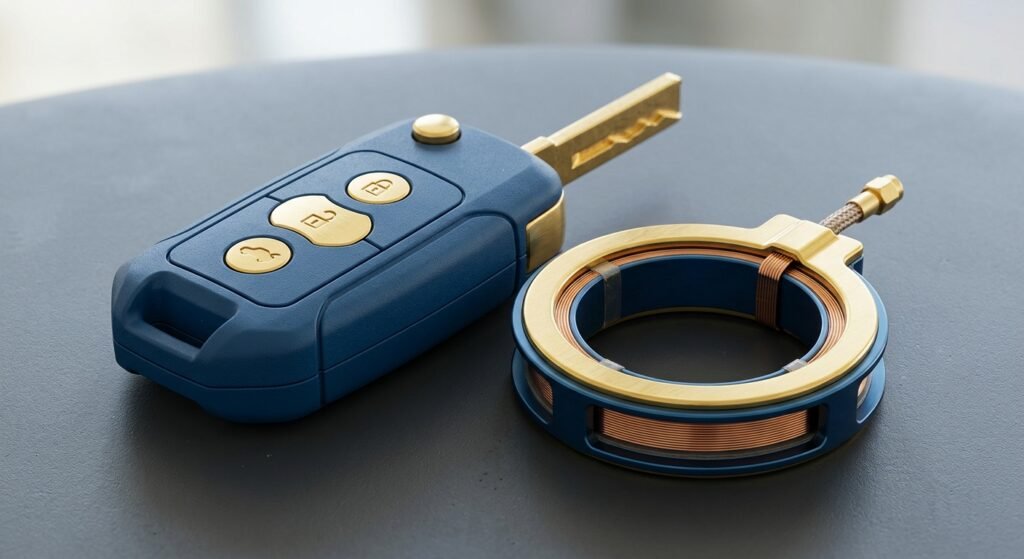
Modern keys contain a small transponder that sends a unique ID to the vehicle’s immobilizer receiver (often an antenna ring around the ignition or push-button module). If the immobilizer doesn’t find a matching ID in its database, it blocks starting and stores the p0513 code. This can happen with a new unprogrammed key, a physically damaged or dead transponder, a failure in the antenna or immobilizer module, or communication faults elsewhere on the vehicle network.
Common causes of P0513 code
- Unprogrammed or newly cut key that hasn’t been added to the vehicle’s immobilizer database.
- Damaged or failed transponder inside the key (drop damage, water intrusion).
- Weak or dead key battery for smart keys (push-button systems) preventing tag transmission.
- Faulty immobilizer antenna ring (no signal from the key).
- Immobilizer module, body control module (BCM), or related module communication faults on the CAN bus.
- Blown fuse or poor ground affecting immobilizer or receiver power.
- Aftermarket keys or poorly made replacements that aren’t compatible.
Symptoms you’ll notice
- Engine won’t crank or start even though the starter spins (or starter disabled).
- Security/immobilizer warning light or key-shaped dash lamp illuminated or flashing.
- Push-button start not recognizing the key fob when it should.
- Intermittent starting — works sometimes with one key but not another.
- No remote functions (lock/unlock) or inconsistent fob behavior on some models.
Quick diagnostic order — how technicians think about P0513
- Confirm the code definition and record any related codes with a proper OEM-capable scan tool.
- Try a known-good, programmed key or spare. If a second key starts the car reliably, the problem is the first key/transponder.
- Check key fob battery for push-button systems — replace the battery and retest before assuming transponder failure.
- Scan for communication or module codes (BCM, immobilizer, body control). Note that p0513 points to identification mismatch, but related codes can reveal wiring or module faults.
- Inspect the immobilizer antenna ring, its connector, fuses and ground points for obvious damage or corrosion.
- Use a transponder/key tester (or dealer-level tool) to verify the transponder ID and antenna reception where available.
- If the key and antenna look good, focus on immobilizer module programming or BCM communication and plan for reprogramming or module replacement if needed.
Detailed diagnostic steps (tools & order)
Do these steps in roughly this order. Technicians use a scan tool, a key-transponder tester (or OEM tool), a multimeter for basic power checks, and access to programming tools when re-provisioning keys.
- Full system scan: read freeze-frame and all stored codes from engine, BCM, immobilizer and related modules.
- Verify key identity: try every known key for the vehicle. If a spare works, clone/inspect the non-working key.
- Inspect vehicle-side: check fuses powering the immobilizer receiver and the antenna ring connector for continuity/looseness.
- Test key signal: use a transponder tester or an OEM diagnostic to confirm the key’s transponder is transmitting and being received.
- Check module comms: verify CAN-bus messages to/from the immobilizer or BCM. Look for lost communication codes that might mask an otherwise good key error.
- Key reprogramming attempt: when hardware checks out, reprogram the key or resync keys to the immobilizer with OEM or locksmith tools.
- Module service: if reprogramming fails and wiring is OK, suspect a failed immobilizer module or BCM that needs replacement and programming.
Table: Quick troubleshooting checklist
| Likely Cause | Driver Symptom | First Technician Test |
|---|---|---|
| Unprogrammed/new key | Car won’t start with new key, starts with original | Try known-good key; program new key |
| Dead/weak fob battery | Push-button fob not detected intermittently (see key not detected fixes) | Replace key battery; retest |
| Damaged transponder | Key works sometimes or not at all | Transponder test or replace key |
| Faulty antenna ring/module | No keys read; immobilizer light on | Inspect antenna, wiring, fuses; test reception |
The correct fix
The actual fix depends on the root cause. For most p0513 events the correct workshop action is one of these:
- Program or provision the problem key so the immobilizer stores its transponder ID (common for newly cut or replacement keys).
- Replace a faulty key or transponder (if the key’s internal chip is damaged) and program the new key to the vehicle.
- Repair or replace a failed immobilizer antenna or replace the immobilizer/BCM module and then program it to the vehicle. Note: LockNCal does not perform mechanical or wiring repairs — see a trusted mechanic or dealer for module swaps if needed.
When the needed action is key recognition or immobilizer programming, a qualified automotive locksmith is the usual and cost-effective route. Locksmiths can program keys and provision immobilizer systems on many American and Asian vehicles right on site in the DFW area. Proof of ownership is required for security and legal reasons.
Is it safe to drive with P0513?
If the immobilizer is preventing starting, you won’t be able to drive the vehicle until the issue is resolved. If the vehicle starts intermittently, driving can be risky—being stranded is the bigger safety concern. Get a diagnosis promptly. If you suspect the immobilizer or security lamp is active, avoid long trips until you have a confirmed working key or a reprogramming solution.
When to get professional help
- If a known-good key won’t start the vehicle, get a professional scan—there may be module or wiring faults.
- If you lost all keys or have newly cut keys, use a locksmith or dealer to provision new keys and disable lost keys from the system.
- If you see related module communication codes, a trained technician should inspect CAN-bus, grounds and immobilizer module behavior.
For DFW area drivers who need on-site key programming or immobilizer provisioning, an automotive locksmith can come to you and restore key recognition for American and Asian vehicles 2008 and newer. If your vehicle is European, locksmiths may still help with certain models but some module work is dealer-only; confirm before booking. For a full module-level diagnostic related to security systems, consider a vehicle diagnostic scan as a follow-up.
Always check your VIN for open recalls and safety notices before ordering parts or making permanent changes—this can affect immobilizer/module replacement eligibility and programming requirements: check the VIN for open recalls.
Related LockNCal services
- Automotive locksmith key & immobilizer programming: https://lockncal.com/automotive-locksmith-services-across-dfw/
- Vehicle diagnostic for airbag/SRS and ADAS faults: https://lockncal.com/vehicle-diagnostic/
- Schedule an appointment or get a precise quote: https://lockncal.com/schedule-your-service-appointment/
FAQ
Can I still drive if my car shows the P0513 code?
If the immobilizer is actively preventing the engine from starting, you cannot drive the car. If it starts intermittently, driving risks being stranded—get a professional diagnosis promptly.
Can a locksmith fix the P0513 code?
Yes. When the fault is an unprogrammed key or transponder issue, qualified automotive locksmiths can program keys and re-provision immobilizer entries for many American and Asian vehicles in the DFW area. Proof of ownership is required.
Do I need the dealer to reprogram keys?
Not always. Locksmiths can handle most key programming tasks, but some late-model or luxury European vehicles may require dealer-level tools or module replacements that only a dealer can perform.
What if I lost all my keys?
Losing all keys usually requires proof of ownership and a locksmith or dealer to cut and program new keys and disable lost ones. This is a common locksmith service in DFW for American and Asian 2008+ vehicles.
Will replacing the key battery fix it?
If the issue is a weak key fob battery (push-button start systems), replacing it is a quick first step. If the code persists, further transponder or module diagnosis is needed.
If you’re dealing with the p0513 code and need key programming or immobilizer help in DFW, schedule an automotive locksmith appointment online or call (469) 277-7277 to discuss next steps and proof-of-ownership requirements: https://lockncal.com/automotive-locksmith-services-across-dfw/.


