 Skip to content

Chevrolet U0100 Code — Expert Safe Fixes
Direct answer: The Chevrolet U0100 code means the vehicle’s network can’t reach the engine/powertrain control module. The correct fix depends on the root cause — bad power/ground/fuses, wiring or connector faults, or a failed/unprogrammed ECM/PCM — and is found by a structured diagnostic scan and then module programming or replacement if the module itself is the problem.
Key Takeaways
- The Chevrolet U0100 code = Lost Communication With ECM/PCM “A” — the network cannot reach the engine/powertrain control module.
- Common causes include battery/charging problems, blown fuses, bad grounds, damaged connectors, or a failed/unprogrammed module.
- Start with a full scan and live data, then check power/grounds, fuses, and CAN wiring before assuming module failure.
- If the module is at fault, professional module programming and a calibrated scan tool are required to restore communication.
What the Chevrolet U0100 code means
Officially: Lost Communication With ECM/PCM “A” – the network cannot reach the engine/powertrain control module. In practical terms, your vehicle’s data bus (CAN) is not talking to the ECM/PCM, so other modules can’t read engine status or send commands. That prevents normal drivability and can trigger limp modes or multiple warning lights.
Why this code shows up — common causes
The U0100 flag is a communication-level error, not a direct symptom of a single failed sensor. Typical root causes include:
- Low battery voltage or poor charging that causes intermittent module behavior.
- Blown ignition or power fuses that feed the ECM/PCM.
- Bad battery/engine/chassis grounds or corroded ground straps.
- Damaged or shorted CAN bus wires, chafed harnesses, or water intrusion at connectors.
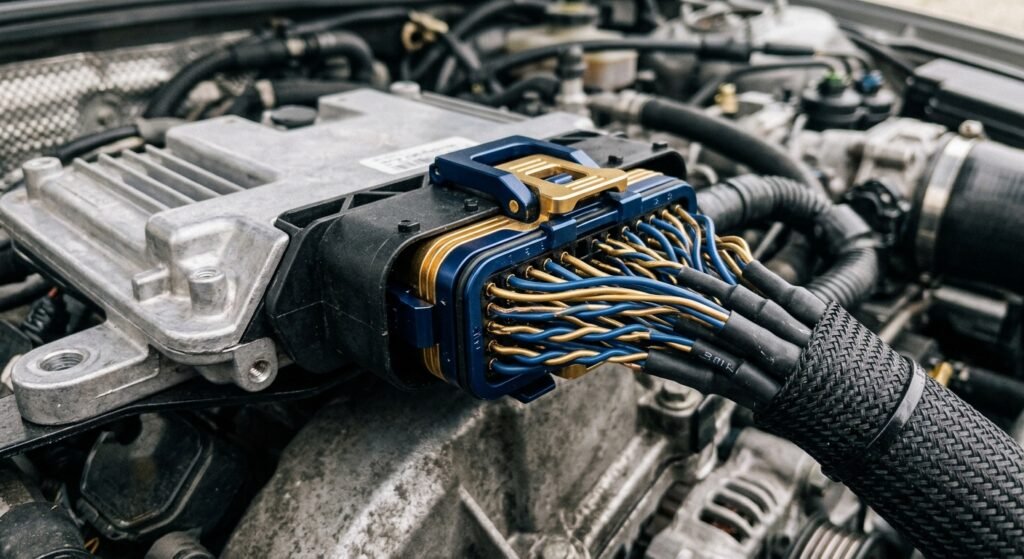
- A failed ECM/PCM (internal electronics) or a module that has been replaced but not programmed/configured to the vehicle network.
Symptoms you’ll notice
- Illuminated check engine light and/or multiple dash warnings.
- Engine stalls, runs poorly, won’t start, or a persistent limp mode.
- Other modules showing spurious faults or inability to communicate with the powertrain module.
- No live data from the ECM/PCM on a scan tool for engine parameters.
Quick reference: likely causes and first checks
| Symptom | Common cause | First technician check |
|---|---|---|
| No ECM live data | Power feed or fuse open | Inspect fuses, ignition power circuits, and battery state |
| Intermittent comms, random faults | Poor ground or low battery voltage | Verify grounds and charging system, look for parasitic drains |
| Permanent loss of communication | Damaged CAN wiring or failed module | Inspect harness, connectors, and for water/corrosion at ECU connector |
Step-by-step technician diagnosis (correct order)
Follow a logical, module-first scan flow. Don’t skip steps — many U0100 cases waste time chasing the wrong component.
- Full OEM-level scan and freeze-frame: capture U0100 plus any related codes and live data availability.
- Confirm battery state and charging behavior. A weak or dying battery often causes intermittent comm codes; clear the code only after confirming stable power.
- Check fuses and ignition-switched power circuits that feed the ECM/PCM and related gateway modules.
- Verify engine and chassis grounds at the battery, engine block, and ECU ground points for corrosion or looseness.
- Inspect the ECM/PCM connector and nearby wiring for water, corrosion, pin damage or melted insulation; wiggle-test with live scan to reproduce intermittent faults.
- Check CAN bus integrity: look for shorts to power or ground, damaged shield wires, or failed terminators. Use a professional scope or OEM diagnostic tool — simple multimeter checks can miss intermittent layer faults.
- If wiring and power are good and the ECM/PCM is not responding, confirm whether the module has been previously replaced or if reprogramming was interrupted. An unprogrammed or corrupt module will not join the vehicle network reliably.
- When the ECM/PCM is suspected, the correct fix is OEM module programming or replacement plus programming. For American vehicles like Chevrolet, module programming is an authorized service route.
When the problem is the module itself
If all wiring, fuses and power/ground checks pass, and the scan tool still shows no communication with the ECM/PCM, the module may be failed or missing proper calibration/programming. Replacing an ECM/PCM requires the correct VIN- and vehicle-specific programming to restore network IDs, immobilizer sync and adaptive parameters.
For on-site programming and diagnostic help in the DFW area, LockNCal offers professional module programming and comprehensive vehicle diagnostic services for American and Asian vehicles 2008 and newer. If a vehicle needs additional scheduling or an exact quote, use our booking page to get a price and time estimate.
Safe-to-drive guidance
U0100 may range from an annoying communication glitch to a safety issue depending on what the ECM/PCM controls at the moment. If the car runs normally and there are no other warning lights or limp-mode symptoms, short drives to a trusted shop for diagnosis are often possible. However, if the engine stalls, won’t start, or the vehicle enters limp mode, stop driving and arrange professional diagnostics to avoid being stranded or causing additional faults.
When to call a professional
- Multiple modules report lost communication or live data is missing from the ECM/PCM.
- Visual inspection shows damaged harnesses, water intrusion, or corroded connectors at the ECM/PCM.
- Engine stalling, non-start, or persistent limp mode accompanies the U0100 code.
For Chevrolet vehicles in DFW, module-level faults often require in-vehicle programming tools and a technician who can safely configure OEM modules; that’s a LockNCal service we provide via module programming for American and Asian makes 2008+ (we do not perform on-site work for European makes).
As you diagnose, it’s also a good idea to check whether your vehicle has any open safety recalls tied to the VIN. You can check the VIN for open recalls at the NHTSA recall site: check your VIN for open recalls.
Common misdiagnoses to avoid
- Assuming the ECM is dead before checking power, grounds, and fuses. Many ECMs are fine but aren’t getting reliable power.
- Replacing wiring without a proper scan or logic trace — intermittent CAN shorts are often localized and repeatable when stress-tested with a wiggle test.
- Using an entry-level scan tool that can’t read module programming status or perform OEM-level relearns; that leads to repeated part swaps.
What LockNCal does for U0100
We follow the service route for module-related codes: comprehensive diagnostics, module programming, and network reconfiguration for American and Asian vehicles 2008+. If the issue points to a failed or unprogrammed ECM/PCM, our module programming service restores the module to the vehicle network. For broader safety-system scans, our vehicle diagnostic service can identify linked faults and help prioritize repairs.
FAQ
Q: What exactly does the Chevrolet U0100 code mean?
A: The verified meaning is: Lost Communication With ECM/PCM “A” – the network cannot reach the engine/powertrain control module. It indicates a communication failure between the vehicle network and the ECM/PCM.
Q: Is it safe to drive with U0100?
A: It depends. If the vehicle runs normally with no limp mode or stalling, short drives to a diagnostic shop are usually possible. If the engine stalls, won’t start, or there are multiple warnings, don’t drive — get professional diagnostics.
Q: Can I fix U0100 myself?
A: You can perform initial checks: verify battery charge, inspect fuses and grounds, and visually inspect harnesses. Diagnosing wiring or module programming problems requires OEM-level tools and experience — that’s when you should call a professional.
Q: Does LockNCal replace or program ECM/PCM modules?
A: LockNCal provides module programming and comprehensive diagnostics for American and Asian vehicles 2008+ in the DFW area. We do not perform board-level module repair; when a module must be replaced, it must be programmed/configured to the vehicle.
Q: How do I get a quote or schedule a diagnostic?
A: Quotes are vehicle-specific. Use our scheduling form to get an exact quote in about 60 seconds: https://lockncal.com/schedule-your-service-appointment/.
If you need a professional module scan or programming for a Chevrolet U0100 code in the DFW area, schedule our module programming service at https://lockncal.com/module-programming/ or call (469) 277-7277 to discuss your vehicle and book an appointment.


