 Skip to content

Direct answer: P0300 on a Nissan is a generic code that means “Random/Multiple Cylinder Misfire Detected.” It flags that the engine control module (ECM) has noticed misfires on multiple cylinders. The correct response is a structured diagnosis—scan for related codes, inspect ignition and fuel systems, test compression and sensors—then fix the underlying mechanical or electrical fault.
Key Takeaways
- P0300 Nissan means Random/Multiple Cylinder Misfire Detected — it’s a symptom, not a specific failed part.
- Common causes: bad spark plugs, ignition coils, fuel delivery problems, vacuum leaks, sensors, or low compression.
- Diagnose in order: read codes and freeze frame, check ignition, fuel, compression, sensors, and wiring.
- Intermittent misfires can often be driven short distances but sustained misfires risk catalytic converter damage and loss of power.
What “P0300 Random/Multiple Cylinder Misfire Detected” means for Nissan owners
The P0300 code is a generic OBD-II powertrain code that any manufacturer (including Nissan) uses when the ECM detects misfires across multiple cylinders or random misfires that don’t point to a single cylinder. It’s a warning that combustion is not occurring correctly on more than one cylinder and that further diagnosis is required to find the root cause.
Common causes of a Nissan P0300
- Worn or fouled spark plugs or poor spark due to failing ignition coils (coil-on-plug or coil packs).
- Fuel delivery issues: clogged fuel filter, weak fuel pump, or faulty fuel injectors.
- Vacuum leaks or intake system leaks causing lean conditions.
- Faulty crankshaft or camshaft position sensors sending bad timing data to the ECM.
- Low compression (worn rings, burned valves, head gasket leaks).
- Mass airflow (MAF), manifold absolute pressure (MAP), or EGR faults that upset fuel trim.
- Wiring or connector problems to coils, injectors, or sensors; corrosion or chafed wires.
Symptoms you’ll notice with Nissan code P0300
- Rough idle or shaking while stopped.
- Hesitation, stumbling or lack of power during acceleration.
- Illuminated Check Engine Light (CEL) — usually steady but can flash on severe misfire.
- Poor fuel economy and increased exhaust smell or visible smoke.
- Possible engine surging, stalling, or limp mode if the ECM detects severe problems.
Tools and data you need before you start diagnosing
Gather the right tools to avoid wasted effort:
- Full-function OBD-II scan tool that shows pending and stored codes and misfire counters.
- Multimeter for resistance and voltage checks.
- Fuel pressure gauge for fuel system checks.
- Compression tester (and/or leakage tester) to evaluate mechanical health.
- Ignition scope or secondary spark tester if available; a simpler method is swapping coils between cylinders.
Step-by-step technician diagnosis for Nissan P0300
- Read codes and freeze-frame data. Note whether other codes are present (P0301–P0308, fuel trims, sensors).
- Clear codes and perform a short road test to reproduce the CEL and capture fresh data and misfire counters.
- Inspect ignition: remove spark plugs and check gap/condition; test or swap ignition coils between cylinders to see if the misfire follows the coil.
- Check fuel: measure fuel rail pressure, inspect injectors (listen with a stethoscope or use a noid light), and check for clogged filters or weak pump symptoms.
- Check for vacuum/intake leaks: visually inspect hoses and intake boots, perform a smoke test if available, and monitor short-term fuel trim for lean indications.
- Test compression on each cylinder to rule out mechanical causes (low compression points to rings, valves, or head gasket issues).
- Inspect crankshaft and camshaft position sensors and their connectors; intermittent timing signals will cause random misfires.
- Check MAF/MAP sensors and EGR operation; contaminated MAF sensors or stuck EGR valves can cause misfires under load.
- Inspect wiring and ECU grounds. Corroded connectors or intermittent wiring faults are common causes of random misfires.
- If everything else checks out, consider ECU software updates or module-related faults and consult service bulletins. A reflash or module programming may be needed in rare cases.
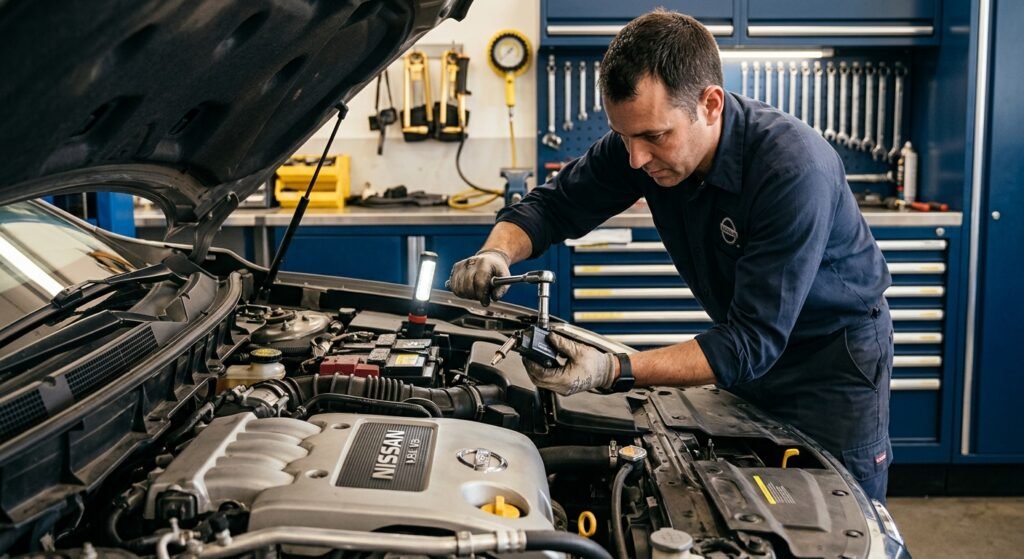
Quick-reference troubleshooting table
| Likely Cause | Driver Symptoms | Fast Diagnostic Check |
|---|---|---|
| Failing ignition coil | Rough idle, misfire codes on multiple cylinders | Swap coil to another cylinder; if misfire follows coil, replace coil |
| Worn spark plugs | Poor throttle response, increased fuel use | Inspect plugs for wear/fouling and replace per interval |
| Fuel delivery problem | Loss of power under load, sputtering | Fuel pressure test and injector pulse check |
| Vacuum leak / MAF issue | High idle, lean short-term trims | Smoke test and MAF cleaning / replacement |
| Low compression | Persistent misfire, oil consumption | Cylinder compression test |
Nissan-specific notes (Altima, Pathfinder, and others)
The P0300 code behaves the same across manufacturers: it indicates randomized misfires. Nissan Altima and Pathfinder owners often report P0300 alongside more specific P0301–P0308 codes that identify individual cylinders—use those codes to speed diagnosis. Always scan for manufacturer-specific freeze-frame data and compare to service information for your exact year and engine option.
When is it safe to keep driving with P0300?
- Short, intermittent misfires that cause only minor roughness are often drivable for short trips to a repair shop, but avoid long highway drives.
- A flashing CEL or loss of power and stalling are signs to stop driving immediately — continued operation can damage the catalytic converter and other components.
- If you smell strong fuel or see white/black smoke, do not drive the vehicle; have it towed to a shop.
When to get professional help
If the cause isn’t a simple plug or coil swap, or if compression is low, get a trusted technician to perform a complete diagnosis. An accurate scan (including misfire counters and freeze-frame) plus the right mechanical tests are the fastest path to repair. If the ECM needs a software update or programming, that is another situation where a professional tool will speed resolution—module programming tools and technicians handle reflashes and updates.
If you later need work on your vehicle’s safety and security systems—airbag/SRS module reset, ADAS calibration, or key programming—LockNCal handles those services professionally. For module programming related to vehicle control modules, see our module programming page.
FAQ
Q: What exactly does P0300 mean on my Nissan?
A: P0300 means Random/Multiple Cylinder Misfire Detected. The ECM has seen misfire events across more than one cylinder; further diagnosis is required to find the failing component.
Q: Can I clear the code and keep driving?
A: You can clear the code temporarily, but if the underlying fault remains, the code and symptoms will return. Short trips to a repair facility are usually okay, but do not ignore recurring misfires.
Q: Is P0300 caused by a bad gas tank or fuel quality?
A: Poor fuel quality can contribute to misfires, but P0300 most commonly stems from ignition, fuel delivery, sensor, or mechanical problems. Test fuel pressure and inspect injectors if suspecting fuel quality.
Q: Will a misfire damage the catalytic converter?
A: Yes. Unburned fuel from misfires can overheat and damage the catalytic converter, so prolonged misfires should be avoided and fixed promptly.
Q: Do I need dealer-level tools to diagnose P0300 on a Nissan?
A: Dealer tools can make diagnosis faster, but a competent independent technician with a full-function scan tool, compression tester, and basic mechanical testing tools can diagnose most P0300 causes.
If you need a reliable scan and want a trusted technician, get your Nissan professionally diagnosed by a local shop. If you need a LockNCal service for vehicle safety systems, schedule an appointment at https://lockncal.com/schedule-your-service-appointment/ or call (469) 277-7277.


