 Skip to content

Airbag Light On After Accident — What to Do & How to Reset
Direct answer: If your airbag light is on after an accident, it means the vehicle’s SRS detected a crash event or a fault and left crash data or a circuit error in the airbag system. Don’t ignore it—drive only if the car is otherwise safe, and have a qualified technician read the SRS codes and either repair the fault or properly reset the airbag module.
Not near Dallas–Fort Worth? Mail us your airbag / SRS module.
We reset most airbag control modules by mail — free 2-way shipping and a fast turnaround. We clear the crash data, restore factory settings, and ship it right back, anywhere in the U.S.
After a fault like this, the airbag/SRS module often needs resetting to clear the warning light — that’s our SRS module reset, mobile in DFW or mail-in nationwide with free two-way shipping.
Key Takeaways
- An airbag light after a crash usually means stored crash data or a damaged component—not just a bulb.
- Driving with the light on can disable airbags or pretensioners; have it evaluated before normal use.
- Resetting without repairing parts can hide dangerous failures—professionals diagnose, repair, then reset or replace the module.
- LockNCal offers both nationwide mail-in airbag module resets and mobile SRS services for on-site diagnosis.
Why the airbag light comes on after an accident
The Supplemental Restraint System (SRS) uses sensors, seat belt pretensioners, inflators, and an airbag control module (sometimes called the SRS or ACU) to detect a crash and deploy safety devices. After even a minor collision the system can record crash data or detect a fault and set one or more diagnostic trouble codes (DTCs). When that happens the airbag (SRS) warning lamp on your dash turns on or flashes.
Common internal reasons
- Crash data stored in the airbag control module — the most common reason after an impact.
- Damaged impact sensors or sensor wiring (front, side, or rollover sensors).
- Seat belt pretensioner or seatbelt buckle wiring faults.
- Passenger weight/occupancy sensor faults (can keep the airbag light on if the system reports inconsistent signals).
- Clock spring or steering column wiring faults after driver-airbag deployment or impact near steering.
Is it safe to drive with the airbag light on after an accident?
Short answer: only temporarily and with caution. The airbag light indicates the airbags or pretensioners may not work in a subsequent crash. If the vehicle has no structural damage and drives normally, you may move it to a repair shop, but don’t continue normal driving until the SRS is repaired and cleared.
Safety checklist before you drive it anywhere
- Check for obvious structural damage, deployed airbags, or sharp metal that could be unsafe.
- Make sure seat belts latch and release normally (pretensioners may still be active or partially deployed).
- Drive directly to a professional, avoid highway speeds if possible, and don’t leave it unattended on the road.
What “resetting” the airbag light actually means
There are two different things people mean by “reset.” One is clearing stored DTCs with a scan tool; the other is recovering or restoring the airbag control module to a state that shows no crash data and no active faults. Clearing codes without addressing the underlying fault simply hides the problem and can leave the safety system disabled.
Three legitimate outcomes:
- Repair component(s) (sensor, wire, pretensioner) then clear codes — the proper fix.
- Reset the module (deleting crash data) after verifying repairs — possible on many modules. Some modules are repairable using specialist SRS reset services.
- Replace and program a new airbag control module if the module is physically damaged or non-resettable.
How a technician diagnoses and resets the airbag light after an accident
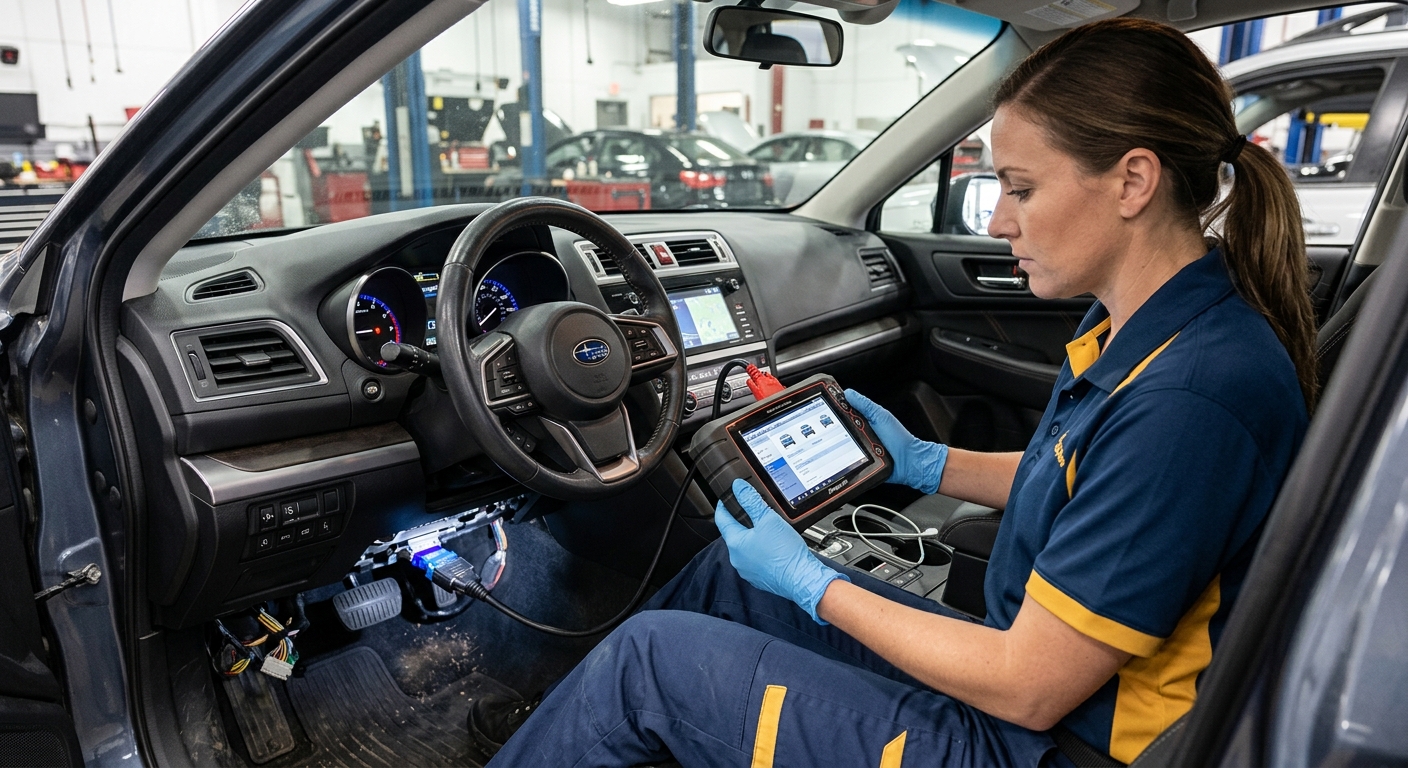
Here’s a typical professional workflow. This is what a trained tech will do; it’s not a DIY checklist for untrained people because SRS components are safety-critical.
- Hook up an SRS-capable scan tool (not a generic OBD-II reader) and record stored crash data and DTCs.
- Interpret codes and live data — check sensor inputs, seatbelt circuits, and passenger weight sensor signals.
- Inspect wiring harnesses, connectors (common trouble spots: driver airbag connector under steering column, side impact sensor connectors in door sills), and the module mounting for water or physical damage.
- Repair or replace failed parts (sensors, harnesses, pretensioners, inflators, clock spring) and retest the circuits.
- If the module supports it and crash data is cleared per procedure, perform an SRS module reset; otherwise replace and program the module.
- Verify the system by cycling ignition and checking that the airbag light goes off and no DTCs return.
Common airbag light behaviors and what they mean
- Solid light after accident: system detected a stored fault or crash event; needs diagnosis.
- Flashing airbag light: often indicates a specific fault code that requires reading — count the flashes if instructed by the factory procedure, but let a tech interpret them.
- Light goes off then returns: intermittent wiring or connector corrosion is common.
Quick reference: common causes and technician checks
| Symptom | Likely cause | What a technician will check |
|---|---|---|
| Airbag light on after minor accident | Stored crash data or minor sensor fault | Scan SRS module, inspect impact sensor wiring, test sensor voltages |
| Airbag light flashing after accident | Specific DTC or module fault | Read flashing pattern or use scan tool, verify module health |
| Airbag light stays on after accident even after repairs | Non-resettable module or missed fault | Check for hidden faults, consider mail-in module reset or module replacement |
Model-specific notes (including Honda)
Some makes and models have common weak points. For example, many Hondas use a passenger weight sensor and specific SRS module behaviors that can keep the airbag light on after an accident even when other parts look OK. If you search “honda airbag light on after accident” you’ll often find issues tied to occupancy sensor calibration, pretensioner circuits, or module replacement procedures.
If your vehicle is one of these cases, a technician will check the passenger seat harness, the occupancy mat connections, and confirm whether the module is resettable. LockNCal offers both mobile diagnostics and nationwide mail-in options for modules, so we can either come to you or reset a module in our shop: https://lockncal.com/mobile-airbag-module-reset-service/ and https://lockncal.com/mail-in-airbag-module-reset-service-free-shipping/.
Why you shouldn’t just clear the codes yourself
Clearing the code without confirming repairs may leave the system unsafe. The SRS is designed to report faults that prevent deployment — clearing codes makes that warning go away but doesn’t restore function. Technicians use scan data, post-repair tests, and sometimes crash-data deletion tools that follow strict procedures to ensure the system is restored correctly.
Options if the module is non-resettable
- Replace the SRS module and program it to the vehicle — requires programming and sometimes immobilizer matching.
- Use a certified module reset service that can remove crash data when the module allows it.
- Mail-in module reset services are available nationwide with secure shipping and testing; see our mail-in services overview for details: https://lockncal.com/mail-in-services/.
Estimated timeline
Every job is different, but expect a technician diagnosis first (typically under an hour), followed by parts repair or replacement. If the module is mailed out for reset, add shipping and test time. Your technician will tell you whether a reset, reprogram, or replacement is needed after the initial scan.
FAQ
Q: How do you reset airbag light after accident?
A: Resetting starts with a full SRS scan and repair. A qualified technician repairs damaged components, then uses an SRS-capable tool or a certified module reset service to clear crash data. Clearing codes without repair is unsafe and not recommended.
Q: My airbag light came on after accident — can I drive it?
A: You can drive it slowly to a repair facility if the car is otherwise safe, but avoid regular driving. The airbag system may be disabled and won’t protect you in another crash.
Q: Why does the airbag light stay on after accident?
A: Because the SRS module detected crash data or an unresolved circuit fault. The module may need repair, reset, or replacement after the root cause is fixed.
Q: What does a flashing airbag light after accident mean?
A: Flashing usually indicates an active diagnostic code or a module error. A technician will read the code with an SRS-capable scanner to diagnose the exact cause.
Q: Honda airbag light on after accident — is it different?
A: Hondas commonly have passenger occupancy sensors and specific module behaviors that can keep the light on. Technicians will check the occupancy mat, passenger harness, and whether the SRS module is resettable.
Final notes and safe next steps
If your airbag light is on after an accident, don’t ignore it. The safest path is a professional diagnosis, repair of any damaged components, and then a proper module reset or replacement. We offer both mobile services for on-site diagnostics and nationwide mail-in module resets depending on what the vehicle needs. Learn more or schedule service here: https://lockncal.com/mail-in-airbag-module-reset-service-free-shipping/.
For a fast quote and to discuss whether a mobile visit or mail-in reset is best for your vehicle, call (469) 277-7277 or schedule online: https://lockncal.com/schedule-your-service-appointment/.


