 Skip to content

Direct answer: The Ford P0420 code means “Catalyst System Efficiency Below Threshold (Bank 1).” It flags that the catalytic converter on bank 1 isn’t reducing emissions as expected — but the actual cause can be an aged converter, bad oxygen sensors, exhaust leaks, or engine problems. Confirm with a full OBD-II scan and live-data tests before replacing parts.
Key Takeaways
- P0420 = Catalyst System Efficiency Below Threshold (Bank 1) — confirm with a scan and live data.
- Common causes: worn catalytic converter, failed downstream O2 sensor, exhaust leaks, engine misfires, or fuel trim problems.
- Diagnosis order matters: scan, check freeze frame, inspect for exhaust leaks, test O2 sensors and fuel trims, then test converter efficiency.
- Sometimes safe to drive short term, but continued driving can worsen emissions and damage the converter.
What “Catalyst System Efficiency Below Threshold (Bank 1)” actually means
Bank 1 refers to the side of the engine with cylinder 1. The onboard diagnostics compare the upstream (pre-converter) and downstream (post-converter) oxygen sensor signals. If the downstream sensor starts to mimic the upstream sensor too closely — indicating the converter isn’t trapping and converting pollutants — the PCM sets P0420. The code is a broad flag, not a precise part number; it points you to the emissions control system for further testing.
Common causes
- Worn or contaminated catalytic converter (age, oil or coolant contamination, or melting of substrate).
- Failed or slow downstream (post-cat) oxygen sensor.
- Exhaust leaks between the upstream O2 sensor and the catalytic converter.
- Engine issues causing rich/lean conditions: misfires, bad fuel injectors, faulty MAF, or fuel pressure problems.
- Damaged wiring or poor connectors for the O2 sensors or heater circuits.
- Incorrect or outdated engine control software in the PCM for that specific year/model (less common but possible).
Symptoms you might notice
- Check Engine Light (CEL) illuminated; P0420 stored.
- Poor fuel economy or rough idle if the root cause is an engine-running issue.
- Failed emissions test (state inspection).
- Rattling noise under the vehicle or a noticeable rotten-egg smell — signs of a failing converter.
- Limping or reduced power is uncommon for a straight P0420, but misfires that triggered the condition can cause drivability problems.
Step-by-step diagnosis (recommended order and tools)
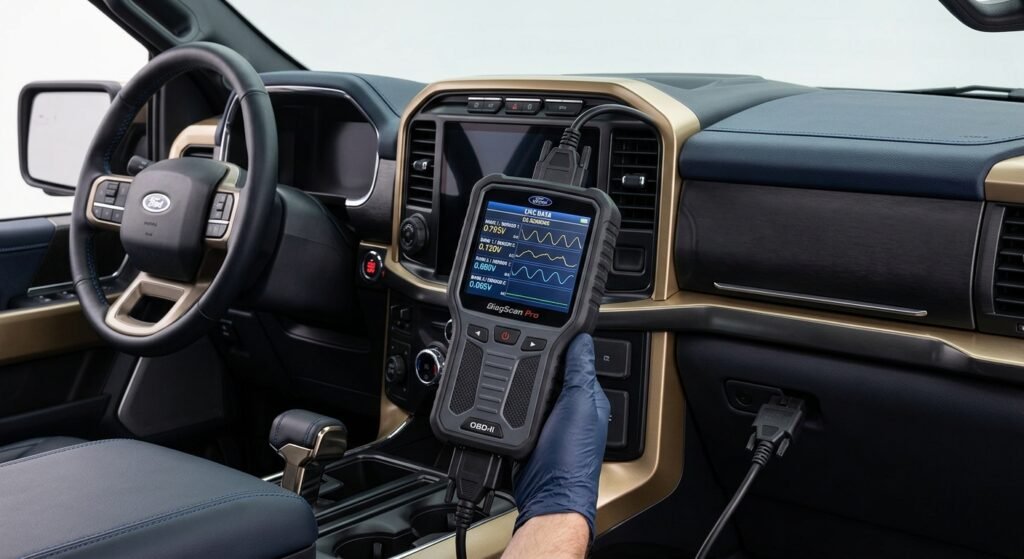
Start with the simplest tests and progress to more involved checks. Typical tools: a quality OBD-II scanner with live-data and freeze-frame, digital multimeter, mechanic’s stethoscope, infrared thermometer (or temp probe), backpressure gauge, and smoke machine for exhaust leak testing.
- Confirm the code and capture freeze-frame: Use a scanner to read P0420 and any additional codes (pending or stored). Freeze-frame tells you engine load, fuel trims, and RPM when the fault occurred.
- Check for related codes: Misfire codes (P0300–P03xx), fuel trim (P0171/P0174) or oxygen sensor codes (P0136–P0167) often point to the root cause. Fix misfires or fuel trim issues first; they can damage converters.
- Visual inspection: Look for exhaust leaks, damaged heat shields, or obvious wiring damage near O2 sensors and the catalytic converter.
- O2 sensor data check (live data): Compare upstream and downstream sensor voltages and response rates. Upstream should switch rapidly; downstream should be steadier at a lower variance. If downstream mirrors upstream, the converter likely isn’t working.
- Sensor heater and wiring check: Verify heater circuits and sensor grounds with a multimeter. A slow-heating or dead heater can give false readings when cold.
- Fuel trim and misfire diagnostics: Look at short- and long-term fuel trims, monitor for lean/rich conditions, and perform a misfire diagnosis if applicable. Correcting these can sometimes clear P0420 without replacing the converter.
- Temperature test across the converter: Use an infrared thermometer or thermocouples. The rear (downstream) of a working converter is typically hotter than the front under load; a lack of temperature rise suggests poor conversion.
- Backpressure test and rattling check: Increased backpressure or internal rattling indicates a clogged or physically damaged converter.
- Exhaust leak pressure/smoke test: Confirm there are no leaks upstream of the converter that could skew O2 readings.
- Confirm with a professional emissions or efficiency test: In some shops, a tailpipe emissions test or bench testing can confirm converter efficiency before costly replacement.
Quick reference: Causes, tests, and likely fixes
| Likely cause | How to test | Typical fix |
|---|---|---|
| Worn/failed catalytic converter | Temp differential test, backpressure, rattling, emissions test | Replace catalytic converter (shop) and verify no upstream engine issues |
| Bad downstream O2 sensor | Compare live voltage traces, sensor heater check, wiring inspection | Replace sensor and clear codes; re-test |
| Exhaust leak | Smoke test, visual, listening for leaks | Repair leak (exhaust shop) and retest before replacing parts |
| Engine misfires or fueling issues | Scan for misfire codes, fuel trim analysis, fuel pressure test | Address misfires/injectors/fuel system, then clear codes |
When is it safe to keep driving?
P0420 alone often doesn’t immediately make a car unsafe to drive, but it isn’t a problem to ignore. If the cause is only an inefficient converter and the engine otherwise runs well, short trips are usually possible. However, if misfires or fuel problems are causing the code, continued driving can overheat and destroy the catalytic converter and create unsafe drivability — get those engine faults fixed promptly.
Cost and parts guidance
Costs vary widely by vehicle and whether an OEM or aftermarket catalytic converter is used. Because P0420 can come from several causes, don’t replace the converter until you’ve confirmed it’s the root cause — start with sensor checks and exhaust leak diagnosis. A careful diagnostic approach avoids unnecessary parts replacement.
Special notes for Ford owners
- Confirm Bank 1 location for your specific engine (Bank 1 always contains cylinder 1). Some Ford V6/V8 arrangements can confuse DIYers — check a trusted repair manual or scan tool freeze-frame to verify.
- Ford Technical Service Bulletins (TSBs) occasionally cover catalytic or sensor updates for certain years; a dealer or subscription database can confirm if a software update or service action exists for your VIN.
- If you’re evaluating a used Ford, add a diagnostic scan and a pre-purchase check — a P0420 history could mean future emissions headaches. Consider a professional inspection like a pre-purchase vehicle inspection before you buy.
When to see a professional
If you’re not comfortable with live-data interpretation, lack tools for temperature/backpressure testing, or see misfires/fuel trim trouble, get a qualified technician to diagnose and fix the root cause. A professional can confirm whether the catalytic converter truly needs replacement or whether a sensor, wiring, or engine issue is responsible.
For questions about safety systems unrelated to P0420, LockNCal handles airbag, SRS, ADAS, and immobilizer/key services through our vehicle safety system offerings: vehicle safety system services.
FAQ
- Q: Will clearing the code fix the problem?
A: Clearing the P0420 code is only temporary unless the underlying issue is fixed. If the fault returns, further diagnosis is needed.
- Q: Can a bad O2 sensor cause P0420?
A: Yes. A failed or slow downstream O2 sensor can mimic a converter failure. Always test the sensors before replacing the catalytic converter.
- Q: How long can I drive with P0420?
A: Short-term driving is usually possible, but fix any related misfires or fueling problems quickly to avoid damaging the catalytic converter and failing emissions tests.
- Q: Will replacing the catalytic converter clear the code?
A: Replacing a genuinely failed converter usually fixes the code, but only after the PCM verifies proper operation. If upstream issues remain, the code can return.
- Q: Do emissions failures affect vehicle resale?
A: Yes — a persistent P0420 can cause failed emissions inspections and reduce resale value. Have a complete diagnostic before purchase; consider a pre-purchase vehicle inspection if buying used.
If you want a professional diagnostic or to schedule service, book an appointment online at https://lockncal.com/schedule-your-service-appointment/ or call (469) 277-7277.


