 Skip to content

Seat Belt Replacement After Accident — What to Do
Direct answer: If a seat belt assembly or its pretensioner fired in a crash, replace the entire assembly and any related SRS modules—do not rely on repair kits or reusing deployed components. A certified technician should scan the airbag/SRS module, inspect buckles, pretensioners and webbing, and replace and program parts as required for safety.
Key Takeaways
- Deployed pretensioners and visibly damaged belts must be replaced — they are single-use devices.
- Seat belt webbing that is stretched, cut, or contaminated by crash forces needs replacement, not sewing or patching.
- Crash data in the SRS/airbag module often requires a module reset or replacement and programming.
- Always have a professional scan the vehicle’s SRS system and follow manufacturer procedures.
Why seat belt replacement after an accident matters
Seat belts and their pretensioners are safety systems designed to work in one crash event. Pretensioners use a pyrotechnic charge to retract webbing instantly during a collision; that charge is consumed when it fires. Webbing and buckles can also stretch, fray, or suffer hidden damage even when they look “okay”. Reusing or attempting to repair these components risks failure in a future crash.
Safety note: LockNCal does not repair, rebuild, or re-web seat belts. Seat belts and pretensioners are life-safety parts, and a repaired or rebuilt belt may not hold in a crash — so we recommend replacement with genuine OEM parts. See our mobile seat belt replacement service.
Single-use safety components
Pretensioners and many buckle assemblies contain small explosive charges or mechanical devices that are certified for one deployment. After deployment they no longer perform to specification and must be replaced with new, manufacturer-approved parts.
Hidden damage is common
Even low-speed crashes can load a seat belt and buckle beyond their design limits. A belt might appear intact while internal stitching, fibers or connectors are compromised. Because the consequences are life-or-death, the safe approach is replacement when any doubt exists.
Signs you need seat belt replacement
- Any visible deployment of the pretensioner (typically a sudden, loud snap in the crash)
- Webbing that is frayed, cut, melted, discolored, or unusually stretched
- Buckles that do not latch securely, release unexpectedly, or show physical damage
- Warning lights for SRS, airbag, or occupant detection on the dash after a crash
- Crash-data stored in the airbag/SRS control module (requires a scan to confirm)
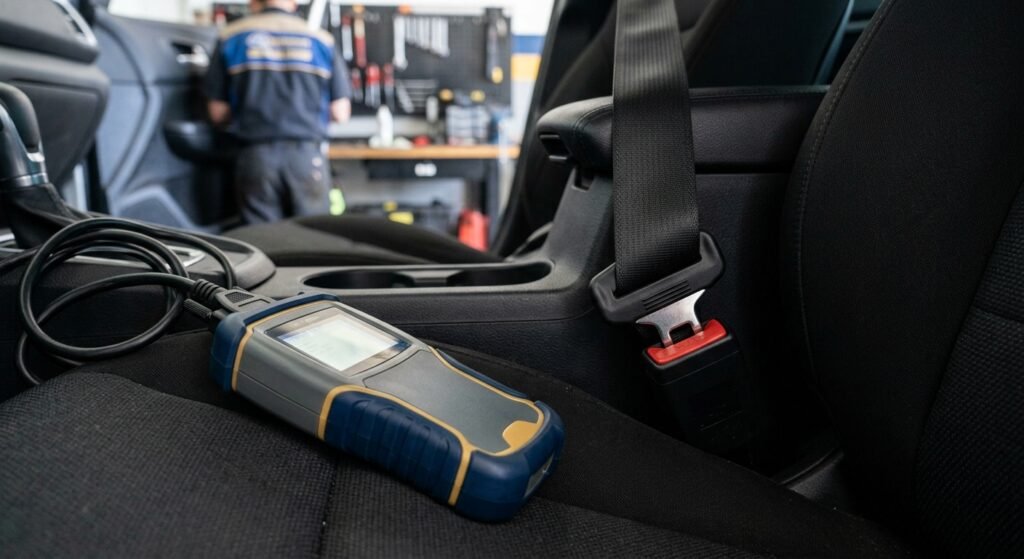
How a professional technician evaluates and replaces seat belt components
Replacing seat belt components after an accident is a multi-step process that combines visual inspection, diagnostic scanning, part replacement, and electronic reset/programming when required. Below is a typical workflow a trained technician follows.
Step-by-step diagnostic and replacement workflow
- Turn off vehicle battery and follow manufacturer-safe disconnect procedures to prevent accidental airbag deployment.
- Use a dedicated OBD-II SRS scanner to read airbag/SRS module fault codes and check for crash-data events stored in the module.
- Visually inspect all belt webbing, buckles, anchor points, and pretensioner connectors for damage or deployment evidence.
- If pretensioners or buckles fired or show damage, remove and replace them with OEM or manufacturer-equivalent parts.
- If the SRS control module contains crash data, either reset the module (where allowed) or replace/reprogram it per manufacturer rules — this often requires professional programming tools.
- After installation, reconnect the battery, clear SRS codes using the scanner, and verify that no faults remain and that the airbag light goes out.
- Perform any required calibrations (for occupant classification systems or seat-occupant sensors) and inspect fit and function of the new belt on the actual seat.
Who should do this work?
Because this process touches the vehicle’s supplemental restraint system (SRS) and pyrotechnic devices, it belongs to experienced technicians who follow OEM procedures and use proper diagnostic tools. LockNCal performs seat belt replacement and SRS-related services as part of our vehicle safety system offerings in the DFW area and handles SRS module resets and programming nationwide; see our vehicle safety system services for details.
Crash severity vs. recommended action
| Crash characteristic | Likely seat belt action | SRS/module steps |
|---|---|---|
| Minor bumper impact, no occupant forces | Inspect webbing and buckles; usually no replacement | Scan SRS; unlikely crash data present |
| Moderate impact with seatbelt load (occupant moved forward) | Replace pretensioner and possibly webbing/buckle | Scan and clear crash data; reset or replace module if required |
| Severe impact with airbag deployment | Replace all deployed pretensioners and affected belts; replace airbags as needed | Module will likely contain crash data — reset or replace and reprogram |
Why “repair kits” and sewing webbing aren’t the safe answer
You’ll find aftermarket repair kits and guides that promise to “fix” a damaged belt with sewing, splicing, or reusing a pretensioner. These are commonly marketed as cheaper alternatives, but they are not manufacturer-approved and can create a false sense of security. Repaired webbing or a re-used pretensioner will not be factory-certified; their energy-absorbing characteristics and attachment strength are unknown after modification.
If someone offers webbing sewing or a pretensioner rebuild, treat it as a red flag. The correct, manufacturer-approved actions are replacement of the single-use components and proper SRS scanning and programming.
Common questions about insurance and inspection
Most insurance claims for crash damage that affect safety systems will cover seat belt and pretensioner replacement when the work is identified on the estimate. An inspector or adjuster may require proof of part replacement and clearing of any stored crash codes in the SRS module. Keep all receipts and a copy of the vehicle scan showing the SRS status after work is completed.
DIY vs professional service — what you can and cannot do
- Do: Visually inspect belts after an accident and keep the vehicle from use if belts look damaged or if the airbag light is on.
- Do: Keep documentation, take photos, and get a professional SRS scan as soon as practical.
- Don’t: Attempt to reuse a deployed pretensioner or splice/reweld webbing yourself.
- Don’t: Bypass sensors or disable warnings to avoid a required repair — the SRS warning light indicates the safety system isn’t functioning properly.
Next steps after a crash
- Make sure everyone is safe and seek medical attention if needed.
- Document the accident and take clear photos of all seat belt components and dash warning lights.
- Have the vehicle scanned for SRS/airbag crash data at a qualified facility.
- If belts or pretensioners need replacement, have a technician install OEM parts and clear/program the SRS module per manufacturer instructions.
- Keep all service records and confirm the airbag light is extinguished before driving regularly.
For more information on related services like module resets and other mail-in options, see our mail-in airbag module reset service.
If you want a local, on-site option in the Dallas–Fort Worth area or to learn more about our full vehicle safety system services, view our on-site mobile services overview or our vehicle safety system services.
FAQ
Do I always need to replace the seat belt after a minor accident?
Not always. If the webbing, buckle and pretensioner show no signs of deployment or damage and the SRS scan shows no crash data, replacement may not be required. A professional inspection and scan are the only safe ways to confirm.
Can a seat belt be repaired instead of replaced?
Short answer: no, not safely. Sewing, splicing, or reusing a deployed pretensioner is not manufacturer-approved and can make the belt unsafe. The correct remedy for deployed or damaged components is replacement with new, OEM-equivalent parts.
Will insurance cover seat belt replacement after an accident?
Many auto insurance policies cover replacement of safety components when the damage is part of a covered collision claim. Check with your adjuster and provide documentation and a post-service SRS scan if requested.
How long does seat belt replacement take?
Time varies by vehicle and which components must be replaced, but a typical replacement and SRS scan can take one to a few hours once parts are on-hand. If module replacement and programming are needed, allow additional time for programming and verification.
Do I need the airbag module reset after replacing a belt?
If crash data is stored in the airbag/SRS module or a pretensioner deployed, the module will often need to be reset or replaced and reprogrammed. LockNCal offers nationwide mail-in airbag module reset services and mobile programming options depending on the vehicle.
For professional seat belt and SRS services, visit our vehicle safety system services page to learn more or schedule an appointment. Call (469) 277-7277 to discuss your vehicle and set up service.


