
OBD Scanner Readings Explained: How to Read Live Data and Check Engine Light Results in Trophy Club TX
Your check engine light is on. Your handheld scanner or diagnostic trouble code reader shows a code and a bunch of numbers. You know something is wrong, but the readings are not obvious, and guessing wrong can get expensive—or unsafe—fast.
This guide is written for drivers in Trophy Club TX and across DFW who want to understand obd scanner readings, live data, and what those values actually mean before deciding on next steps. We’ll keep it plain English first, then add technical depth so you can tell when DIY interpretation is reasonable and when it’s time to schedule a professional Vehicle Diagnostic with LockNCal.
For local service coverage details, you can review our Trophy Club page here: https://lockncal.com/Trophy-Club-TX. If you need to confirm exactly which vehicle you are dealing with, use our VIN Decoder here: https://lockncal.com/vin-decoder/.
What Are OBD Scanner Readings and What Can They Tell You?
On any 1996+ vehicle, the onboard diagnostics system (OBD-II) continuously monitors sensors and systems. When something is out of range, the computer stores a trouble code and may turn on the check engine light. Your scanner can read both the codes and the live data those codes are based on.
Difference between a code, a PID, freeze-frame data, and readiness monitors
When you plug in a diagnostic trouble code reader, you’re typically seeing four main types of information:
- Codes (DTCs): Short identifiers like P0300 (random misfire) or P0420 (catalyst efficiency below threshold). These tell you which system saw something abnormal, not which part to replace.
- PIDs (Parameter IDs): These are the individual data items your scanner can show, such as RPM, coolant temperature, fuel trims, O2 sensor voltage, MAF airflow, etc. This is the core of OBD-II live data.
- Freeze-frame data: A snapshot the moment a code was stored—RPM, speed, load, coolant temp, fuel trims. This is critical to understanding what the engine was doing when the fault happened.
- Readiness monitors: Self-tests for systems like the catalyst, O2 sensors, EVAP, EGR, etc. Monitors show as complete, incomplete, or not supported. This matters for emissions inspection and for confirming a fix.
What a diagnostic trouble code reader can show vs. what advanced scan tools show
A basic handheld scanner or phone-based tool generally shows:
- Stored, pending, and sometimes permanent codes
- Basic live data PIDs (RPM, coolant temp, simple fuel trims, O2 sensor voltage)
- Readiness monitor status and simple freeze-frame data
Advanced professional scan tools used in a proper Vehicle Diagnostic can also access:
- Manufacturer-specific codes from multiple modules (power steering, ABS, SRS, hybrid, etc.)
- Enhanced misfire data (per-cylinder counters and history)
- Detailed network and communication fault traces—exactly what is discussed in articles like Why the Lincoln P164D Code Matters for Vehicle Safety and Why DTC C1692 Matters for Your Hyundai.
- Bi-directional controls and advanced data streams necessary for issues like those covered in Understanding and Resolving Lexus DTC P3004-131 Issues.
That advanced data is where a professional in the DFW area, like LockNCal, goes far beyond a simple code pull.
Why a code is a clue, not a confirmed failed part
A code points to a circuit or system, not a guaranteed bad component. For example:
- P0171 (system too lean, bank 1) might be caused by a vacuum leak, weak fuel pump, clogged fuel filter, dirty MAF sensor, or even an exhaust leak ahead of the O2 sensor—not just a bad sensor.
- P0301 (cylinder 1 misfire) might be a spark plug, ignition coil, injector, compression issue, or wiring problem.
Misreading a code as a parts shopping list is one of the fastest ways to waste money. The real value of obd scanner readings comes from pairing the codes with live data, symptoms, and proper testing.
What Happens During an OBD Scan Check Engine Light Check?
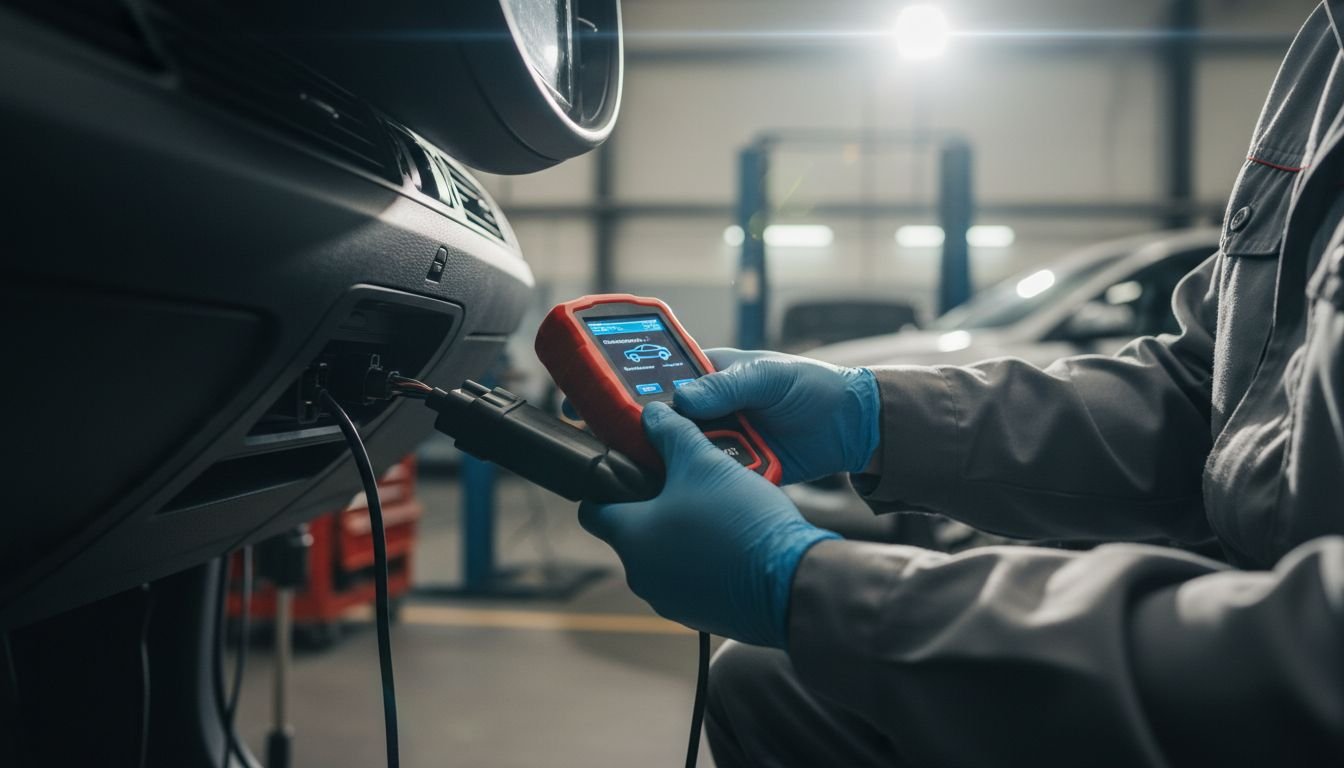
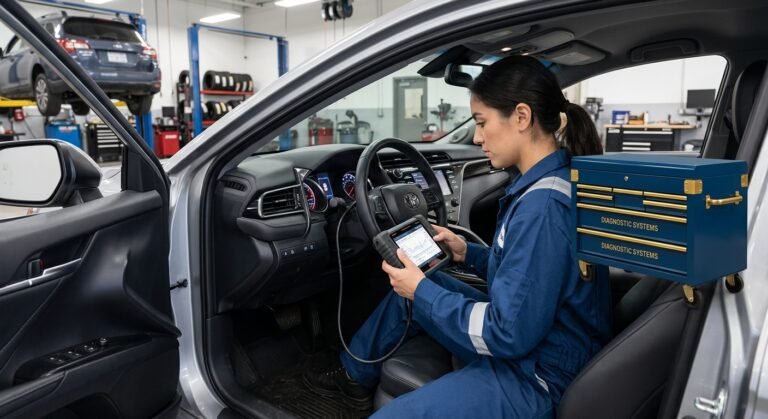
Whether you use a small handheld tool at home in Trophy Club or ask a shop to perform an obd scan check engine light check, the basic steps are similar.
What drivers usually see during an obd scan check engine light process
Typical steps and results on a basic scanner:
- Plug scanner into OBD-II port (usually under the dash on driver’s side).
- Turn ignition ON (engine off or running depending on the tool instructions).
- Scanner connects and reads fault codes from the engine control module (ECM/PCM).
- Screen shows code(s), like P0xxx, and sometimes a short description.
- Some tools also show live data and freeze-frame information you can scroll through.
Common scan outcomes: stored codes, pending codes, permanent codes
After a check engine light obd scan, you may see:
- Stored codes: Confirmed faults that turned the light on. These happened recently enough that the computer considered them real issues.
- Pending codes: The computer saw something odd once, but not enough times to “confirm” the problem. These are early warning signs.
- Permanent codes: Certain emissions-related codes that remain even after clearing, until the onboard system confirms the issue has been properly resolved and the monitor has passed.
Understanding which type of code you’re seeing helps decide if you’re dealing with an intermittent glitch or a confirmed ongoing fault.
Why the check engine light obd scan result should be matched with symptoms
Codes alone are only half the story. Always ask:
- Is the engine running rough, misfiring, or stalling?
- Is fuel economy suddenly worse?
- Is there loss of power, hesitation, or hard starting?
- Are there additional warning lights (ABS, traction, airbag/SRS, hybrid/battery)?
When the codes and the symptoms don’t line up, or when more than one system is involved, that’s a strong sign it is time for a professional Vehicle Diagnostic, not a guessing game with parts.
An educational guide explaining OBD-II PIDs, common live-data parameters (RPM, fuel trims, O2 sensors), how to read live stream data, how to correlate sensor readings with codes/symptoms, and sample diagnostic workflows using scanner readings.
This section is where most competitors fall short. They list codes, but they don’t teach you how to read the live data behind them. As a DFW driver, learning a few key scanner PIDs can help you talk more confidently with any technician and avoid obvious misdiagnosis.
Key OBD-II PIDs every driver should know
Common PIDs you’ll see on many scanners include:
- Engine RPM
- Vehicle speed
- Engine load
- Coolant temperature (ECT)
- Intake air temperature (IAT)
- MAF (Mass Air Flow) or MAP (Manifold Absolute Pressure)
- Short-term fuel trim (STFT)
- Long-term fuel trim (LTFT)
- O2 sensor readings and, on many cars, A/F (air-fuel) sensor data
- Fuel system status (open loop/closed loop)
- Misfire counters on more advanced tools
Each PID is a piece of the puzzle that helps confirm whether a code truly reflects what’s happening inside your engine.
RPM, engine load, coolant temp, intake air temp, MAF/MAP basics
- RPM: Idle should be stable (typically 600–900 RPM for many gasoline engines). Big swings, surging, or extremely low/high idle are red flags.
- Engine load: Indicates how hard the engine is working. High load at low speed can suggest drag, restriction, or transmission issues.
- Coolant temperature: After warm-up, many engines run around 190–220°F. If it never warms up, a thermostat issue is possible; if it overheats, cooling system faults are likely.
- Intake air temperature: Should usually track near ambient temperature once moving, hotter at idle.
- MAF/MAP: These sensors indicate how much air the engine is pulling in. Erratic or unrealistic airflow readings can cause poor drivability and fuel trim issues.
Short-term and long-term fuel trims in plain English
Fuel trims show how much the computer is adding or subtracting fuel to hit the target air/fuel mixture:
- STFT: Quick, moment-to-moment corrections.
- LTFT: Longer-term learned adjustments.
As a simple rule of thumb:
- Numbers near 0% (between about -5% and +5%) are typically normal.
- Positive trims (e.g., +15% or higher) mean the computer is adding fuel—often indicating a lean condition (too much air, not enough fuel, or false air).
- Negative trims (e.g., -15% or more) mean the computer is pulling fuel—often indicating a rich condition (too much fuel or not enough air).
But fuel trims alone don’t tell you which part is bad. They only tell you the direction and size of the correction.
Upstream and downstream O2 sensor behavior
O2 sensor readings are a big part of emissions diagnosis:
- Upstream O2 (before catalyst): Should “switch” quickly between rich and lean as the computer fine-tunes the mixture.
- Downstream O2 (after catalyst): Should be relatively stable if the catalyst is working properly. If it mimics the upstream sensor, the catalyst may be weak or failing.
A code like P0420 (catalyst efficiency) should always be checked against real O2 sensor behavior before assuming the converter is bad.
Misfire data, fuel system status, and readiness monitors
- Misfire data: Some scanners show which cylinders are misfiring and how often. High counts on one cylinder point to a localized issue; widespread misfires point to fuel, timing, or compression problems.
- Fuel system status: “Open loop” means the computer is not using O2 sensor feedback yet (cold start, heavy acceleration); “closed loop” means full feedback control based on sensor input.
- Readiness monitors: These show which self-tests have completed. If many are incomplete, it’s often because codes were recently cleared or the drive cycle has not been completed.
How to spot normal vs. suspicious live-data patterns
Red flags in obd scanner readings can include:
- Idle RPM swinging up and down with no A/C or power steering load change.
- Fuel trims stuck high positive (lean) or negative (rich) on one bank.
- Coolant temp stuck very low or very high with no change.
- Upstream O2 sensors not switching, or downstream O2 sensors copying upstream behavior.
- Misfire counters rising rapidly on one or more cylinders.
If your scan tool shows these patterns and you are not sure why, it’s time to move from DIY observation to a structured Vehicle Diagnostic.
How to Interpret Common Live Data From Your Scanner
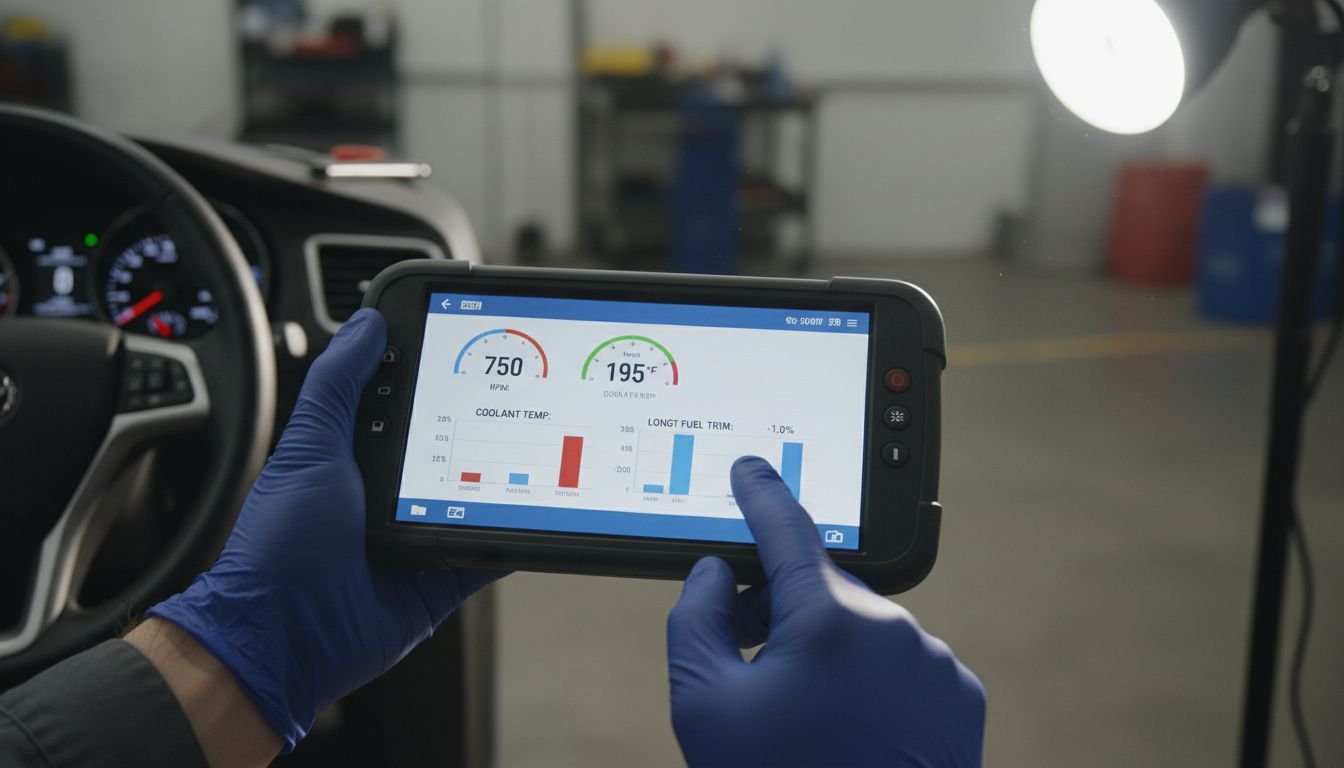
This section walks through how to read the live stream values you’re most likely to see on a consumer scanner, and what they might mean in everyday Trophy Club and DFW driving.
RPM and idle stability readings
Watch RPM with the engine warmed up, in Park or Neutral, with no extra loads:
- Stable idle: Slight movement is normal.
- Hunting or surging idle: Possible vacuum leak, idle air control issue, or fuel/air imbalance.
- Very low idle with shaking: Possible misfire, compression issues, or incorrect airflow at idle.
Combine RPM readings with misfire data and fuel trims for a clearer picture instead of focusing on one number alone.
Fuel trim patterns for lean and rich conditions
At warm idle and at a steady cruise:
- If LTFT + STFT on a bank add up to around +15–25% or more, the PCM is heavily adding fuel (lean condition).
- If combined trims are around -15–25% or more, it’s pulling fuel (rich condition).
Patterns to notice:
- High trims only at idle: Often points to vacuum leaks, PCV issues, or intake gasket leaks.
- High trims under load only: Often suggests fuel delivery problems (weak pump, restricted filter).
O2 sensor switching and catalyst clues
On many gasoline engines:
- Upstream O2: Should actively flip from low to high voltage in closed loop.
- Downstream O2: If the catalyst is effective, should show a flatter, more stable line.
If a catalyst code appears but your downstream O2 shows good catalyst behavior, a deeper Vehicle Diagnostic is recommended before authorizing major parts replacement.
Coolant temperature and warm-up behavior
Check ECT from cold start through warm-up:
- Temperature should rise steadily until it reaches its normal operating range.
- If it stays unusually low, the thermostat may be stuck open and can affect fuel trims and drivability.
- If it spikes quickly to very high values, you may have a real overheating issue or a sensor/circuit fault that needs immediate attention.
MAF/MAP readings and airflow logic
MAF readings should rise smoothly with RPM and load; MAP should decrease at idle and rise as you open the throttle. Sudden drops, spikes, or obviously unrealistic values can trigger lean/rich codes and driveability complaints.
Because airflow calculations are critical to the entire fuel strategy, suspicious MAF/MAP data is a strong reason to move beyond DIY scans and into a professional Vehicle Diagnostic before replacing sensors blindly.
How to Match OBD Scanner Readings With Codes and Symptoms
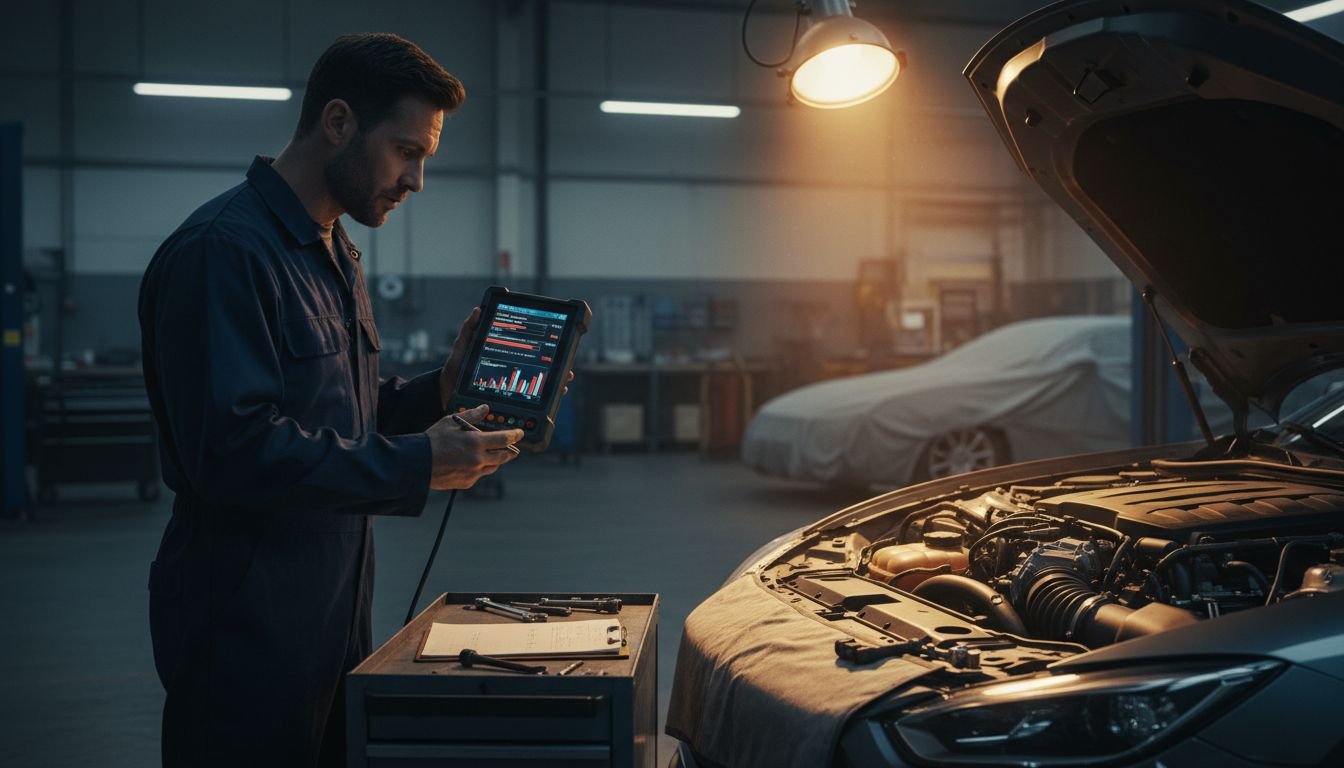
Now we’ll put everything together with example workflows. These show how an expert in Trophy Club or wider DFW would connect obd scanner readings, codes, and real-world symptoms before recommending any next steps.
Example workflow: rough idle plus misfire code
Symptoms: Rough idle, check engine light on.
Code: P0302 (cylinder 2 misfire).
Live data to check:
- RPM at idle (is it unstable?)
- Misfire counters (is cylinder 2 consistently higher?)
- Fuel trims (are both banks normal or skewed?)
- O2 sensor behavior (normal switching or stuck?)
Interpretation approach:
- If only cylinder 2 misfires with normal trims, you may be dealing with a localized issue (ignition or injector related).
- If multiple cylinders show misfires and trims are off, think broader (fuel delivery, mechanical, or timing concern).
In a professional Vehicle Diagnostic, LockNCal would use more advanced misfire data and testing to confirm whether this is ignition, fuel, compression, or control-module related before any part is condemned.
Example workflow: catalyst-efficiency code plus O2 data
Symptoms: Often none, or mild loss of power; usually no obvious drivability change.
Code: P0420 or similar catalyst efficiency code.
Live data to check:
- Upstream vs. downstream O2 switching patterns.
- Fuel trims (lean or rich patterns that could damage the catalyst).
- Readiness monitors (catalyst and O2 monitor completion).
Interpretation approach: If downstream O2 behaves almost the same as upstream, the catalyst may indeed be weak. But if the pattern is borderline, or fuel trims are abnormal, addressing mixture issues first via a Vehicle Diagnostic is the safer and often more cost-effective path.
Example workflow: lean code plus fuel trim imbalance
Symptoms: Possible hesitation, weak acceleration, or higher fuel economy readings than normal.
Code: P0171 (system too lean, bank 1).
Live data to check:
- LTFT and STFT on both banks.
- MAF/MAP airflow readings.
- Idle vs. cruise trims (does the issue change with load?).
- O2 sensor response speed and range.
Interpretation approach:
- High positive trims at idle that improve with RPM often point to vacuum or intake leaks.
- High positive trims mostly under load often suggest restricted fuel delivery.
This is a classic situation where many DIYers replace MAF sensors or O2 sensors when the real issue is air leaks or fuel supply. A structured Vehicle Diagnostic helps prevent those expensive wrong turns.
Example workflow: no major code but drivability complaint
Symptoms: Hesitation, occasional stumble, or poor fuel economy with no obvious stored code (maybe only a pending code).
Live data to check:
- Fuel trims over time.
- O2 sensor behavior and fuel system status.
- MAF/MAP at various throttle positions.
- Any pending codes or incomplete readiness monitors.
If you see odd live data but no solid code, that is exactly when a professional scan tool and experienced eye are critical. LockNCal’s Vehicle Diagnostic digs deeper into intermittent and pre-failure situations like this.
Common Mistakes People Make When Reading Scanner Data
Most of the costly mistakes around obd scanner readings happen before any proper testing is done.
Replacing parts based on the code name alone
This is the most expensive habit we see in DFW. A code that mentions a sensor (like an O2 sensor or MAF sensor) does not automatically mean that sensor is bad. The code often means that the reading from that sensor is out of range—which can be caused by many things further upstream or downstream.
Clearing codes before saving freeze-frame data
Freeze-frame data captures exactly what the engine was doing when the fault set. Clearing codes without writing down the freeze-frame information erases some of your best diagnostic clues. Always note or photograph freeze-frame data before hitting “erase.”
Ignoring pending codes and readiness status
Pending codes and incomplete readiness monitors tell you the system still has questions. Repeatedly clearing codes just to pass an inspection or hide a light is a temporary band-aid and often leads to greater repair costs or failures at the worst possible time.
Confusing sensor reporting with sensor failure
A sensor can report a bad value because:
- The sensor itself is failing.
- The wiring or connector has a problem.
- The system the sensor monitors is out of balance (air leaks, fuel delivery, mechanical problems).
Professional testing within a Vehicle Diagnostic confirms which of these is actually happening before a part is replaced.
When DIY Interpretation Is Reasonable—and When You Need a Professional Vehicle Diagnostic
There is a place for DIY scanning, and there is a point where continuing without professional help becomes a safety or cost risk, especially in heavy DFW traffic and heat.
Safe basic checks a driver can do
Reasonable DIY steps after a check engine light obd scan include:
- Confirming the code and writing down freeze-frame data.
- Visually checking for disconnected vacuum hoses or obvious broken wiring (without disassembling critical systems).
- Checking fluid levels (coolant, oil, transmission) if related symptoms are present.
- Monitoring fuel trims and O2 sensor behavior to see if the issue is persistent or intermittent.
Signs the issue needs professional testing
You should strongly consider a professional Vehicle Diagnostic with LockNCal if:
- Multiple unrelated codes appear at once.
- Live data looks abnormal, but you are not sure why.
- The check engine light flashes, indicating active misfires.
- There are additional warning lights (ABS, traction, steering, hybrid, SRS/airbag).
- You have already replaced parts based on codes with no improvement.
When warning lights may point beyond basic emissions faults
If your scan shows module, airbag, or ADAS-related fault codes, that moves beyond basic emissions diagnosis:
- ABS or traction control codes can affect braking safety.
- Power steering or stability control codes can affect vehicle control.
- Airbag or SRS codes can affect crash protection.
- ADAS (Advanced Driver Assistance Systems) codes can affect lane-keep, emergency braking, and radar/ camera-based safety functions.
Safety Warning: SRS components can involve pyrotechnic devices/explosive charges. DIY probing, removal, or improper reset attempts can create serious safety risks. These systems should be handled carefully and professionally.
How LockNCal’s Vehicle Diagnostic helps Trophy Club TX drivers avoid misdiagnosis
LockNCal provides structured Vehicle Diagnostic services for drivers in Trophy Club TX and across DFW. We don’t just read codes—we interpret OBD-II live data, look at scanner PIDs, and, when needed, use advanced tools that go well beyond a simple code reader. This approach minimizes guesswork and helps direct you to the correct next step, whether that’s further module work, programming, or other services outside the scope of basic DIY.
OBD Scanner Readings in Trophy Club TX: When Local Drivers Should Stop Guessing
Driving in DFW means heat, traffic, stop-and-go congestion, and long highway stretches. Those conditions put extra load on your engine, cooling system, and emissions equipment, and they make it more important that you trust what your scanner is actually telling you.
Daily-driver scenarios common in DFW traffic and heat
Common local patterns we see include:
- Check engine lights that appear after long idling in traffic or sitting in summer heat.
- Intermittent misfire or lean codes that show up after highway runs.
- EVAP or minor emission system codes that appear around seasonal temperature shifts.
In each case, obd scanner readings (like fuel trims and O2 sensor data) help determine whether you’re looking at an aging component, heat-related wiring issues, or something more serious that needs immediate attention.
Why repeated code clearing before inspection is a mistake
Clearing codes over and over before heading to an inspection station is risky because:
- Readiness monitors reset to incomplete, often leading to automatic inspection failure.
- You erase valuable freeze-frame and learned data.
- You delay necessary repairs or diagnostics, which can cause more damage over time.
Using your scanner to monitor readiness and fuel trims after a confirmed fix is smart; using it to hide problems is not.
When local drivers should schedule a diagnostic visit
In Trophy Club, Southlake, Grapevine, and other nearby communities, you should schedule a Vehicle Diagnostic with LockNCal when:
- The same code returns quickly after clearing.
- Multiple codes across different systems keep appearing.
- Live data looks suspicious but you’re not sure what to make of it.
- Any safety-related warning light appears (steering, brakes, SRS/airbag, ADAS).
At that point, more advanced testing and interpretation are required than most home scanners can provide.
What LockNCal Can Help With After the Scan
Once obd scanner readings and a full Vehicle Diagnostic clarify what’s going on, LockNCal can assist with specific, approved services that relate directly to the diagnostic findings.
Vehicle Diagnostic for unresolved check engine light concerns
If your check engine light obd scan leaves you with more questions than answers, LockNCal’s Vehicle Diagnostic is the next safe step. We correlate codes, live data, freeze-frame information, and symptoms to create a clear diagnostic path instead of a parts guessing game.
When module-related faults may require Module Programming or Airbag Module Programming
Sometimes, scanner results point to control module or communication issues rather than simple sensor faults. In those cases, after proper diagnosis confirms it, LockNCal can perform:
- Module Programming for supported vehicle modules when required by the manufacturer service information.
- Airbag Module Programming or SRS Airbag Module Reset when diagnostics confirm this is the correct next step.
Safety Warning: SRS components can involve pyrotechnic devices/explosive charges. DIY probing, removal, or improper reset attempts can create serious safety risks. These systems should be handled carefully and professionally.
When post-collision or warning-system issues may require ADAS Calibration or SRS Airbag Module Reset
After a collision repair or a major safety-system event, scanner readings may reveal that cameras, radar sensors, or airbag modules need attention. In those situations, LockNCal can provide:
- ADAS Calibration when diagnostic and manufacturer procedures call for it.
- SRS Airbag Module Reset or Mail-In Airbag Module Reset when appropriate.
These services become relevant only after a proper Vehicle Diagnostic and repair path confirm that calibration or module work is needed.
Reminder to only mention these services when directly relevant to the scanner findings
LockNCal does not treat every code as an automatic reason for programming or calibration. We recommend Module Programming, Airbag Module Programming, ADAS Calibration, or SRS Airbag Module Reset only when your vehicle’s actual obd scanner readings, fault codes, and test results show they are required.
FAQ
1. What do OBD scanner readings actually mean?
They are the computer’s way of reporting what it sees—codes, live sensor values, and system test results. Obd scanner readings show how the engine and related systems are behaving, but they still need interpretation to turn data into a clear diagnosis.
2. Can a diagnostic trouble code reader tell me exactly which part is bad?
No. A diagnostic trouble code reader tells you which system or circuit is out of range. Turning that clue into an exact failed component requires additional testing and, often, a professional Vehicle Diagnostic.
3. What is the difference between a code and live data?
A code is a stored message that something went outside normal limits. Live data (PIDs) are the real-time values from sensors and calculated parameters the computer uses every moment to run the vehicle. Both together provide a much clearer picture than either alone.
4. What should I check after a check engine light obd scan shows a code?
Write down the code and freeze-frame data, look for obvious issues like loose hoses or connectors, and then review key live data (fuel trims, O2 sensor behavior, coolant temp). If anything looks abnormal or the issue involves multiple systems, schedule a Vehicle Diagnostic.
5. Are fuel trim readings enough to diagnose a lean or rich condition?
Fuel trims confirm that the computer is correcting for lean or rich conditions, but they do not reveal the root cause by themselves. They must be combined with O2 sensor readings, MAF/MAP data, and sometimes more advanced testing to identify the actual fault.
6. When should I book a professional Vehicle Diagnostic instead of relying on scanner readings?
Any time you see repeated codes, multiple system warnings, confusing live data, or safety-related lights (brakes, steering, SRS, ADAS), you should move beyond DIY and book a Vehicle Diagnostic—especially before long trips or daily commuting in busy DFW traffic.
7. Can scanner readings help with module, airbag, or ADAS-related faults?
Yes. Scanner data can reveal which module or safety system has set a fault, but these areas almost always require professional diagnosis and, when appropriate, services like Module Programming, Airbag Module Programming, SRS Airbag Module Reset, Mail-In Airbag Module Reset, or ADAS Calibration. Safety Warning: SRS components can involve pyrotechnic devices/explosive charges. DIY probing, removal, or improper reset attempts can create serious safety risks. These systems should be handled carefully and professionally.
Conclusion / Next Step
Obd scanner readings are powerful tools—but only when they are interpreted correctly. A simple check engine light obd scan gives you a starting point, not a final answer. Matching codes with live data, freeze-frame information, and real-world symptoms is how you avoid misdiagnosis, wasted parts, and unsafe driving situations in Trophy Club and the wider DFW area.
If your scanner results are unclear, conflicting, or tied to any safety-related warning, your best next step is a professional Vehicle Diagnostic with LockNCal. We serve Trophy Club TX and surrounding communities, using advanced tools and real-world expertise to turn raw data into actionable answers.
To learn more about our local services, visit our Trophy Club page: https://lockncal.com/Trophy-Club-TX. If you’re unsure about your exact vehicle details, start by decoding your VIN here: https://lockncal.com/vin-decoder/. When you’re ready, schedule a Vehicle Diagnostic and let a local expert help you interpret your scanner data safely.