 Skip to content

Crash Data Explained: What Drivers, Rebuilders, and Buyers Should Know
As an auto safety technician in the DFW area, I see the same confusion over and over: people hear about “crash data” or an “EDR download” and assume it’s the same thing as a police report, a full accident reconstruction, or a guarantee that a rebuilt car is safe. That’s not how it works.
After a fault like this, the airbag/SRS module often needs resetting to clear the warning light — that’s our SRS module reset, mobile in DFW or mail-in nationwide with free two-way shipping.
In plain English, crash data is the information your vehicle’s computers may store around the time of a collision — things like speed, brake status, seat belt use, and whether airbags deployed. It usually comes from an event data recorder (EDR) that is often built into the airbag / SRS control module.
This article will explain what crash data is, what it is not, how it relates to airbag modules and rebuilt or salvage vehicles, and how buyers and shops in Kennedale TX and across DFW can verify what they’re really looking at. We’ll also cover when it makes sense to use a professional car crash data reset service versus when you need broader safety work.
If you’d like to confirm basic history on a vehicle before you go any further, you can start with the LockNCal VIN decoder, then come back to this guide to understand how crash data fits into the bigger picture.
What “Crash Data” Means in a Modern Vehicle
Let’s clear up the terms first, because this is where most of the confusion starts.
The difference between crash data, EDR data, and a standard diagnostic trouble code
Crash data generally refers to the stored information your vehicle keeps around the time of an impact. It is usually generated by an Event Data Recorder (EDR), which may live inside the airbag / SRS module or another safety controller, depending on make and model.
- Crash data / EDR data: Time-stamped snapshots from before, during, and just after a crash. These focus on speed, throttle, brake use, seat belt status, and restraint deployments.
- Diagnostic Trouble Codes (DTCs): These are fault codes (for example, an airbag light or ABS fault) that tell you something isn’t working correctly. They can be cleared once the fault is repaired, and they are not the same as a locked crash event record.
- Police crash report: Human-written report from law enforcement about the incident, location, road conditions, and statements from people involved. This lives completely outside the car; it is not stored in the vehicle.
Important: You can have crash data without current DTCs, and you can have DTCs without a stored crash event. The two are related but not interchangeable.
What an event data recorder may capture before, during, and after a crash
Exact details vary by year, make, and model, but a typical EDR may record:
- Vehicle speed in the seconds before impact
- Brake pedal status (on/off, sometimes pressure)
- Throttle position (how far the accelerator was pressed)
- Engine RPM
- Seat belt status for front occupants
- Airbag deployment commands (which bags, timing)
- Pretensioner firing (seat belt tightening events)
- Change in speed (delta-V) during impact
- Whether ABS or stability control activated
Some vehicles store multiple events, others only one major event. Some only record when an airbag deploys; others may record a “near deployment” event even if the bags do not go off.
What crash data does not tell you by itself
Crash data is not a complete story of what happened. By itself, it usually does not tell you:
- Who was driving or who was at fault
- Exact road conditions (wet, gravel, oil, etc.)
- Visibility, driver distraction, or impairment
- Full extent of structural damage to the car
- Whether all repairs after the collision were performed correctly
Key takeaway: Crash data is one tool. It supports diagnostics and safety decisions, but it should not be treated as the only proof of how safe — or unsafe — a rebuilt or used vehicle is.
How Crash Data Relates to Airbag Modules and SRS Systems
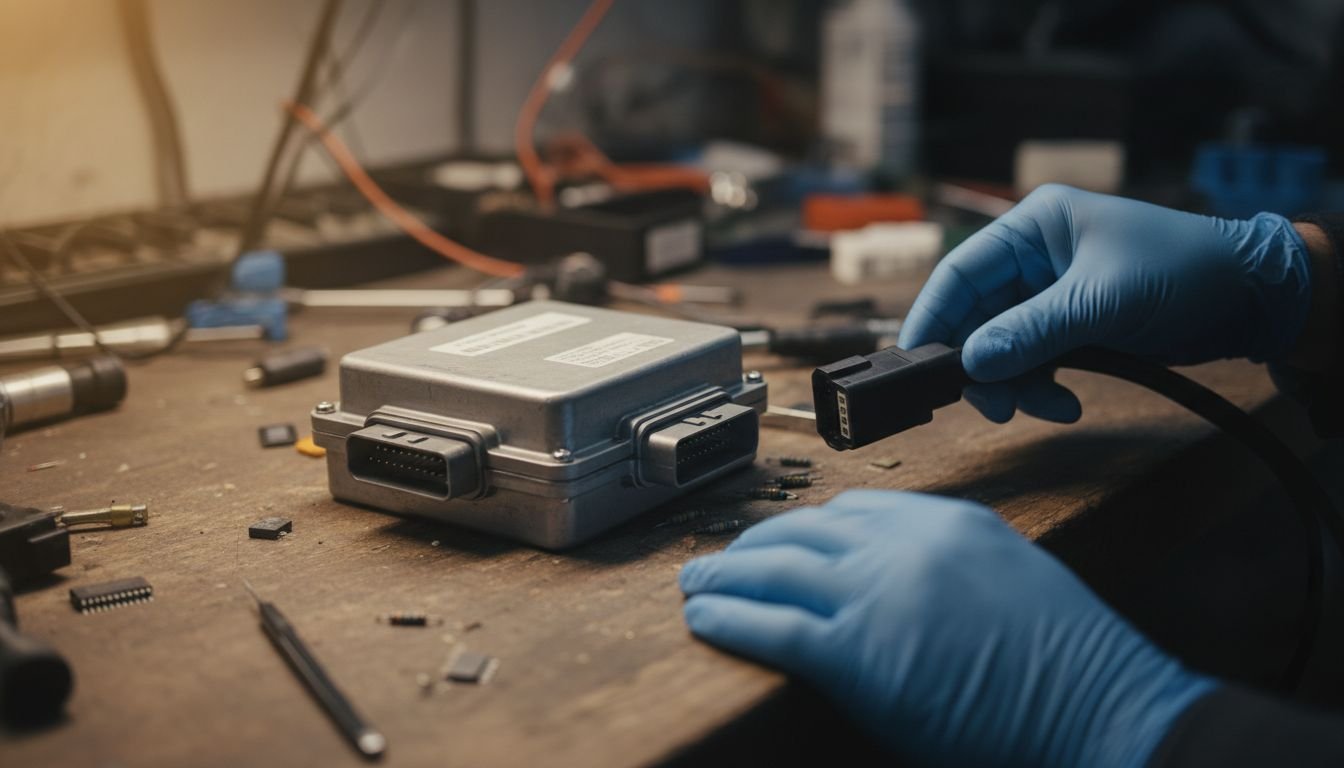
In many American and Japanese vehicles, the airbag control module (also called the SRS module or restraint control module) is the component that both deploys airbags and stores crash event data.
Why the airbag control module stores event information
The SRS module constantly monitors sensors: accelerometers, impact sensors, seat belt latches, seat occupancy sensors, and more. During a qualifying impact, it:
- Decides whether to deploy airbags or pretensioners
- Records a “snapshot” of vehicle and occupant status
- Stores this snapshot as a crash event in non-volatile memory
That stored event helps technicians understand how the restraints responded and can support post-collision diagnostics and, in some contexts, investigations.
When stored crash events can trigger the need for SRS Airbag Module Reset
After many collisions, the SRS module will log a “crash event” and may lock. Symptoms include:
- Airbag warning light staying on
- Scanner reporting a “crash event stored” or “deployment recorded” code
- Module reporting as locked or not ready for deployment
In these cases, once all required collision repairs and parts replacements have been completed, a SRS Airbag Module Reset may be appropriate. This process, when done correctly with proper equipment, clears the stored crash event data and returns the module to a normal, deploy-ready state.
Important safety point: An airbag crash data reset should only be done after:
- Deployed airbags and damaged components have been replaced
- Seat belts and pretensioners have been inspected and replaced if needed
- Any related wiring or sensor damage has been repaired
Resetting a module before or instead of those repairs is a major safety problem.
When Airbag Module Programming may also be needed after replacement or rebuild work
If the SRS module is replaced (used, new, or remanufactured), the vehicle may require:
- Airbag Module Programming to match the module to the exact VIN, configuration, and options
- Initialization or calibration procedures for seat sensors, occupancy detection, steering angle, or similar components
- Clearing of any stored configuration faults after programming
Without proper programming, a “plug-and-play” swap can leave you with incorrect deployment logic or persistent warning lights, even if the wiring and sensors are fine.
Why seat belts and pre-tensioners must be checked too
Any legitimate post-crash SRS repair must include seat belts and pre-tensioners. These devices often contain pyrotechnic (explosive) charges that fire to tighten the belt during impact.
- If pretensioners have fired, they typically need Pre-Tensioner Replacement.
- If belts are frayed, cut, stuck, or fail to retract properly, they need Seat Belt Replacement.
Resetting crash data without addressing fired pretensioners or damaged seat belts is unsafe. The restraint system is a chain; every link must be solid.
Explain what crash/event data recorders store, how that data relates to airbag modules and rebuilt/salvage vehicles, legal/privacy considerations, how shops and buyers should verify EDR history, and red flags around ‘cleared’ crash data.
Common data points that may be stored
Most EDRs in American and Japanese vehicles will focus on:
- Pre-crash speed and throttle position
- Brake use and ABS activation
- Seat belt buckled/unbuckled status
- Airbag and pretensioner deployment commands
- Impact severity (change in velocity over time)
- Some may track steering input or stability control actions
Again, this varies by year/make/model. Not all cars store the same level of detail, and some older models may not have a readable EDR at all.
Why rebuilt and salvage vehicles deserve extra scrutiny
If you’re looking at a salvage vehicle or a car with a rebuilt title, EDR and SRS history deserves special attention. Concerns include:
- Was the vehicle involved in one major collision or multiple events?
- Were all airbags, belts, pretensioners, and sensors replaced or just a few pieces?
- Was the original SRS module reset, replaced and programmed, or simply cleared with a low-level tool?
- Was the crash data reset used to restore safety functions or to hide how severe the crash was?
For buyers in Kennedale TX and across DFW, rebuilt and salvage units can be good values, but only if post-repair safety work is verified, not just cosmetic repairs.
If you want to go deeper on how modern driver-assistance systems fit into this picture, see our guide on ADAS calibration issues in salvage cars.
Legal and privacy considerations owners should understand
Crash data and EDR information comes with legal and privacy boundaries that vary by state and circumstance. Without giving legal advice, here are basic principles owners should keep in mind:
- The vehicle owner (or lessee) generally has some rights over who can access the EDR data.
- In some situations, law enforcement, insurers, or courts may obtain crash data as part of an investigation or claim.
- Downloading EDR data typically requires specialized tools and training; it is not the same as a simple OBD-II code scan.
This article is not legal advice. If you have specific questions about who can access your crash data and how it can be used, consult an attorney familiar with Texas law.
What “cleared” or reset crash data can and cannot prove
A professional airbag crash data reset can return a properly repaired SRS module to normal operating status. But a “module shows no crash data” result by itself proves very little:
- It does not prove the vehicle was never in a crash.
- It does not prove all prior damage was repaired correctly.
- It only proves that, at that point in time, the module does not have a stored crash event in its memory.
Red flag: If a seller leans heavily on “the crash data was cleared” as their main evidence of safety, but cannot show parts invoices, alignment specs, airbag/seat belt work orders, or ADAS calibration records, you should proceed with caution.
Red Flags When a Vehicle Has Had an Airbag Crash Data Reset
Seeing that a module has been reset isn’t automatically bad. The problem is when reset data is used instead of full repairs, or to paper over missing documentation.
Missing paperwork after collision repairs
If you are buying or inspecting a previously wrecked vehicle, watch for these paperwork gaps:
- No itemized estimate listing airbags, seat belts, pretensioners, and sensors that were replaced
- No documentation for SRS Airbag Module Reset or module replacement/programming
- No alignment printouts, even after major front/rear damage
- No notes on ADAS recalibration after bumper, grille, windshield, or mirror replacement
A clean-looking car with minimal documentation is a concern, especially in salvage and rebuilt title situations.
Signs the module was reset but other safety parts were ignored
Physical and functional signs that the reset may not match the actual repair quality include:
- Seat belts that are slow to retract, locked up, or make grinding noises
- Airbag covers that don’t sit flush, or mismatched color/texture compared to the rest of the interior
- Steering wheel or dash that looks recently replaced, but no matching parts invoices
- Airbag light that was on previously but is now off with no documentation of what was fixed
Any time you see a reset module with questionable restraint hardware, the vehicle needs a thorough inspection.
Why a reset alone does not confirm the vehicle is road-ready
Crash data and DTCs are only part of the safety picture. A vehicle can have:
- No stored crash event
- No current DTCs
- But still have bent structure, misaligned ADAS sensors, or compromised belts
Bottom line: A reset module can be a normal part of a proper repair, but by itself it is not proof that the car is safe.
How “airbag crash data reset” should be documented on a rebuilt vehicle
On a professionally repaired rebuilt vehicle, you ideally want to see:
- Collision repair estimate and final invoice listing restraint components replaced
- Line item for SRS Airbag Module Reset or module replacement + Airbag Module Programming
- Any Vehicle Diagnostic reports showing no active SRS codes after repairs
- Separate documentation if ADAS Calibration was performed
Clear records are a good sign that the rebuilder treated crash data reset as part of a larger, safety-focused repair, not a quick cover-up.
How Shops and Used-Car Buyers in Kennedale TX Can Verify Crash Data History
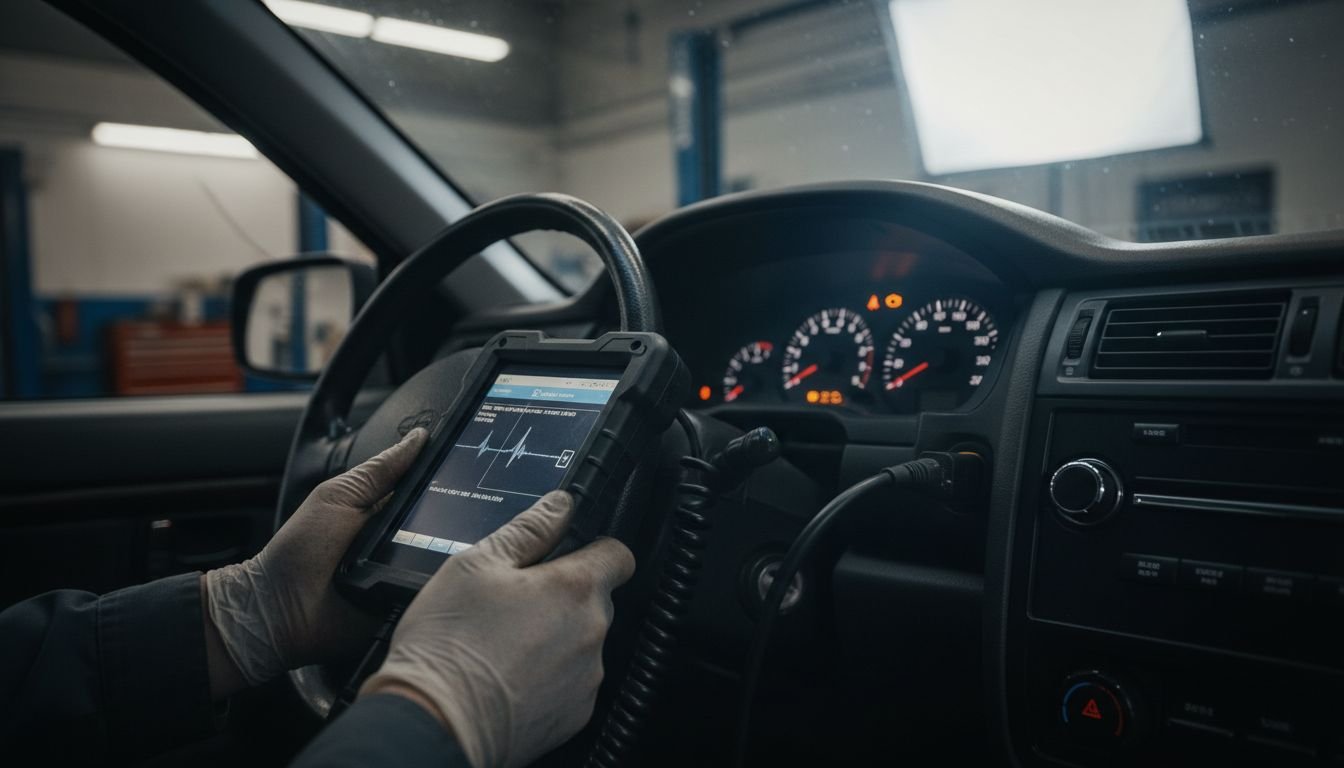
Whether you’re a local body shop, a small rebuilder, or a private buyer in Kennedale TX, you can take practical steps to verify crash and SRS history before putting a vehicle back on the road.
Questions to ask a seller, rebuilder, or repair shop
Use these questions to start the conversation:
- “What collision damage did this vehicle have, and which panels were repaired or replaced?”
- “Which airbags, seat belts, and pretensioners were replaced?”
- “Was the airbag / SRS module reset, replaced, or reprogrammed?”
- “Who performed the work, and do you have invoices or receipts?”
- “Was any ADAS Calibration performed after the repairs?”
If the seller is vague, defensive, or has no documents, that’s a sign to slow down and investigate further.
Records to request before buying a rebuilt or salvage vehicle
At a minimum, ask for:
- Body shop estimate and final bill
- Part numbers or invoices for airbags, belts, pretensioners, modules
- Any printed Vehicle Diagnostic or alignment reports
- Proof of SRS Airbag Module Reset or module programming when applicable
- Any ADAS calibration or radar/camera alignment documents
To understand how ADAS and airbag work interact, especially on local roads, you can read more about hidden ADAS and airbag issues on rural roads near Kennedale.
When a Vehicle Diagnostic helps confirm module communication and fault status
A proper Vehicle Diagnostic does more than just read generic OBD-II codes. For crash and SRS concerns, it should include:
- Connecting to the SRS/airbag module directly
- Checking for current and history codes
- Verifying module communication on the data bus
- Confirming whether a crash event is stored or the module is locked
- Verifying instrument cluster warning lights match scan results
If crash data has been cleared, this diagnostic step helps confirm whether the module is healthy and communicating, or if there are underlying issues.
When ADAS Calibration should be part of the post-repair conversation
Any collision that affects the front bumper, grille, fenders, windshield, mirrors, or rear bumper can misalign cameras and radar used for:
- Forward collision warning
- Automatic emergency braking
- Lane keep assist
- Blind spot monitoring
That’s why ADAS Calibration is often required after collision repairs, especially on late-model American and Japanese vehicles. Even if crash data has been cleared and the SRS light is off, misaligned ADAS can still put you at risk. For more detail on this topic, see how airbag and ADAS safety concerns after a Kennedale collision can persist.
DIY Risks, SRS Safety Warnings, and Why This Is Not a Guesswork Job
Modern safety systems are not a good place to experiment. There are real physical risks, not just warning lights.
Why SRS components involve explosive devices
Critical safety warning: Airbags and pretensioners contain explosive charges. Mishandling them can cause:
- Unintended deployment during service
- Serious injury from blast force or flying parts
- Fire or burns if components are shorted or overheated
This is why manufacturers publish strict procedures for disconnecting power, handling connectors, and testing circuits. Improvising with a test light or jumper wire in SRS circuits can be dangerous.
Risks of disconnecting, swapping, or probing modules incorrectly
Common risky DIY behaviors include:
- Swapping SRS modules from one vehicle to another without programming
- Probing airbag or pretensioner circuits with the wrong tools
- Bypassing seat belt buckles or occupancy sensors to “kill the light”
- Using generic scan tools that cannot properly handle crash event data
Best case, you end up with more warning lights. Worst case, you damage the system, trigger an unintended deployment, or leave the vehicle unable to protect you in a real crash.
Why improper reset procedures can leave hidden safety faults behind
Improper or incomplete reset procedures can:
- Clear visible warnings while leaving actual faults in place
- Mask history that a future technician needs for accurate diagnosis
- Leave mismatched configuration between the module and the vehicle equipment
Bottom line: SRS work is not a hobby project. If you are not trained and equipped, have a professional handle the diagnostics, reset, and programming.
When a Professional Car Crash Data Reset Service Makes Sense
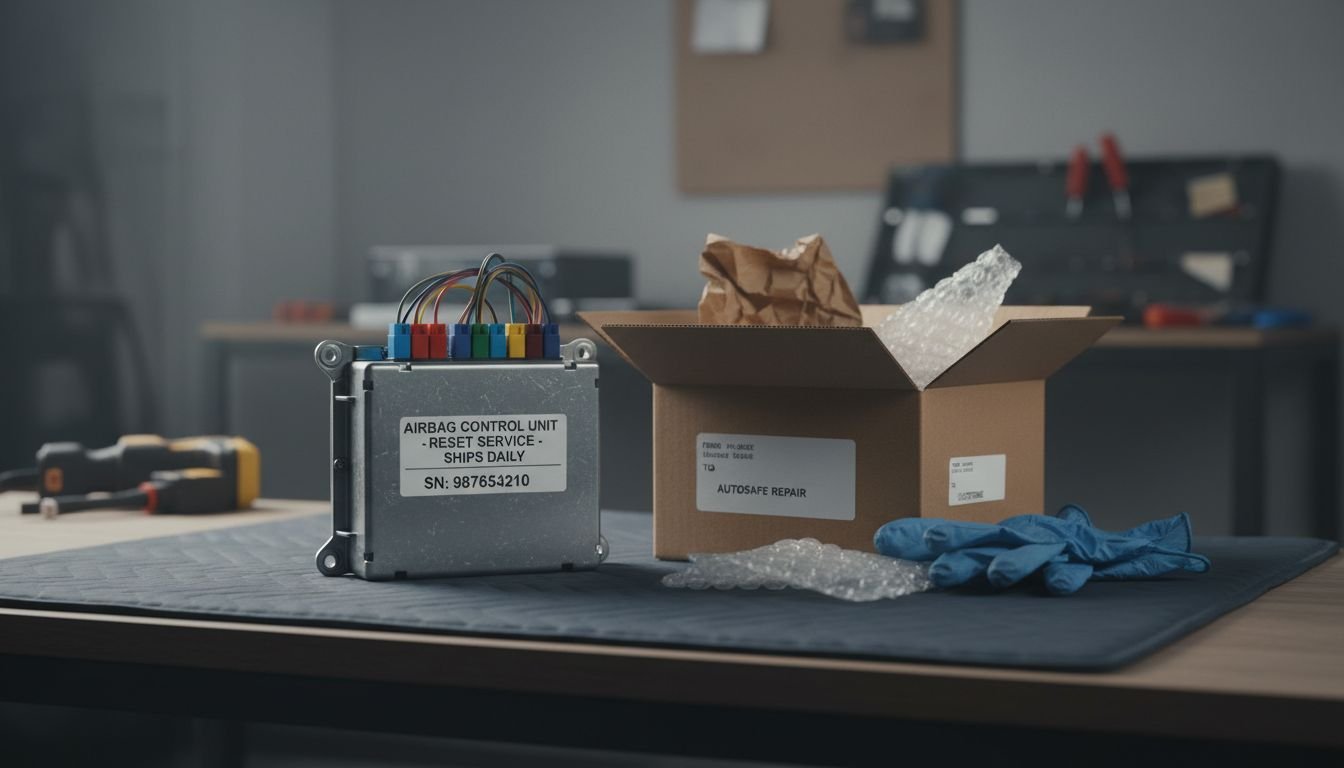
A professional car crash data reset service is appropriate in specific situations — and only as part of a complete safety strategy.
Legitimate reasons to seek a car crash data reset service
Legitimate use cases include:
- A collision has been fully and properly repaired, and the module now needs a SRS Airbag Module Reset to clear deployment history.
- A used or salvage vehicle had airbags and belts replaced, wiring repaired, and now the module must be reset to restore normal operation.
- A module is being reused in the same vehicle after repair verification, and the crash event memory needs to be cleared as part of the process.
Never use a reset to disguise missing repairs or to sell a damaged vehicle as “never wrecked.”
In-shop vs Mail-In Airbag Module Reset options
In the DFW area — including Kennedale TX and surrounding cities like Arlington, Mansfield, Fort Worth, and more — some shops can handle SRS work in person. If you’re nearby, you can look into services available through LockNCal’s Kennedale-area service page.
For owners and shops outside the immediate area, a Mail-In Airbag Module Reset option can make sense. You remove the SRS module, ship it to the service provider, and have it reset and returned using professional equipment and procedures. This is particularly useful for American and Japanese vehicles where the module is compatible with the reset equipment used.
Which vehicles are typically supported at LockNCal (American & Japanese only)
LockNCal focuses on American and Japanese vehicles. Coverage depends on the specific year and model, but generally includes many popular brands in those categories.
We do not represent support for European or German brands in this context. If you’re unsure whether a vehicle is supported, start with the VIN decoder and then contact a professional with your VIN and details.
What a proper service should include besides just clearing data
A responsible reset service should focus on safety and accuracy, not just making the light go away. That typically includes:
- Verifying the module is the correct unit for the vehicle
- Clearing crash event data with specialized equipment
- Checking for corruption or communication issues where possible
- Supporting Airbag Module Programming if a replacement module is used
- Recommending a full Vehicle Diagnostic upon reinstallation to confirm no active SRS faults remain
In many post-collision scenarios, it is also wise to discuss Seat Belt Replacement, Pre-Tensioner Replacement, and ADAS Calibration with your repair facility to ensure the entire safety system is addressed.
Final Takeaway: Crash Data Is Only One Piece of the Safety Puzzle
Crash data is a valuable tool, but it is only one piece of the safety puzzle. A proper post-collision repair on a modern American or Japanese vehicle should bring together:
- Accurate understanding of EDR / crash data when available
- Correct SRS Airbag Module Reset or replacement with Airbag Module Programming as needed
- Thorough inspection and, when required, Seat Belt Replacement and Pre-Tensioner Replacement
- Structural, suspension, and alignment verification
- Appropriate ADAS Calibration so radar, cameras, and sensors are aimed correctly
- A final Vehicle Diagnostic confirming that modules are communicating and no active SRS faults remain
Clearing crash data is not the same as repairing a crash. It should never be used to hide history or skip necessary safety work.
If you own, repair, or are considering a salvage or rebuilt vehicle in Kennedale TX or the greater DFW area — and you have questions about stored crash events, SRS lights, or module history on an American or Japanese vehicle — it may be time to schedule a Vehicle Diagnostic or ask about SRS Airbag Module Reset, Airbag Module Programming, or a Mail-In Airbag Module Reset.
FAQs About Crash Data, EDRs, and Airbag Module Resets
1. What is crash data in a car?
Crash data is the information your vehicle’s computers may store around the time of a collision, usually in an Event Data Recorder (EDR) that’s part of the airbag/SRS system. It can include speed, braking, seat belt use, and whether airbags or pretensioners were commanded to fire.
2. Does crash data stay in the airbag module forever?
Many modules will keep a recorded crash event until the module is replaced or professionally reset. Some systems only record one major event, others can store multiple. A proper SRS Airbag Module Reset or replacement with programming is usually required to clear a locked crash event.
3. Is an airbag crash data reset the same as fixing collision damage?
No. An airbag crash data reset only addresses the stored event memory in the SRS module. It does not repair bent structure, damaged wiring, deployed airbags, or fired pretensioners. Reset should come after all necessary collision and safety repairs, not instead of them.
4. What should I ask before buying a rebuilt or salvage vehicle?
Ask for repair estimates and final invoices, a list of all airbags, seat belts, pretensioners, and modules that were replaced or reset, any Vehicle Diagnostic or alignment printouts, and proof of ADAS Calibration when appropriate. If documentation is missing or unclear, consider having the vehicle professionally inspected before purchase.
5. Can a car crash data reset service hide a vehicle’s accident history?
It can certainly make the module look “clean” even though the vehicle was in a prior crash. That’s why a reset should never be used as the main proof of condition. Always look at body repairs, restraint components, and alignment/ADAS records to understand the true history and safety status.
6. Do I need a vehicle diagnostic after crash data is cleared?
Yes, a post-reset Vehicle Diagnostic is strongly recommended. It confirms the SRS module communicates correctly, checks for any remaining fault codes, and helps verify that instrument cluster warning lights match the module’s actual status.
7. Can I mail in my airbag module for reset if I’m outside DFW?
Yes, that’s where a Mail-In Airbag Module Reset option applies. For many American and Japanese vehicles, you can remove the module, ship it to a qualified service provider, have it reset using professional tools, and then reinstall it. Always follow proper SRS handling procedures and pair this with a complete safety inspection once it’s back in the vehicle.
See what to budget in our guide to our airbag module reset pricing guide.


