 Skip to content

Automotive Diagnostic Trouble Code Guide: What Your Check Engine Light Means in Denton County TX
When a warning light pops up on your dash around Denton, Lewisville, The Colony, or anywhere in Denton County TX, it can be tempting to ignore it and hope it goes away. But that check engine light code (or airbag, ABS, or traction light) is your vehicle’s way of telling you something is wrong. Understanding an automotive diagnostic trouble code (DTC) can help you decide what’s safe to drive, what’s a quick check, and what needs a professional Vehicle Diagnostic.
This guide is written specifically for drivers in Denton County TX and the greater DFW area, where North Texas heat, stop-and-go traffic, and emissions inspection requirements all play a role in how modern American and Japanese vehicles behave when a fault is stored.
If at any point you prefer to skip the guesswork, you can go straight to scheduling a professional Vehicle Diagnostic in Denton County: LockNCal Denton County TX Service Area.
What Is an Automotive Diagnostic Trouble Code?
What DTC means in plain English
An automotive diagnostic trouble code (DTC) is a standardized code stored in your vehicle’s computer when it detects a problem. Think of it as a fault area label – it tells us where the problem is being detected, not automatically which part has failed.
For example, a code that points to an oxygen sensor circuit may be caused by:
- A failing oxygen sensor
- Damaged wiring or a corroded connector
- An exhaust leak upstream of the sensor
- A problem with the engine’s fueling
The DTC gets us into the right neighborhood, but it does not, by itself, name the guilty part.
Why modern vehicles store codes
Every modern OBD-II vehicle (roughly 1996 and newer) uses multiple control modules to monitor engine, transmission, body, chassis, and safety systems. Those modules store DTCs when they detect readings outside a safe or expected range.
In DFW driving, especially in North Texas heat, common reasons modules set codes include:
- Overheating or marginal cooling system performance in summer traffic
- Age-related sensor failures in high-mileage American and Japanese vehicles
- Evaporative emissions (EVAP) issues made worse by hot fuel tanks and loose gas caps
- Electrical and wiring issues from prior collision work or accessory installs
Difference between a warning light and a confirmed fault code
A warning light on the dash is what you see. A DTC is what the vehicle’s control module stores in memory. You can have:
- A light on and multiple codes stored
- A light off but pending codes waiting to see if a problem repeats
- Permanent codes stored even after the light is off, especially for emissions-related faults
That’s why a professional Vehicle Diagnostic goes deeper than just reading a single code on a scan tool. We look at the full picture: codes, freeze-frame data, live data, and symptoms.
How OBD-II Codes Work and How to Read the Letters and Numbers
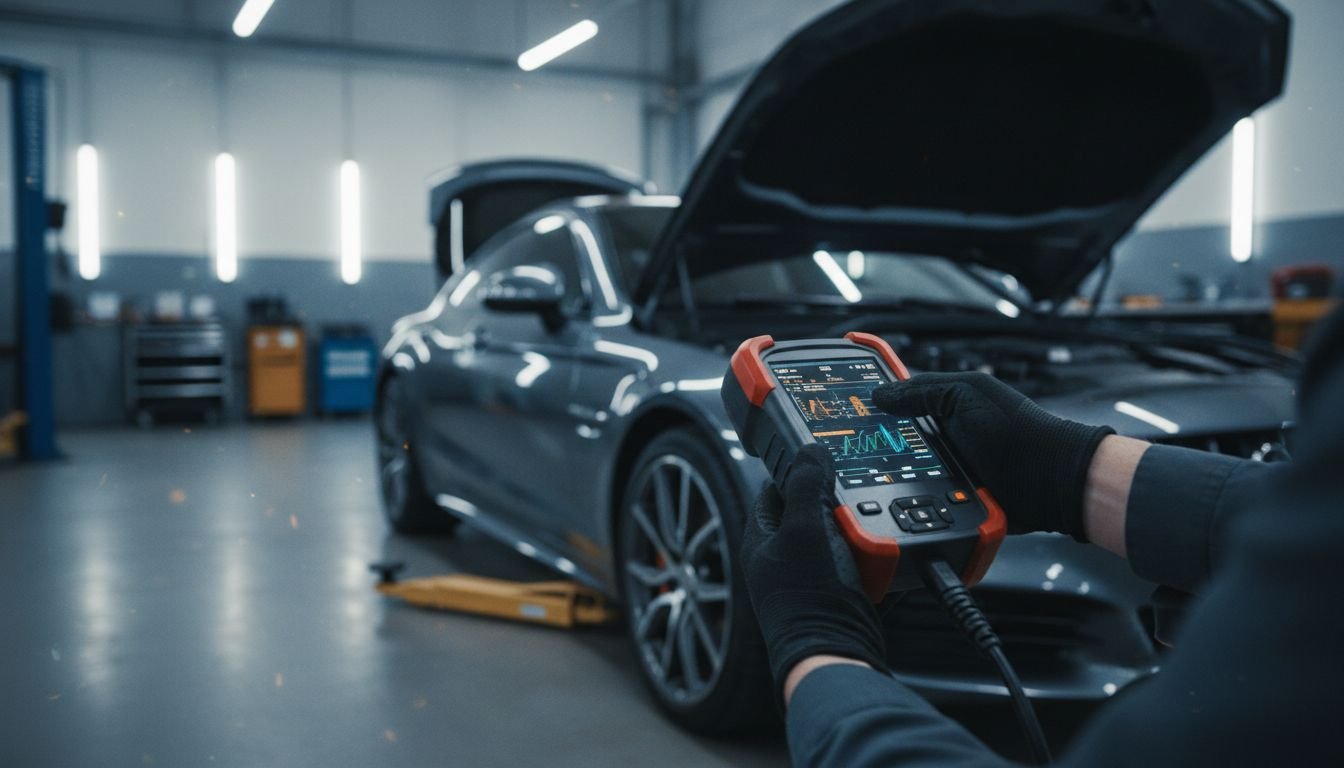
OBD-II codes all follow the same basic structure: one letter followed by four numbers, like P0300 or C0045. Once you understand the pattern, you can quickly tell which system is involved and how serious something might be.
What the first letter means: P, B, C, and U
The first letter tells you which part of the vehicle’s network the issue is coming from:
- P – Powertrain: Engine and transmission (for example, misfires, fuel system, sensors related to engine performance).
- B – Body: Interior systems like airbags, seat belts, climate control, and some comfort electronics.
- C – Chassis: ABS, traction control, steering, and suspension-related electronics.
- U – Network/Communication: Module communication issues where different control units are not talking correctly on the vehicle network.
For example, if you’d like a deeper dive into a specific chassis code, LockNCal has an article on understanding Subaru DTC C0045 and its impact on vehicle safety.
What the first number means: generic vs manufacturer-specific
The first number after the letter (the second character of the code) tells us whether the DTC is a standard OBD-II code or specific to a manufacturer:
- 0 = Generic (SAE standard). These apply across most brands. Example: P0300 (Random/Multiple Cylinder Misfire Detected).
- 1 or 2 = Manufacturer-specific. These are defined by the vehicle maker (Toyota, Honda, Ford, GM, Subaru, Nissan, etc.).
So if you see a code like P2118 on a Pontiac, that’s a manufacturer-specific DTC tied to the throttle system. LockNCal covers this in detail in our P2118 Pontiac diagnostic guide.
What the remaining digits tell you about the system and fault
The remaining three numbers narrow the fault down further:
- The second digit (third character) often points to a subsystem (fuel/air metering, ignition, emissions, etc.).
- The last two digits identify a specific condition or circuit.
Example: P0301 is a misfire on cylinder 1. P0441 is an EVAP system incorrect purge flow. They’re both powertrain codes, but they describe very different fault areas.
Why a diagnosis trouble code description is only a starting point, not a final diagnosis
A diagnosis trouble code description from a cheap scanner or phone app might say “O2 Sensor Circuit Low Voltage” or “EVAP System Leak Detected.” That does not mean the oxygen sensor or EVAP canister must be replaced. It only tells you what the module is seeing, not why.
Proper troubleshooting in Denton County or anywhere in DFW needs a full Vehicle Diagnostic with:
- Professional-grade scan tools (not just code readers)
- Live data and freeze-frame review (what the engine was doing when the code set)
- Electrical and wiring checks where needed
- Verification drives to confirm the fix
What the Check Engine Light Code Is Trying to Tell You
Not every light means the same thing, and not every DTC carries the same level of urgency. In Denton County traffic, knowing the difference can help you decide whether to head straight to a shop or safely drive home first.
Solid vs flashing check engine light
- Solid check engine light: Usually indicates a non-immediate but important fault. Examples include EVAP leaks, sensor faults, or minor performance issues. It’s generally okay to drive short-term, but you should schedule a Vehicle Diagnostic soon, especially if the light stays on or returns quickly.
- Flashing check engine light: This is typically a severe misfire or another condition that can damage the catalytic converter or engine. In this case:
– Reduce speed, avoid heavy acceleration, and safely stop as soon as practical.
– Have the vehicle inspected before continuing to drive.
Pending, stored, and permanent codes
OBD-II separates faults into several categories:
- Pending code: The module has seen something abnormal once or intermittently but is waiting to see if the fault repeats. The light may not be on yet.
- Stored code: The module has confirmed a fault and stored it in memory. The warning light may be on (current fault) or may have been on previously (historical fault).
- Permanent code: Certain emissions-related codes are flagged as permanent until the system passes specific self-tests. You can’t simply clear these with a basic scanner; the vehicle has to verify the problem is fixed.
In North Texas, it’s common for a minor issue (like a loose gas cap) to start as a pending EVAP code, then become stored or permanent if the condition repeats or is ignored.
When it may be unsafe to keep driving
You should consider it potentially unsafe to continue driving if:
- The check engine light is flashing.
- You feel severe shaking, stalling, or power loss.
- You smell raw fuel, see smoke, or notice overheating.
- Warning lights for ABS, traction, stability control, or airbags/SRS are also illuminated.
In these situations, it’s wise to minimize driving and arrange a professional Vehicle Diagnostic before the issue becomes more serious or unsafe.
Explain what DTCs are (OBD-II structure), how to decode the letters/numbers, examples of common DTCs, when a code indicates a DIY fix vs. professional service, and how DTCs relate to the check engine light.
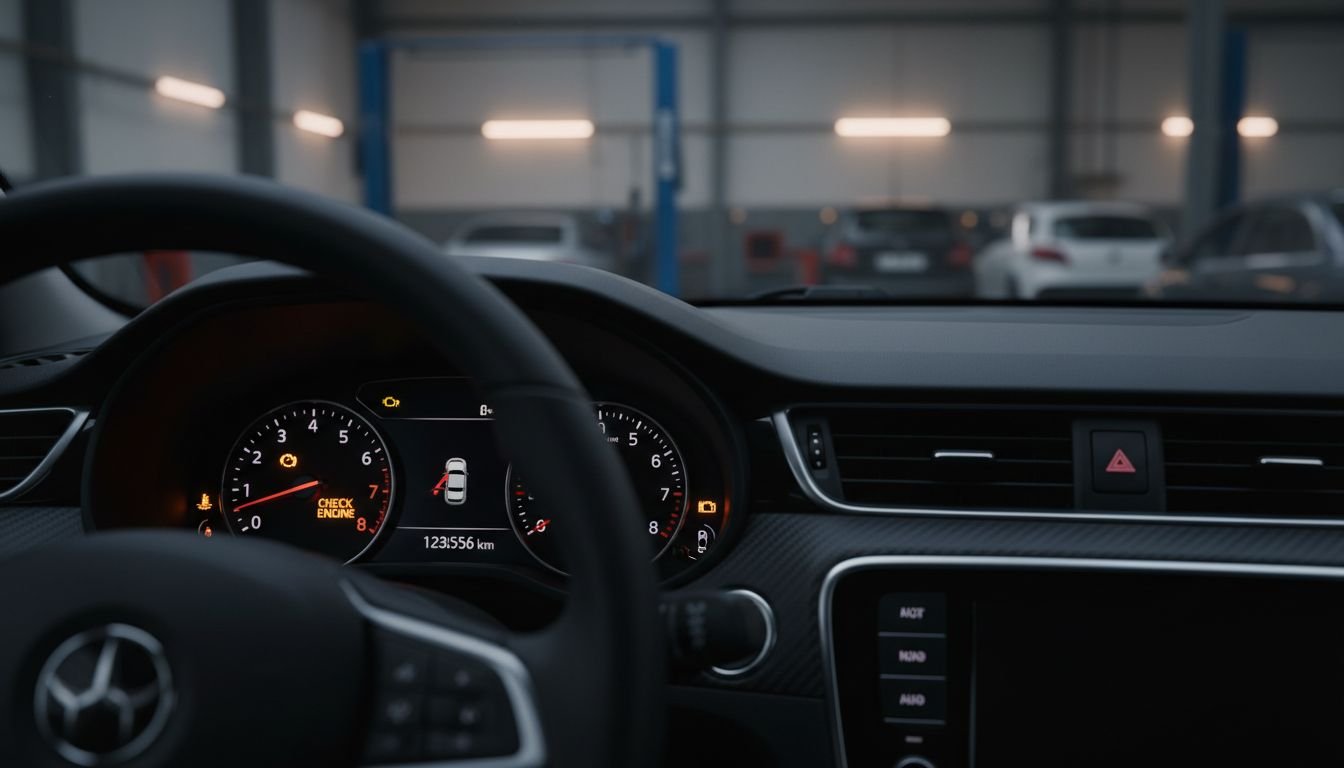
Pulling all of this together, here’s how to treat DTCs as useful information instead of panic triggers.
1. What DTCs are & OBD-II structure: Every OBD-II vehicle stores numeric and lettered fault codes whenever a monitored system goes out of range. The typical structure is P/B/C/U + 4 digits, where the letter identifies the system group, and the digits narrow down the subsystem and specific fault.
2. Decoding the letters and numbers:
- Letter: P (powertrain), B (body), C (chassis), U (network).
- First number: 0 for generic, 1 or 2 for manufacturer-specific.
- Remaining numbers: Identify subsystem and specific condition.
Examples:
- P0300 – Random/multiple cylinder misfire.
- P0446 – EVAP system vent control circuit issue.
- B00xx range – Often airbag/SRS or restraint-related on many American and Japanese vehicles.
- U0xxx – Network faults like lost communication with a specific control module.
3. When a code might be a DIY-check item:
- EVAP codes that might be caused by a loose or damaged gas cap.
- Low-voltage codes after a known weak battery or recent jump-start.
In these cases, safe DIY checks include:
- Ensuring the gas cap is tightened until it clicks.
- Noting whether the battery is older and having it tested.
4. When a code clearly needs professional service:
- Any misfire code (P0300–P030x), especially with rough running.
- Repeated catalyst efficiency or oxygen sensor codes.
- Any B, C, or U code involving ABS, airbags, seat belts, steering, or ADAS.
- Codes that come back immediately after clearing.
5. How DTCs relate to the check engine light: A confirmed powertrain-related DTC usually turns the light on. When the condition stops occurring for long enough, the light may turn off but the codes can remain stored or permanent. This is why a professional Vehicle Diagnostic looks beyond just whether the light happens to be on today.
Common Automotive Diagnostic Trouble Codes and What They Usually Mean
Below are some DTC families Denton County drivers see frequently. These are general guidelines for American and Japanese vehicles; a proper Vehicle Diagnostic is always recommended before any parts are replaced.
P0128 and cooling system-related issues
P0128 – Coolant Thermostat (Coolant Temperature Below Thermostat Regulating Temperature) usually means the engine isn’t warming up as expected. In North Texas, this might show up more in cooler months, but a weak thermostat or sensor can cause it any time of year.
Typical causes may include:
- Stuck-open thermostat
- Coolant level issues
- Cooling fan running too much or too early
- Faulty engine coolant temperature sensor
Next steps: It’s usually safe to drive short distances if the vehicle feels normal, but prolonged driving with improper operating temperature can affect fuel economy, emissions, and long-term engine life. Schedule a Vehicle Diagnostic to confirm whether the issue is with the thermostat, sensor, or another part of the cooling system.
P0300 random or multiple misfire codes
P0300 – Random/Multiple Cylinder Misfire Detected indicates that more than one cylinder is misfiring, or the pattern isn’t consistent. In Denton County stop-and-go traffic and summer heat, misfires can come from ignition components, fuel delivery, or mechanical issues.
Possible symptoms:
- Rough idle
- Shuddering under acceleration
- Poor fuel economy
- Flashing check engine light (severe misfire)
Next steps: A steady misfire needs prompt professional evaluation. Do not ignore a flashing check engine light – that can rapidly damage the catalytic converter. This is a clear case for a full Vehicle Diagnostic rather than guessing at coils, plugs, or injectors.
P0420 and trouble code po430 catalyst efficiency issues
P0420 – Catalyst System Efficiency Below Threshold (Bank 1) and P0430 – Catalyst System Efficiency Below Threshold (Bank 2) indicate the emission control system is not reaching expected performance. Some scanners display this family as trouble code po430 – the standard OBD-II spelling is P0430.
Typical causes may include:
- Worn or contaminated catalytic converter
- Exhaust leaks near the converter or O2 sensors
- Long-term misfire or fuel issues that have overheated the converter
- Faulty or slow oxygen sensors
Next steps: In many cases, the vehicle will still drive “normally,” but emissions and long-term reliability are at risk. Because these faults can interact with misfires, fueling, and exhaust leaks, a Vehicle Diagnostic is essential before assuming the converter itself is the problem. LockNCal focuses on diagnostics and module-related work, not on generic parts swaps, so our goal is to verify the root cause and document what the data actually shows.
P0441, P0446, and EVAP-related codes
EVAP system codes (like P0441 – Incorrect Purge Flow and P0446 – Vent Control Circuit) relate to fuel vapor control. In hot North Texas weather, these are very common.
Possible causes:
- Loose, damaged, or incorrect gas cap
- Leaking or cracked EVAP hoses
- Faulty purge or vent solenoid
- Wiring or connector issues
Reasonable DIY check: Ensure your gas cap is present, in good shape, and tightened fully until it clicks. If the cap was loose, it may take several drive cycles for the light to go out.
When to seek professional help: If the EVAP code comes back after verifying the gas cap, or you smell fuel, it’s time for a professional Vehicle Diagnostic. Proper EVAP diagnosis often requires smoke testing and scan data that DIY tools don’t provide.
B, C, and U codes that may point to body, chassis, communication, ADAS, or module concerns
B-codes (Body) may involve airbags, seat belts, interior electronics, or climate control. C-codes (Chassis) usually relate to ABS, traction, steering angle sensors, or suspension control. U-codes (Network) indicate module communication or network problems.
In late-model American and Japanese vehicles around Denton County, B, C, and U codes can directly affect:
- ABS and traction control (longer stopping distances, unstable braking)
- Stability control (reduced control in wet or emergency maneuvers)
- Airbags and SRS (airbags may not deploy correctly in a crash)
- ADAS features (lane departure, adaptive cruise, collision warning)
Next steps: Any time you see B, C, or U codes related to braking, steering, or restraints, treat it as a safety priority. These are not DIY-friendly systems. A Vehicle Diagnostic combined with services like ADAS Calibration, Module Programming, or Airbag Module Programming may be necessary depending on what the testing shows.
DIY Checks vs Professional Vehicle Diagnostic: How to Know the Difference
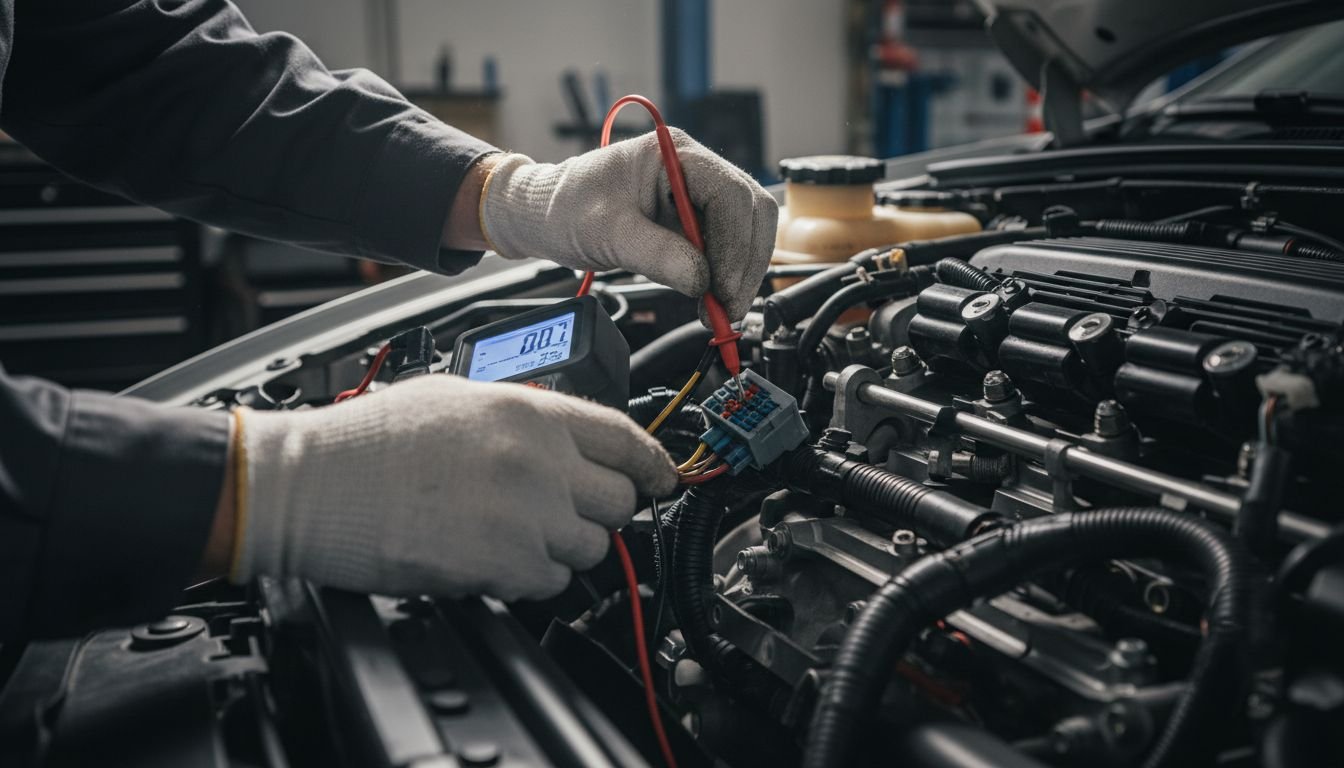
In Denton County and across DFW, many drivers use a phone app or parts store scanner to pull basic codes. That’s fine as a starting point, but it often leads to misunderstanding. Here’s a clear line between reasonable DIY checks and where you really need a full Vehicle Diagnostic.
Reasonable DIY steps, such as checking gas cap fitment or battery voltage
For most American and Japanese vehicles, safe DIY checks include:
- Gas cap: Verify it’s present, undamaged, and tightened until it clicks if you have EVAP-related codes like P0441 or P0446.
- Basic observations: Note rough idle, hard starts, fuel smells, smoke, or overheating tendencies.
- Battery/charging: If you have access to a simple voltmeter and are comfortable using it, you can check approximate battery voltage with the engine off and running (but do not attempt advanced testing if you’re unsure).
These checks don’t replace diagnosis, but they give your technician valuable information.
Problems that need scan data, smoke testing, wiring tests, or module evaluation
Situations that go beyond DIY and require a professional Vehicle Diagnostic include:
- Any misfire (P0300 series) or repeated stalling.
- Persistent catalyst efficiency or O2 sensor codes (P0420/P0430 family).
- EVAP leaks that remain after verifying the gas cap.
- Repeated B, C, or U codes, especially involving ABS, airbags, seat belts, or ADAS.
- Any codes after a collision or windshield replacement (ADAS sensors may need calibration).
These issues often require:
- Advanced scan tool data and bidirectional tests
- Electrical and wiring checks with meters or scopes
- Network diagnostics for communication (U-code) problems
- Specialized procedures like Module Programming
Why clearing codes without testing can hide the real problem
Simply clearing codes and hoping they don’t come back is not diagnosis. It erases important freeze-frame data (what the vehicle was doing when the fault occurred) and can temporarily hide symptoms, especially just before an emissions inspection in Texas.
If a fault is intermittent, clearing the code can delay proper detection until the problem is bigger – for example, running an engine with a mild misfire long enough to damage the catalytic converter.
LockNCal’s approach is to document and interpret codes, then verify the root cause through testing, not to just reset lights.
Why Some DTCs Can Point to Safety System Problems
Not all DTCs are about emissions or fuel economy. Many B, C, and U codes directly involve safety systems such as airbags (SRS), seat belts, ABS, stability control, and ADAS features.
How network, chassis, or body codes may affect driver-assist and restraint systems
On modern American and Japanese vehicles, several modules talk to each other to coordinate braking, traction, stability, and airbags. A DTC in one system can impact others. Examples:
- A steering angle sensor fault (often a C-code) can affect stability control and lane-keeping assist.
- A U-code indicating no communication with the ABS module can disable ABS and traction control.
- A B-code in the SRS module can affect airbag deployment timing or seat-belt pretensioners.
In the dense traffic and sudden stops common on I-35E through Denton County, these systems are critical. Ignoring these codes can seriously increase risk in an emergency maneuver or collision.
When ADAS-related faults may require ADAS Calibration
Advanced Driver-Assistance Systems (ADAS) – such as lane departure warning, forward collision warning, and adaptive cruise – rely on cameras, radar, and sensors that must be precisely calibrated.
After collisions, windshield replacements, suspension work, or even some alignments, ADAS-related DTCs or warning lights can indicate the need for a professional ADAS Calibration. This is not a DIY task; it requires specialized equipment, targets, and procedures to verify the system meets factory specifications.
When module-related faults may require Module Programming or Airbag Module Programming
Modern American and Japanese vehicles use multiple modules that sometimes need software updates or replacement. You might see U-codes or specific B/C-codes pointing to module internal faults or communication issues.
In these situations, a professional Vehicle Diagnostic can determine whether the next step is:
- Module Programming – Updating or configuring a replacement module so it communicates correctly on the vehicle network.
- Airbag Module Programming – Programming or configuring an SRS module following collision repair or module replacement.
When collision-related symptoms may lead to SRS Airbag Module Reset, Mail-In Airbag Module Reset, Seat Belt Replacement, or Pre-Tensioner Replacement
Collision events often trigger DTCs in the SRS system. Once deployed or triggered, components like airbags and seat belt pretensioners may set crash data and will not function correctly until properly reset or replaced.
Depending on your location and the specific SRS DTCs found during a Vehicle Diagnostic, the necessary safety-focused services may include:
- SRS Airbag Module Reset
- Mail-In Airbag Module Reset (especially helpful for customers outside the DFW area)
- Seat Belt Replacement
- Pre-Tensioner Replacement
Important safety warning: SRS components are explosive safety devices. Airbags, pretensioners, and related modules can deploy with significant force. DIY work on airbag systems is dangerous and should not be attempted. Always have SRS codes and components evaluated by a qualified professional.
What Drivers in Denton County TX Should Do After Reading a Diagnostic Trouble Code
Once you’ve pulled a code with a scanner or app in Denton County TX, here’s a practical, step-by-step process to follow.
Step 1: Record the exact code and symptoms
Write down:
- The exact DTC(s), including letter and numbers (for example, P0300, C0045).
- Any symptoms you notice: rough idle, hard starting, unusual noises, burning smell, smoke, or changes in fuel economy.
- Conditions when it happens: engine cold vs hot, on the highway vs around town, during A/C use, etc.
Step 2: Note whether the light is solid or flashing
As discussed earlier:
- Solid check engine light: Usually safe for short trips but should not be ignored.
- Flashing check engine light: Treat as urgent; minimize driving and arrange a Vehicle Diagnostic quickly.
Step 3: Avoid guessing based on one-line app descriptions
Scanner apps and basic parts-store tools can pull a code, but their one-line descriptions are often misleading. For example, an app might say “replace oxygen sensor” when the real cause is a leaking exhaust or a misfire upstream. Or it may say “airbag fault” without specifying which part of the system is affected.
Use the code description as information, not as a parts list. Let a trained technician interpret it in context with live data, service information, and real-world testing.
Step 4: Schedule a professional Vehicle Diagnostic if the code returns, affects drivability, or involves safety systems
In Denton County TX, you should schedule a Vehicle Diagnostic with LockNCal when:
- The same DTC keeps coming back after clearing.
- The vehicle runs poorly, misfires, stalls, or hesitates.
- Warning lights appear for ABS, traction, stability control, or SRS/airbags.
- You’ve recently been in a collision or had major work done (suspension, windshield, etc.).
You can get started and confirm coverage in Denton County here: LockNCal Denton County TX Vehicle Diagnostic.
How LockNCal Helps Turn a Code Into a Verified Solution
LockNCal specializes in diagnostics and module-related services for American and Japanese vehicles in Denton County and the DFW area. Our goal is to turn a confusing DTC into clear, test-based information you can act on safely.
What a professional Vehicle Diagnostic includes
While each situation is unique, a typical Vehicle Diagnostic may include:
- Pulling all DTCs from relevant modules (engine, transmission, ABS, SRS, body, etc.).
- Reviewing freeze-frame and live data related to the fault.
- Performing targeted electrical, sensor, or network tests as needed.
- Confirming or ruling out suspected causes based on test results, not guesses.
In some cases, our findings may align with prior LockNCal case studies, such as the Suzuki DTC P0965 diagnostic process in Denton County TX.
Why code reading is not the same as root-cause diagnosis
Code reading: Anyone with a cheap scanner can read and clear codes.
Root-cause diagnosis: Requires training, equipment, and a process. It includes verifying whether the fault is caused by a sensor, wiring, module software, mechanical condition, or even driver habits.
This is especially critical for safety systems like SRS and ADAS, where incorrect assumptions can leave you without proper protection in a crash.
Approved services LockNCal may provide after diagnosis
After a thorough Vehicle Diagnostic, the next steps may include services within LockNCal’s approved menu, such as:
- ADAS Calibration after repairs affecting cameras, radar, or alignment.
- Module Programming when replacing or updating control units.
- Airbag Module Programming after SRS module replacement.
- SRS Airbag Module Reset for crash data or related events.
- Mail-In Airbag Module Reset for customers outside the DFW service radius.
- Seat Belt Replacement or Pre-Tensioner Replacement when indicated by SRS diagnostics.
Any recommended action is based on test results and OEM-level information, not guesswork.
Final Takeaway: Don’t Panic Over a Code—Verify It Properly
When a warning light turns on in Denton County TX – whether you’re in Denton, Lewisville, Flower Mound, or nearby – the most important step is not to panic, and not to guess.
An automotive diagnostic trouble code is a starting point, not a verdict. It tells you where to look, not automatically which part to replace. Some issues may be as simple as tightening a gas cap; others involve complex safety systems and SRS components that are explosive safety devices and must be handled professionally.
If your DTC is recurring, affects drivability, involves ABS or airbags, or you simply don’t feel confident driving the vehicle, schedule a professional Vehicle Diagnostic. LockNCal is here to turn confusing codes into clear, test-backed answers for American and Japanese vehicles in Denton County and across DFW.
Want to confirm exactly what your vehicle left the factory with before you start looking at codes? Use the LockNCal VIN Decoder to pull detailed information from your VIN.
FAQs
1. What is an automotive diagnostic trouble code?
An automotive diagnostic trouble code (DTC) is a standardized code stored by your vehicle’s control modules when they detect a fault. It identifies a fault area or condition, not automatically the failed part. A professional Vehicle Diagnostic is needed to confirm the real cause.
2. What does a check engine light code mean?
A check engine light code is a specific DTC related to powertrain (engine or transmission) performance or emissions. It can range from relatively minor issues, like an EVAP leak, to serious misfires that can damage the engine or catalytic converter. The code itself is a starting point for diagnosis, not a final answer.
3. What is the difference between a pending code and a stored code?
A pending code is a fault the computer has seen once or intermittently but hasn’t fully confirmed yet; the warning light may not be on. A stored code is a confirmed fault that has met the criteria to be considered a problem. Stored codes may remain even after the light turns off, and some become permanent codes until the system proves the fault is truly gone.
4. Can I keep driving with a DTC showing?
It depends on the code and symptoms. If the light is solid and the vehicle drives normally, short-term driving is often safe, but you should schedule a Vehicle Diagnostic soon. If the light is flashing, or you notice severe misfires, stalling, overheating, or safety-system warnings (ABS, SRS, etc.), reduce driving and have the vehicle inspected as soon as possible.
5. What does trouble code po430 mean?
Trouble code po430 (properly written as P0430) indicates that the catalytic converter on Bank 2 is not meeting expected efficiency levels. Causes can range from converter wear or damage to upstream issues like misfires or fueling problems. Because it affects emissions and long-term reliability, it should be evaluated with a professional Vehicle Diagnostic rather than guessing.
6. Can I clear a code myself, and should I?
Most basic scanners or apps allow you to clear codes, but clearing a code is not fixing the problem. It erases valuable diagnostic information and can temporarily hide an issue until it comes back, sometimes worse. It’s usually better to record the code, schedule diagnosis, and let a technician clear codes only after the root cause has been addressed.
7. When should I schedule a professional Vehicle Diagnostic in Denton County TX?
You should schedule a Vehicle Diagnostic with LockNCal in Denton County TX when:
- The same DTC returns after clearing.
- The vehicle runs poorly, misfires, or stalls.
- You have warning lights for ABS, traction, stability control, or airbags/SRS.
- You’ve experienced a collision or major repair and now have new warning lights.
Any suspected airbag, seat belt pretensioner, or ADAS issue should always be professionally evaluated, because SRS components are explosive safety devices and DIY work is risky.
To confirm service availability in your area, visit: LockNCal Denton County TX.


