 Skip to content

Blind Spot Sensor Calibration in Dallas–Fort Worth | ADAS Radar & Camera Alignment Services
Key Takeaways
– Blind spot sensor calibration ensures your radar and camera-based blind spot monitoring system sees vehicles where they actually are, not where the car thinks they are.
– Miscalibrated blind spot sensors can cause no warning, late warning, or constant false alerts, especially after collisions, bumper work, or suspension/alignment changes.
– LockNCal provides ADAS Calibration (including blind spot sensor calibration) for American & Japanese vehicles in DFW, with both mobile support for shops and in-shop service options.Driver-assist systems usually need recalibration after a repair — our professional ADAS calibration comes to you across Dallas–Fort Worth.
LockNCal calibrates cameras and radar on-site across Dallas–Fort Worth. See what ADAS calibration costs. On-site: $0 today, pay after the job. Book mobile ADAS calibration or call (469) 277-7277.
In This Guide:
💡 What Blind Spot Sensor Calibration Actually Is – Plain-language overview tied to your ADAS radar/camera systems
⚠️ Symptoms and Dangers of Miscalibrated Blind Spot Sensors – How to know there’s a problem and what can happen if you ignore it
🛠️ How Blind Spot Sensor Calibration Is Performed – Step-by-step look at our ADAS Calibration process in DFW
💰 Blind Spot Calibration Cost and Time in DFW – What most drivers and shops pay and how long it takes
🚐 Mobile vs In-Shop Calibration: What’s Best for You – When we come to your shop vs when you come to us
✅ Why LockNCal for ADAS & Blind Spot Calibration in DFW – Certifications, documentation, and safety focus
📍 Blind Spot Calibration Service Near Rockwall TX and DFW – Local areas we serve around Dallas–Fort Worth
❓ FAQs About Blind Spot Sensor Calibration – Quick answers for drivers and body shops
On crowded DFW highways like I-30, I-35, I-20, 635, and George Bush, you depend on your blind spot monitoring every time you change lanes. When your alerts don’t match what you see in your mirrors, blind spot sensor calibration becomes a critical safety issue, not a convenience feature. As an ADAS-focused shop, we help Dallas–Fort Worth drivers and local body/mechanical shops get these systems calibrated correctly before vehicles go back into heavy traffic.
What Blind Spot Sensor Calibration Actually Is
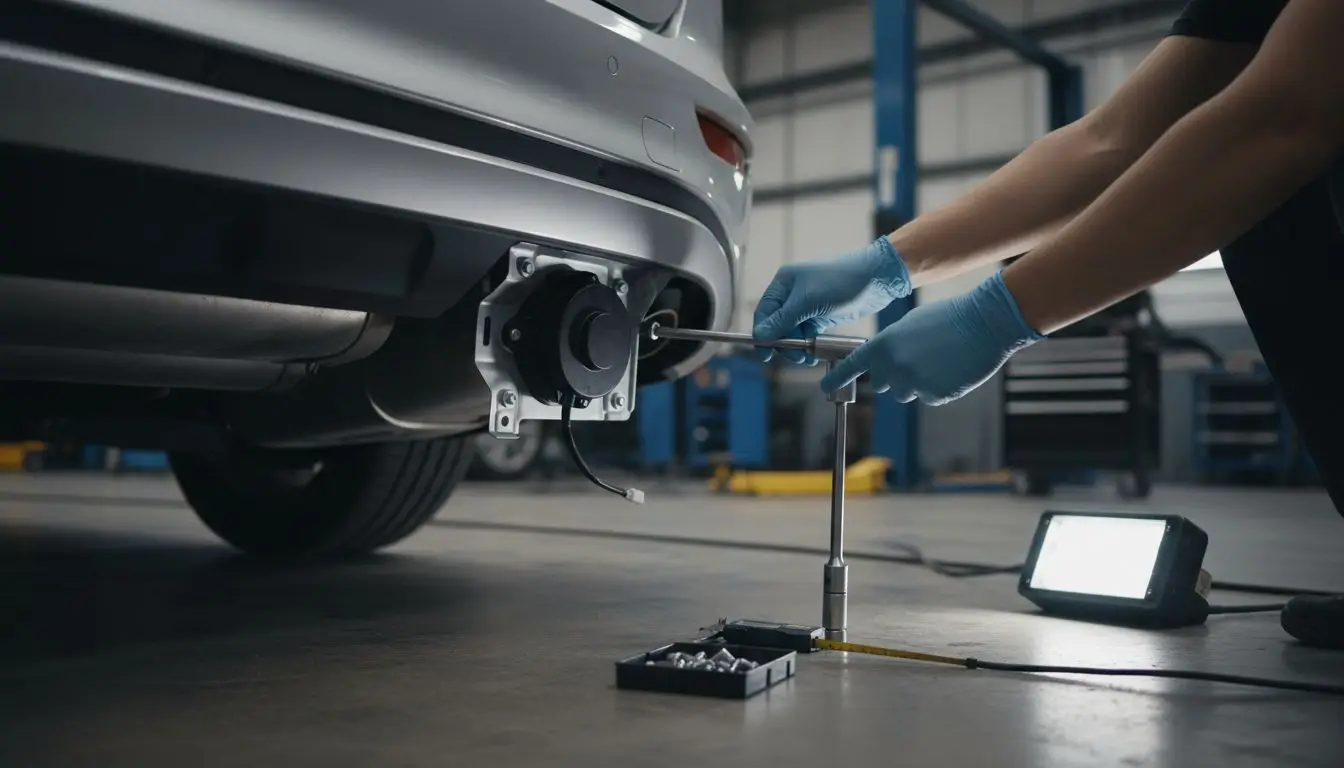
Blind spot sensor calibration is the process of teaching your vehicle’s computer exactly where the rear or side radar sensors sit in relation to the car. The goal is simple: when another vehicle is in your blind spot, the warning in your mirror or on the A-pillar triggers at the right time and in the right place. If the sensor’s aim is off by even a few degrees, your blind spot system can miss vehicles completely or keep warning when the lane is clear.
Most modern blind spot systems rely on rear/side radar units mounted behind the bumper cover, quarter panel, or in the tailgate. Some vehicles also blend that radar data with rear or side ADAS camera calibration to support features like rear cross-traffic alert and lane-keep assist. All of this rolls up under a broader ADAS Calibration process, where we calibrate radar and cameras so the entire safety suite is aligned.
You may hear terms like radar calibration, ADAS recalibration, or even OEM-specific phrases such as Honda radar calibration. They all refer to the same core idea: making sure your sensors and cameras point exactly where the manufacturer intended, so the car’s software can make correct decisions about surrounding traffic.
Symptoms and Dangers of Miscalibrated Blind Spot Sensors
Common Symptoms Drivers Notice
Most drivers sense something is off with their blind spot system long before it completely fails. Your vehicle might still drive normally, but the alerts feel wrong or inconsistent. If you notice any of the following, it is time to consider ADAS Calibration focused on blind spot sensors.
- Blind spot icons flickering, staying on constantly, or only working on one side.
- Messages like “Blind Spot System Fault,” “BSM System Needs Service,” or similar warnings in the cluster.
- No alert even when a vehicle is clearly in the blind spot for several seconds.
- Constant false warnings on an empty lane or when vehicles are far away.
- Blind spot or rear cross-traffic alerts acting differently after body work, suspension work, or a curb hit.
The Safety Risks on DFW Roads
On high-speed lanes around Dallas, Fort Worth, Arlington, Plano, and Rockwall, a miscalibrated blind spot system is more than an annoyance. It can give you false confidence that the lane is clear when it isn’t. That risk is highest during quick lane changes on I-30, 635, or George Bush when traffic is dense and gaps are tight.
Side-swipe collisions often happen when drivers rely on a warning that never comes or assume a persistent warning is “just being sensitive.” In heavy rain, at night, or when you are fatigued, that extra layer of ADAS protection matters even more. After a crash, insurance adjusters and attorneys may also look at whether ADAS was properly calibrated, so having proof of blind spot sensor calibration can help protect you and your repair shop from liability questions.
Safety warning: A miscalibrated blind spot or ADAS system can be just as dangerous as having no system at all. If your vehicle is asking for service or acting unpredictably, do not ignore it before driving long distances or putting it back on busy DFW freeways.
When Your Blind Spot System MUST Be Recalibrated
After Collisions and Body Work
Any time your vehicle takes a hit near the rear or side, your blind spot radar position can change even if the damage looks minor. Repairs around the bumper, quarter panel, or tailgate often involve removing or disturbing the radar brackets and wiring. That means the system needs blind spot sensor calibration before it can be trusted again.
- Rear- or side-impact collisions, even at low speeds.
- Bumper covers, quarter panels, or tailgates replaced, repaired, or repainted.
- Radar sensor or bracket replacement after damage or corrosion.
- Any situation where collision repairs left your safety sensors miscalibrated or out of position.
Even if the body gaps look perfect, the radar behind the plastic may now be pointed a few degrees high, low, or sideways. The vehicle’s ADAS computer does not know that until you complete a proper ADAS recalibration session.
After Suspension, Alignment, or Wheel Changes
Blind spot radar expects the vehicle to sit at a certain height and angle. Major suspension or alignment work can change that geometry and shift the sensors’ aim relative to the road. That is why many OEMs call for ADAS Calibration after specific chassis repairs.
- Subframe drops for engine, transmission, or suspension work.
- Major suspension component replacement or ride height changes.
- Four-wheel alignment after a hard impact or curb strike.
- Events like hitting a curb in Rockwall TX hard enough to bend a wheel or control arm.
Once angles change, the radar may see too much road surface or point into the next lane incorrectly. Blind spot sensor calibration recenters the radar view so lane-change alerts make sense again.
Dash Warnings and DTCs
If your dash shows a blind spot or ADAS warning, the vehicle has usually stored one or more diagnostic trouble codes (DTCs). The first step is a professional Vehicle Diagnostic scan to see exactly which modules are complaining and why. This is especially important on American models such as Chevrolet, where ADAS-related codes like those discussed in why DTC P0609 matters for Chevrolet owners can point to communication and sensor issues.
During a Vehicle Diagnostic, we verify whether the problem is calibration-related, sensor-related, or wiring-related. If the underlying hardware is intact and communication is healthy, we proceed with ADAS recalibration for the blind spot system and any related radar or camera modules.
How Blind Spot Sensor Calibration Is Performed (Step-by-Step)
Pre-Calibration Vehicle Diagnostic & Setup
Every blind spot sensor calibration starts with a thorough Vehicle Diagnostic. We connect professional scan equipment, check all ADAS modules for DTCs, and confirm that power, communication, and sensor status are normal. If the car is not ready—due to low battery voltage, stored crash events, or active faults—we address those prerequisites before moving forward.
Next, we prepare the vehicle and work area. That includes parking on a perfectly level surface, confirming correct tire size and pressure, checking fuel level when required, and making sure the vehicle is at normal ride height with no heavy cargo. Small details here matter, because they directly affect the angles used during radar calibration.
Important safety warning: Blind spot and ADAS modules often sit near SRS components such as airbags and seat belt pretensioners, which contain explosive charges. DIY attempts to remove bumpers, interior panels, or modules near these systems can be dangerous and can accidentally deploy airbags or damage safety equipment. Calibration and related work should be handled only by trained technicians like ours at LockNCal.
Static vs Dynamic Radar Calibration
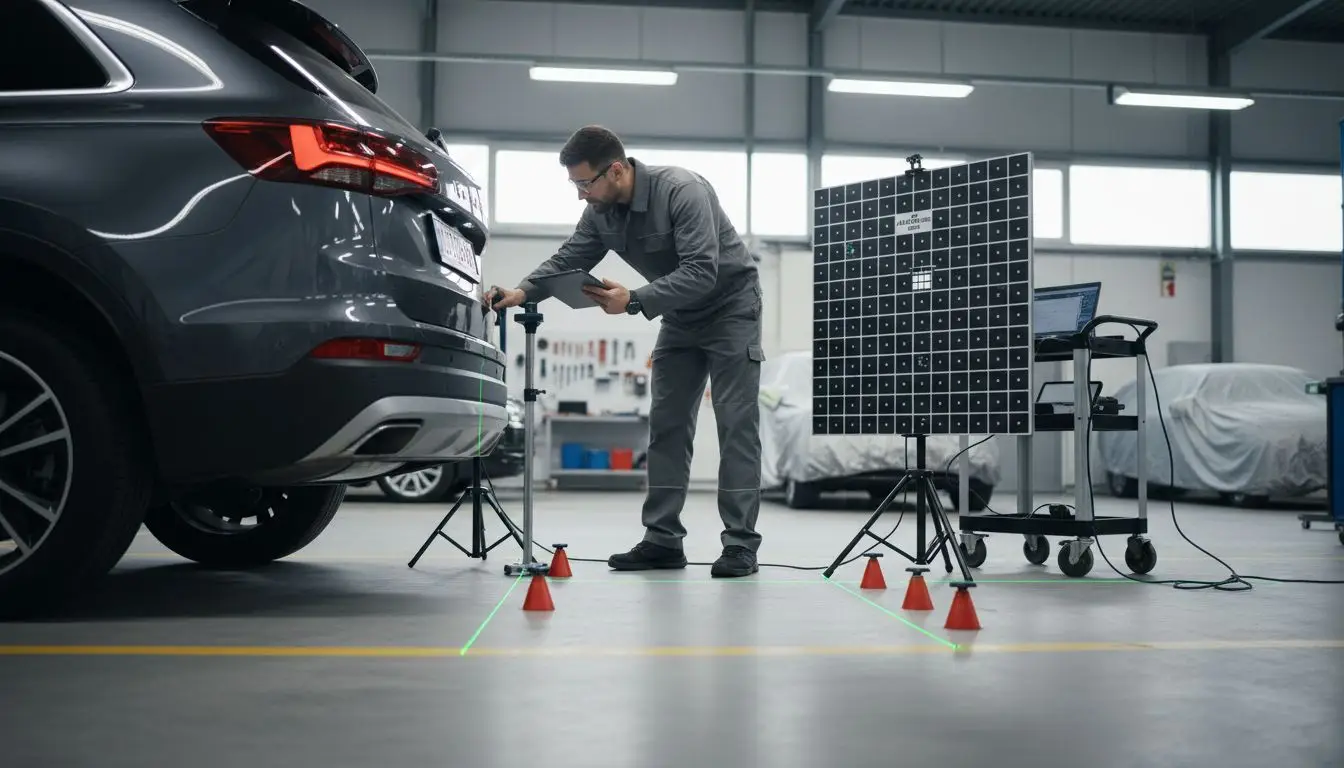
Depending on the vehicle, radar calibration may be static, dynamic, or both. In a static procedure, we set up specialized targets, reflectors, and measurement tools behind or beside the vehicle at precise distances and angles. The scan tool then guides us as the car learns exactly where the blind spot radar sensors are aimed.
Dynamic ADAS recalibration involves a controlled road test at specific speeds under defined conditions. The vehicle uses real-world traffic and lane information to fine-tune the radar alignment and confirm system performance. Some manufacturers require a combination of static and dynamic steps for the blind spot system to fully complete calibration.
Certain brands, such as Honda, have very strict Honda radar calibration requirements after bumper replacement or sensor movement. While we are not a Honda factory dealer, we follow OEM procedures and use professional equipment to calibrate radar modules to specification as part of a complete ADAS Calibration session.
ADAS Camera Calibration and System Integration
Many vehicles share data between blind spot radar, rear cameras, lane-keep cameras, and rear cross-traffic alert systems. That means a proper blind spot sensor calibration may also involve ADAS camera calibration so the entire safety suite agrees on what is happening around the car. If the cameras and radar do not align, you can get inconsistent warnings or “system unavailable” messages.
During a full ADAS Calibration, we follow OEM procedures to calibrate all involved systems on American and Japanese vehicles we service. That may include front radar, rear radar, surround-view cameras, and lane-keep cameras, depending on what your repair or collision affected. Our goal is a vehicle that not only clears codes but also behaves predictably in real-world DFW traffic.
Post-Calibration Verification and Documentation
Once calibration completes, we re-run Vehicle Diagnostic scans to confirm that all related modules show “calibrated” or “completed” status and no new DTCs are present. When dynamic driving is required, we verify blind spot alerts, rear cross-traffic, and related functions on the road where it is safe to do so. Any residual issues are investigated before the vehicle is released.
LockNCal provides calibration and diagnostic reports for every ADAS Calibration service. These documents are important for drivers, body shops, mechanical shops, and insurance companies as proof that required procedures were completed. Proper documentation also helps protect everyone involved if there are questions about ADAS performance after a future incident.
Blind Spot Calibration Cost and Time in DFW
Most blind spot and related ADAS Calibration procedures take about 1–3 hours, depending on vehicle complexity and how many systems were disturbed during repair. Static-only calibrations are typically on the shorter side, while multi-system or static-plus-dynamic procedures can take longer. Extra time may also be needed if initial Vehicle Diagnostic scans reveal additional ADAS faults.
In the Dallas–Fort Worth market, most blind spot sensor calibration jobs generally start around $200–$300 for a basic single-system calibration. When combined with full ADAS Calibration and extended Vehicle Diagnostic work across multiple systems, total costs often range up to $400–$700, depending on the make, model, and number of modules that require calibration.
Several factors influence final price:
- Vehicle make, model, and year (high-end and newer vehicles often have more complex ADAS suites).
- How many systems need calibration (rear blind spot radar only vs. blind spot, front radar, and cameras together).
- Whether Vehicle Diagnostic reveals additional DTCs or communication issues that must be addressed first.
- Whether the procedure is mobile at a shop or in our controlled in-shop environment.
We focus on clear, upfront quotes once we understand your vehicle, the type of repair completed, and any warning messages you are seeing. Contact us with your VIN (or use our online VIN decoder) and repair details so we can give you an accurate estimate before you schedule.
Mobile vs In-Shop Blind Spot Calibration: What’s Best for You
Mobile ADAS Calibration for DFW Body & Mechanical Shops
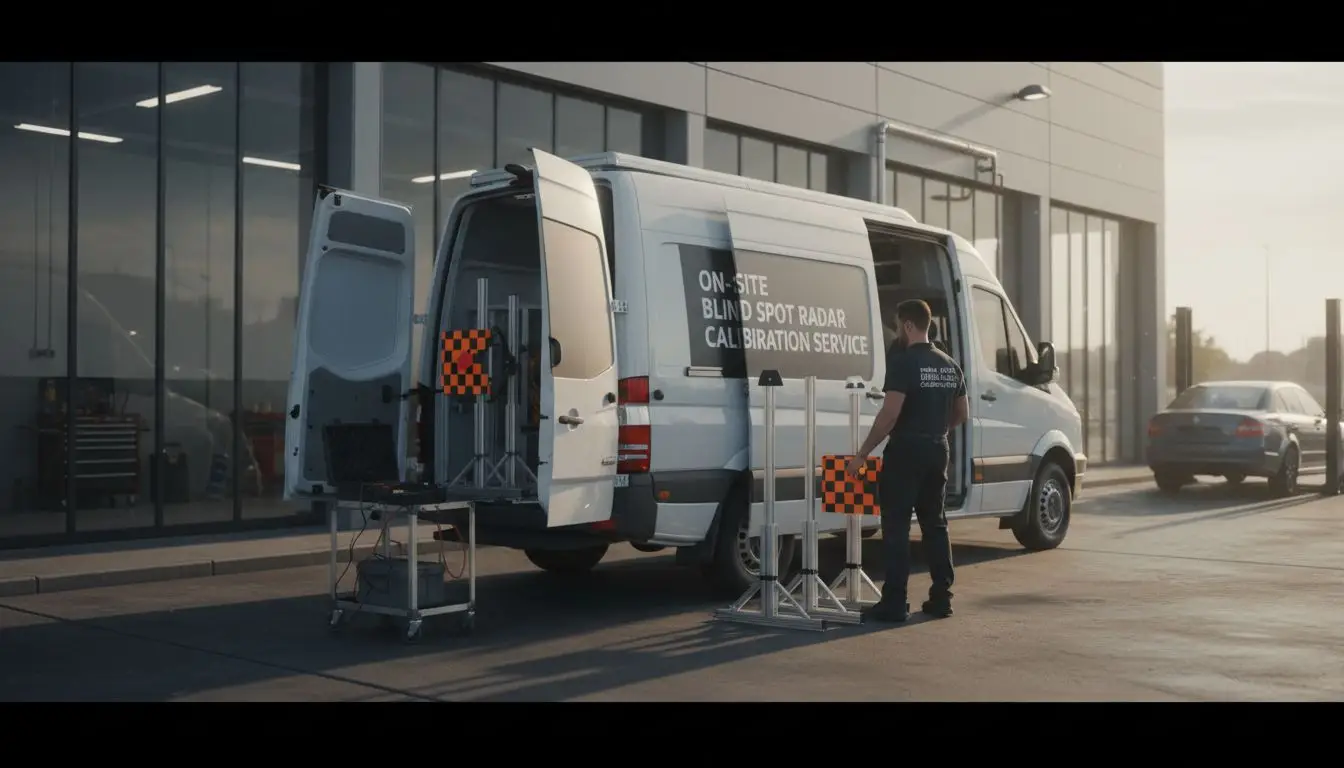
Many body and mechanical shops across the Metroplex prefer to keep vehicles on-site and bring in an ADAS specialist. LockNCal offers mobile ADAS Calibration services for qualifying locations in Dallas County, Tarrant County, Denton County, Collin County, Rockwall County, and nearby cities. This is ideal when you want a vehicle calibrated and delivered back to the customer without additional transport.
Mobile blind spot sensor calibration works best when the repair facility can provide:
- A level, obstruction-free floor with enough room behind and beside the vehicle.
- Consistent lighting and power for equipment.
- A vehicle that is fully reassembled, aligned, and ready for calibration.
This option is particularly helpful for freshly repaired vehicles, dealership overflow, and fleet accounts that need efficient turnaround while maintaining strict safety standards.
When In-Shop Calibration Is the Safer Choice
Some vehicles and situations are better handled in a controlled shop environment. If multiple ADAS systems require work—such as blind spot radar, front radar, and cameras all at once—our in-house setup allows faster changes between target configurations and more precise measurements. This can save time and reduce the chance of repeat calibrations.
In-shop service is also recommended when:
- Extended Vehicle Diagnostic time is needed to trace communication issues or complex DTC stacks.
- The repair facility’s floor is not sufficiently level or space is too tight around the vehicle.
- Weather or lighting conditions could interfere with camera or radar targeting.
If you are unsure which option is best for your situation, call us to review your vehicle, the repairs completed, and your location. We will recommend mobile or in-shop ADAS Calibration based on safety and accuracy first, then convenience.
Why LockNCal for ADAS & Blind Spot Calibration in DFW
Safety-First Philosophy
Everything we do at LockNCal starts with a safety-first mindset. Blind spot monitoring, lane-keep assist, and automatic braking are not just technology features—they are critical safety layers that protect families on I-30, I-20, and other DFW corridors. We treat every blind spot sensor calibration as a safety procedure, not a checkbox.
Our technicians are trained to work around SRS explosive components such as airbags and seat belt pretensioners. We respect OEM procedures for disabling and re-enabling these systems when necessary. This careful approach reduces the risk of accidental deployment, damage, or latent safety issues after repairs.
Specialization in ADAS Calibration and Vehicle Diagnostic
LockNCal focuses on ADAS Calibration and Vehicle Diagnostic services for American and Japanese vehicles. We invest in professional-grade scan tools, targets, and measurement systems rather than generic, one-size-fits-all setups. That specialization matters when you are trusting us with complex systems like blind spot, forward collision, and lane-keep assist.
By following OEM procedures where applicable and verifying results through post-calibration scans, we help ensure that your radar and cameras are functioning as designed. Whether you need to calibrate radar after bumper work or complete an ADAS recalibration after a multi-system collision repair, we tailor the process to your specific vehicle.
Documentation, Insurance Support, and Shop Partnerships
We understand what local insurers, adjusters, and shops expect to see after ADAS work. Every blind spot sensor calibration and broader ADAS Calibration includes documentation showing procedures performed, DTC status before and after, and calibration completion. This helps streamline supplements, reduce comebacks, and protect your shop’s reputation.
Many body shops and mechanical shops across Dallas TX, Fort Worth TX, Arlington TX, Plano TX, Garland TX, Mesquite TX, Irving TX, Carrollton TX, Frisco TX, McKinney TX, Rockwall TX, and the rest of our service area rely on us as their ADAS partner. We coordinate scheduling, share reports, and support you in explaining ADAS requirements to your own customers.
Blind Spot Calibration Service Near Rockwall TX and DFW
LockNCal provides blind spot sensor calibration and full ADAS Calibration across much of the Dallas–Fort Worth Metroplex. Our service area includes Addison TX, Allen TX, Anna TX, Arlington TX, Burleson TX, Carrollton TX, Cedar Hill TX, Celina TX, Colleyville TX, Coppell TX, Dallas TX, Denton TX, DeSoto TX, Duncanville TX, Euless TX, Farmers Branch TX, Flower Mound TX, Fort Worth TX, Frisco TX, Garland TX, Grand Prairie TX, Grapevine TX, Haltom City TX, Highland Park TX, Hurst TX, Hutchins TX, Irving TX, Kennedale TX, Lake Dallas TX, Lake Worth TX, Lancaster TX, Lewisville TX, Little Elm TX, Mansfield TX, McKinney TX, Melissa TX, Mesquite TX, North Richland Hills TX, Pantego TX, Plano TX, Prosper TX, Richardson TX, Richland Hills TX, Rockwall TX, Rockwall County TX, Saginaw TX, Seagoville TX, Southlake TX, Tarrant County TX, The Colony TX, Trophy Club TX, University Park TX, Watauga TX, White Settlement TX, and Wilmer TX.
For example, a driver in Rockwall TX may get rear-ended on I-30 near Lake Ray Hubbard, have the rear bumper and sensors replaced, and then see blind spot or rear cross-traffic warnings on the dash. Before that vehicle goes back into the daily commute toward Dallas or Garland, it needs a proper blind spot sensor calibration as part of a complete ADAS Calibration session.
If you are in or near Rockwall, you can learn more about our local services on our dedicated page at https://lockncal.com/Rockwall-TX. Whether you are a driver or a shop, we recommend scheduling Vehicle Diagnostic and calibration before putting the vehicle back into heavy Metroplex traffic.
FAQs About Blind Spot Sensor Calibration
What is blind spot sensor calibration?
Blind spot sensor calibration is the process of aligning your vehicle’s rear/side radar sensors (and sometimes supporting cameras) with the exact position and geometry of the car. During ADAS Calibration, we use specialized tools and scan procedures so the vehicle’s computer “learns” where the sensors are pointing, ensuring that blind spot warnings match real-world traffic instead of an outdated or incorrect reference.
When do I need blind spot sensor calibration after a repair?
You typically need calibration any time work is done near the blind spot radar or anything that changes vehicle geometry. That includes collisions, bumper or quarter panel replacement, sensor or bracket replacement, subframe or suspension work, wheel alignments after hard impacts, curb strikes, and any time you see blind spot or ADAS warning messages on your dash.
Is it safe to drive if my blind spot system says “Service Required”?
Your vehicle may still drive normally, but relying on a malfunctioning blind spot system is not safe. A missing, late, or false warning can lead to side-swipe collisions during lane changes, especially on fast-moving roads like I-30, I-35, or 635 in DFW.
If you see “Service Required” or similar messages, schedule a Vehicle Diagnostic and ADAS Calibration as soon as possible, particularly before long trips or daily highway commuting.
How much does blind spot sensor calibration cost in DFW?
Most blind spot sensor calibration services in the Dallas–Fort Worth area start around $200–$300 for a single-system calibration. When combined with full ADAS Calibration and more extensive Vehicle Diagnostic work, total costs commonly range up to $400–$700, depending on the vehicle and number of systems involved.
For an exact quote, contact us with your VIN, repair details, and any dash messages you are seeing so we can price your specific situation accurately.
Can a regular body shop handle blind spot sensor calibration, or do I need a specialist?
Some body and mechanical shops have their own ADAS equipment and may handle basic calibrations in-house. However, many DFW shops partner with specialists like LockNCal for ADAS Calibration and Vehicle Diagnostic because of the precision equipment, training, and documentation required.
Given the safety implications and proximity to SRS explosive components, we strongly recommend using an ADAS-focused specialist for blind spot, radar, and camera calibration rather than treating it as a generic shop task.
Call to Schedule Your Blind Spot Sensor Calibration in DFW
If your blind spot system is showing warnings, acting strangely, or has been affected by recent repairs, now is the time to address it. The combination of dense traffic, high speeds, and complex interchanges across Dallas–Fort Worth makes a properly calibrated blind spot system a critical safety tool, not an optional convenience.
Contact LockNCal today to schedule:
- ADAS Calibration – including blind spot, radar, and camera systems.
- Vehicle Diagnostic – to identify ADAS-related DTCs and confirm what needs calibration.
Have your VIN ready or use our online VIN decoder, along with basic repair details, and we will walk you through the next steps. Same-day or next-day appointments are often available depending on workload and location, and we will always prioritize doing the job correctly and safely over rushing.


