
Seat Belt Retractor Repair – Safe Fix Options for DFW Drivers
Key Takeaways
• Seat belt retractor repair is a safety-critical job; in most cases, the safest solution is professional Seat Belt Replacement and Pre-Tensioner Replacement, not DIY repair.
• Ignoring a stuck, slow, or locked seat belt retractor can lead to failed Texas inspections and leave your SRS airbag system unable to protect you in a crash.
• DFW Safety Restore in the Dallas–Fort Worth area offers same-day availability for diagnostics and seat belt/pre-tensioner replacement on most American & Japanese vehicles.
In This Guide:
💡 How Retractors Work: Simple explanation of the parts inside your seat belt retractor
⚠️ The Danger: Why a stuck or slow belt is a serious safety risk
🛠️ Your Options: Professional “fix seat belt retractor” options – repair vs. replacement
💰 The Costs: What to expect to pay in DFW vs. dealer/OEM prices
📍 Local Help: How DFW Safety Restore in Frisco TX can service your vehicle
Looking for a way to fix seat belt retractor problems safely after it gets stuck, locked, or stops retracting? Many drivers in Frisco TX and the wider DFW area search for seat belt retractor repair when their belt no longer works like it should. As safety-focused technicians, we turn that search into a proper Vehicle Diagnostic, Seat Belt Replacement, and Pre-Tensioner Replacement plan so your SRS airbag system works correctly again.
If you are in Frisco or anywhere in Dallas–Fort Worth, you can learn more about our local service here: DFW Safety Restore – Frisco TX Service Page.
Do You Really Need Seat Belt Retractor Repair?
Most people search for seat belt retractor repair after one of a few common problems. The belt may be stuck, won’t pull out, retracts very slowly, or is locked solid after an accident. You may also see a red SRS/airbag light on the dash and suspect the belt system is part of the issue.
Here are typical situations we see in DFW:
- Post-accident locked retractor after even a moderate crash or airbag deployment.
- Daily-use wear leading to a slow or weak retraction that does not “snap back.”
- SRS or airbag warning light staying on, often tied to a seat belt or pre-tensioner circuit.
- Seat belt retractor stuck from internal damage, contamination, or a partially triggered mechanism.
The important point: drivers often ask us to “repair” or “fix seat belt retractor” issues when what they really need is diagnosis plus replacement of the affected seat belt assembly, pre-tensioner, or SRS airbag module. As a safety-first shop, we do not open and rebuild these units. We diagnose and replace them using the correct components.
How a Seat Belt Retractor Works (And Why It Fails)
Understanding the basics helps you see why DIY “seat belt retractor repair” is risky and why Seat Belt Replacement is usually the right answer. Inside that small housing on the side of your seat or pillar are several critical parts working together.
The Basic Mechanics: Spool, Spring, and Lock Mechanism
Every modern seat belt retractor has three core mechanical pieces:
- Spool – The round drum that the belt webbing winds onto.
- Return spring – A flat spiral spring that provides the tension to retract the belt.
- Locking mechanism – A set of pawls and gears that lock the spool when the vehicle decelerates or the belt is yanked sharply.
Common failure modes we see in DFW include:
- Weak or broken spring – Causes a slow seat belt retractor that will not pull the belt back firmly.
- Contaminated or twisted webbing – Dirt, liquid, or a twist can cause the belt to bind inside the retractor.
- Damaged lock mechanism – Internal parts wear or break so the belt will not pull out or keeps locking unexpectedly.
Once these parts are damaged, opening the unit to “repair” it is not a safe option for a crash-critical component. The recommended professional solution is Seat Belt Replacement with the proper assembly matched to your vehicle.
The Pre-Tensioner and SRS System (Pyrotechnic Charge, Sensors)
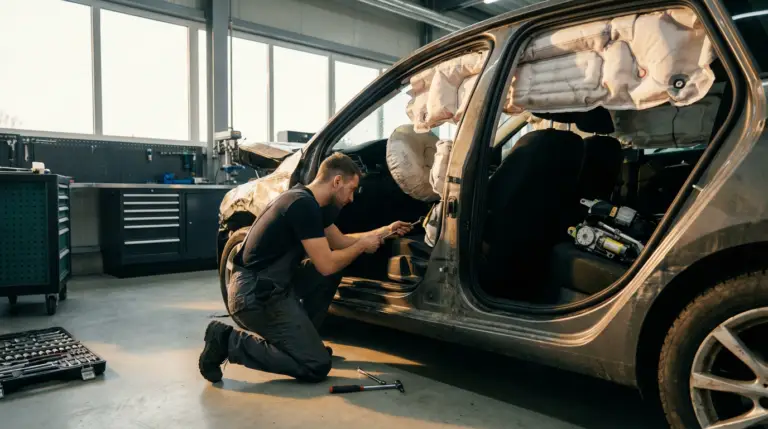
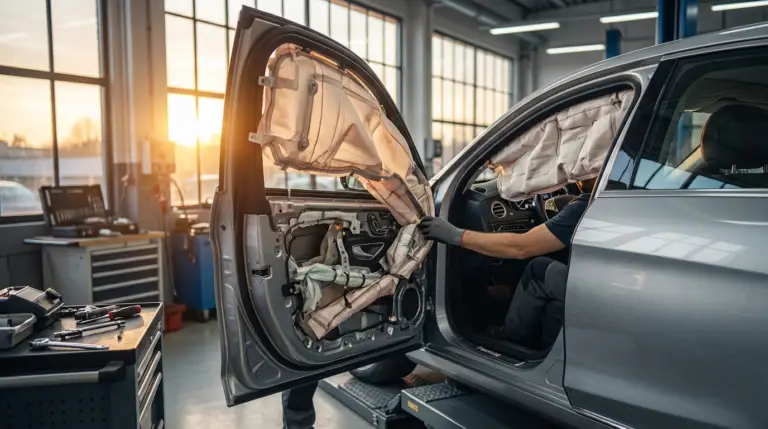
Modern retractors are more than springs and gears. Most include a pre-tensioner that is part of the SRS airbag system. In a qualifying crash, the SRS airbag module sends a command that fires a pyrotechnic (explosive) charge in the pre-tensioner.
That charge instantly tightens the belt against your body just before or as the airbags deploy. If this pre-tensioner has fired, the internal unit is no longer safe or reusable. At that point, a proper “seat belt retractor repair” means:
- Pre-Tensioner Replacement using the correct component.
- Seat Belt Replacement of the full assembly as needed.
- Addressing any SRS Airbag Module Reset or Airbag Module Replacement that is required.
The retractor, pre-tensioner, and SRS airbag module work as a team. If one piece is damaged or deployed, the whole system can be compromised and will often store fault codes that turn the SRS light on.
Common Seat Belt Retractor Problems We See in DFW
Seat Belt Retractor Stuck or Locked After an Accident
After even a moderate crash, many DFW drivers find the seat belt retractor locked after accident and will not pull out at all. This usually means the pre-tensioner fired and locked the mechanism or internal parts were damaged by crash forces.
In this case, the safe fix is not to “un-jam” it. The recommended solution is typically:
- Vehicle Diagnostic to read SRS codes and confirm which components deployed.
- Pre-Tensioner Replacement for the affected belt positions.
- Seat Belt Replacement of the locked assemblies.
- SRS Airbag Module Reset or Airbag Module Replacement if crash data must be cleared.
Slow or Weak Retraction (Belt Doesn’t Snap Back)
A very common complaint is a slow seat belt retractor that will not retract the belt fully. The belt may hang loose, get caught in the door, or require you to feed it back by hand.
This can be caused by:
- Worn return spring inside the retractor.
- Contaminated belt webbing from spills, dirt, or pet hair.
- Internal fatigue of older components.
While some DIY guides recommend washing or relubricating the belt, that does not address internal wear. For a safety-critical system, the professional solution is usually Seat Belt Replacement rather than temporary DIY cleaning that may hide a deeper problem.
Belt Won’t Pull Out or Keeps Locking Unexpectedly
Another common issue is when the belt will not pull out smoothly or it locks with very little movement. This may come and go with certain angles of the seat or vehicle position.
Causes can include:
- Damaged lock sensor or inertia mechanism.
- Internal wear or bent components inside the retractor.
- Incorrect installation angle after earlier work or collision repair.
The right approach is to perform a Vehicle Diagnostic to rule out SRS faults, then plan for Seat Belt Replacement of that assembly. For DFW Safety Restore, “seat belt retractor repair” in this scenario means diagnose, replace, and verify – not attempt to re-bend or grind internal parts.
SRS Light On and Codes Pointing to Seat Belt Circuit
If your SRS or airbag light is on, the system has detected a problem and stored a fault code. Many times those codes are related to the seat belt retractor, pre-tensioner, buckle switch, or wiring circuit.
At DFW Safety Restore, we use a Vehicle Diagnostic scan to identify whether the fault is:
- A deployed pre-tensioner that needs Pre-Tensioner Replacement.
- A failed seat belt assembly that requires Seat Belt Replacement.
- A stored crash event in the SRS airbag module that needs an SRS Airbag Module Reset or Airbag Module Replacement.
Once the root cause is identified, we put together a repair plan using only approved, professional services. For North Texas drivers who need deeper diagnostics beyond just seat belts, we also help North Texas drivers who need deep diagnostics and safety system repair.
The Danger of Driving with a Bad Seat Belt Retractor
Any compromised retractor or pre-tensioner is a significant safety hazard. It is not just an annoyance. In a crash, your entire injury risk changes if the belt does not function exactly when and how it should.
Key dangers include:
- Belt may not lock fast enough in a crash, letting you move too far forward.
- Airbag timing may be off because the SRS system expects you to be held firmly by a working belt.
- Texas state inspections may fail if the belt is visibly damaged or the SRS light is on.
- Insurance claims or liability questions can arise if known safety defects are ignored.
Critical safety warning: seat belt retractors, pre-tensioners, and airbags are part of the SRS system and often contain pyrotechnic (explosive) charges. Never drill, cut, heat, or attempt to open a pre-tensioner or airbag component at home.
Incorrect handling can cause:
- Serious injury from accidental deployment or shrapnel.
- Permanent damage to the SRS system so it cannot protect you in a crash.
- Failed inspections and expensive rework later.
Only trained professionals with proper tools and procedures should work on these systems. Our role at DFW Safety Restore is to provide that safety-first professional service for drivers and body shops throughout Dallas–Fort Worth.
Step-by-Step: How We Diagnose Seat Belt Retractor Issues
Step 1 – Vehicle Safety & Visual Inspection
We start by verifying your concern and inspecting the visible parts of the system. That includes:
- Checking the webbing for cuts, fraying, burns, or contamination.
- Inspecting the buckle, latch, and anchor points for damage.
- Testing the retractor’s pull-out and lock behavior in a controlled way.
This step helps us see whether the issue is purely mechanical, crash-related, or likely tied to the electronic SRS system.
Step 2 – SRS/ECU Scan with Professional Vehicle Diagnostic
Next, we use professional scan tools to perform a full Vehicle Diagnostic on your SRS system. We connect to the vehicle, read any stored or current fault codes, and note related data.
This helps us determine whether the problem involves:
- The seat belt retractor or pre-tensioner.
- The clock spring in the steering column.
- The SRS airbag module itself.
- Other components like airbags or wiring harnesses.
Step 3 – Isolate the Faulty Component
Based on the visual inspection and diagnostic results, we isolate which components are no longer safe or functional. Our recommended repair plan may include:
- Seat Belt Replacement when the retractor, webbing, or lock mechanism is compromised.
- Pre-Tensioner Replacement when the crash charge has deployed or the circuit has failed.
- SRS Airbag Module Reset to clear crash data when appropriate.
- Airbag Module Replacement if the module is not resettable or is damaged.
- Clock Spring Replacement if steering wheel airbag or control circuits are affected.
We do not attempt to rebuild the internal retractor body. Instead, we replace compromised safety components with correct parts and verify operation.
Step 4 – Present Options & Pricing Before Any Work
Before we perform any repairs, we explain your options and expected costs. You will know:
- Which safety components need replacement.
- Whether an SRS Airbag Module Reset is sufficient or a module replacement is required.
- How long the work is likely to take and whether same-day completion is realistic.
Only once you approve the plan do we move forward with parts ordering and installation.
Repair vs. Replace: What’s the Safest Way to Fix a Seat Belt Retractor?
Many people type in “seat belt retractor repair” or ask how to “fix seat belt retractor” hoping there is a simple, low-cost tweak. The reality is that with SRS and pyrotechnic components, true internal “repair” is rarely recommended and often not compliant with manufacturer or safety standards.
Here is the difference between risky “repairs” and our professional approach in DFW:
| Approach | DIY / Non-Certified “Repair” of Retractor | DFW Safety Restore Professional Solution |
|---|---|---|
| What it involves | Opening the retractor body, modifying or reusing internal parts, sometimes tampering with pre-tensioner charges. | Vehicle Diagnostic to identify faults, followed by Seat Belt Replacement and Pre-Tensioner Replacement as needed. |
| Safety risk | High. Hidden damage may remain, explosive charges may be mishandled, and the system may fail in a crash. | Low. Uses proper components and procedures designed for crash performance and SRS integration. |
| Compliance | May violate manufacturer guidance, can cause inspection or insurance issues. | Aligned with industry best practices: replace deployed or damaged safety components. |
| Long-term reliability | Uncertain. You cannot see internal stress or know how the unit will behave in another crash. | Predictable. New or proper replacement parts, verified with SRS scans and functional checks. |
| Services used | Unlisted, non-approved work. | Seat Belt Replacement, Pre-Tensioner Replacement, Vehicle Diagnostic, SRS Airbag Module Reset, Airbag Module Replacement, Clock Spring Replacement when needed. |
Later in the FAQs we will answer it plainly, but the bottom line is this: for safety-critical SRS components, replacement is the safe option. At DFW Safety Restore, our version of “seat belt retractor repair” is to professionally diagnose and replace, not to gamble on hidden internal damage.
What Does It Cost to Fix a Seat Belt Retractor in DFW?
Costs depend on your specific vehicle and the extent of SRS damage. Still, there are some general patterns we see across American & Japanese vehicles in the Dallas–Fort Worth area.
Dealer/OEM replacement:
- Dealers often quote hundreds of dollars per seat belt assembly, plus labor.
- If multiple belts, pre-tensioners, and the SRS module are involved, the total can climb quickly.
DFW Safety Restore approach:
- We start with a Vehicle Diagnostic so you only pay to fix the components that are actually faulty.
- Our Seat Belt Replacement and Pre-Tensioner Replacement solutions are usually a more cost-effective total package vs. dealer-only routes.
- We focus on value and safety, not simply being the cheapest option.
Expect that properly fixing a seat belt retractor in DFW will be an investment, not a cosmetic quick fix. You are restoring a life-saving system that must perform correctly on the worst day you hope never comes.
How DFW Safety Restore Fixes Seat Belt Retractor Problems Safely
Certified Diagnostic Process for American & Japanese Vehicles
Our shop in Frisco TX focuses on American & Japanese vehicles because that is where we can confidently provide fast, accurate diagnostics and the correct parts. When you come in for seat belt retractor repair, you are getting:
- A thorough Vehicle Diagnostic using professional scan tools.
- Clear explanation of which components failed and why.
- A repair plan tailored to your vehicle and driving needs.
OEM-Quality Parts and Correct Programming
We use OEM-quality or equivalent components for:
- Seat Belt Replacement when retractors, webbing, or internal locks are damaged.
- Pre-Tensioner Replacement when crash charges have deployed or circuits have failed.
- SRS Airbag Module Reset or Airbag Module Replacement when modules contain crash data or internal faults.
When collisions also affect driver assistance systems, our SRS and seat belt work often pairs with ADAS checks. To understand how these systems interact, see our guide on why proper ADAS calibration and airbag resets matter on Frisco’s changing roads.
Same-Day Availability for Many DFW Drivers
For many American & Japanese vehicles, we can offer same-day availability for diagnostics and many seat belt or pre-tensioner replacements once parts and scheduling are set. That is especially valuable for:
- Drivers facing Texas inspection deadlines.
- Body shops trying to deliver repaired vehicles on time.
- Small dealers needing safe, ready-for-sale inventory.
We do not promise a fixed 24-hour turnaround or lifetime warranties. Instead, we give realistic timelines and keep the focus on doing the job safely and correctly.
Local Seat Belt & SRS Service in Frisco TX and the DFW Area
DFW Safety Restore is based in Frisco TX and serves drivers and shops across the Dallas–Fort Worth metro area, including Plano, McKinney, Allen, Little Elm, and surrounding communities. If you are looking for seat belt retractor repair in DFW, you do not have to ship parts anywhere or guess at remote services.
Local benefits include:
- Shorter scheduling times for diagnostics and repairs.
- The ability to visit the shop and talk to a technician in person about your SRS concerns.
- Convenient support for body shops and small dealers who need reliable seat belt and airbag help.
We also see many vehicles after hail or collision repair that still have SRS or ADAS issues. If you’ve recently been through body work, you may find this article helpful: airbag and ADAS resets after hail or collision damage in Frisco.
To learn more about our Frisco TX location and services, visit: DFW Safety Restore – Frisco TX.
When You Might Also Need Airbag or Clock Spring Services
Seat belt retractor issues often show up along with other SRS problems, especially after an accident. If your SRS light is on, you may also need:
- SRS Airbag Module Reset when crash data must be cleared so the system can arm again.
- Airbag Module Replacement if the module is not resettable or is internally damaged.
- Clock Spring Replacement when steering wheel airbags or controls lose their connection.
At DFW Safety Restore, we handle these services within our approved safety system menu. That allows us to deliver a complete solution: seat belts, pre-tensioners, airbags, modules, and clock springs all working together the way the manufacturer intended.
How to Get Started – Steps to Fix Your Seat Belt Retractor in DFW
Getting your seat belt and SRS system back to safe operation is straightforward when you work with a local specialist. Here is the simple process:
- Call or text DFW Safety Restore in Frisco TX to schedule a Vehicle Diagnostic appointment.
- Bring your vehicle in for a full SRS scan and visual inspection of belts, pre-tensioners, and related components.
- Review and approve our recommendations for Seat Belt Replacement, Pre-Tensioner Replacement, and any needed SRS Airbag Module Reset or Clock Spring Replacement.
- Drive away with a properly functioning seat belt and SRS system, ready for Texas roads and inspections.
Ready to fix your seat belt retractor the right way? Schedule your Vehicle Diagnostic with DFW Safety Restore today and let a safety-focused technician handle the rest.
If you want to check your vehicle details ahead of time, you can use our FREE VIN decoder to quickly look up key information.
FAQs About Seat Belt Retractor Repair in DFW
Q: Can I repair my seat belt retractor, or do I need to replace it?
Many drivers search for “seat belt retractor repair” or ways to “fix seat belt retractor” without replacing the unit. For safety-critical SRS components, the safest and most reliable option is usually replacement, not internal repair.
At DFW Safety Restore, we first perform a Vehicle Diagnostic to confirm what has failed. Then we use Seat Belt Replacement and Pre-Tensioner Replacement to restore proper function. Internal DIY repairs or non-certified rebuilds are not recommended because they can hide damage and may not protect you in a crash.
Q: Is it safe to drive with a stuck or slow seat belt retractor?
No, it is not recommended. A stuck, loose, or slow retractor may fail to restrain you properly in a crash. If the SRS or airbag light is on at the same time, your entire safety system may already be compromised.
The smart move is to schedule a Vehicle Diagnostic and repair as soon as possible so you are not relying on a belt that may not lock or tighten when you need it most.
Q: How much does it cost to fix a seat belt retractor in the DFW area?
Costs vary by vehicle and damage, but a proper fix usually includes more than just the retractor. The price depends on:
- Vehicle make and model (we focus on American & Japanese vehicles).
- Whether the pre-tensioner deployed in a crash.
- Whether you also need SRS Airbag Module Reset, Airbag Module Replacement, or Clock Spring Replacement.
Dealers often quote hundreds of dollars per belt assembly plus labor. DFW Safety Restore typically offers a more cost-effective, safety-focused solution by combining diagnostics with targeted Seat Belt Replacement and Pre-Tensioner Replacement instead of replacing everything blindly.
Q: How long does it take to replace a faulty seat belt retractor or pre-tensioner?
Once parts and scheduling are lined up, many jobs can be handled with same-day availability. For a lot of American & Japanese vehicles, diagnostics plus replacement can often be completed within a single day.
Exact timing depends on parts availability, the number of components involved, and current shop workload. When you contact us, we will give you a realistic estimate based on your specific vehicle and situation.
Q: Do you service all vehicle makes for seat belt and SRS issues?
DFW Safety Restore focuses on American & Japanese vehicles for seat belt, pre-tensioner, airbag module, and related SRS services. That focus lets us maintain deep expertise, stocking, and diagnostic capability where it matters most.
If you drive an American or Japanese vehicle in Frisco TX or the greater Dallas–Fort Worth area, contact us to schedule a Vehicle Diagnostic and review your repair options for seat belts, pre-tensioners, and other SRS components.
Q: Will a bad seat belt or SRS light cause me to fail a Texas inspection?
While inspection details can vary, a visible seat belt defect or an illuminated SRS/airbag warning light can lead to problems during Texas state inspection. Inspectors expect seat belts to function correctly and safety warning lights to operate as designed.
If you are facing an upcoming inspection with a seat belt retractor issue or SRS light on, it is smart to address it sooner rather than later. We can perform a Vehicle Diagnostic and put together a Seat Belt Replacement and Pre-Tensioner Replacement plan to help you move forward safely.