 Skip to content

Seat Belt Buckle Sensor Repair — Why Replacement Is the Safe Fix
Direct answer: “Seat belt buckle sensor repair” is often not a simple DIY fix — the buckle switch is usually part of the buckle assembly and, when it fails, the correct action is replacement of the buckle or belt, plus SRS diagnostics and module reset/programming. LockNCal diagnoses buckle-sensor faults, replaces seat belt assemblies, and handles SRS module resets and programming.
Safety note: LockNCal does not repair, rebuild, or re-web seat belts. Seat belts and pretensioners are life-safety parts, and a repaired or rebuilt belt may not hold in a crash — so we recommend replacement with genuine OEM parts. See our mobile seat belt replacement service.
If your seat belt needs replacing, our mobile seat belt replacement restores it to factory condition, mobile across DFW.
Key Takeaways
- A failed buckle sensor commonly requires replacing the buckle assembly or the entire belt — the sensor itself is usually not safely “repaired”.
- Symptoms include persistent seat-belt warning lights, incorrect airbag readiness faults, or seatbelt buckle not latching in the dash as expected.
- Dangerous DIY kits and splices are common online — the safe fix is replacement and professional diagnostics plus SRS reset/programming.
- LockNCal provides diagnostics, seat belt replacement, SRS module reset (mail-in nationwide or mobile in DFW), and module programming.
How a seat belt buckle sensor works (plain English)
Most modern vehicles use a simple switch inside the buckle latch that tells the vehicle whether the buckle is latched. That signal goes to the Supplemental Restraint System (SRS) control module and the instrument cluster to trigger the seat belt warning light and chime. Some vehicles use an additional resistor-based seat-occupancy or seat-belt tension sensor — but the buckle switch itself is usually a mechanical or magnetic switch inside the latch housing.
Common symptoms of a failing buckle sensor
- Seat belt warning light stays on even when the buckle is latched.
- Chime sounds intermittently when the buckle is latched.
- Airbag/SRS warning light illuminated (often accompanies buckle faults).
- DTCs (diagnostic trouble codes) such as B179X / B18XX or manufacturer-specific buckle/sensor codes show up on a scanner.
- Buckle physically feels loose or the latch doesn’t click reliably.
What to check before assuming the buckle itself is the issue
Work in a safe order: inspect wiring and connectors first, then test the buckle. Common easy checks include:
- Check the visible wiring under the seat for pinched or disconnected plugs.
- Look for water, dirt, or corrosion in the buckle opening — debris can prevent the contact from closing.
- Scan for SRS and buckle-related codes with a capable scanner that reads the airbag/SRS module.
- If you can access the buckle connector, perform a continuity check on the switch circuit (requires basic multimeter skills).
Why most online “seat belt buckle repair kits” are risky
Search results often show inexpensive kits or instructions for splicing wires or replacing a tiny internal part. Two problems with that approach:
- Safety-critical components: the buckle and pretensioner are part of the vehicle’s passive restraint system. Incorrect work can cause the system to malfunction in a crash.
- Manufacturer validation: OEM designs and crash certification assume single-use pyrotechnic parts and factory-assembled buckles. Modifying or splicing can invalidate safety performance and vehicle warranty.
For these reasons LockNCal does not sell or install repair kits for buckles or pretensioners. If the buckle switch is bad, the safe options are replacement of the buckle or the complete belt assembly and professional diagnostics plus any required SRS module work.
Model-specific notes (Audi, Chevy, Ford F-150)
Different manufacturers package sensors differently. Useful general notes:
- Audi: Some Audi models have complicated seat harness routing and seat-occupancy mats in addition to the buckle switch; diagnosing requires reading airbag codes and often accessing the seat module.
- Chevy (GM family): Buckle switches are commonly contained in the buckle assembly; some GM consoles make access easier, but airbag system scans are still required after replacement.
- Ford F-150: Many pickups route buckle wiring under the seat or through the console and some models have interchangeable buckle modules — but the SRS module must be scanned and possibly recalibrated after replacement.
These are manufacturer tendencies, not guarantees — the correct procedure is vehicle-specific diagnostics and the right replacement parts.
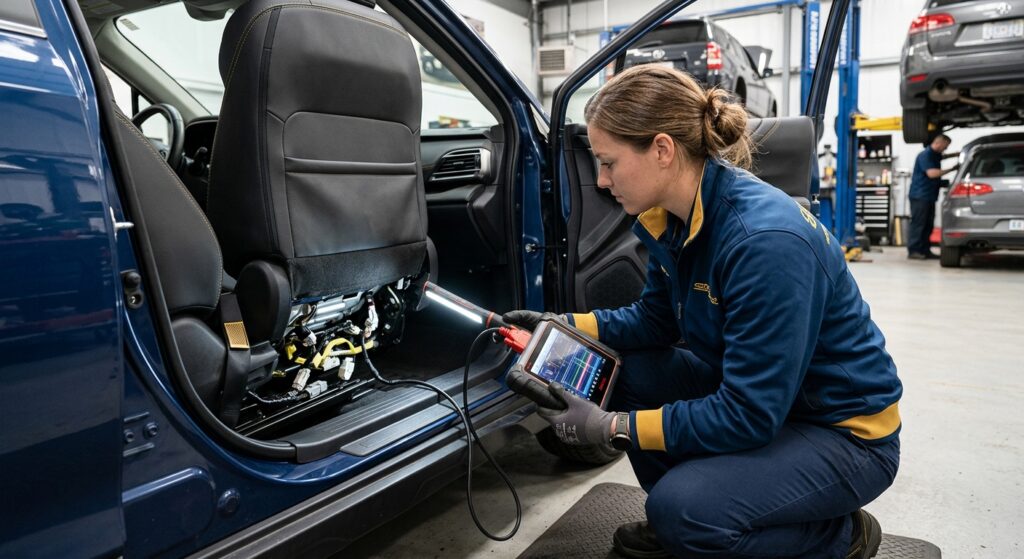
Practical troubleshooting steps (what a pro does)
- Safety first: disable the battery and follow vehicle manufacturer procedures for SRS work to avoid accidental airbag deployment.
- Scan the SRS module and read all stored codes; note manufacturer-specific data (module ID, freeze frame).
- Visually inspect connectors and wiring under the seat, inside the console, and at the buckle plug.
- If wiring and connectors check out, bench-test the buckle switch or perform a continuity check with the buckle unplugged.
- If the buckle switch fails testing, replace the buckle assembly or full belt per manufacturer instructions — do not attempt to re-sew or splice webbing or re-arm pyrotechnic pretensioners.
- After replacement, clear codes and perform SRS module reset or programming if required; confirm with a post-repair scan and road test.
Quick reference table: symptom → likely cause → recommended LockNCal service
| Symptom | Likely cause | What LockNCal can do |
|---|---|---|
| Seat belt light/chime stays on | Faulty buckle switch, wiring, or connector | Diagnostics, wiring inspection, buckle or belt replacement, SRS module reset |
| SRS / airbag light on with buckle code | Fault reported to SRS control module (may need crash data handling) | Full SRS scan, module reset (mail-in or mobile), module programming |
| Buckle won’t latch physically | Broken latch mechanism or contaminated buckle | Replace buckle assembly or belt; post-replacement SRS check |
Why LockNCal’s approach is different (and safer)
We treat seat belt buckle sensor problems as part of the vehicle’s safety system, not an isolated convenience issue. That means we:
- Start with an SRS-capable scan tool to see exactly which module recorded the fault.
- Inspect wiring and connectors before changing parts.
- Replace the buckle assembly or belt when required and never re-use pyrotechnic devices or re-sew webbing.
- Provide module resets, crash data deletion (mail-in), and programming when the SRS module requires it.
If you’re outside the Dallas–Fort Worth area and only the SRS module needs reset or crash data deletion, our nationwide mail-in service can help: mail-in airbag module reset (nationwide, free shipping). For on-vehicle module programming and diagnostics we offer mobile support in DFW and module programming services: module programming. To see the full list of vehicle-safety offerings, visit our vehicle safety system services page.
Common questions people search for
Many drivers search for “how to repair seat belt buckle” or “seat belt buckle repair kit” because they want a fast, cheap fix. That’s understandable, but remember the buckle is part of a crash-protection system. A temporary fix or an uncertified kit can make the system unreliable.
FAQ
Can a seat belt buckle sensor be repaired?
Not safely in most cases. The sensor is usually inside the buckle assembly; the safe, manufacturer-approved option is replacement of the buckle or the full belt assembly and professional SRS diagnostics.
Are seat belt buckle repair kits safe?
Most online kits are not recommended. They often involve splicing or bypassing circuits that interact with the airbag system. LockNCal does not install or endorse such kits.
What does it cost to fix a buckle sensor?
Costs vary by year, make, and model. LockNCal can give an exact price for your vehicle — call (469) 277-7277 to get a quote for your specific car.
Can you reset the airbag light after replacing a buckle?
Yes, but you need the right SRS scan tools and may need module programming or a module reset. LockNCal offers module programming and mobile SRS services and a nationwide mail-in module reset service if applicable.
How do I find “seat belt buckle repair near me”?
Search for vehicle safety or SRS specialists and look for technicians who offer SRS scans and module programming. If you’re local to DFW we provide mobile on-vehicle service; for nationwide SRS module resets use our mail-in service.
For a professional assessment and safe repairs, schedule an appointment or call (469) 277-7277. Book online: Schedule an appointment.


