 Skip to content

Car Seat Belt Buckle Repair — What Is Fixable and When Replacement Is the Answer
Direct answer: “Car seat belt buckle repair” can mean two very different things: simple mechanical fixes (cleaning, freeing a stuck latch) are often safe DIY jobs, while safety-critical parts — deployed pretensioners, pyrotechnic components, or damaged buckle assemblies with fired pretensioners — must be replaced by a professional. LockNCal diagnoses buckle sensors, replaces buckle assemblies when required, and handles SRS module programming and resets.
If your seat belt needs replacing, our seat belt replacement service restores it to factory condition, mobile across DFW.
Key Takeaways
- Minor latch issues (debris, sticky release) can often be fixed without replacing parts; electrical faults need diagnostics.
- Deployed pretensioners and pyrotechnic components are never repaired — the correct fix is replacement.
- Faulty buckle sensors often trigger SRS/airbag codes; a scan, replacement, and module reset/programming are usually required.
- LockNCal performs diagnostics, buckle assembly replacement, SRS module resets, and module programming — we do not “repair” pyrotechnic devices.
- Exact cost depends on year, make, and model — call (469) 277-7277 for a vehicle-specific quote or schedule online.
What people mean by “seat belt buckle repair”
Searchers use the term “repair” for problems ranging from a sticky latch to an airbag light tied to a buckle sensor. It helps to split issues into two buckets:
- Mechanical latch/spring problems — the buckle won’t latch or release, or it’s hard to insert the tongue.
- Electrical/sensor problems — the seat belt light stays on, or the car shows an SRS/airbag fault referencing the buckle/sensor circuit.
When a DIY approach is reasonable
If the buckle won’t latch or release, try these safe first checks before assuming a replacement is necessary:
- Inspect for obvious debris, dirt, or coins in the buckle recess that block the tongue.
- Press the release button repeatedly while applying compressed air to blow out grit (avoid spraying lubricants into electronics).
- Check the tongue for bent edges; a gently filed burr can restore engagement if the metal is only slightly deformed (use caution).
- Verify the belt retracts and extends smoothly — sometimes a twisted webbing prevents proper seating.
How to test a buckle sensor (basic, no disassembly)
For electrical complaints you can do limited, low-risk checks:
- Fasten and unfasten the belt while watching the dash light — does it change state consistently?
- Try the same buckle with a different seat (if available) to rule out module vs. buckle issues.
- Look for water intrusion or corrosion around the buckle mounting point.
When you need professional help
Do NOT attempt to open, disassemble, or service any component that contains a pretensioner or pyrotechnic charge — those are single-use safety devices and can be dangerous if mishandled. Call a professional in these situations:
- The vehicle’s SRS/airbag light is on or registers a buckle/sensor fault after an accident.
- The pretensioner has fired (you’ll often see a deployed airbag or have a collision history) — the belt assembly must be replaced.
- There’s internal wiring damage, connector corrosion, or you see permanent deformation of the buckle assembly.
How professionals diagnose buckle problems
A trained technician follows a consistent sequence:
- Read SRS/airbag trouble codes with a proper scan tool to identify buckle circuit faults (SRS module B‑codes or manufacturer codes that point at the buckle).
- Visually inspect buckle, harness, connectors, and ground points for damage/corrosion.
- Test continuity and switch operation with a multimeter with the connector unplugged (manufacturer procedures vary — tech data required).
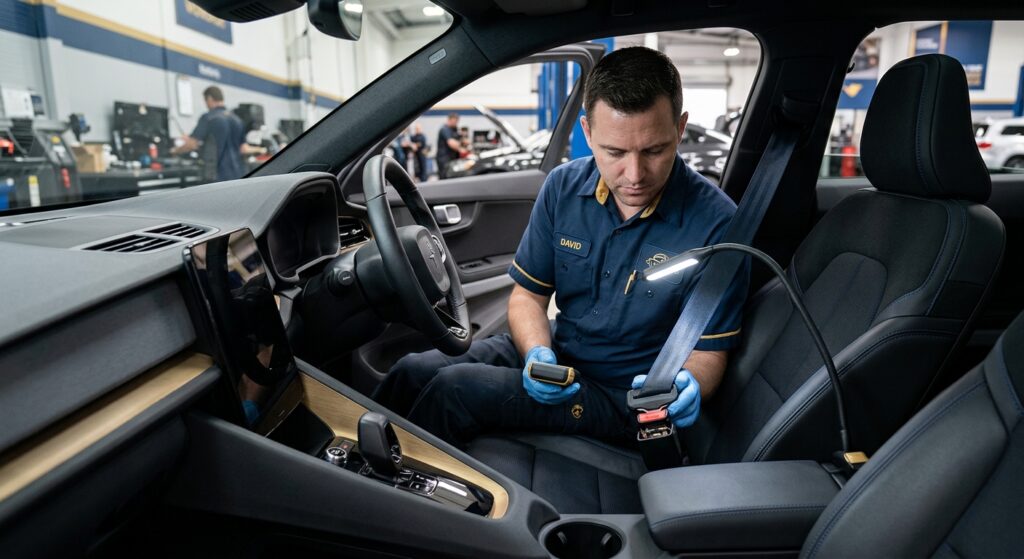
- If the buckle assembly fails, replace the buckle assembly or seat belt as required and clear/reset the SRS module, then recheck codes.
Model-specific notes: Audi, Chevy, Ford F-150
Different makes use different wiring and diagnostic flows. A few examples:
- Audi: many Audi models log detailed airbag/belt codes in the airbag control module; replacing a buckle sensor may require a clear and sometimes module adaptation.
- Chevy: GM vehicles often use body control module or SRS module entries for buckle status; connectors can corrode in older trucks and cause intermittent faults.
- Ford F‑150: Fords frequently place buckle sensors on harnesses with dedicated connectors under the seat — access and connector condition are common failure points.
Because procedures vary by model and year, accurate diagnosis always begins with the vehicle’s specific service data.
Practical troubleshooting table
| Symptom | Likely cause | What to try |
|---|---|---|
| Buckle won’t latch or tongue won’t seat | Debris, bent tongue, worn latch spring | Clean the buckle, inspect tongue, try compressed air; if still fails, replace buckle assembly |
| Buckle won’t release | Stuck release, broken release lever | Release button workarounds, compressed air; don’t force pyrotechnic pretensioners — replace if damaged |
| Airbag/SRS light on, code refers to buckle/sensor | Faulty buckle switch, wiring/connector issue, SRS module needing reset | Get a scan tool diagnosis; repair/replace connector or buckle and clear codes — professional service recommended |
| Intermittent belt warning | Loose connector, corrosion, broken wiring in harness | Inspect connectors under the seat; if wiring damaged, professional repair/replacement and module reset required |
Why “seat belt buckle repair kits” are risky
Online “repair kits” often promise to restore a worn latch or replace a switch. For non‑pyrotechnic mechanical parts that bolt on externally, a replacement buckle assembly is the safe, correct choice. Never attempt to modify, re-sew, or re‑arm any pretensioner or pyrotechnic device. If a kit claims to re-arm or repair a pretensioner or to restore a fired buckle, avoid it — it’s unsafe and not manufacturer-approved.
What LockNCal can do for you
LockNCal provides professional diagnosis and the correct safety-first fixes:
- Seat belt buckle and full belt assembly replacement, including belts whose pretensioners have fired.
- SRS/airbag module diagnostics, resets, and new module programming when required.
- Connector and wiring diagnosis related to buckle switches and sensor circuits.
For more on our vehicle safety work, see our vehicle safety system services page: https://lockncal.com/vehicle-safety-system-services/. If a module reset or programming is needed after a buckle replacement, our module programming service covers that as well.
Common questions about cost and parts
People often ask about seat belt buckle repair cost. Because buckle assemblies, sensor types, and labor time vary widely by year, make, and model, we can’t give accurate prices online. Call (469) 277-7277 or schedule an appointment for a vehicle-specific quote.
FAQ
Q: Can I repair a seat belt buckle myself?
A: You can safely attempt basic mechanical cleaning and debris removal. Do not open, re-arm, or modify pretensioners or pyrotechnic parts. If the problem is electrical or the pretensioner has fired, replace the assembly and get professional diagnostics.
Q: What does it mean if the airbag light comes on after replacing a buckle?
A: The airbag/SRS module stores fault codes and may need to be reset or reprogrammed after a buckle or sensor replacement. A scan tool and correct procedures are required to clear codes and confirm the system is functional.
Q: Is a seat belt buckle sensor repair the same as replacing the whole belt?
A: Not always. Sometimes the buckle assembly with the sensor can be replaced separately; other times the entire belt assembly must be changed, especially if the pretensioner has fired or the webbing/hardware is damaged.
Q: Do you sell seat belt buckle repair kits?
A: We do not sell or endorse kits that claim to re-arm pretensioners or “repair” pyrotechnic components. The safe path is replacement of single-use devices and professional module work.
Q: Can you service my Ford F-150/Audi/Chevy seat belt buckle?
A: Yes — LockNCal diagnoses model-specific issues and performs buckle or belt assembly replacement, sensor/wiring diagnostics, and any required SRS module resets or programming.
Next steps
If you have a buckling problem that’s more than simple debris or if the SRS light is on, the safest route is professional diagnosis. To schedule a vehicle-specific inspection and quote, book an appointment or call (469) 277-7277. We’ll tell you exactly what your vehicle needs and explain the correct, manufacturer‑approved fix.


