 Skip to content

Chrysler B2799 Immobilizer Code — Meaning & Fix
Direct answer: B2799 on a Chrysler means an engine immobilizer system malfunction — the vehicle’s security system is actively preventing the engine from starting. The correct fixes are to diagnose whether it’s a bad key/transponder, antenna ring, module communication error, or a corrupt module, then reprogram keys or replace/program the faulty module.
Not near Dallas–Fort Worth? Mail us your airbag / SRS module.
We reset most airbag control modules by mail — free 2-way shipping and a fast turnaround. We clear the crash data, restore factory settings, and ship it right back, anywhere in the U.S.
Key Takeaways
- Chrysler B2799 = Engine Immobilizer System Malfunction; the vehicle may not crank or start.
- Common causes: bad key/transponder, dead fob battery, damaged antenna ring, module communication faults, or theft-related tamper damage.
- First checks: read full scan data, try a known-good spare key, check security light and fuses, and verify battery voltage.
- The real fixes are key reprogramming or module programming/replacement — route to locksmith or authorized module programming, not DIY bypasses.
- LockNCal can help with on-site key programming and module programming services; schedule a technician to diagnose and restore proper immobilizer operation.
What B2799 actually means
The verified definition for Chrysler B2799 is “Engine Immobilizer System Malfunction – the immobilizer is preventing the engine from starting.” In plain English: the car’s anti-theft system (the immobilizer) detected a problem and has blocked fuel injection/ignition. That prevents theft but also prevents you from driving until the fault is fixed.
How you’ll notice it (symptoms)
- Engine cranks but won’t start, or the starter doesn’t engage.
- Security or immobilizer light on the dash is flashing or stays solid.
- Key not recognized: no remote functions, or the vehicle behaves as if no valid key is present.
- Intermittent starts: sometimes the car starts with one key but not another.
Common causes
- Faulty key transponder or dead key fob battery (key not sending proper code).
- Damaged antenna ring / reader around the ignition or push-button start area.
- Immobilizer module (SKIM or equivalent) communication failure with the PCM/BCM via CAN bus.
- Corrupted or mismatched programming after module replacement (PCM, SKIM, BCM) or battery disconnects.
- Physical damage from theft attempts, water intrusion, or crash-related electrical faults.
Quick checks you can do now (before you call a tech)
- Try a second known-good key or spare fob — if the spare works, the problem is the key/transponder, not the module.
- Replace the coin cell battery in the key fob and retry.
- Observe the security light: steady vs. blinking patterns can confirm immobilizer behaviour in the owner’s manual.
- Check fuses related to the security/immobilizer system and ensure the vehicle battery voltage is healthy (low voltage can confuse modules).
Step-by-step technician diagnosis (real tools, real order)
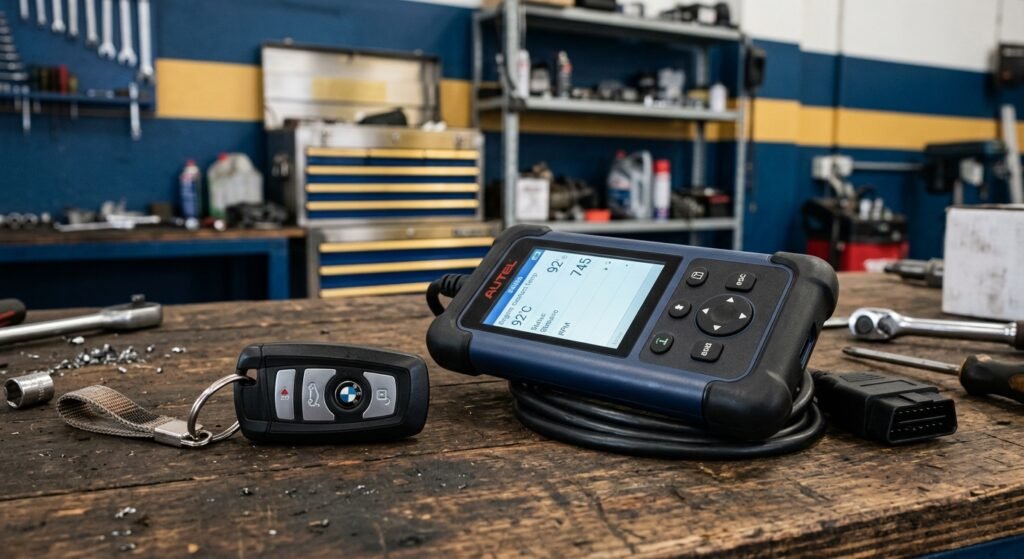
- Scan the vehicle with a capable scan tool (dealer-level wiTECH or advanced aftermarket tools such as Autel/Snap-on) to read B2799 and any related communication codes (CAN, BCM, PCM). Record module UDS/OBD data.
- Confirm whether SKIM (Sentry Key Immobilizer Module), BCM, or PCM reports communication faults or internal errors. Look for related codes like lost CAN communication or module internal faults.
- Test with a confirmed-good key: if a spare key starts the car, the technician isolates the fault to the key or transponder circuit.
- Check the antenna ring/reader: measure continuity and inspect connector at the ignition switch or push-button reader; damaged antenna coils are a frequent cause.
- Inspect wiring and fuses for the SKIM/BCM/PCM, including connectors behind dash and steering column. Water, chafing, or corrosion often shows up here.
- Verify module programming levels. If a PCM or SKIM was replaced or updated, confirm both modules share compatible security data — mismatched programming will trigger immobilizer behavior.
- If hardware tests fail, reprogram keys and modules as required. If a module is defective, replacement followed by correct programming is the proper fix.
How to interpret common scan results
| Scan result | Likely cause | Next step |
|---|---|---|
| Only B2799 present; spare key starts car | Faulty key transponder or dead fob battery | Replace fob battery or reprogram/replace key |
| B2799 + CAN communication codes | Module communication fault (BCM/SKIM/PCM) | Check wiring/fuses, then module programming or replacement |
| B2799 + antenna coil error | Damaged antenna ring/reader around ignition | Inspect/replace antenna reader and reprogram |
What the correct fixes look like
There are two categories of correct fixes — key-related and module-related. Attempts to bypass an immobilizer (hot-wiring, bridging, or non-OEM hacks) are unsafe, may be illegal, and leave the vehicle vulnerable to theft.
Key-related fixes
- Replace the key fob battery or replace a damaged key.
- Have a certified technician program the replacement or spare key so the SKIM/PCM recognizes it.
- If the transponder is physically damaged, the key must be replaced and programmed; LockNCal offers mobile key services such as car key copy.
Module-related fixes
- If the SKIM or PCM is faulty, replacement is the manufacturer-approved fix. After replacement, the new module must be programmed so the vehicle recognizes it.
- Often the correct path is reprogramming (restoring the correct security data) rather than attempting circuit-level fixes. For on-site module work, see LockNCal’s module programming service.
When it’s safe or unsafe to keep driving
If the immobilizer is actively preventing starting, you cannot drive the vehicle — it won’t start. If the code appears intermittently but the car starts reliably, it’s still risky: immobilizer faults can become permanent at any time. Fix the root cause before relying on the vehicle for important trips.
How much will it cost?
Costs vary by whether the fix is a simple key reprogram or requires module replacement and programming. For a precise price and to book a technician, use the LockNCal booking form — the technician will confirm the specific service and price during scheduling: Schedule an appointment. Mobile key and module programming services are available on-site.
Related LockNCal services
- On-site module programming and diagnostics: Module Programming
- Mobile car key copy and key/fob programming: Car Key Copy
- General on-site services overview: On-site mobile services
FAQ
A: Clearing the code may temporarily turn off the warning, but if the immobilizer is still malfunctioning the vehicle can refuse to start again. You need to diagnose and fix the root cause (key programming or module programming/replacement).
Q: Will replacing the car battery cause B2799?
A: A battery replacement can trigger module recalibration needs or communication errors, but it doesn’t directly damage the immobilizer. If B2799 appears after a battery change, re-scan and check module programming; some modules need re-initialization.
Q: My spare key works—do I still need a technician?
A: Yes. A working spare tells you the key/transponder is likely the issue, but a technician should reprogram or replace the faulty key so you aren’t stranded later.
Q: Can I bypass the immobilizer to get it started now?
A: Do not attempt bypass methods. They are unsafe, may be illegal, and expose the vehicle to theft. The correct fixes are key reprogramming or module replacement/programming by a qualified technician.
Q: Does LockNCal repair immobilizer modules?
A: LockNCal performs diagnostics, key/fob programming, and on-site module programming — and will arrange module replacement and programming as required. We do not perform board-level repairs; module replacement and programming is the correct manufacturer-approved solution.
Next steps
If your Chrysler shows B2799 and won’t start, don’t try to jury-rig a fix. Book a diagnostic visit so a technician can read full module data, test keys and antenna coils, and perform the required key programming or module programming on-site. Schedule an appointment here: Schedule an appointment or call (469) 277-7277 for help getting back on the road safely.


