 Skip to content

Ram P1610 Code — Lock Mode Immobilizer (NATS)
What P1610 means: Lock Mode — immobilizer / anti-theft (WCM/SKREEM lockup). It is a immobilizer / keys code.
Does LockNCal handle this? Yes — P1610 involves your vehicle’s immobilizer / keys system, which is exactly what our mobile team specializes in. Call or text (469) 277-7277 or book online and we’ll take care of it.
Direct answer: Ram P1610 means “Lock Mode – the Nissan NATS immobilizer has locked the engine start function”. The real fix is not body-shop guessing: diagnose which part of the immobilizer system failed (key transponder, immobilizer antenna/receiver, or module/ programming) and then reprogram or replace and program the affected component.
Key Takeaways
- P1610 = “Lock Mode” — the immobilizer has deliberately blocked starting.
- Common causes: bad key transponder, dead key battery, antenna/receiver fault, module mismatch or wiring/CAN faults.
- Diagnosis needs an OEM-level scan tool, spare key tests, and targeted electrical checks.
- Correct fixes are key/fob programming or module programming/replacement — call an automotive locksmith or programming specialist.
What P1610 Means (Plain English)
By definition, P1610 is: “Lock Mode – the Nissan NATS immobilizer has locked the engine start function.” That means the vehicle’s security system believes the key or immobilizer system is not authenticated, so it prevents the starter or fuel system from enabling the engine. It’s a safety feature, not a random electrical glitch.
Common Causes of P1610 on a Ram
- Key transponder failure or dead key/fob battery — the vehicle can’t read the transponder code.
- Faulty immobilizer antenna/reader around the ignition (antenna ring) or smart key receiver.
- Immobilizer/module software mismatch after module replacement, VIN programming error, or corrupted module memory.
- Wiring issues or CAN-bus communication faults between the immobilizer, BCM, and PCM.
- Intermittent faults caused by low vehicle battery voltage or poor grounds.
Symptoms You’ll Notice
- Engine refuses to crank or turns over but will not start.
- Security/immobilizer warning light on the dash, sometimes accompanied by a key icon or “No Key Detected” message.
- Starting works sporadically with one key but not another, or only after cycling the ignition several times.
- No other engine fault codes (or communication codes) appear, or you see related CAN/communication DTCs.
Common causes, checks, and likely fixes
| Possible cause | Quick check | Likely fix |
|---|---|---|
| Dead/weak smart‑key battery or damaged transponder | Try a fresh key battery; test spare key. | Replace key battery or have key transponder reprogrammed/replaced. |
| Antenna ring / receiver fault | Scan for communication faults; wiggle ignition while observing code behavior. | Replace antenna/receiver and program as required; module re-learn. |
| Immobilizer module programming/VIN mismatch | Read module IDs and VINs with an OEM-level scan tool. | Program module to vehicle (module programming service) or correct VIN entries. |
| Wiring or CAN communication problem | Check grounds, battery voltage, and CAN bus voltages with multimeter/oscilloscope. | Repair connector/wiring fault; clear codes and re‑test. (A programming step may follow.) |
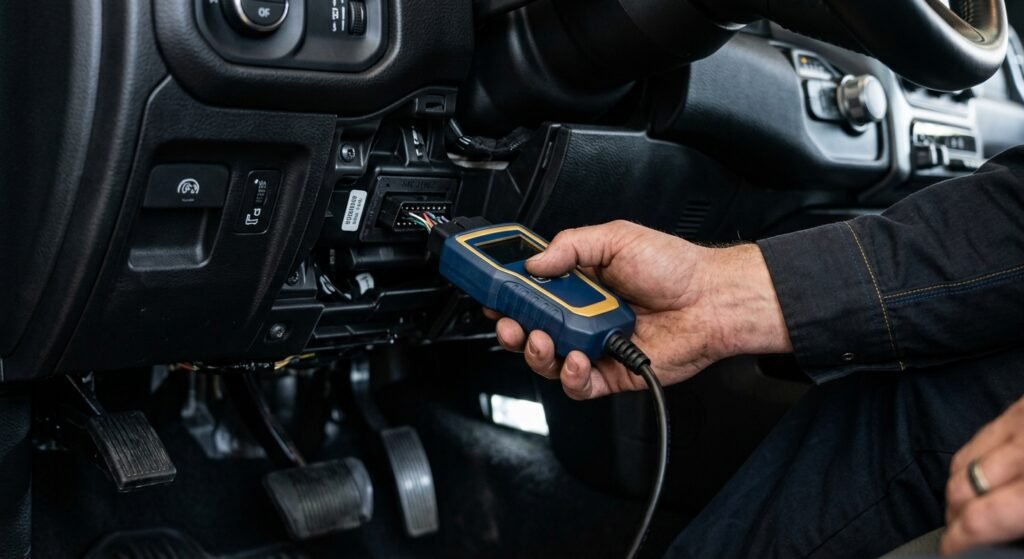
Step-by-step diagnosis: what a technician will actually do
Diagnosing P1610 requires methodical checks in the correct order. A good tech follows safety first, then starts with the simplest possible causes and works toward the more complex module-level work.
Tools you’ll see used
- OEM-level scan tool (wiTECH for FCA/Ram or equivalent) to read SRS/BCM/immobilizer data and live parameters.
- Basic OBD2 reader to confirm codes, plus a laptop with dealer-level software if needed.
- Digital multimeter and test light for power/ground checks.
- Optional oscilloscope for CAN-bus waveform checks on complex communication faults.
- Factory wiring diagrams and pin lists (for connector tracing) — the order matters more than guessing parts.
Diagnosis order (real-world steps)
- Safety & supply: verify vehicle battery voltage (12.4–12.8V resting) and good grounds. Low battery can trigger spurious immobilizer behavior.
- Try the spare key and a fresh key battery. If a spare starts the truck, the problem is the original key transponder or fob battery.
- Read all DTCs with an OEM-level scan tool (wiTECH). Note P1610 and any companion communication codes — these guide the next checks.
- Check the immobilizer/antenna ring and smart-key receiver for power, ground, and connector corrosion using a multimeter. Wiggle-test connectors while monitoring live data to see intermittent drops.
- Confirm module VINs and software versions. If a recent module swap or BCM replacement was done, look for VIN mismatch or missing programming.
- Observe transponder recognition data live (OEM tool will show whether the key ID is seen). If the key ID never appears, the coil/antenna or key is at fault; if the key appears but engine still locks, the immobilizer memory or PCM interlock is suspect.
- If wiring and modules check out, attempt a controlled re-learn or key programming with OEM procedures. Document each step and any changes to codes or behavior.
- If reprogramming fails, proceed to module programming/replacement as indicated (immobilizer control module, BCM, or PCM), performed by a specialist with the correct OEM tool and security credentials.
Which part is the culprit?
Indicators that point to the key: spare key works, or only the remote functions fail but the transponder ID reads fine. Indicators for a module or wiring problem: no transponder IDs shown to the scan tool, VIN mismatches, communication errors on the CAN bus, or failure to accept re-learn sequences.
Correct fix (what actually resolves P1610)
The only correct, safe fixes are targeted and documented: reprogram keys, program a replacement immobilizer module to the vehicle, correct VIN or software mismatches, or fix faulty wiring/grounds that prevent module communication. For key/transponder faults, an automotive locksmith or key programming specialist can clone or program a new key. For module-level issues, a certified programming service will perform module programming or replacement and the required security re-learns.
LockNCal offers mobile key and fob programming and module programming services and can help with on-site diagnostics and programming if you are in the DFW area. For owners nationwide needing module work that must leave the vehicle part (SRS modules excepted), LockNCal also provides mobile module programming services and guidance. If you need to book service, use the booking form to see availability and your exact service option.
Is it safe to drive with P1610?
If P1610 has triggered, the vehicle may not start at all. If the engine is running and the code appears, unpredictable starting behavior later could strand you. If you can only start intermittently, avoid long trips until the root cause is fixed. When the immobilizer prevents starting reliably, it’s safer to have the vehicle towed or serviced on-site rather than risk being stranded.
FAQ
Q: Can I fix P1610 by cycling the battery or disconnecting the negative cable?
A: Temporary power resets rarely fix immobilizer security flags. Cycling the battery may clear a stored code temporarily, but if the root cause is a bad key/transponder, antenna, or module mismatch, the code will return. Proper diagnosis and programming are required.
Q: Will replacing my key fob battery fix P1610?
A: If the issue is a weak fob battery or the transponder inside the fob has lost power, replacing the battery can restore communication. Try this first along with testing a spare key — but if the transponder is damaged or the immobilizer antenna is faulty, you’ll still need programming or module-level work.
Q: Does P1610 mean my immobilizer module is bad?
A: Not necessarily. P1610 means the immobilizer has put the vehicle in Lock Mode. The cause can be the key, antenna/reader, wiring, or module. Follow the diagnostic steps to isolate which component failed before replacing a module.
Q: Can a locksmith help with P1610?
A: Yes. Professional automotive locksmiths can test keys, program or clone keys/fobs, and often perform initial diagnostics. If the problem requires module programming, a specialist with OEM programming tools may be needed.
Q: How much does key programming or module programming cost?
A: Pricing varies by vehicle and the exact service required. To get confirmed availability and service options, use the schedule form to see your precise service choices and timing.
Need help diagnosing P1610 on your Ram? If you prefer a pro to handle secure programming and re-learn procedures, book service through our scheduling page or call (469) 277-7277 to discuss options and availability. You can schedule an appointment here: https://lockncal.com/schedule-your-service-appointment/
Additional resources: mobile car key copy and programming details are available on our mobile car key copy services page, and module work is described on our module programming page.


