
Camera Calibration After Windshield Replacement: Safety, Costs, and ADAS Calibration in DFW
Key Takeaways – Camera Calibration After Windshield Replacement
- Camera calibration after windshield replacement is required because your ADAS camera aims through the glass and even tiny shifts can make lane assist, collision warning, and emergency braking react at the wrong time or in the wrong place.
- Recalibration is done using static calibration (in the shop with targets and equipment) and/or dynamic calibration (on the road under set conditions), and the process usually takes about 1.5–3 hours including setup and verification.
- DFW drivers should never DIY this; schedule professional ADAS Calibration with LockNCal so your safety systems work correctly on Dallas–Fort Worth roads.
In This Guide:
💡 What Camera Calibration After Windshield Replacement Really Is – Plain-English overview of ADAS cameras and your windshield
⚙️ Why Recalibration Is Required, Methods, Costs & Safety – Static vs dynamic calibration, pricing, and safety risks
🚗 What Happens During Professional ADAS Calibration in Dallas TX – Step-by-step process at LockNCal
💰 How Much Camera Recalibration Costs in DFW – Realistic local price and time ranges
🛡️ When OEM/Ford/Tesla-Level Calibration Is Necessary – When you need dealership-level/OEM procedures
📍 ADAS Calibration Services for Dallas TX Drivers – How we help local drivers stay safe
❓ FAQs About Camera Calibration After Windshield Replacement – Quick answers to common questions
As the in-shop ADAS specialist at LockNCal here in Dallas TX, I see the same concern every week: you just had a new windshield installed, and now someone is telling you that you also need camera calibration after windshield replacement. It sounds like an upsell, but in 2026, on most modern vehicles, it is a safety requirement, not a luxury. Below I’ll walk you through what actually happens, what it costs in Dallas–Fort Worth, and how we handle it professionally so you can trust your lane assist and collision-avoidance systems again.
What Is Camera Calibration After Windshield Replacement?
How Modern ADAS Cameras Rely on Your Windshield
Most late-model cars, SUVs, and trucks use ADAS (Advanced Driver Assistance Systems) that depend on a forward-facing camera mounted near the rearview mirror. That camera looks through a very specific area of your windshield and works together with radar and other sensors to judge lane position, distance to other vehicles, and traffic signs. When the glass is replaced, even if the new windshield looks perfect, the camera’s aim and the way it “sees” the road can shift just a few millimeters, which is enough to throw calculations off.
Features like lane keep assist, lane departure warning, adaptive cruise control, automatic emergency braking, and lane assist calibration routines all assume that camera is perfectly aligned. If the angle or distance is wrong, the system’s internal maps and algorithms are wrong too. Camera recalibration after windshield replacement is the process of teaching that camera exactly where straight ahead is again and how far away objects really are.
Common Systems That Need Recalibration (Lane Assist, Collision Warning, and More)
After windshield replacement, any ADAS feature that depends on the front camera may require recalibration. The most common include:
- Lane keep assist and lane departure warning
- Forward collision warning and automatic emergency braking
- Adaptive cruise control (especially when the camera works with radar)
- Traffic sign recognition and some auto high-beam systems
Different brands package these features under different names. For example, ford camera calibration supports Ford Co-Pilot360, Toyota uses Toyota Safety Sense, Honda uses Honda Sensing, and Subaru uses the dual-camera EyeSight setup. All of these systems require precise ADAS camera recalibration after windshield replacement if the glass or camera bracket has been disturbed.
Why ADAS Camera Recalibration Is Required, Methods, Costs and Safety
Why Recalibration Is Required After Windshield Replacement
Your camera doesn’t know you changed the glass; it still thinks it is sitting in the exact original factory position. When the windshield is replaced, the curvature, thickness, mounting height, or bracket position can shift by a millimeter or two, which is enough to change where the camera thinks lane lines and vehicles actually are. That tiny misalignment becomes a big problem at 70 mph on I‑35 or I‑635.
In real life, this can show up as lane assist tugging you toward a lane line instead of away from it, forward collision warning going off too late, or automatic braking activating when nothing is actually in your path. Because of these risks, OEM repair procedures from Ford, Toyota, Honda, Subaru, and others clearly state that camera recalibration is required any time the windshield, camera bracket, or related components are removed or replaced.
Static vs Dynamic Camera Calibration (And When Each Is Used)
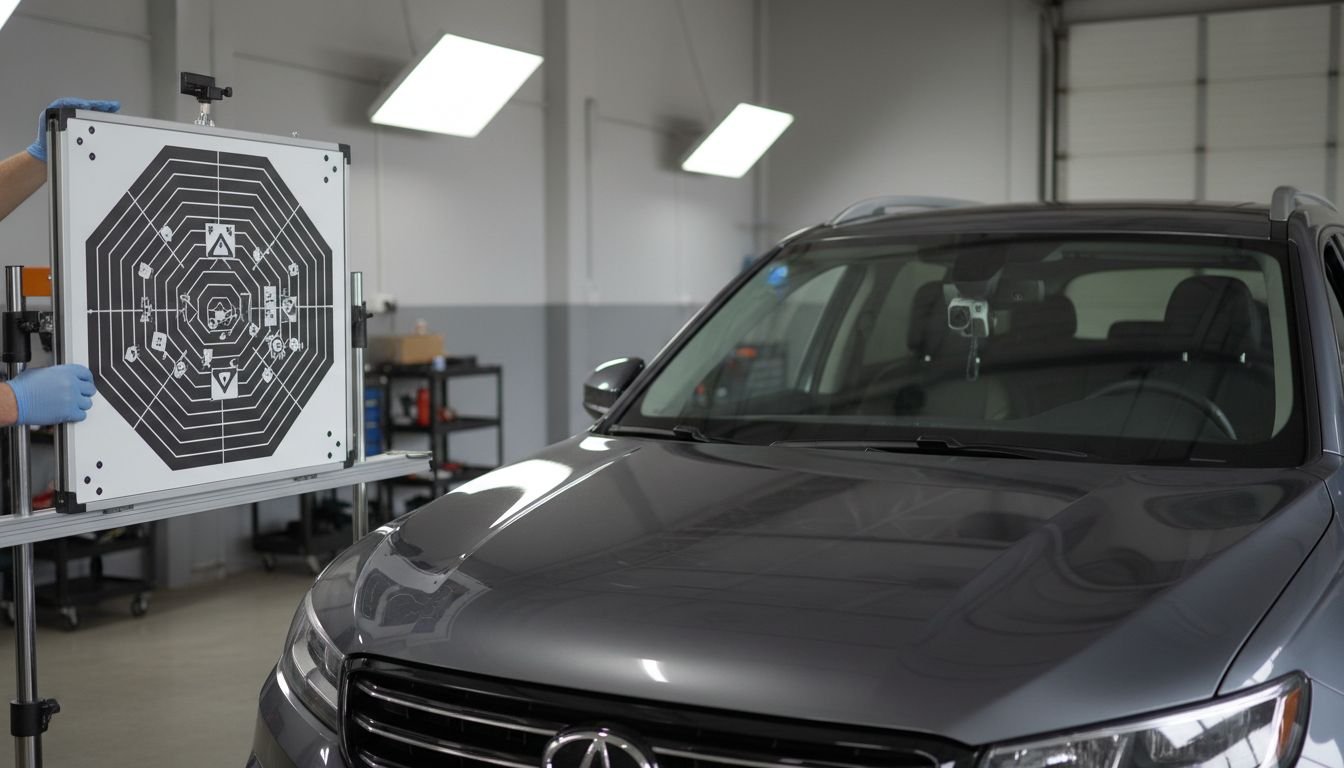
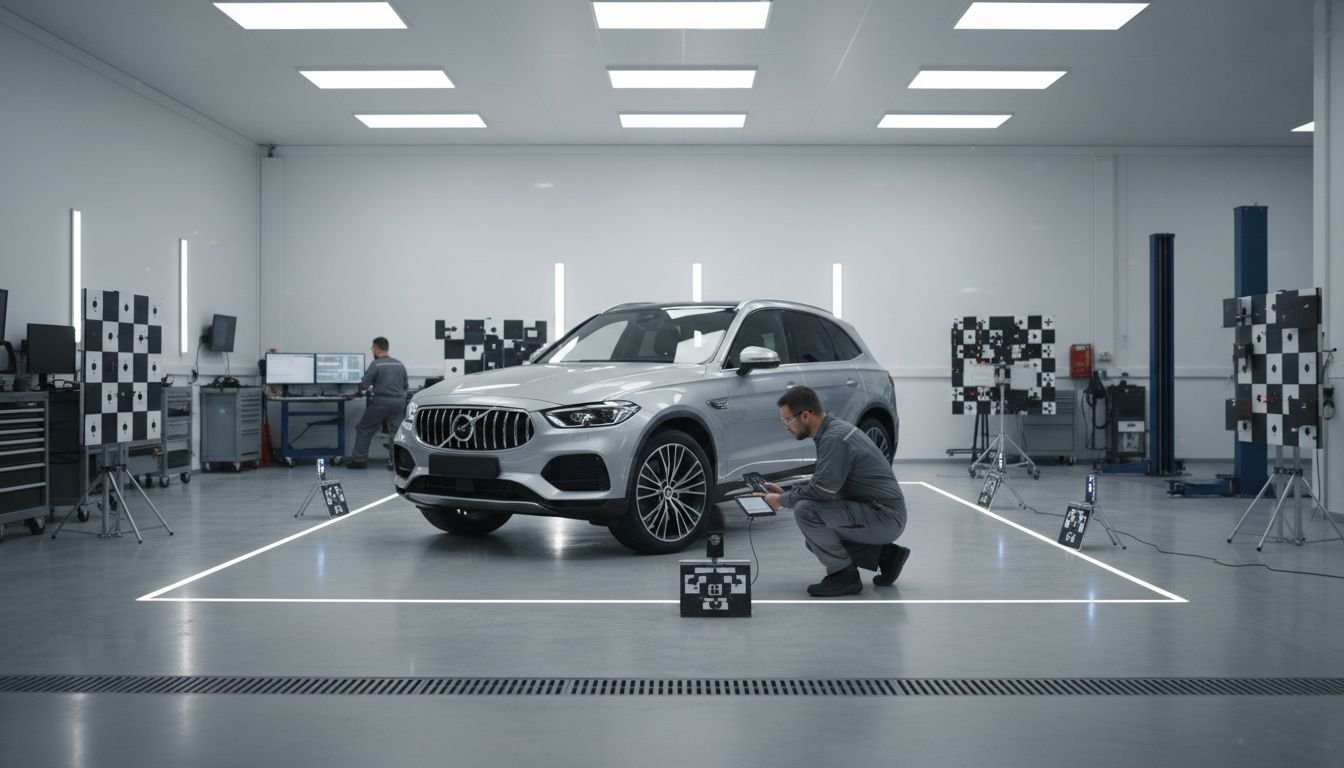
Static calibration is performed with the vehicle sitting still, centered in a level bay, while we position special calibration targets, boards, and measurement tools at precise distances and angles around the car. Using factory-level or equivalent ADAS equipment, we run a calibration routine that teaches the camera exactly where the targets are relative to the vehicle. This is common on many Toyota Safety Sense, Honda Sensing, and Subaru EyeSight systems.
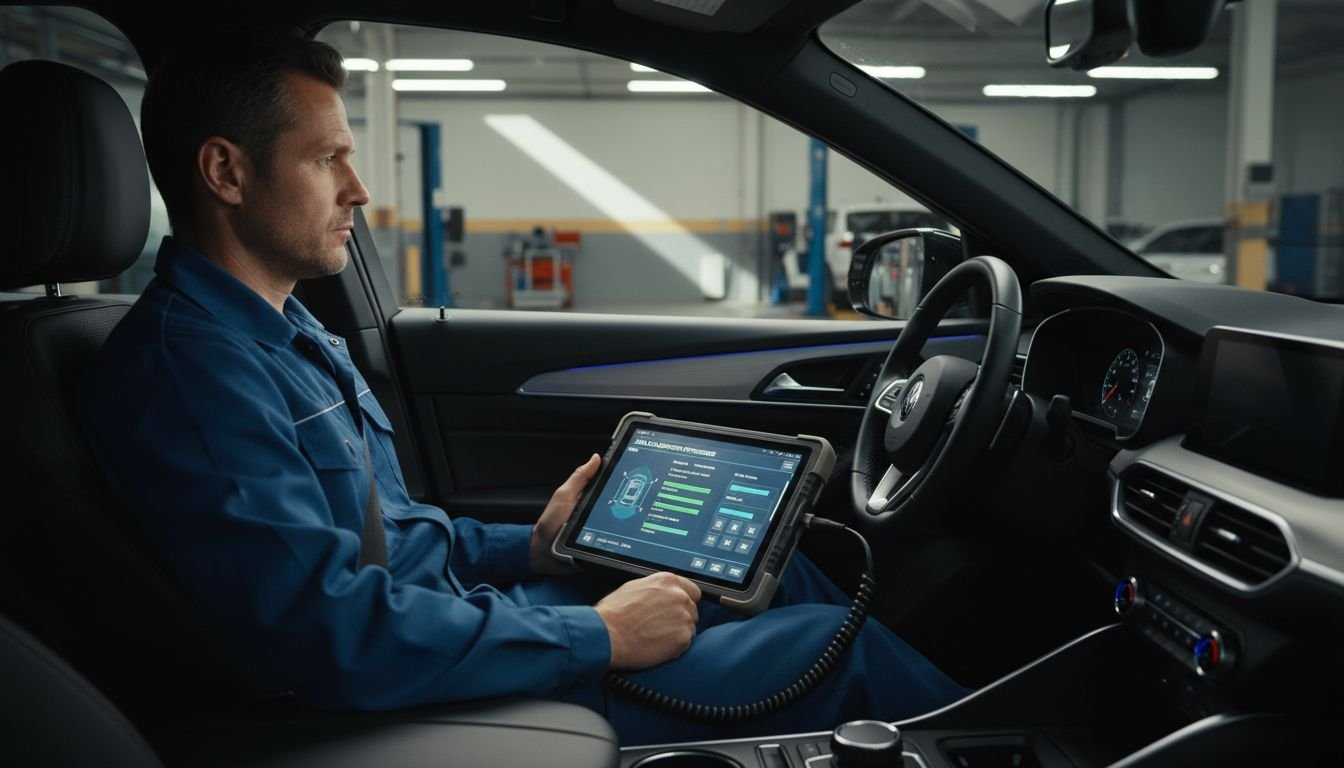
Dynamic calibration is done on the road under very specific conditions like minimum speed, clear lane markings, and certain lighting, using a scan tool while we drive. The vehicle learns by watching real lane lines and traffic, and the procedure must follow the OEM instructions step by step. Some vehicles, including many ford camera calibration applications and other lane assist calibration routines, may require static, dynamic, or both depending on year, model, and options.
Safety Implications of Skipping or Botching Recalibration
When calibration is skipped or done incorrectly, your vehicle may look fine but the safety systems are quietly wrong. The camera could think the car is centered when it is actually hugging one side of the lane, or it could misjudge the distance to a vehicle ahead by several feet. On busy Dallas–Fort Worth highways where brake checks and lane shifts are constant, that gap can be the difference between a close call and a rear-end collision.
There are also potential liability concerns. If you’re involved in a crash and an investigation shows that required calibration was not performed after windshield replacement, questions may arise about whether the vehicle was properly repaired. Worse, improper DIY or shortcut calibration is more dangerous than turning ADAS off, because you believe the system will save you when it may actually make the wrong decision.
How Long Does Camera Recalibration Take?
On most vehicles in the DFW area, static calibration typically takes about 45–90 minutes, including setup, measurements, and running the calibration procedure. Dynamic calibration often adds another 30–60 minutes, depending on traffic, weather, and how quickly the system completes its learn routine. Together, that means you should plan on roughly 1.5–3 hours of calibration time itself, not counting glass installation or cure time.
If your windshield was just installed, the adhesive may need time to cure before we can safely start calibration. In some cases, especially with more complex ADAS setups, the total visit can realistically be a half-day between glass work, ADAS Calibration, and verification road tests. When you contact us, we’ll give you a time window based on your specific year, make, model, and ADAS package.
What Happens During Professional ADAS Calibration in Dallas TX
Step 1 – Intake, Inspection, and Vehicle Diagnostic Scan
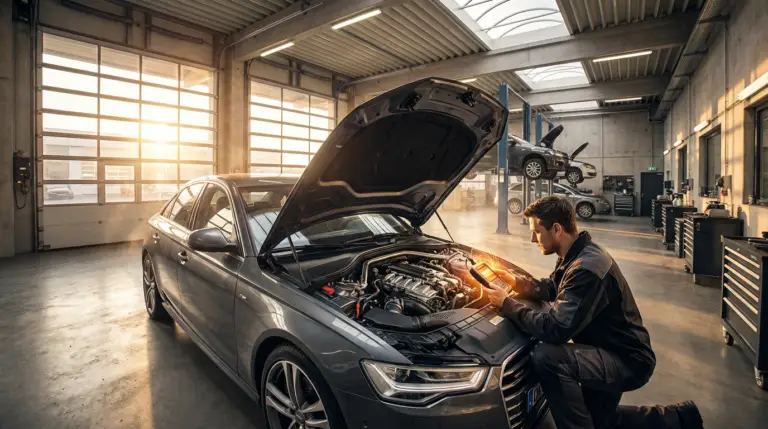
When you arrive at LockNCal in Dallas TX or anywhere in our DFW service area, we start with a focused intake. We’ll ask when and where the windshield was replaced, whether OEM or aftermarket glass was used, and whether any ADAS warning lights or strange behaviors have appeared. Then we perform a Vehicle Diagnostic scan to check for ADAS-related diagnostic trouble codes and to confirm which modules and cameras are online.
If you’re curious how we approach trouble codes and safety systems in general, you can read more about diagnostic trouble codes and vehicle safety diagnostics in Dallas TX. The goal at this stage is simple: document the current state of your systems before we touch anything, so we know exactly what changed after calibration.
Step 2 – Confirm Proper Windshield Installation and Camera Mounting
Calibration is pointless if the glass or camera isn’t installed correctly. Before setting up targets, we verify that the windshield is seated correctly, the correct style of glass was installed for your camera system, and the camera bracket is properly secured. We also check the camera lens area for contamination, chips, or distortion.
Next, we make sure nothing is blocking the camera’s field of view. That means no dark tint strips over the camera, no stickers or dash cams mounted in the critical zone, and no loose trim around the mirror. If something is in the way, we’ll explain what needs to move so your camera recalibration after windshield replacement is accurate.
Step 3 – Static ADAS Calibration (If Required)
For static calibration, we pull your vehicle into a dedicated, level bay and center it relative to the shop floor. Using manufacturer specifications, we perform precise measurements from the vehicle centerline, wheel centers, and bumpers to place calibration targets and boards at the exact distances and heights required. Lighting is controlled so the camera can clearly see the targets without glare or shadows.
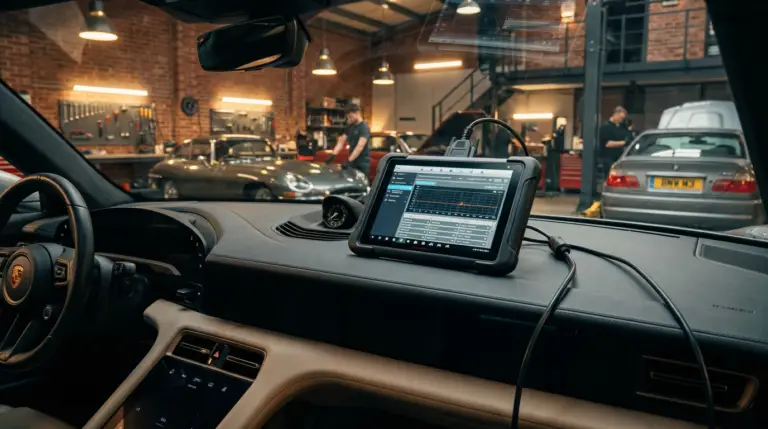
Then we connect our ADAS-capable diagnostic equipment and run the factory-specified calibration routine. During this process, the camera learns how those targets appear and stores that information as its reference for where the road and lane lines should be. We monitor the progress and make adjustments if the system requests repositioning or confirms specific alignment values.
Step 4 – Dynamic Calibration / Road Test (If Required)
If your vehicle calls for dynamic calibration, we take it on a controlled road test that meets the OEM’s conditions. That usually means a certain speed range, well-marked lanes, dry weather, and enough distance to allow the camera to complete its learning cycle. This is not \”just driving around the block\”; we follow a documented procedure using our scan tool to confirm when calibration has passed.
On Dallas–Fort Worth roads, we choose routes that meet those conditions as safely as possible, avoiding heavy construction zones and unpredictable traffic when we can. Once the camera reports that dynamic calibration is complete, we perform additional checks of lane assist and forward collision functions to make sure they behave as expected.
Step 5 – Verification, Final Diagnostic Scan, and Documentation
After calibration, we perform a final Vehicle Diagnostic scan to ensure there are no remaining ADAS fault codes and that all relevant modules report a successful calibration state. We test key functions like lane departure warning, lane keep assist, and collision warning on a brief verification drive when appropriate. If anything looks off, we correct it before proceeding.
We then generate a calibration report or documentation that you can keep for your records and, if needed, provide to your insurance company or body shop. We do not release the vehicle until it meets OEM specifications for ADAS Calibration and we’re satisfied that the safety systems are behaving correctly.
Camera Calibration Costs and Timelines in Dallas–Fort Worth
Typical Price Range for Camera Recalibration After Windshield Replacement
In the Dallas–Fort Worth area, most standalone windshield camera recalibrations (without the glass replacement itself) typically fall between $200 and $450 for common American and Japanese vehicles. The exact price depends on whether your vehicle needs static calibration only, dynamic only, or both, and whether there are multiple cameras or additional sensors involved. Higher-end or more complex setups can cost more, but in most everyday sedans and SUVs, you’ll be somewhere in that range.
If the calibration is bundled with a windshield replacement done through a glass provider, your total invoice will be higher, but the portion for calibration is often clearly itemized. When you call us at LockNCal, we’ll give you a realistic range for camera recalibration after windshield replacement on your specific vehicle based on your VIN and ADAS features.
Insurance Coverage and Out-of-Pocket Scenarios in Texas
In Texas, if you have comprehensive coverage or dedicated glass coverage, ADAS Calibration is often included when it is required by OEM procedures after a windshield replacement. Many insurers now understand that cameras, radars, and sensors are part of the safety system, not optional gadgets. That means your out-of-pocket cost for calibration can be reduced significantly, or in some cases covered, depending on your policy and deductible.
LockNCal regularly works with major Texas insurance carriers to document calibration procedures and provide the proof they need. If you’re not sure how your coverage applies, we can help you gather the needed information and guide you on what to ask your adjuster.
Time Expectations for Dallas Drivers
For typical sedans and small SUVs with standard ADAS, you should plan on 1.5–3 hours at our shop for calibration and verification once the glass is properly installed. More complex systems, or vehicles requiring both static and dynamic calibration under very specific driving conditions, may take longer. We’ll let you know up front if your vehicle falls into that category.
Depending on our schedule, many calibrations can be handled same-day or next-day in Dallas County, Tarrant County, Collin County, and Denton County. When you contact us, we’ll coordinate timing so you can minimize downtime and still leave with properly functioning ADAS systems.
When OEM or Dealer-Level Calibration Is Necessary
Ford Camera Calibration, Tesla, and Other OEM-Specific Requirements
Some manufacturers have especially strict procedures and tooling requirements for ADAS work. Ford camera calibration routines often require specific target sets and software workflows tied to Ford’s service information. Toyota Safety Sense, Honda Sensing, and Subaru EyeSight also have detailed alignment specs and environmental conditions that must be met.
At LockNCal, we focus on American and Japanese vehicles, and we follow OEM-level procedures or approved-equivalent methods for those brands. That means we use the correct target setups, distances, and scan routines required by the manufacturer instead of generic shortcuts.
When You Should Choose Dealer or OEM Support
There are some situations where a dealer visit may still be the right move. Examples include certain Tesla vehicles that require proprietary online access, unusual software updates or recalls, or rare cases where the OEM mandates in-house calibration tools that independents cannot access. In those cases, you want the dealer’s specific infrastructure involved.
We position LockNCal as your first call for ADAS concerns on American and Japanese vehicles in Dallas–Fort Worth. After our Vehicle Diagnostic and inspection, if we determine that a dealer-only software update or procedure is required, we’ll explain why and help you understand your options, instead of guessing or experimenting on your vehicle.
Signs Your Camera or Lane Assist Calibration May Be Off
Dashboard Warning Lights and Error Messages
One clear indicator that something is wrong is an ADAS warning light or message popping up on your dash after windshield replacement. You may see icons related to lane departure, collision avoidance, or adaptive cruise, along with messages like “camera unavailable” or “front assist not available.” These are the vehicle’s way of telling you it doesn’t trust its own sensors.
Sometimes, the light will disappear intermittently, especially if conditions improve, but that does not mean calibration is correct. If the system has stored fault codes, we can see that during a Vehicle Diagnostic scan and use that information to guide recalibration.
Strange Lane Assist or Adaptive Cruise Behavior
Even without warning lights, you might feel something is off. Lane keep assist may gently steer you when no lane line is nearby, or fail to intervene when you drift. Adaptive cruise control might brake too late, or follow too closely even when you’ve set a larger distance.
If that describes your car after glass work, a lane assist calibration or full ADAS calibration is likely needed. Do not ignore your gut feeling; you drive your car every day and you’re usually right when something feels different or less predictable.
What to Do If You Notice These Symptoms in DFW
If you’re seeing warning lights or odd ADAS behavior anywhere in Dallas, Fort Worth, Arlington, Plano, Irving, or other nearby cities, treat it as a safety issue. Stop relying on lane assist, adaptive cruise, and emergency braking until the system has been checked. You can still drive the car carefully to an appointment, but drive it like it has no driver aids at all.
Contact LockNCal to schedule both ADAS Calibration and a supporting Vehicle Diagnostic so we can confirm root causes and verify that your systems are back within spec. If you’re unsure which features your vehicle has, you can use our VIN decoder beforehand and share the results when you book.
DIY Camera Calibration vs Professional ADAS Calibration – Risks and Limits
Why In-Car “Relearn” Buttons Are Not Full Calibration
Some vehicles have a menu option to “relearn,” “initialize,” or “reset” camera or lane assist settings from the infotainment screen. This can be useful after simple things like a windshield cleaning or minor service, but it is not a substitute for full professional static/dynamic calibration after a windshield has been replaced. The system still needs precise targets and measurement conditions that you cannot reproduce in a driveway.
Relying only on those in-car options after glass work can leave your ADAS partially calibrated or misaligned without any obvious warning. That’s why we strongly recommend professional ADAS Calibration after any windshield replacement that affects the camera’s mounting or viewing area.
Safety Risks and SRS/Explosive System Warnings
Serious Safety Warning: The area around the windshield and A-pillars often contains SRS (airbag) components, including front airbags, side curtain airbags, and associated wiring and sensors. These systems use explosive charges to deploy airbags and pretension seat belts in milliseconds during a crash. DIY disassembly of trim, sensors, or modules around the windshield without proper training and equipment can cause accidental deployment or hidden damage.
Improper handling of airbag modules, pretensioners, clock springs, and harnesses can lead to airbags not deploying when needed, deploying at the wrong time, or leaving your dash lit with SRS warning lights. If a collision or prior repair has affected these components, LockNCal offers professional services such as SRS Airbag Module Reset, Airbag Module Replacement, Airbag Replacement, Seat Belt Replacement, Pre-Tensioner Replacement, Clock Spring Replacement, and Vehicle Diagnostic to make sure the system is safe and compliant.
Dallas heat and temperature swings can also stress safety components over time. To see how environmental conditions matter, you can read about how summer heat in Dallas can damage safety systems like airbags and sensors. Combining that stress with DIY tinkering around sensitive parts is a risk you don’t want to take.
Why Professional ADAS Calibration Is the Safe Choice in DFW
ADAS Calibration requires more than a code reader and a parking lot; it needs specialized targets, measurement tools, accurate vehicle specifications, and controlled lighting and distance. On top of that, a technician has to understand how each brand’s system learns and validates its calibration. That’s why we’ve invested heavily in training and equipment specifically for American and Japanese vehicles in our Dallas–Fort Worth market.
Given the traffic, construction, and high-speed travel common on I‑35, I‑20, I‑30, and I‑635, this isn’t the place to gamble on camera alignment. Let us handle the professional ADAS Calibration so you can drive knowing your safety systems are working the way the engineers designed them to.
ADAS Calibration Services for Dallas TX Drivers
Why Dallas–Fort Worth Drivers Need Reliable Camera Calibration
Driving in the Dallas–Fort Worth area means dealing with constant construction, lane shifts, and debris on major routes like I‑35, I‑20, I‑30, and I‑635. Rock chips that start on 635 or the Dallas North Tollway often turn into full windshield cracks after one good Texas hailstorm. Every time that glass is replaced, your ADAS camera’s alignment is put at risk.
Reliable camera calibration after windshield replacement is especially important here because we spend so much time at highway speeds in dense traffic. ADAS can be a huge safety net when it’s calibrated correctly, but only if the underlying camera data is accurate.
For more on how our climate can affect safety electronics, you can also read about how Dallas heat affects ADAS sensors and safety systems.
How LockNCal Handles ADAS Calibration in Dallas TX
At LockNCal, our core focus for post-glass work is ADAS Calibration, backed up by thorough Vehicle Diagnostic work when needed. For collision-related or airbag-related issues discovered during diagnostics, we can also provide SRS Airbag Module Reset, Airbag Module Replacement, Airbag Replacement, Seat Belt Replacement, Pre-Tensioner Replacement, and Clock Spring Replacement to restore the rest of the safety system.
We specialize in American and Japanese vehicles, which covers a large portion of what Dallas–Fort Worth drivers are actually using on the road: Ford, Chevrolet, Toyota, Honda, Nissan, Subaru, and similar brands. If you’re not sure where to start, our VIN decoder can help you identify the options and ADAS packages your vehicle came with from the factory.
Service Area Across DFW
We provide safety-focused calibration services across much of the DFW Metroplex, including Dallas TX, Fort Worth TX, Arlington TX, Plano TX, Irving TX, Grand Prairie TX, Frisco TX, McKinney TX, Garland TX, Mesquite TX, Richardson TX, and many more communities. Our coverage includes Dallas County TX, Tarrant County TX, Collin County TX, and Denton County TX, along with cities like Addison, Allen, Anna, Burleson, Carrollton, Cedar Hill, Celina, Colleyville, Coppell, DeSoto, Duncanville, Euless, Farmers Branch, Flower Mound, Grapevine, Haltom City, Highland Park, Hurst, Hutchins, Kennedale, Lake Dallas, Lake Worth, Lancaster, Lewisville, Little Elm, Mansfield, Melissa, North Richland Hills, Pantego, Prosper, Rockwall, Saginaw, Seagoville, Southlake, The Colony, Trophy Club, University Park, Watauga, White Settlement, and Wilmer.
If you’re anywhere in that footprint and your windshield has been replaced, we’re your local choice for ADAS Calibration that puts safety first instead of treating it like an add-on.
For more information about our Dallas location specifically, you can visit our Dallas TX service page.
FAQs About Camera Calibration After Windshield Replacement
Is camera calibration really necessary after windshield replacement?
Yes. On most modern vehicles with ADAS, the manufacturer’s service information states that ADAS camera recalibration after windshield replacement is required any time the glass or camera bracket is removed or disturbed. Skipping it can leave lane assist, collision warning, and emergency braking operating with bad data, which can be more dangerous than having no assist at all. Professional ADAS Calibration is the safe choice.
How much does camera recalibration after windshield replacement cost in Dallas–Fort Worth?
Most standalone windshield camera recalibrations in the DFW area fall between $200 and $450 for typical American and Japanese vehicles. The final amount depends on the number of cameras, whether you need static, dynamic, or both types of calibration, and how complex your ADAS package is. If calibration is tied to an insurance glass claim, your out-of-pocket cost may be reduced or covered depending on your policy.
How long does ADAS camera recalibration take?
Plan on roughly 45–90 minutes for static calibration and another 30–60 minutes if dynamic calibration is required. Including setup, road testing, and final Vehicle Diagnostic scans, many vehicles are completed in about 1.5–3 hours once the windshield is properly installed. More complex systems can take longer, but we’ll give you realistic timing when you schedule.
Can I drive my car before doing lane assist calibration after a windshield replacement?
You can usually drive carefully to an ADAS Calibration appointment after your glass is installed, but you should not rely on ADAS features like lane assist, adaptive cruise, or automatic emergency braking until calibration is complete and verified. Treat the car like it has no driver assistance at all. If warning lights or unsafe behavior appear, schedule calibration and diagnostics as soon as possible.
Can I recalibrate the camera myself using the car’s settings menu?
No. In-car “relearn” or “reset” options are not full replacements for professional static and dynamic calibration with targets and scan tools, especially after windshield replacement. They may clear messages or attempt minor adjustments, but they cannot correct for changed glass curvature, mounting position, or camera angle. For safety, always have professional ADAS Calibration performed after glass work.
What if my vehicle doesn’t show any warning lights after the windshield is replaced?
Warning lights are helpful, but their absence doesn’t guarantee proper calibration. The system can be misaligned but still think everything is fine if it has not run its own internal self-checks yet. If the OEM says calibration is required after windshield replacement on your model, you should complete it even if the dash is quiet.
How to Schedule ADAS Calibration in DFW
What to Have Ready When You Call
When you contact LockNCal to schedule ADAS Calibration, having a few details ready helps us give you accurate time and price ranges. We’ll ask for your VIN, year, make, and model, a quick list of the ADAS features you know you have (like lane keep assist, adaptive cruise, or automatic braking), and the date and location where the windshield was replaced. If insurance is involved, having your policy information and claim number available speeds things up.
If you don’t know your exact options, you can run your VIN through our VIN decoder before you call or text us and share the results. That lets us confirm whether you’re likely to need static, dynamic, or both types of calibration.
Call-to-Action for DFW Drivers
If your windshield has been replaced anywhere in the Dallas–Fort Worth area and your vehicle uses lane assist, collision avoidance, or adaptive cruise, don’t rely on those systems until a professional has calibrated them. Your safety systems are designed to be precise, and small errors can show up in big ways at highway speed. The best next step is to schedule a professional ADAS Calibration appointment with LockNCal so we can confirm everything is aligned and functioning the way the manufacturer intended.
Whether you’re in Dallas, Fort Worth, Arlington, Plano, Irving, or any of the surrounding communities we serve, reach out by phone, text, or our online form to book your calibration. We’ll walk you through the process, explain costs and timing up front, and make sure your vehicle’s ADAS is ready for real-world DFW driving again.