

Key Takeaways
– Battery diagnostics is more than a quick voltage check – it should include open-circuit voltage, cranking voltage, load testing, and CCA to see if the battery can actually start your vehicle in real DFW conditions.
– Many “no-start” issues around Arlington TX aren’t just a weak battery; the true cause may be the alternator, starter, wiring, parasitic drain, or safety modules, so guessing and swapping parts gets expensive fast.
– When in doubt, a professional Vehicle Diagnostic at a safety-focused shop in Arlington TX is the safest way to sort out battery, charging, and safety-system issues without risking SRS airbags or ADAS modules.
In This Guide:
🔍 What Battery Diagnostics Actually Check – Battery, charging, starting systems, and real-world symptoms
🧪 Battery Tests, Tools and How to Read Results – Voltage, load, CCA, battery trouble codes, and when replacement actually makes sense
🛠️ DIY Battery Diagnostics vs Professional Vehicle Diagnostic – What’s safe to do at home and where DIY goes wrong
🚗 How a Professional Vehicle Diagnostic Finds the Real Problem – How techs separate battery issues from alternator, wiring, and safety modules
📍 When to Call a Pro in Arlington TX – Local DFW red flags and what to expect at a diagnostic visit
🛡️ How Battery Diagnostics Connect to Other Safety Services – SRS, seat belts, and ADAS after electrical issues
❓ FAQ: Battery Diagnostics & Vehicle Safety – Common questions from DFW drivers
In modern vehicles, battery diagnostics is not just “is my battery dead or not.” It is a structured process to see how your battery behaves under load, how your alternator charges it, and how the starter and wiring handle that power. In Arlington TX and across the Dallas–Fort Worth area, the heat, traffic, and short-trip driving make proper diagnostics even more important.
As a local safety-focused shop, we routinely see cars towed in after a quick parts-store test said the battery was “good” or “bad,” but the reading didn’t match what the car was actually doing. In this guide, I’ll walk you through voltage, load, and CCA tests, what a diagnostic battery tester really measures, and when it is time to schedule a full Vehicle Diagnostic instead of throwing more parts at the problem.
If you are in Arlington TX or anywhere in DFW, you can learn more about our local services here: DFW Safety Restore – Arlington TX.
What Battery Diagnostics Actually Check
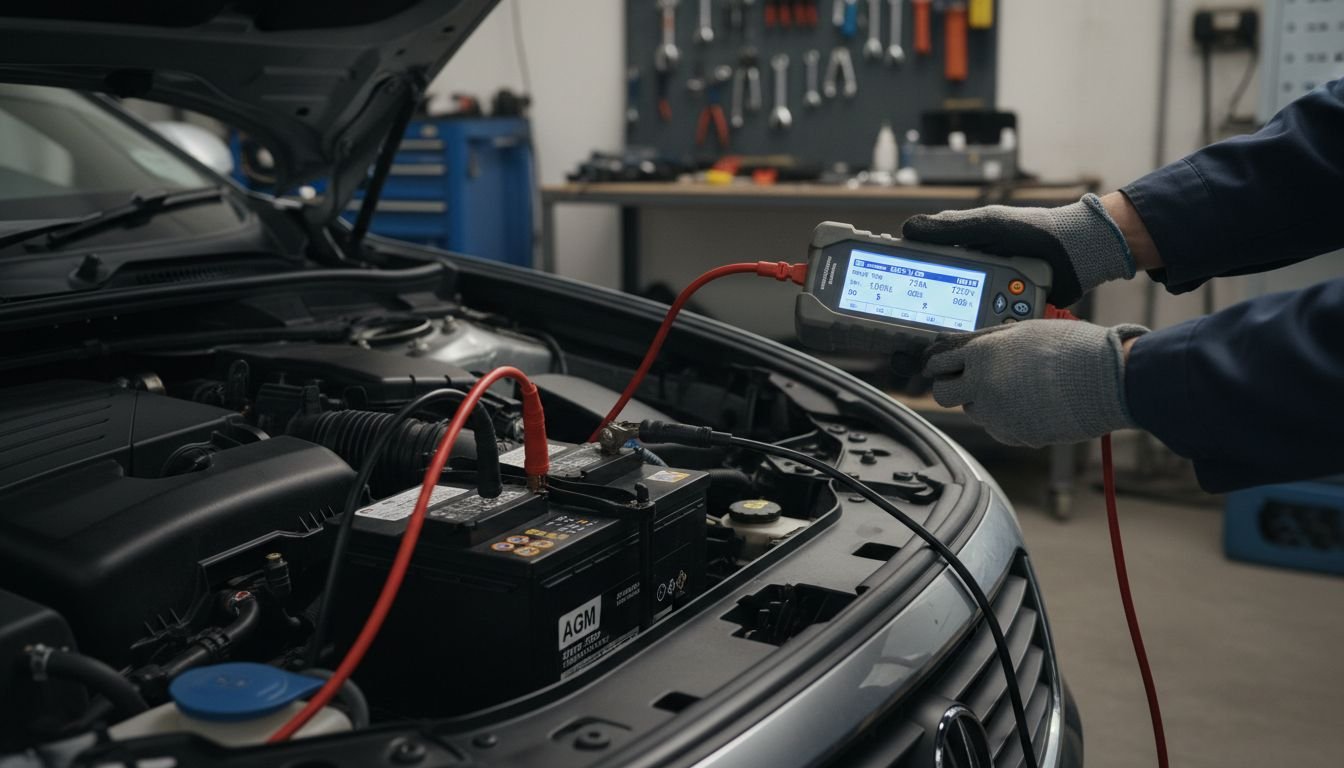
When we talk about battery diagnostics in DFW, we’re really talking about three systems that all have to work together. The battery, charging system, and starter circuit each play a different role, and a real diagnostic checks all three instead of guessing at one piece. That’s where a basic counter test at a parts store often falls short.
Battery vs Charging vs Starting Systems
The battery is your energy storage. It supplies power to crank the engine, run lights, power steering on some models, and keep memory in modules when the engine is off.
The alternator and charging system are responsible for refilling that battery while you drive. If the alternator is weak or the wiring has issues, a brand-new battery can still end up dead after a few days in Arlington traffic.
The starter circuit uses a big surge of current to turn the engine over. Problems here can look like a bad battery, even when the battery itself is fine, which is why a proper vehicle diagnostic for battery problems looks at current draw, voltage drop, and connections.
Common Symptoms That Call for a Battery Diagnostic
- Slow cranking – the engine turns over slowly, especially after sitting overnight or after work in a hot parking lot.
- Clicking and no crank – you hear rapid clicks when you turn the key or push the start button, but the engine doesn’t turn.
- Dim headlights or dash lights – especially noticeable at idle with the A/C blasting, which is common in North Texas summers.
- Electrical gremlins – radio resets, windows move slowly, interior lights flicker, or random warning lights pop on and off.
- Battery or charging warning light – a battery symbol or charging system warning on the dash while driving.
- Car dies at stoplights or after sitting – the vehicle stalls at a red light or refuses to start after sitting overnight, at the airport, or after a Rangers/Cowboys game.
In Arlington TX, Texas heat and heavy A/C loads are tough on batteries. Short trips from neighborhood to neighborhood don’t give the alternator much time to recharge, so proper battery diagnostics in DFW has to factor in how the car is driven, not just a single voltage reading.
Battery Tests, Tools and How to Read Results
Most drivers hear terms like “load test,” “CCA,” or “system voltage” without anyone ever explaining what those numbers mean. Big-box parts stores advertise free car battery testing in Arlington TX, but they rarely walk you through how their testers interpret the results or what they did and did not test.
A safety-focused shop uses a professional diagnostic battery tester, a scan tool, and real-world checks under load. Let’s break down the main tests and how we read them in the shop.
Voltage Tests – Open-Circuit and Cranking Voltage
Open-circuit voltage (OCV) is the battery voltage measured with the engine off and no major loads running. It gives a rough idea of the battery’s state of charge.
- About 12.6V or higher – typically a fully charged, healthy battery.
- 12.4–12.5V – roughly 75% charged.
- 12.2V – around 50% charged.
- Below about 12.0V – deeply discharged and possibly sulfated or weak.
We also watch cranking voltage, which is how low the voltage drops while the engine is cranking. If it falls below roughly 9.6V during a 10–15 second crank, that can indicate a weak battery, high starter draw, or poor connections.
In North Texas heat, we interpret these numbers with battery age, temperature, and load in mind. A three-year-old battery in Arlington TX at 105°F that drops low during cranking might be near the end of its real-world life even if a quick test calls it “marginal.”
Load Testing – Can the Battery Hold Up Under Stress?
A battery load test applies a controlled heavy electrical load to simulate how the battery behaves when you start the engine. Old-school testers used big carbon piles; modern digital analyzers do it electronically while watching voltage and internal resistance.
In simple terms, a pass means the voltage stays above the required threshold during the test and the internal resistance is within range for that battery’s rating. A fail usually means voltage collapses under load or the internal resistance is too high, showing the plates inside are tired.
This is where quick checks at a counter often miss problems. A battery can show a healthy open-circuit voltage but fail a load test, so the car still struggles to start in the morning even though your printout says “battery OK.”
CCA (Cold Cranking Amps) and Why It Matters in Texas
CCA (Cold Cranking Amps) is a measure of how much current the battery can deliver for 30 seconds at 0°F without voltage dropping below a specified level. It was designed for cold climates, but it is still a good indicator of the battery’s overall muscle.
Every battery has a rated CCA printed on the label. A professional tester performs a CCA battery test and reports a measured CCA versus the rated number.
- If measured CCA is close to rated CCA, the battery is generally strong.
- If measured CCA is significantly lower than rated CCA, the battery is near end of life.
In the Arlington TX and DFW climate, the heat slowly cooks batteries from the inside. It is common for a battery to test “barely acceptable” on CCA at three to four years old and then fail suddenly on the first cool front or after a weekend parked at DFW Airport. That’s why we pair CCA readings with age, usage, and real-world symptoms.
Common Battery-Related Diagnostic Trouble Codes (DTCs)
Modern vehicles also set battery-related diagnostic trouble codes when voltage or charging goes out of range. You might not see a specific “battery code” on your dash, but a scan will reveal stored faults.
- Low system voltage / high system voltage – the computer saw voltage too low or too high for a period of time.
- Charging system performance – the alternator is not providing the expected output, or communication with a smart alternator is faulty.
- Control module low-voltage history – modules record that they experienced low voltage in the past, even if things seem normal now.
These battery trouble codes help us decide if the main issue is the battery itself, the alternator, wiring, or a control module not managing charging correctly. If you want a deeper dive into how DTCs work in general, including non-battery codes, you can read our guide on understanding diagnostic trouble codes using a real Pontiac example.
Recommended Tools for Basic Battery Checks
For basic checks at home, a few tools can give you useful information if you already know how to use them safely.
- Digital multimeter – great for measuring open-circuit voltage and, in experienced hands, checking basic voltage drop across terminals and grounds.
- Consumer battery tester – handheld testers sold online can show voltage and a rough health estimate, but they don’t always do a true load or CCA test like a shop-grade analyzer.
- Professional diagnostic battery analyzer – what we use in the shop to check voltage, load, CCA, and internal resistance with more accurate algorithms.
- Scan tool – even a basic code reader can show you if charging or low-voltage codes are stored, though a professional scan tool reads far more modules.
The limitation of DIY tools is not only the hardware, but interpretation. Misreading a tester result is one of the biggest reasons we see good batteries replaced and the real issue – alternator, wiring, ignition, or safety modules – still causing problems.
When Battery Replacement Is Actually Necessary
Even though we do not sell or install batteries, we are very clear with customers about when a battery is at the end of its life based on testing and symptoms. In general, replacement is justified when:
- The battery fails a load test or CCA test consistently on a professional analyzer.
- You have repeated low-voltage issues even after the battery has been properly charged and the charging system checks out.
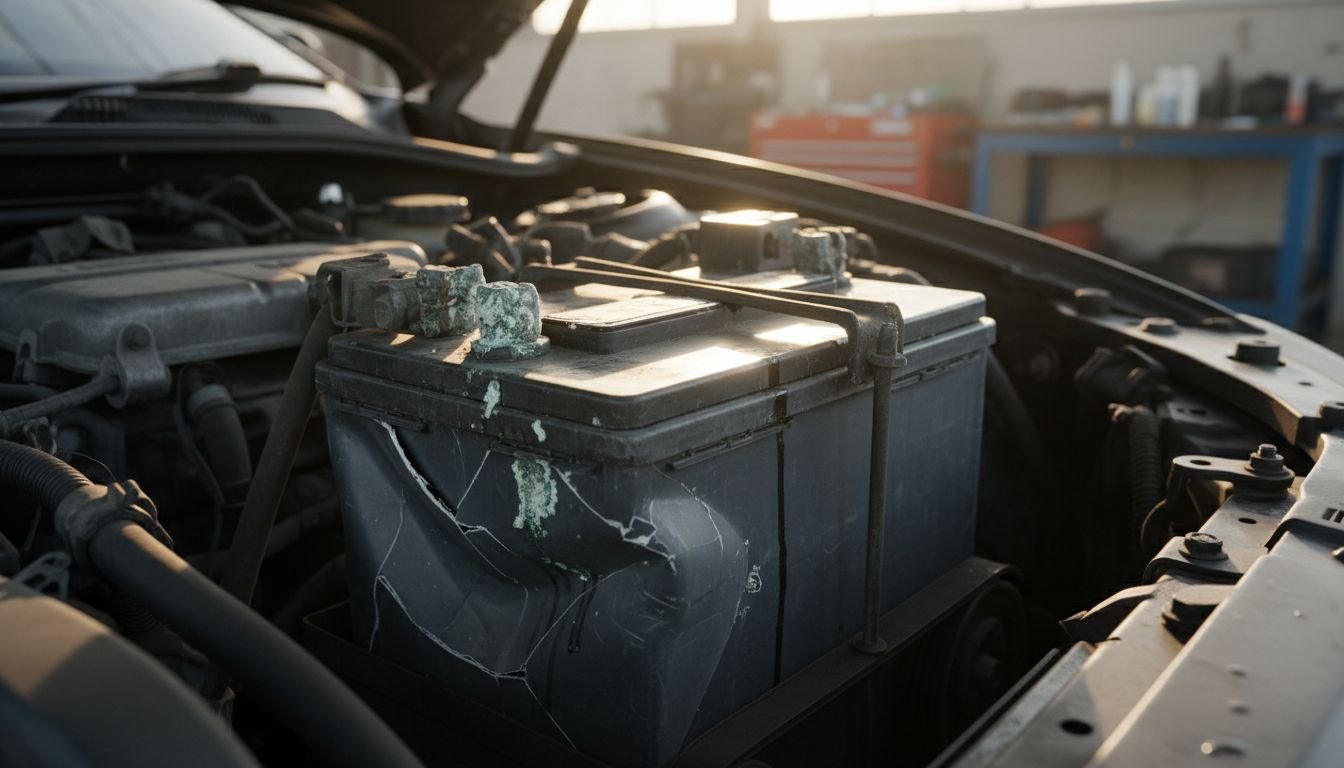
- The battery is swollen, leaking, or physically damaged – in that case, it is a safety hazard and must be replaced immediately.
- The battery is in the 3–5 year age range in Texas heat and is showing marginal test results and real symptoms.
A proper Vehicle Diagnostic confirms whether you truly need a battery or if the real issue is the alternator, starter, parasitic drain, or a control module. We routinely point customers to a trusted local shop for battery or alternator replacement only after diagnostics prove that is the right move.
DIY Battery Diagnostics vs Professional Vehicle Diagnostic
There are a few simple checks most Arlington TX drivers can do safely in the driveway. Beyond that, modern vehicles are packed with electronics and safety systems that do not react well to guesswork or random probing with a test light.
What You Can Safely Check Yourself
If you are comfortable popping the hood, you can do a few low-risk inspections before you call a shop.
- Corrosion on battery terminals – look for white, green, or blue buildup on the posts and clamps.
- Check cable tightness – gently try to move each cable; they should not twist or lift off easily.
- Visual inspection – with the engine off, look for a swollen case, cracks, or leaks around the battery.
- Simple voltage check – if you already know how to use a meter, you can check basic open-circuit voltage as a starting point.
Keep in mind that these checks tell you almost nothing about how the battery behaves under real load or how the alternator and starter are performing. They are just a first step to spot obvious problems.
Where DIY Battery Testing Can Go Wrong
The biggest DIY issue we see in DFW is misdiagnosis. A driver replaces the battery themselves based on a single low-voltage reading, but the alternator or a parasitic drain is the real problem, and the new battery dies in days.
- You can misread a voltage or tester message and replace a good battery while a failing alternator, corroded ground, or weak starter is actually to blame.
- DIY tools rarely catch intermittent parasitic drains that slowly kill a parked vehicle overnight or over a weekend trip.
- Clearing codes at home without understanding them can erase important data that helps a technician later.
These mistakes cost money in unneeded parts, tows, and missed work. A single professional Vehicle Diagnostic is often cheaper than one round of “try a battery, then an alternator, then a starter” guessing.
Safety Warning – SRS, Airbags and Electrical Systems
Modern vehicles tie the electrical system directly into SRS airbag modules, seatbelt pretensioners, and ADAS (advanced driver assistance) components. These systems are designed to protect you in a crash, but they can be damaged by unstable voltage or improper testing.
Important safety warning: SRS components contain explosive charges that deploy airbags and pretensioners in milliseconds. Untrained probing, back-probing, or jumping wires near SRS or ADAS circuits is dangerous and can cause short circuits, sparks, or even inadvertent airbag deployment.
If your battery or charging issue overlaps with airbag warning lights, seatbelt faults, or ADAS errors, stop DIY testing and schedule a professional Vehicle Diagnostic. Shops like ours can then determine if you need services such as SRS Airbag Module Reset, Airbag Module Replacement, Seat Belt Replacement, Pre-Tensioner Replacement, Airbag Replacement, Clock Spring Replacement, or ADAS Calibration after the electrical problem is resolved.
How a Professional Vehicle Diagnostic Finds the Real Problem

When a vehicle comes into an Arlington TX shop for a no-start or electrical complaint, we do not just slap a tester on the battery and decide in 30 seconds. A structured Vehicle Diagnostic follows a process that looks at battery, charging, starting, and safety systems together.
What a Full Vehicle Diagnostic Includes
While every case is a little different, a thorough diagnostic for battery-related problems usually includes:
- System scan for DTCs – reading codes from powertrain, body, and safety modules to see how the car has been behaving over time.
- Battery and charging system analysis – using a professional analyzer to measure voltage, load performance, CCA, and internal resistance.
- Starter draw and voltage drop checks – watching how much current the starter pulls and how far voltage drops during cranking.
- Visual and wiring inspection – looking for loose grounds, damaged cables, or signs of overheating.
The goal is to pinpoint whether the issue is truly the battery or something else: alternator output, wiring resistance, ignition switch, or even a control module. This same structured mindset is how we approach other diagnostics, like oxygen sensor and emissions faults; you can see an example in our article on vehicle diagnostic and safety systems in Arlington TX using a Hummer code case study.
Why This Matters for Safety Systems
Low or unstable voltage is hard on sensitive electronics. It can create false warnings, stored faults, or erratic behavior in SRS airbag modules and ADAS systems such as lane keep assist, adaptive cruise, or automatic emergency braking.
After electrical issues are stabilized, a correct Vehicle Diagnostic helps determine whether your vehicle needs follow-up services like SRS Airbag Module Reset, Airbag Module Replacement, Seat Belt Replacement, Pre-Tensioner Replacement, Airbag Replacement, Clock Spring Replacement, or ADAS Calibration. We never guess at these safety decisions; we base them on data from scans and inspections.
Skipping diagnostics and randomly replacing modules or sensors is not just expensive – it can leave you with safety systems that do not work when you really need them.
When Vehicle Key and Locksmith Services Tie Into Battery Issues
Battery and electrical problems can sometimes look like key or immobilizer issues, especially on push-button start vehicles. A weak battery can cause a no-crank situation or security warning that makes you think the key is bad.
Once we verify power and charging are healthy, we can then address actual key problems with services such as Vehicle Key Cutting, Transponder Key Programming, Smart Key Programming, Key Fob Replacement & Programming, Vehicle Key Duplication, Vehicle Key Copying, Vehicle All Keys Lost, Car Lockout Assistance, and general Locksmith Services when needed.
If you suspect the key rather than the battery, or you are stranded and need to get moving again quickly, you can learn more about same day help getting back on the road with professional key services. Just remember that electrical and battery health should be confirmed first.
When to Call a Pro in Arlington TX
There is a point where continuing to jump-start, wiggle cables, or guess with parts becomes unsafe and expensive. In Arlington TX and across DFW, that point comes faster because of our heat and stop-and-go driving.
Situations Where You Should Stop DIY Testing
If any of these apply, stop DIY testing and schedule a professional Vehicle Diagnostic:
- The battery is swollen, cracked, or leaking – that is a chemical and safety hazard.
- You notice a burning smell, smoke, or melted plastic around the battery, cables, or fuse box.
- Airbag/SRS or ADAS warning lights are on at the same time as your electrical or no-start issues.
- The car has repeated no-starts even after a jump or after installing a new battery.
- You are not comfortable using a meter or reading DTCs and do not want to risk damaging electronics.
In these cases, calling a local expert in Arlington TX is cheaper and safer than one more risky attempt under the hood.
How a Vehicle Diagnostic Visit Works at a DFW Shop
At a professional shop in the Dallas–Fort Worth area, a typical battery-related Vehicle Diagnostic follows a clear process. The goal is to get you honest answers, not to sell unnecessary parts.
- Quick intake – we confirm year, make, model, and the symptoms you are seeing (slow crank, no start, warning lights, etc.).
- Structured testing – we perform voltage, load, and CCA checks, inspect wiring, and scan for codes in powertrain, body, and safety modules.
- Clear explanation – we review what we found, explain it in plain English, and discuss next steps such as battery replacement at a parts or tire shop, alternator work at a trusted mechanic, or safety-system services if needed.
Our focus is always safety-first decision making, not just clearing a light long enough to get the car out of the bay.
Arlington TX and DFW Conditions That Kill Batteries Faster
Drivers in Arlington TX, Grand Prairie, Fort Worth, Dallas, and the rest of DFW face conditions that are tough on batteries. Long periods of Texas heat, short commutes, and heavy A/C loads shorten battery life more than most national articles admit.
Many local drivers discover their batteries are marginal after the car sits for a day at a ballpark, airport, or when the first cool front hits. That is why we recommend proactive battery diagnostics before summer road trips, after any major jump-start event, or when a vehicle has been stored.
If you are unsure where your vehicle stands, you can always start by decoding your exact vehicle details with our FREE VIN Decoder and then schedule a Vehicle Diagnostic tailored to your make and model.
How Battery Diagnostics Connect to Other Safety Services
Battery and charging problems rarely stay “just electrical” in late-model vehicles. Once voltage becomes erratic, safety systems start logging faults, and those systems often require attention even after the power problem is fixed.
After Electrical Issues – When Safety Systems Need Attention
If your vehicle has experienced a major electrical event – such as deep battery discharge, multiple jump-starts, an incorrect jump, or a collision that disrupted power – there is a good chance your SRS and restraint systems recorded data or fault codes.
Depending on what our diagnostic finds, you may need services such as SRS Airbag Module Reset, Airbag Module Replacement, Seat Belt Replacement, Pre-Tensioner Replacement, Airbag Replacement, or Clock Spring Replacement. These services ensure that, once voltage is stable again, your airbags and seat belts are actually ready to do their job.
Every one of these decisions starts with accurate diagnostics. We do not guess at safety equipment; we check, confirm, and only then recommend reset or replacement.
ADAS Calibration After Power or Collision Events
Advanced driver assistance systems (ADAS) – like lane keep assist, adaptive cruise control, and automatic emergency braking – rely on properly powered and calibrated sensors. Power loss or collision repairs can knock these systems out of spec.
Even if your original problem was “just a dead battery,” incorrect electrical work, module replacement, or collision damage can leave you needing ADAS Calibration to restore proper operation. A Vehicle Diagnostic helps reveal when calibrations are needed after the electrical dust settles.
In busy DFW highways, from Arlington TX to Plano, Fort Worth, and beyond, making sure ADAS works correctly is not a luxury – it is part of staying safe in heavy traffic every day.
FAQ: Battery Diagnostics & Vehicle Safety
Below are some of the most common battery diagnostic questions we hear from drivers in Arlington TX and the surrounding Dallas–Fort Worth area.
What is included in a professional battery diagnostic?
In a professional setting, a battery diagnostic is usually part of a broader Vehicle Diagnostic. It includes measuring open-circuit voltage, watching cranking voltage, performing a battery load test, and running a CCA battery test with a quality analyzer.
We also visually inspect the battery and cables and use a scan tool to check for battery-related and charging-system DTCs. The result is a clear picture of whether the problem is battery, alternator, starter, wiring, or something deeper in the electronics.
Can I just rely on a free battery test at a parts store?
Free tests at big-box parts stores and auto chains are helpful as a quick screening tool, but they are often limited. They may not check charging system performance, starter draw, parasitic drain, or safety modules.
That is why stubborn no-starts and warning lights often come back even after a “pass” or “fail” from a counter test. When symptoms do not match the printout, it is time for a full Vehicle Diagnostic at a shop that looks at the whole vehicle, not just the battery.
How do I know if I need a new battery or something else fixed?
Typical signs of a failing battery include slow cranking after sitting overnight, dim lights at idle, and a battery that fails voltage or load tests even after charging. Alternator issues usually show up as a battery light while driving, flickering lights, or a battery that keeps going dead despite being fairly new.
Wiring problems can mimic both, causing intermittent no-starts or random electrical issues. The only way to know for sure is to combine tests – voltage, load, CCA, charging output, and DTCs – in a proper vehicle diagnostic for battery problems.
Is it safe to jump-start or test my own battery?
Jump-starting can be safe if you follow your owner’s manual instructions exactly, connect cables in the correct order, and avoid sparks near the battery. However, incorrect connections or repeated jump-starts can damage sensitive electronics and put extra stress on SRS and ADAS systems.
Basic checks with a meter are fine if you already know how to use one, but if you are unsure – or if safety warning lights are already on – it is smarter to call a professional. Preserving the health of your airbag and safety modules is not worth a risky DIY experiment.
How can battery problems affect my airbags or ADAS systems?
Low or unstable voltage can cause SRS airbag modules and ADAS sensors to behave unpredictably or set error codes. In severe cases, modules may lock in crash data or go offline until they are reset or replaced.
After we stabilize the electrical system, a thorough Vehicle Diagnostic will show whether you need services such as SRS Airbag Module Reset, Airbag Module Replacement, or ADAS Calibration to restore safety functions. That is why we always look at electrical health and safety systems together instead of treating them as separate problems.
If you are anywhere in Arlington TX, Dallas, Fort Worth, Plano, Frisco, or the surrounding DFW communities and you are unsure where to start, use our FREE VIN Decoder to pull your vehicle details and then schedule a safety-first Vehicle Diagnostic tailored to your exact car.