 Skip to content

U0101 Code — Proven Safe Fixes for Lost TCM Communication
Direct answer: The u0101 code means the vehicle’s network has lost communication with the Transmission Control Module (TCM). Fixing it requires diagnosing the network first — wiring, power, grounds and fuses — and, when the TCM itself is unresponsive or needs reconfiguration, module programming or replacement is the correct service.
Key Takeaways
- u0101 code = Lost Communication With TCM; confirm exact manufacturer suffix in OEM documentation.
- Possible causes include wiring/connectors, low or missing power, blown fuses, or a failed/unprogrammed TCM.
- Start with a full scan, battery/charging check and wiring inspection before replacing parts.
- LockNCal can perform module programming and vehicle diagnostics in DFW for American and Asian vehicles 2008+, and will advise next steps.
What the u0101 code means in plain English
The u0101 code—often shown in scanners as “Lost Communication With TCM”—is a network fault: the vehicle’s controller area network (CAN) or related wiring isn’t allowing the powertrain control modules to talk to the transmission control module. The code itself indicates a communication failure, not exactly why that failure happened; the root cause can be electrical, hardware, or software related.
Not near Dallas–Fort Worth? Mail us your airbag / SRS module.
We reset most airbag control modules by mail, with free 2-way shipping and a fast turnaround. We clear the crash data, restore factory settings, and ship it right back, anywhere in the U.S. Book online and you’ll see your firm price in about 60 seconds.
Common causes of a u0101 code
- Faulty or disconnected TCM (failed module, disconnected harness).
- Blown fuse, missing power or poor ground to the TCM.
- Damaged CAN bus wiring, corroded connectors, or water intrusion.
- Battery or charging system trouble causing low voltage to modules.
- Aftermarket modules or modules that haven’t been properly programmed.
Symptoms drivers typically notice
- Warning lights: Check Engine, Transmission, or multiple network-related lights illuminate.
- Transmission may go to limp mode or fail to shift normally if the TCM is offline.
- Intermittent drivability issues — strange shift timing, lack of communication with other modules.
- Sometimes the vehicle appears fine until a scan is done and the code is present.
Quick reality check: what this code does NOT tell you
u0101 tells you there is a communication failure but not whether the TCM is physically dead, unprogrammed, or simply disconnected by a wiring fault. Also, any manufacturer suffix (for example, “U0101:00”) is a vendor-specific detail that must be checked in OEM service information — don’t assume the suffix defines the exact fix without confirming with the vehicle’s factory documentation.
Step-by-step technician diagnosis (recommended order)
Work in a logical sequence: start with the easiest and most common causes, then move to the rarer ones. Typical steps a trained technician will follow:
- Connect a full OBD-II / manufacturer-level scanner and record all network and module codes across all control units.
- Check battery state of charge and charging system health — low voltage can show as network faults.
- Inspect fuses and relays that supply power to the TCM and related modules.
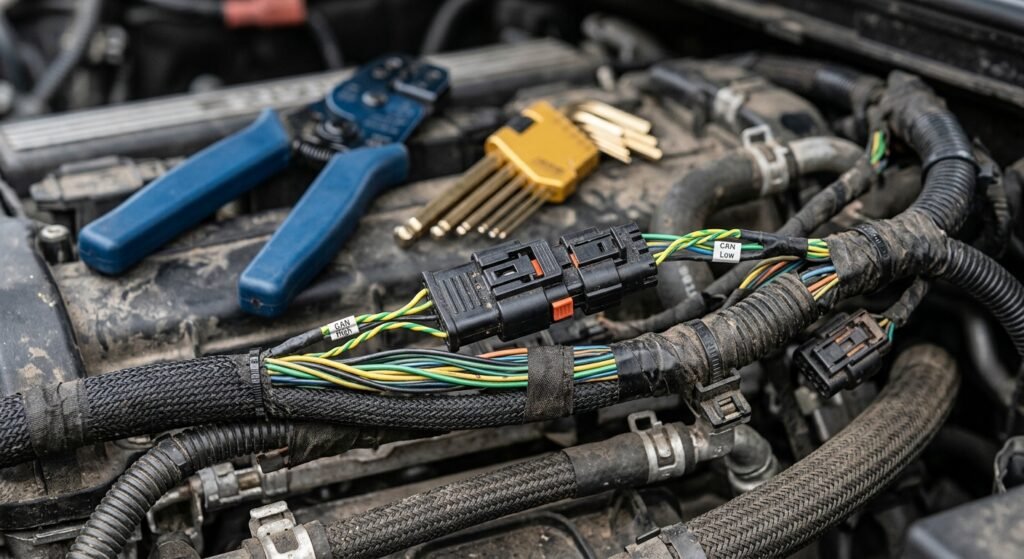
- Visually inspect TCM connectors and CAN bus wiring for corrosion, damage, or water entry; wiggle-test connectors while watching live data.
- Check for other modules reporting lost communication (that helps narrow the affected network segment).
- If wiring and power are good, try re-establishing communications: some vehicles allow a module wake-up or reset sequence through a scan tool.
- If the TCM is unresponsive or returns internal errors, the module may need programming or replacement and programming.
Useful quick checks you can do safely
- With the vehicle off, visually inspect accessible module connectors for obvious damage or moisture.
- Check the dashboard for multiple warning lights — multiple modules throwing U-codes points more to a network or power issue.
- If you have a basic OBD-II scanner, capture freeze-frame data and screenshots to share with a technician.
How professionals decide between wiring fixes and module programming
Because u0101 can come from both wiring faults and a failed or unprogrammed TCM, technicians separate “network” problems from “module” problems by systematically verifying power, ground, and the physical integrity of the CAN bus. If the TCM powers up and communicates intermittently or shows software faults, the correct next step is often module programming or replacement plus reprogramming to the vehicle.
LockNCal does module programming in the DFW area for American and Asian vehicles 2008+; we don’t perform automotive wiring repair, so if the diagnosis shows damaged wiring, a trusted auto-electrician or dealer-level shop should correct that before programming.
Which vehicles commonly set u0101?
Any modern vehicle with a separate TCM can set u0101. That includes domestic and imported models. Search traffic shows many users look for variations such as “u0101 gmc acadia”, “u0101 gmc terrain”, “u0101 gmc sierra”, and other GMC-related queries — those are legitimate searches for the same network symptom on specific models. The diagnostic order stays the same across makes: scan first, then power/wiring, then module-level tests.
Table: Causes, quick checks, and likely next steps
| Likely Cause | Quick Checks | Likely Next Step |
|---|---|---|
| Blown fuse / no power to TCM | Inspect fuses, look for ignition-switched power | Restore power; clear codes and retest |
| Poor ground or low battery voltage | Check battery charge & connections; look for other modules throwing codes | Correct charging/ground; rescan |
| Damaged CAN wiring or corroded connector | Visual inspection, wiggle harness while scanning | Repair wiring (not a LockNCal service), then confirm comms |
| Failed, unprogrammed, or replaced TCM | TCM does not respond or reports internal faults | Module programming or replacement + programming |
When is it safe to keep driving?
Safety depends on whether the transmission still shifts correctly. If the vehicle enters limp or failsafe mode, do not drive long distances — have it towed or brought to a shop. If the car appears to drive normally but the code is present, limit driving and get a thorough diagnostic scan; network issues can lead to unpredictable behavior when a module goes fully offline.
When the problem is the module itself
When diagnostics show the TCM is powered but unresponsive, or the module has been replaced and needs vehicle-specific configuration, the correct fix is module programming. In DFW, LockNCal offers professional module programming services for American and Asian vehicles 2008+; we can also run comprehensive vehicle diagnostics to confirm whether the issue is wiring or the module.
If a manufacturer recall or service bulletin may affect control modules, check the vehicle’s VIN for open recalls using the NHTSA recall site before replacing parts: checking the VIN for open recalls.
Notes about GMC- and model-specific searches
Searches like “u0101 gmc acadia”, “u0101 gmc sierra”, “gmc code u0101” or “u0101 00 gmc” reflect people troubleshooting these exact network symptoms on GMC trucks and SUVs. The diagnostic process is the same across those models, but always confirm suffix details and OEM troubleshooting steps in the factory service manual for that year and model.
What LockNCal does (and what we don’t do)
- We perform module programming and vehicle diagnostic services in DFW for American and Asian vehicles 2008+.
- We do not perform wiring repair, soldering, or board-level module repairs. If wiring is the root cause, it must be fixed before programming.
- We do not claim to “repair” modules on the bench. When a replacement module is required it must be programmed and configured to the vehicle.
How to prepare before you visit or call
- Gather the VIN, model year and a full list of dashboard lights observed.
- Have scan tool screenshots or freeze-frame data if available.
- If you’re in DFW, consider scheduling a diagnostic appointment so a technician can start with a full network scan on arrival: schedule an appointment.
FAQ
Q: Can I clear the u0101 code myself?
A: You can clear codes with an OBD-II scanner, but clearing may not fix the underlying issue. The code will likely return until the root cause (power, wiring, or module) is repaired or programmed.
Q: Will replacing the TCM always fix u0101?
A: Not always. If the cause is wiring or power, a new TCM will show the same symptom until those issues are corrected. Also, a replacement TCM usually requires vehicle-specific programming.
Q: Is u0101 dangerous?
A: The code itself is a communication fault. It becomes dangerous if it causes the transmission to go into limp mode or lose proper shifting. Have the vehicle diagnosed promptly.
Q: Can LockNCal program a replaced TCM?
A: Yes—LockNCal provides module programming in the DFW area for American and Asian vehicles 2008+; if wiring is bad, the wiring must be repaired first.
Q: How do manufacturer suffixes affect diagnosis?
A: Suffixes are manufacturer-specific failure details; always confirm their meaning in the OEM service documentation rather than assuming a universal definition.
If your vehicle shows u0101 and you want professional help diagnosing whether the fault is wiring or the TCM itself, schedule a module programming or diagnostic appointment with LockNCal at https://lockncal.com/module-programming/ or call (469) 277-7277.


