 Skip to content

Ford U0100 Code — Expert, Safe Diagnosis
Direct answer: The Ford U0100 code means the vehicle’s network can’t communicate with the ECM/PCM “A” — usually an electrical, wiring or module issue. Fixing it requires a systematic scan, tests of power/ground and CAN-bus wiring, and often module programming or replacement rather than guessing parts. Professional module programming or diagnostics restores proper network communication.
Not near Dallas–Fort Worth? Mail us your airbag / SRS module.
We reset most airbag control modules by mail, with free 2-way shipping and a fast turnaround. We clear the crash data, restore factory settings, and ship it right back, anywhere in the U.S. Book online and you’ll see your firm price in about 60 seconds.
Key Takeaways
- Ford U0100 code = Lost Communication With ECM/PCM “A” — a network-level failure, not a specific sensor.
- Common causes: dead/weak battery, poor grounds, blown fuse, damaged CAN wiring, or a failed module.
- Diagnosis order matters: scan, verify battery/charging, check fuses/grounds, inspect connectors, then test bus signals.
- When the module is at fault, module programming or replacement (with correct configuration) is the correct route.
- LockNCal offers diagnostic and module programming services in DFW to restore communication and program replacements.
Ford U0100 code: Plain-English meaning
The code states that the vehicle’s control network cannot reach the engine/powertrain control module (ECM/PCM) labeled “A.” That doesn’t assign a single cause — it only says the network-level message from the ECM/PCM is missing. Confirm the exact diagnostic trouble code details with a scan tool, then follow a logical test order to find whether wiring, power, or the module itself is at fault.
Why this matters
When the ECM/PCM is silent on the network, related systems (cruise, transmission shifting logic, reduced engine performance, or even immobilizer interactions) can act up. Diagnosing the network fault quickly prevents misdiagnosis, needless parts replacement, and unsafe conditions on the road.
Common causes of a U0100 on Ford vehicles
- Weak battery or poor charging voltage that prevents modules from waking on the CAN bus.
- Blown fuse or removed power feed to the ECM/PCM.
- Poor ground connection(s) at the engine or chassis ground points.
- Damaged CAN / LIN wiring harness, corroded connectors, or water intrusion.
- Failed or unconfigured ECM/PCM — for example after replacement, module programming is missing.
Typical driver-visible symptoms
- Multiple warning lights (check engine, traction, ABS) appearing at once.
- Engine failing to start or starting but running poorly.
- Transmission behaving oddly (gear hunting, limp mode).
- Loss of cruise control or stability control functions.
- Inconsistent or intermittent faults — sometimes the vehicle is fine, other times the warnings return.
Quick reference: Common causes and first tests
| Possible Cause | First Technician Check | Why it matters |
|---|---|---|
| Battery/charging problem | Verify battery charge and charging system behavior during cranking/start | Low voltage can keep modules from communicating on the bus |
| Blown fuse / lost power feed | Inspect fuses related to ECM/PCM power circuits | No power to ECM = no messages sent |
| Poor ground | Check engine and chassis ground points for corrosion and tightness | Bad ground creates noise or lost modules on bus |
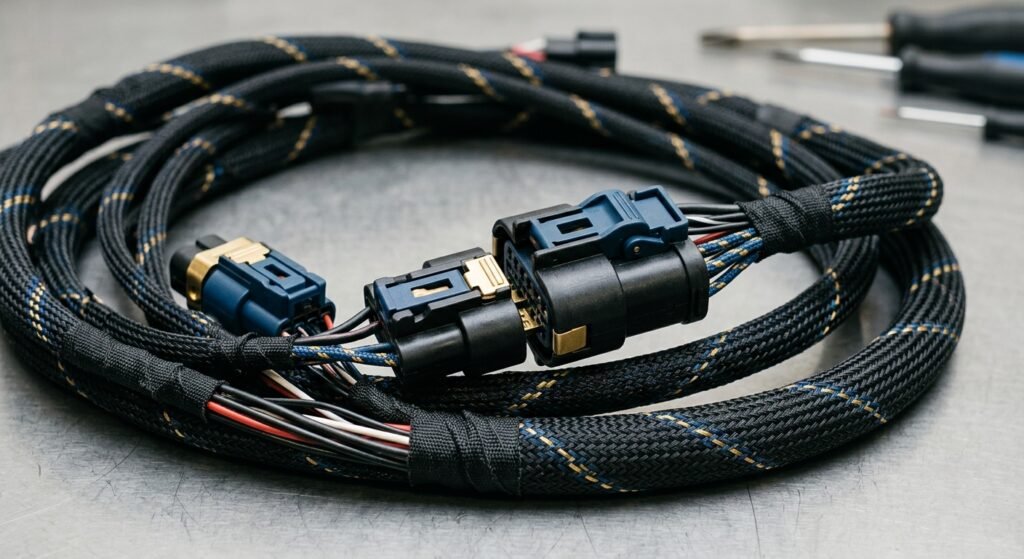
| Damaged CAN wiring or connectors | Visual inspection, wiggle tests, and backprobe connectors if safe | Open or shorted CAN wires stop message flow |
| Failed or unprogrammed module | Confirm module presence on network with scan tool; check software/configuration | Replaced or corrupted modules need programming/replacement |
Step-by-step diagnosis: how a technician should proceed
Follow these steps in order — skipping steps increases the risk of replacing the wrong part.
- Full scan with a capable scan tool: record all codes across modules, save snapshots, and confirm the exact U0100 description. If the vehicle reports multiple network codes, document them all before clearing anything.
- Confirm battery and charging health: test under load. Many network faults are triggered by low or flaky battery voltage during key-on or cranking.
- Check fuses and power feeds: identify fuses feeding the ECM/PCM and related network nodes. Replace only after verifying the cause of a blown fuse.
- Inspect grounds and physical connectors: look for corrosion, bent pins, water entry, or rodent damage in harnesses and connector bodies.
- Verify module presence on the bus: use the scan tool to see whether the ECM/PCM appears on the CAN network. If the module doesn’t respond, confirm power and ground at the module connector before assuming module failure.
- Trace the CAN bus: if power/ground are good and the module remains silent, inspect CAN-H and CAN-L wiring for opens, shorts, or chafed sections. Wiggle tests while monitoring the bus can reveal intermittent faults.
- Check for software/configuration issues: modules replaced or updated without proper programming may not talk on the bus. Confirm OEM programming status with service information and history.
- Only then consider module replacement: if testing shows the ECM/PCM is non-responsive with correct power, ground, and bus wiring, the module may need replacement and programming.
When the problem is the module itself
If diagnostic tests show the ECM/PCM is powered and grounded correctly but still doesn’t respond on the network, the correct repair path is module replacement plus OEM programming or correct module reconfiguration. On Ford vehicles, simply swapping in a used module without programming often creates further communication issues. That programming/configuration step is why professional module programming matters — it ensures the replacement module is recognized and communicates correctly on the vehicle network.
In Dallas–Fort Worth, LockNCal provides professional module programming and vehicle network diagnostics. If you need a full scan that covers airbag/SRS and related network faults, consider our vehicle diagnostic service.
Safe-to-drive guidance
Whether it is safe to drive with a U0100 depends on which systems rely on the ECM/PCM. If the engine won’t start or the transmission is in limp mode, do not drive. If only a warning light is present and engine/transmission behave normally, limited local driving to a repair shop may be acceptable. Always err on the side of safety: stop driving if handling or power are affected, or if multiple critical warnings are lit.
Check for recalls and service campaigns
Sometimes network or module faults are related to manufacturer recalls or campaigns. It’s a good idea to check the VIN for open recalls at the NHTSA recall site before proceeding with parts replacement: check the VIN for open recalls.
What LockNCal can do for a Ford U0100 code
Because the U0100 points to a communication failure, the best first step is a full vehicle network diagnostic to find whether the issue is wiring, power/ground, or the module itself. In DFW, LockNCal performs professional diagnostics and module programming to restore proper network communication. If the module needs programming or replacement and programming, our module programming service is the correct route to ensure the replacement is configured and the vehicle network is healthy.
FAQ
Q: Can I clear the U0100 code and drive?
A: Clearing the code may turn the light off temporarily, but it doesn’t fix the underlying network problem. If the vehicle runs normally after clearing, monitor it closely and get a full diagnostic — persistent or recurring U0100 needs proper diagnosis.
Q: Will replacing the ECM/PCM fix a U0100?
A: Only if the replacement module is known-good and properly programmed/configured. Replacing the module without confirming power, ground, and wiring or without programming can make the problem worse.
Q: Is U0100 related to SRS or airbags?
A: U0100 specifically describes lost communication with the ECM/PCM. Airbag/SRS modules use the vehicle network too, so related network faults can trigger multiple warnings. For SRS airbag module resets or crash data issues, LockNCal offers a nationwide mail-in service at https://lockncal.com/mail-in-airbag-module-reset/.
Q: Can a weak battery cause U0100?
A: Yes. Low or unstable voltage during key-on or cranking can prevent modules from waking and communicating on the CAN bus, causing U0100 and other network codes.
Q: How quickly can this be diagnosed?
A: A competent tech can often confirm whether the issue is power/ground or wiring versus module failure in a few hours, but full diagnosis and programming times vary by vehicle and condition. Schedule a diagnostic appointment to get an exact timeline.
If your Ford is showing a U0100 and you’d like professional help, book a module programming or vehicle diagnostic appointment with LockNCal’s DFW team at module programming or call (469) 277-7277.


