 Skip to content

U0100 Code — Proven Fixes & Critical Guide
Direct answer: The U0100 code means Lost Communication With ECM/PCM “A” – the network cannot reach the engine/powertrain control module. Fixing it requires a disciplined electrical diagnosis (fuses, grounds, wiring, battery/charging, and module presence) and, when the module itself is the fault, correct replacement and programming.
Not near Dallas–Fort Worth? Mail us your airbag / SRS module.
We reset most airbag control modules by mail, with free 2-way shipping and a fast turnaround. We clear the crash data, restore factory settings, and ship it right back, anywhere in the U.S. Book online and you’ll see your firm price in about 60 seconds.
Key Takeaways
- U0100 code = “Lost Communication With ECM/PCM \”A\” – the network cannot reach the engine/powertrain control module”.
- Common causes: dead/low battery, blown fuse, poor ground, damaged wiring/connectors, or a failed/unprogrammed module.
- Start troubleshooting with battery/charging, then fuses, grounds, and physical connector inspection before any module swap.
- If the module is confirmed failed or needs replacement/programming, a professional module programming service is the correct next step.
What the U0100 code means in plain English
The diagnostic trouble code U0100 stands for Lost Communication With ECM/PCM “A” – the network cannot reach the engine/powertrain control module. In practice this means some part of the vehicle’s communication network (CAN bus or similar) cannot see or talk to the ECM/PCM. That loss of communication can be intermittent or permanent and often causes multiple other network codes to appear.
Why you see U0100 (common root causes)
- Battery or charging system problems: low voltage, bad battery, or a failing alternator can drop the network and confuse modules.
- Blown fuse(s) protecting the ECM/PCM or gateway module.
- Poor or corroded ground(s) shared by the ECM/PCM and other modules.
- Damaged CAN-bus cabling, chafed wires, or water-damaged connectors (common after accidents or wheel-well exposure).
- Failed gateway, ECM/PCM, or other control module that routes messages across the network.
- Aftermarket electronics, improper towing battery isolation, or previous incorrect module installation that left a module unprogrammed or incompatible.
Symptoms drivers notice
- Check engine light, traction control, ABS, or multiple warning lights turning on together.
- Engine cranking but not starting, or sudden loss of drivability if ECM commands stop.
- Stalling or limp-home behavior when the vehicle can’t communicate with the powertrain module.
- Loss of data on a scan tool—either the ECM doesn’t respond or many modules report “no communication”.
Common U0100 subcodes and how model-specific variants (like Ford) appear
Manufacturers and scan tools often add subcodes or suffixes that give extra context (for example Ford owners frequently see variations such as ford u0100:00-08, ford u0100 00 08, ford u0100-20, or ford u0100 00 0b). Those suffixes are helpful for technicians but the high-level diagnosis is the same: a communication break between the network and the ECM/PCM.
| What you see on the scan tool | What it tells you |
|---|---|
| U0100 (no suffix) | A module lost communication with the ECM/PCM. Scan every module to see which ones report it. |
| U0100 with a suffix such as :00, -08, -20 or 00 0B | The suffix is a manufacturer “failure type” detail. Its exact meaning varies by make, so confirm it in the OEM service information for your vehicle rather than guessing. |
| U0100 set in many modules at once | Points toward the ECM/PCM itself (power, ground, or the module) or a shared section of the network wiring. |
| U0100 in only one module | Points toward that module’s own connector or network branch. |
Step-by-step technician diagnosis (real tools, correct order)
Follow this order to avoid unnecessary part swaps. Keep safety in mind—disconnect battery only when instructed by the repair manual for the particular vehicle.
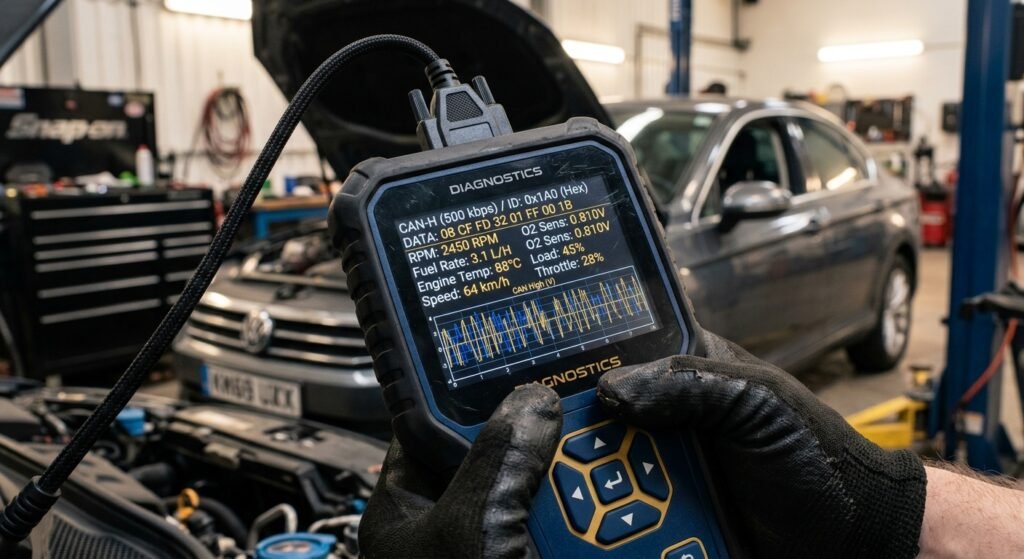
- Scan and record codes: Use a capable OBD-II scanner that shows network codes and module presence. Note all U-codes and which modules report “no communication”.
- Check battery & charging: Measure battery voltage at rest and while cranking; measure charging voltage with engine running. Many network issues start with low voltage.
- Visual inspection: Inspect ECM/PCM connectors, main harness runs, and common chafe points (engine bay, firewall, wheel wells). Look for water intrusion, corrosion, or rodent damage.
- Fuses & relays: Identify and test fuses related to the ECM/PCM and gateway module. A single blown fuse can remove a module from the network.
- Grounds: Locate and test major chassis and engine grounds for continuity and tightness. Clean corroded ground points and retest.
- CAN-bus checks: Use a lab scope or CAN bus tester to look for proper differential voltages (on a typical high-speed CAN bus both lines rest near 2.5 V; exact values vary by design, so compare against OEM specs). Look for short to power or ground.
- Connector pin voltage: At the ECM connector, verify battery power and switched power pins, and check reference voltages where applicable before assuming module failure.
- Intermittent checks: Wiggle tests on wiring harness while watching live data can surface broken wires that only fail under movement. Be cautious—do not short pins together.
- Use OEM service info: If available, consult manufacturer wiring diagrams and module pinouts. Subcode suffixes (e.g., ford u0100 00 08) map to specific failure modes on OEM data.
When the correct fix is a replacement or programming
If testing shows the ECM/PCM itself is dead, absent, or needs replacement, the correct process is to replace and program/configure the new module to the vehicle. Modern powertrain modules often require vehicle-specific calibration and VIN programming—simply dropping in a used or unprogrammed module usually leaves the vehicle non-functional or with security/immobilizer faults.
LockNCal does not perform general wiring repair. When a module swap and programming is required, a professional module programming service can install and configure the replacement so it communicates on the vehicle network.
Troubleshooting checklist you can try right now
- Confirm battery voltage is healthy and connections are clean and tight.
- Check engine bay fuses related to ECM and gateway modules.
- Look for obvious wiring damage, especially after recent work or accidents.
- After you’ve ruled out simple causes, get a full network scan to identify which modules are silent.
Safety and driveability guidance
A U0100 can be a benign intermittent communication drop or it can turn the vehicle into a no-start/limp mode, depending on whether the ECM is responding. If the vehicle runs and drives normally, you may be able to travel to a repair shop; if the engine stalls, won’t start, or multiple safety systems are disabled (ABS, traction, airbags showing network errors), do not drive long distances—have the vehicle towed to a shop for diagnosis.
When the problem is the SRS or other safety system module
Sometimes a U0100 appears alongside SRS, steering angle, or ADAS faults because the vehicle’s central gateway isn’t passing messages. If the silent module is an airbag/SRS module, LockNCal offers both nationwide mail-in SRS airbag module reset services and local options in DFW:
- mail-in SRS airbag module reset (nationwide, all makes 2008+)
- On-site airbag module reset (DFW)
Useful external reference
Before replacing any module, check your VIN for open recalls or service campaigns on the NHTSA recall lookup.
FAQ
Q: Can I clear U0100 myself?
A: You can clear the code with an OBD-II scanner, but if the root cause remains (bad battery, wiring, or failed module) the code will return. Always diagnose the underlying cause before clearing codes.
Q: Is U0100 dangerous?
A: The code itself is a symptom. It can be dangerous if it means the ECM has lost communication and engine or safety systems behave unpredictably. If multiple systems show warnings, avoid driving long distances.
Q: Could a battery or alternator set U0100?
A: Yes. Low voltage or intermittent charging can drop network communication and trigger U0100. Always check battery and charging first.
Q: My Ford shows ford dtc u0100 00 08—anything Ford-specific I should try?
A: The diagnostic order is the same: battery, fuses, grounds, connectors, and CAN-bus integrity. Ford subcodes give extra detail—use an OEM-level scan tool or service information for the precise meaning, but don’t jump to module replacement without basic electrical checks.
Q: When should I call a pro?
A: Call a professional if you find no simple cause (bad battery/fuse/loose ground), if the ECM is non-responsive, or if module replacement and programming are needed. Module programming is a specialist task that requires correct tools and vehicle-specific configuration.
For professional module programming and the correct replacement/configuration when a module is at fault, consider our module programming service; call (469) 277-7277 to schedule an appointment.


