 Skip to content

Honda U0100 Code — Expert Guide (Reliable, Critical)
Direct answer: The Honda U0100 code means the vehicle’s network has lost communication with the engine control module (ECM/PCM). Fixing it requires a structured diagnosis—scan for related codes, check power, ground and connectors, test network wiring, and, if needed, module programming or replacement. Avoid guesswork: confirm with a full scan before replacing parts.
Key Takeaways
- Honda U0100 code = Lost Communication With ECM/PCM; the network cannot reach the engine control module.
- Common causes: blown fuse, poor power/ground, damaged CAN wiring, faulty ECM, or another module dragging the network down.
- Diagnosis order matters: start with a full OBD-II scan, then check power/ground and wiring, then module-level tests.
- LockNCal can diagnose and reprogram or program replacement modules with our module programming services.
What the Honda U0100 code actually means
The trouble code Honda U0100 code is a network communication fault: one or more control modules on the vehicle network (CAN, LIN, or other bus) cannot talk to the ECM/PCM. Practically that means the powertrain computer is not responding to other modules or the scan tool, and the vehicle may show drivability problems or limp-home behavior because engine management data isn’t available.
Common causes of a U0100 on Hondas
The same code can come from many root causes. The most common are:
- Blown fuse or ignition-switched power loss to the ECM/PCM.
- Poor or corroded ground(s) at the engine harness, transmission, or chassis.
- Damaged CAN bus wiring (shorts to ground, short between CAN high/low, or opens).
- Faulty ECM/PCM or a replacement module that has not been correctly programmed.
- Another module on the network creating bus errors that prevent ECM communication.
Symptoms drivers notice
- Check Engine or Service Engine Soon lamp illuminated.
- Engine stalls, rough idle, reduced power or limp mode.
- Failure to start if the ECM is completely offline.
- Multiple unrelated modules reporting faults or showing offline status on a scan tool.
Tools you’ll need for a correct diagnosis
- Quality OBD-II scanner with module list and CAN bus data (preferably OEM-level or advanced aftermarket scanner).
- Digital multimeter (voltage, continuity, and ground tests).
- Backprobe pins or non-destructive harness connectors and wiring diagrams for your year/model.
- Oscilloscope is helpful for spotting CAN differential signal faults but not required for basic diagnosis.
Step-by-step technician diagnosis (real order to follow)
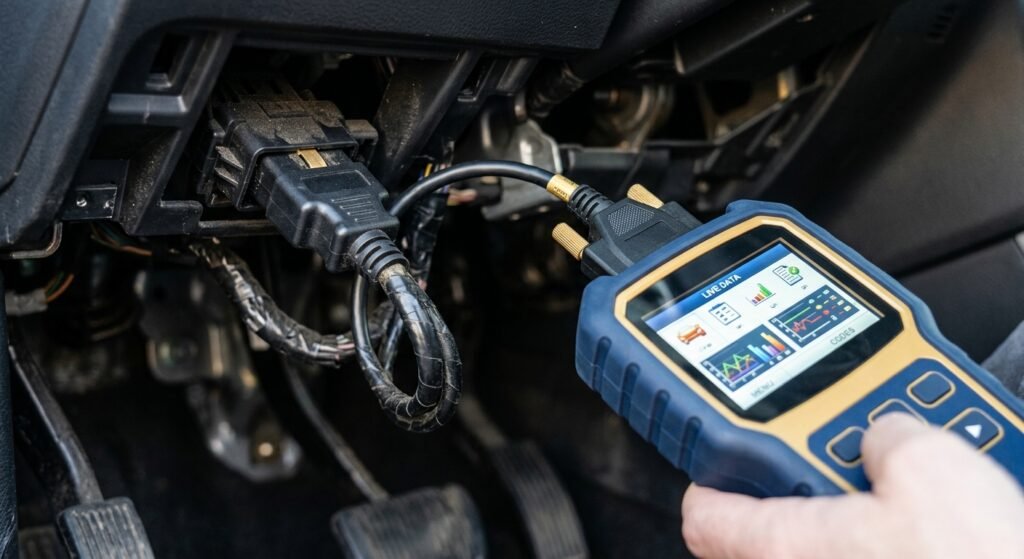
- Record all codes and freeze frame data. Use an advanced scan tool to capture U0100 plus any supporting or pending codes from other modules.
- Verify the scan tool can list modules. If only a few modules respond, note which are offline—this helps localize the bus fault.
- Check fuses and power feeds to the ECM/PCM. A missing ignition feed can produce U0100 immediately after start.
- Test key grounds. Measure resistance between known engine/transmission grounds and chassis; clean or tighten if high.
- Inspect CAN bus wiring and connectors. Look for rodent damage, pin pulls, water intrusion in connectors, or chafing.
- Measure CAN High/Low voltages with ignition on. You should see ~2.5V idle on both nodes and valid differential behavior while the engine cranks/runs.
- Isolate modules. If possible, disconnect suspect modules one at a time (other than ECM) to see if the bus recovers.
- If wiring and power are good, test or bench-check the ECM/PCM. A known-good replacement or reflash often proves whether the original module failed.
- When a replacement module is fitted, programming is required. Replacing an ECM/PCM without correct programming/IMMOBILIZER and calibration steps will keep the U0100 or introduce new DTCs.
Diagnostic data at a glance
| Symptom/Code | Likely cause | Quick test |
|---|---|---|
| U0100 only | Power/ground or intermittent wiring | Check fuses and grounds, wiggle test harness |
| U0100 + other module U-codes | CAN bus short or module failure | Scan all modules, inspect connectors, measure CAN voltages |
| No modules visible on scan | Loss of bus power or major network fault | Confirm ignition feed and main fuses; trace harness power |
Why guessing ‘swap parts’ can make the problem worse
It’s tempting to replace the ECM because it appears logical, but replacing modules without correct diagnosis often wastes time and money. Worse, a replacement ECM that has not been programmed to the vehicle can remain invisible on the network or cause immobilizer and communication conflicts. The correct fix follows diagnosis: repair wiring/power/ground issues first, then replace and program modules if necessary.
When module programming is the correct fix
If testing shows the ECM/PCM itself is faulty or if you fit a replacement module, the next step is programming: LockNCal offers professional module programming and diagnostics that restore proper network communication and ensure the replacement module is configured to the vehicle. Programming is also required after many replacement modules, and it may clear the U0100 if communication is restored.
Common pitfalls and safety notes
- Do not attempt board-level repair of modules—module replacement and programming are the manufacturer-approved procedures.
- Disconnecting modules without a proper scan may clear evidence—capture all data before erasing codes.
- Electrical shorts can cause multiple unrelated codes; solve the root electrical issue rather than chasing symptoms.
Quick troubleshooting checklist for DIY mechanics
- Use a scanner that can list all modules; note which modules are missing.
- Check related fuses, ignition-switched feeds, and main grounds.
- Visually inspect wiring harnesses from engine to dash—look for damage or moisture.
- If comfortable, measure CAN-H and CAN-L voltages; both near 2.5V at rest is expected.
- If you must replace the ECM, plan for professional module programming—not a plug-and-play swap.
For more on how module programming works and what LockNCal offers, see our module programming page and our overview of vehicle safety system services for related needs.
Professional module programming can restore lost communication when the ECM must be replaced or reconfigured.
If your vehicle has safety-system related faults too—airbag lights, occupant detection, or seat belt pretensioner codes—see our vehicle safety system services for coordinated diagnostics and programming.
For authoritative background on OBD-II networks and how communication codes are defined, see the NHTSA OBD-II overview.
FAQ
What does a U0100 code mean on a Honda?
U0100 means the network has lost communication with the ECM/PCM; the engine control module is not responding to other modules or the scan tool.
Can I drive with a U0100 code?
Sometimes you can drive, but performance may be reduced or the vehicle may enter limp mode. If the engine stalls or the vehicle won’t start, do not drive—have it towed for diagnosis.
Will replacing the ECM fix U0100?
Only if the original ECM is faulty. Replacing the ECM without fixing wiring, power, or ground issues will not solve the root cause. A replacement ECM must also be programmed.
Can a bad battery cause U0100?
A weak or failing battery can cause voltage drops that interrupt module communication, so test battery and charging system as part of diagnosis.
How does professional module programming help?
Programming ensures a replacement module has the correct software, VIN, immobilizer pairing, and configuration so it can communicate correctly on the vehicle network.
If you want expert help diagnosing a Honda U0100 code, LockNCal provides module programming and mobile diagnostics; schedule service or contact us for a secure option.
Schedule an appointment or call (469) 277-7277 to arrange module programming and network diagnostics for your Honda U0100 code.
Authoritative safety reference: NHTSA vehicle safety & recalls.


