 Skip to content

Direct answer: The Ram P0420 code means the vehicle’s catalytic converter on Bank 1 is performing below the manufacturer’s efficiency threshold. It’s an emissions issue, not a safety-system fault — diagnosing it requires live-data scans (O2 sensors, fuel trims, misfire history), smoke/leak checks, and sometimes catalytic-converter replacement by a qualified shop.
Key Takeaways
- P0420 = Catalyst System Efficiency Below Threshold (Bank 1).
- Common causes: faulty O2 sensors, exhaust leaks, catalytic failure, or long-term engine issues causing rich/lean running.
- Start with a proper OBD-II live-data diagnosis, checking upstream/downstream O2 sensors and fuel trims.
- Don’t assume the cat is bad—systematic testing avoids unnecessary catalytic-converter replacement.
- If you need vehicle safety or security work (airbags, ADAS, keys), a specialist like LockNCal handles those systems separately.
- Failing catalytic converter (age, contamination, internal breakdown).
- Faulty or slow oxygen sensors (typically the downstream sensor but upstream failures can mimic the issue).
- Exhaust leaks between the engine and downstream O2 sensor that let ambient air in.
- Engine misfires, oil or coolant burning, or long-term rich/lean condition that contaminates or overloads the catalyst.
- Wiring or connector faults to O2 sensors or the PCM.
- Aftermarket exhaust components, incorrect sensors, or missing heat shields can affect readings.
- Check Engine Light (CEL) steady or flashing (P0420 is usually a steady CEL).
- Poor fuel economy with a persistent CEL.
- Failed emissions test (smog).
- Sometimes rough running or reduced power if the root cause is an engine problem, though many P0420 cases drive normally.
- OBD-II scanner with live-data and freeze-frame capability (preferably graphing of O2 sensors and fuel trims).
- Digital multimeter for sensor/wiring checks.
- Smoke machine or pressure tester to find exhaust leaks.
- Mechanic’s stethoscope for detecting rattles inside a failing catalytic converter.
- Accessory tools: jack stands, basic hand tools, and possibly an infrared thermometer to check converter operating temperature.
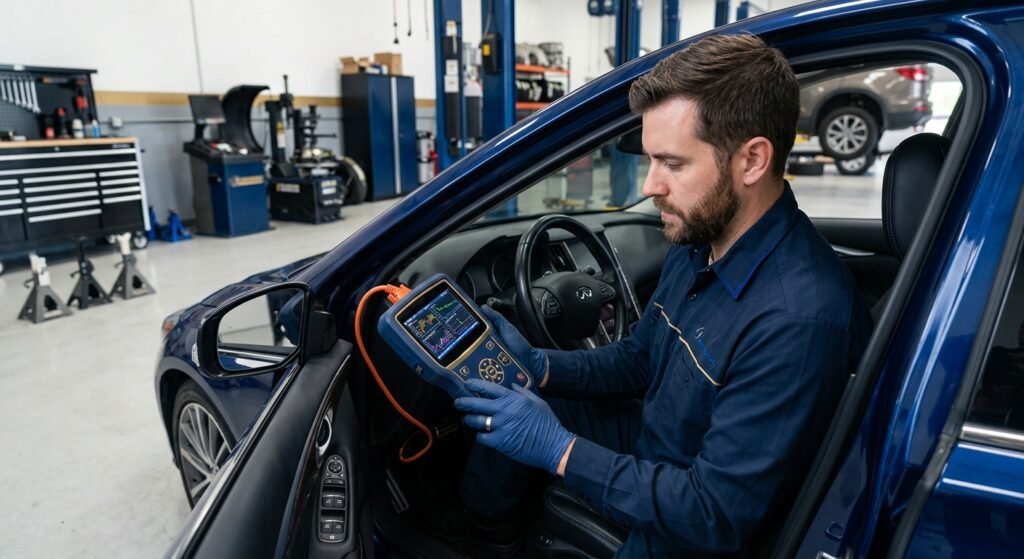
- Connect an advanced scan tool and confirm the exact code: P0420 = Catalyst System Efficiency Below Threshold (Bank 1). Record freeze-frame data.
- Check for pending codes and stored misfire, fuel trim, or fuel system trouble codes. Misfires and fuel-trim issues often cause downstream converter problems.
- View live O2 sensor traces: upstream (sensor 1) should switch quickly between ~0.1–0.9V; downstream (sensor 2) should be much steadier if the cat is working. If both sensors look the same or downstream is as switchy as upstream, the cat may be ineffective.
- Compare short-term and long-term fuel trims. Large positive/negative trims point to vacuum leaks, fueling problems, or sensor issues that must be resolved first.
- Visually and physically inspect the exhaust for leaks, damaged piping, or holes before the downstream sensor. A leak can introduce oxygen and fool the sensor readings.
- Check O2 sensor heater circuit and sensor wiring for open or short conditions with a multimeter. Replace a proven-faulty sensor rather than guessing.
- Use a smoke machine or pressure test to find hidden exhaust leaks and inspect the catalytic converter for rattles or external damage.
- If engine problems (misfire, oil burning) are present, fix those first. Continental issues can destroy converters quickly.
- If sensor and engine operation are good but downstream readings still indicate low efficiency, the catalytic converter is the likely root cause and is typically replaced by a qualified repair facility.
- After any repair (sensor, exhaust leak, engine fix, or cat replacement), clear codes and perform a drive cycle with live data to confirm P0420 does not return.
- Replacing the catalytic converter without confirming O2 sensor and engine condition first—this wastes money and can mean the new cat will fail too.
- Assuming aftermarket parts are compatible—some aftermarket cats or sensors don’t meet OEM specs and can trigger P0420.
- Ignoring an intermittent misfire or oil consumption problem—the catalyst can be damaged by unburned fuel or oil blow-by.
- Repair exhaust leaks and replace damaged gaskets or piping.
- Replace faulty oxygen sensors upstream or downstream after verifying they are at fault with live data and wiring checks.
- Address engine issues such as misfires, oil leaks, or fuel-system problems that contaminate the cat.
- If diagnostics confirm a degraded catalyst, replacement of the catalytic converter (OEM or high-quality aftermarket) is the final step—this is performed by exhaust specialists or dealerships.
What the Ram P0420 code means
The stored code P0420 on a Ram identifies a problem reported by the vehicle’s onboard diagnostics: “Catalyst System Efficiency Below Threshold (Bank 1).” Bank 1 is the side of the engine containing cylinder #1. The PCM watches the upstream (pre-cat) and downstream (post-cat) oxygen (O2) sensors to judge whether the catalytic converter is cleaning exhaust gases effectively. When the downstream sensor’s response pattern becomes too similar to the upstream sensor (or the converter no longer reduces pollutants enough), the PCM sets P0420.
Common causes of P0420 on Ram trucks
Symptoms you’ll notice
Tools and data you need for diagnosis
Step-by-step diagnosis (technician workflow)
Quick test checklist table
| Test | How it helps | Pass/fail sign |
|---|---|---|
| Live O2 sensor graphing | Shows upstream vs downstream behavior | Fail: downstream follows upstream closely |
| Fuel trim review | Reveals rich/lean conditions affecting cat | Fail: large +/- trims (>10–15%) |
| Exhaust leak smoke test | Finds leaks that introduce air | Fail: visible smoke escaping before downstream sensor |
| Visual/physical cat check | Detects rattles, external damage, overheating | Fail: internal rattle or melted substrate |
| Sensor wiring continuity | Rules out open/shorts that mimic sensor faults | Fail: open/short on circuit |
Common misdiagnoses to avoid
When it’s safe to drive
Most P0420 cases do not immediately endanger the driver or vehicle; you can usually continue driving short distances. However, if the check engine light is flashing, that indicates active misfire and potential catalytic damage — stop driving, as a flashing CEL can damage the catalyst and harm the engine. If you fail an emissions test, plan repairs before registration renewal.
Typical professional fixes
If you’re preparing to sell or buy a Ram, a professional pre-purchase vehicle inspection can catch causes of emissions trouble early. For safety and security system work like airbags, ADAS, and keys, see our vehicle safety services overview at vehicle safety system services.
Further reading
For an official overview of OBD-II diagnostic concepts and why codes like P0420 matter for emissions, see the EPA’s page on OBD-II diagnostic trouble codes and vehicle emissions testing: EPA: Diagnostic Trouble Codes (OBD-II).
FAQ
What exactly is Bank 1?
Bank 1 is the side of the engine that contains cylinder #1. On V-engines it designates the cylinder bank; on inline engines Bank 1 is the engine’s only bank. The P0420 code specifically references the catalytic converter performance for that bank.
Will clearing the code make the problem go away?
Clearing the code only turns off the check engine light temporarily. If the underlying cause isn’t fixed (bad sensor, exhaust leak, or bad cat), P0420 will return after the PCM runs its readiness tests.
Can a bad O2 sensor cause P0420 on my Ram?
Yes. A slow or faulty downstream O2 sensor can report incorrect readings and trigger P0420. Always verify the sensor’s behavior with live data and test its wiring before replacing the catalytic converter.
Is P0420 covered under warranty?
Coverage depends on your vehicle’s parts warranty or emissions warranty. Many states have emissions warranties for catalytic converters that last longer than basic warranties—check your vehicle warranty documents or contact the dealer for specifics.
How much does it cost to fix P0420?
Costs vary widely depending on the root cause: sensor replacement is relatively inexpensive, while catalytic converter replacement is more costly. Get a proper diagnosis from a trusted shop before accepting any estimate.
Need professional help diagnosing a persistent Ram P0420 code? Get your vehicle scanned by a qualified technician and avoid unnecessary parts replacement. If you also have safety or security system needs—airbag resets, ADAS calibration, or key programming—LockNCal handles those services directly. Schedule an appointment online at https://lockncal.com/schedule-your-service-appointment/ or call (469) 277-7277 for help.


