 Skip to content

Ford U0155 — Lost Communication With IPC (How to Fix)
Direct answer: The Ford U0155 code means “Lost Communication With Instrument Panel Cluster (IPC).” It indicates the IPC is not talking to other modules over the vehicle network. The correct fix is a focused electrical diagnosis and module programming or replacement when hardware or calibration faults are confirmed — not guesswork.
Key Takeaways
- U0155 = Lost Communication With Instrument Panel Cluster (IPC).
- Common causes: wiring/CAN bus faults, IPC power/ground issues, poor connectors, or a failed IPC/module programming error.
- Diagnosis order matters: scan, verify power/ground, check CAN bus, inspect connectors, then test/replace or reprogram the module.
- LockNCal handles module programming and vehicle diagnostics to restore communication safely.
What the code means in plain English
U0155 is a communication error: the IPC (dashboard cluster that shows speed, gauges, warning lights) is not responding on the vehicle’s network. Modern Fords use multiple modules (BCM, PCM, ABS, airbag module, etc.) that send and receive messages over a shared bus (CAN). When the IPC doesn’t reply, other systems flag U0155 because expected messages are missing.
Why this matters
A non-communicating IPC can cause missing speedometer readings, wrong odometer display, incorrect warning lights, and can interfere with other modules that rely on IPC data. Fixing the communication problem restores proper instrument behavior and prevents false or missing safety alerts.
Common causes of U0155 on Ford vehicles
- Loss of power or ground to the IPC (blown fuse, poor ground strap, disconnected connector).
- Damaged or corroded instrument cluster connector pins.
- CAN bus wiring fault (broken CAN High/Low, short to ground or battery, high resistance connection).
- Faulty IPC module electronics or internal failure.
- Intermittent module programming or corrupted module flash (requires reprogramming).
- Aftermarket equipment or poor installations that tap into the bus or power feeds.
Symptoms drivers will notice
- Blank or partially dead dash cluster, flickering gauges.
- Multiple warning lights that don’t correspond to actual faults.
- Loss of speedometer or odometer readout.
- Electrical features tied to IPC may not function correctly (e.g., chimes, lighting).
- Sometimes the vehicle starts and runs fine; other times modules go into limp mode because they lack IPC data.
Quick reference: symptoms vs likely causes
| Visible Symptom | Most Likely Cause |
|---|---|
| Entire cluster dead but vehicle runs | IPC power/fuse/ground issue or connector unplugged |
| Gauges flicker or intermittent messages | Intermittent connector or wiring problem on CAN bus |
| CAN-related errors on multiple modules | CAN High/Low short or open, poor termination |
| Persistent U0155 after wiring checks | IPC internal failure or corrupted programming |
Step-by-step technician diagnosis (what a pro will do)
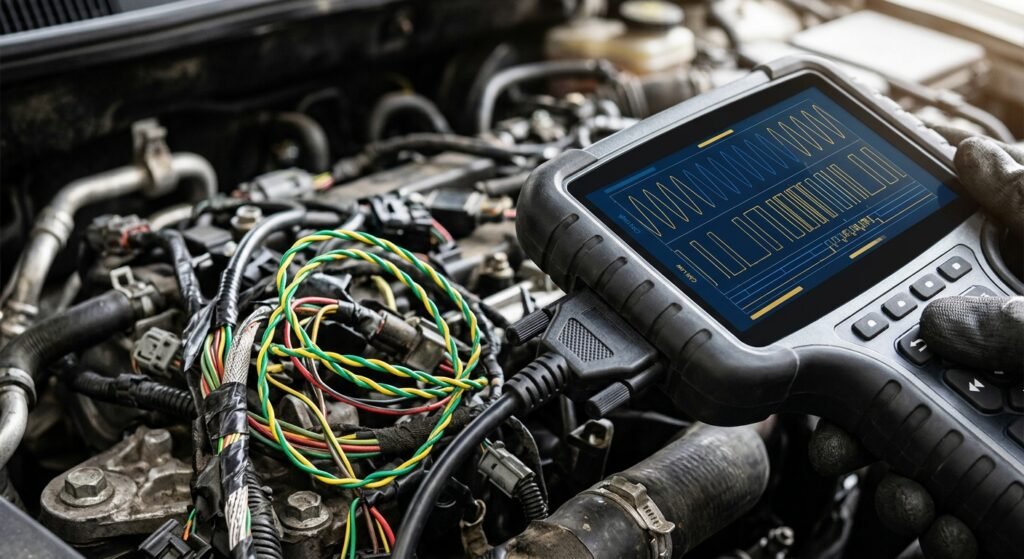
Technician tools you should expect: a full-function OEM or professional scan tool (not a basic code reader), wiring diagrams, multimeter, lab-grade oscilloscope or CAN bus tester, backprobe pins, and a reliable bench power supply if bench-testing the IPC is needed.
- Confirm the code and freeze frame data. Use an OEM-level scanner to read U0155 and any related U-codes or B-codes. Note which modules are flagging communication errors.
- Check for recent events. Ask if the vehicle was jumped, had battery disconnected, or if aftermarket electronics were added. Many communication errors follow battery disconnects or poor jump starts.
- Verify IPC power and ground. Check the IPC fuses and measure battery voltage at the IPC power pin with the ignition on. Verify a solid ground at the IPC chassis ground point with under 0.1Ω of resistance to battery negative.
- Inspect IPC connector and pins. Remove the cluster trim and visually inspect for corrosion, bent pins, or pushed-out terminals. Wiggle test connectors while monitoring the scanner for communication dropouts.
- Test the CAN bus. Measure CAN_H and CAN_L voltages with key on; look for expected idle voltages (~2.5V midline) and complementary signals. Use an oscilloscope or CAN bus tester to confirm clean differential signals and proper termination at ends of the bus.
- Trace wiring harness. If CAN signals are missing at the IPC connector, trace back toward BCM and other nodes checking for opens, shorts, or damage especially in common areas: door sills, under dash harness chases, near the firewall, and previous repair sites.
- Scan other modules. Check BCM, PCM, ABS, airbag module for related communication faults. If multiple modules lose the IPC at once, the fault may be central (power/ground or bus termination).
- Swap or bench-test the IPC if needed. If wiring and power are good but communication still fails, bench-test or replace the IPC and reflash the module with manufacturer software if reprogramming is required.
- Reprogram and clear codes. If the IPC is replaced or the module shows corrupted firmware, the correct step is to program the module with the latest calibration and then clear codes and re-test.
Bench vs. on-vehicle module work
Some shops bench-test instrument clusters away from the vehicle; others prefer on-vehicle testing because of immobilizer/anti-theft dependencies. Whatever the method, the goal is the same: confirm electrical health, program the correct VIN/calibrations, and verify network communication across the bus.
Correct fix
The correct fix follows the diagnosis. If a wiring fault or bad connector is found, repair the wire or replace the connector and re-test. If the IPC itself is failed or shows corrupted software, the right step is module replacement or reprogramming with factory software. Reprogramming (module programming) is often necessary after replacing an IPC so it speaks correctly to the rest of the vehicle.
Important note: while some searches use the word “repair” for module or cluster issues, module-level fixes must follow manufacturer procedures — that means module replacement or programming, not DIY board surgery or “repair kits.” Board-level work is not manufacturer-approved and can create safety or security issues.
When is it safe to keep driving?
- If the vehicle starts and runs normally and the only issue is a dead or erratic cluster, short trips may be possible, but you lack critical feedback like speedometer readings and warning lights — proceed with caution.
- Do not ignore multiple safety warnings, ABS or airbag lights, or complete loss of speedometer; get it diagnosed promptly.
- If in doubt, pull over and have the vehicle towed to a shop for diagnosis to avoid risking safety or generating additional electrical damage.
How LockNCal can help
For communication codes like U0155, the matching LockNCal service is professional module programming and diagnostics. We perform on-site diagnostics and module programming for vehicle safety and security systems and offer mobile module programming services to restore proper communication and calibrations. Learn more about our module programming and diagnostic services and see how we work with instrument clusters and other modules.
If you prefer a general overview of our vehicle safety work, visit our vehicle safety system services page. To book a service appointment or get a VIN-based price quote, use our scheduling page.
FAQ
What does Ford code U0155 mean?
U0155 means “Lost Communication With Instrument Panel Cluster (IPC).” The IPC is not communicating over the vehicle network with other modules.
Can I clear U0155 with a code reader?
You can clear the code temporarily with a scanner, but clearing doesn’t fix the underlying fault. If the root cause remains (wiring, power, or a failed IPC), the code will return. Proper diagnosis is required.
Will replacing the IPC always fix U0155?
Not always. If the cause is wiring, connector, or CAN bus faults, replacing the IPC won’t help until those are fixed. If the IPC is defective or corrupted, replacement plus correct programming is required.
Is it safe to drive with U0155?
Short drives may be possible, but you may lose speedometer and warning indicators. If safety systems like ABS or airbags show errors, do not delay diagnosis. When unsure, have the vehicle towed to a professional.
Does LockNCal repair instrument clusters on-site?
LockNCal provides module diagnostics and programming services and can perform on-site module programming. We do not perform board-level repairs; we follow manufacturer-authorized programming and replacement procedures.
If your Ford shows U0155, schedule module programming and diagnostics online at https://lockncal.com/mobile-module-programming-services/ or call (469) 277-7277 for help restoring your IPC communication.


