 Skip to content

Buick B0051 Airbag Code — Deployment Commanded
Direct answer: Buick B0051 means the vehicle’s restraints module recorded a crash event and commanded airbag deployment. That code does not simply clear — it’s a crash-record flag that points to a deployment event and stored crash data. The correct path is a safety-first inspection, replacement of any deployed pyrotechnics, and a verified SRS module reset or programming.
Key Takeaways
- B0051 = “Deployment Commanded” — the restraints module recorded a crash and commanded deployment.
- This code almost always follows a crash; deployed airbags/pretensioners are single-use and must be replaced.
- Diagnosis requires a proper scan tool, visual crash inspection, and checks of impact sensors, wiring, and power/ground.
- The permanent fix: replace any fired airbags or belts, then have the SRS/crash data cleared and module reset by a qualified service like an SRS airbag module reset.
- If you’ve got B0051 and need a safe, manufacturer-correct solution, LockNCal offers mail-in and mobile SRS module reset services.
What “Buick B0051 — Deployment Commanded” actually means
The official meaning: “Deployment Commanded – the restraints module recorded a crash event and commanded deployment; crash data is stored.” In plain English: the vehicle’s SRS/airbag control unit detected a crash-level event and either triggered deployment or logged that a deployment command was issued. It also saved crash data (event time, sensor inputs, pre-deployment vehicle state) to its nonvolatile memory.
Not near Dallas–Fort Worth? Mail us your airbag / SRS module.
We reset most airbag control modules by mail — free 2-way shipping and a fast turnaround. We clear the crash data, restore factory settings, and ship it right back, anywhere in the U.S.
Why this code appears (common causes)
- Actual crash/impact resulted in one or more airbags deploying or the SRS deciding deployment was necessary.
- An accidental short, damaged wiring, or a sensor fault that mimicked a crash signal to the restraints module.
- Aftermarket work (airbags, seat removal, steering-wheel service) with the battery reconnected without correct procedures, causing false SRS events or faults.
- Previous improper handling: someone cleared codes without addressing a crash, leaving crash data stored and the B0051 flag set.
Typical symptoms the driver will notice
- Airbag warning light (SRS light) illuminated and refusing to turn off.
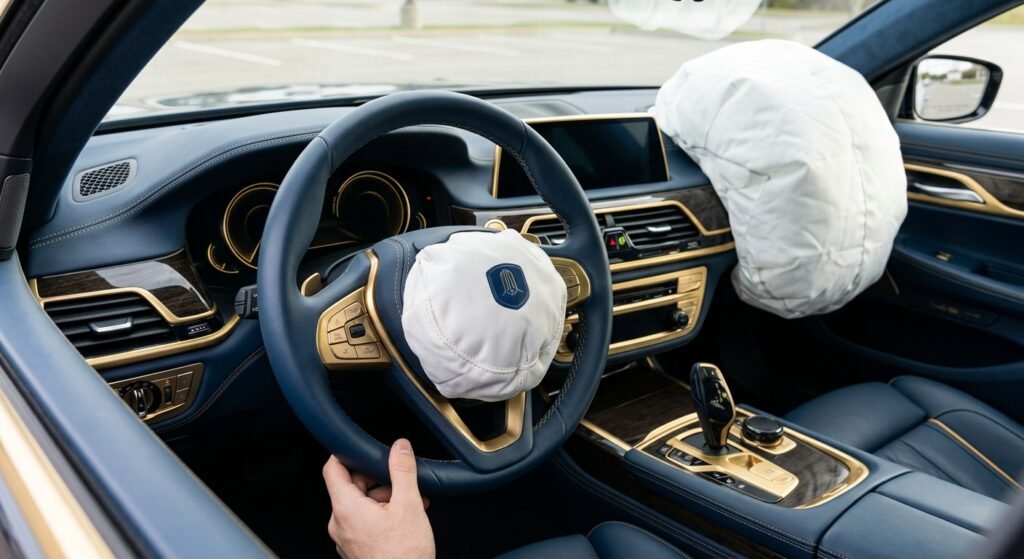
- After an actual collision, airbags or seat belt pretensioners are visibly deployed or spent.
- Possible loss of some airbag/seat belt functions; some vehicles will disable certain safety subsystems until cleared and repaired.
- In rare false-trigger cases, you may have the SRS light without visible deployment — still treat as serious until diagnosed.
Safety first: when it’s safe (and unsafe) to drive
If any airbags or pretensioners deployed during a crash, the vehicle is not safe to drive until those components are replaced and the restraint system is restored. Driving with deployed airbags or fired pretensioners leaves you without those critical protections.
If the SRS light is on but there is no evidence of deployment, short trips may be possible but are not recommended. The SRS warning means a fault exists in a system designed to protect occupants — prioritize diagnosis and repair before regular driving.
Step-by-step technician diagnosis (what pros do, and in what order)
Use this as the technician’s checklist. Don’t skip safety steps — batteries disconnected incorrectly or pyrotechnic components mishandled are dangerous.
- Full vehicle scan with a capable SRS-capable scanner (GM factory-level or equivalent). Record the code (B0051) and any companion codes. Note whether the module lists crash data present or a deployment count.
- Visual crash inspection: check bumpers, frame rails, radiator support, interior trim, steering wheel, and seat belt anchors for signs of impact or deployment. Look for deployed airbags or spent pretensioners.
- Battery & power checks: verify stable battery voltage and good grounds. Low voltage events during service can cause false faults—use a DVOM to test battery and chassis ground points.
- Check airbag and sensor connectors, including impact sensor connectors, front side impact sensors, seat-occupant detection connectors, and the main SRS module connector. Look for corrosion, loose pins, or damaged wires.
- Inspect clockspring (spiral cable) in the steering column if driver-airbag circuits or driver-side deployment appear involved.
- Sensor testing: where service information allows, compare impact sensor signals and harness continuity to factory specs. Do NOT fabricate pinouts; use OEM documentation or a dealer-level scan tool for detailed tests.
- Decide whether airbags/pretensioners must be replaced. Any deployed pyrotechnic device must be replaced, not repaired. Seat belts whose pretensioners fired must be replaced as well.
- SRS module handling: if crash data is stored, the module will need to be reset or replaced depending on damage and manufacturer rules. Many vehicles allow a controlled, logged reset; others require module replacement. Use a qualified SRS module reset/programming service to clear crash data and reprogram the module to a safe, factory state.
- Final verification: after component replacement and module reset/programming, re-scan to confirm codes are cleared and perform any required post-repair ADAS or steering angle calibrations.
Quick diagnostic table
| Symptom / Code | Likely cause | Next technician step |
|---|---|---|
| B0051 with visible deployment | Actual crash → deployed airbags/pretensioners | Replace deployed devices, inspect vehicle structure, reset module |
| B0051 with SRS light only | Stored crash data or false trigger | Full scan, inspect sensors/wiring, verify battery/grounds |
| B0051 after recent service | Connector disconnected/reconnected or improper battery handling | Re-check connectors, scan for companion codes, verify wiring |
Correct fix — what actually restores safety
The correct, manufacturer-approved path is:
- Replace any deployed airbags and fired seat belt pretensioners and replace any other single-use pyrotechnic components.
- Repair or replace damaged harnesses and connectors; do not splice or jury-rig safety wiring.
- Reset or reprogram the SRS/crash-data module with the appropriate tools and authorization once all physical replacements are complete. The module reset removes stored crash data and clears the B0051 flag only after the vehicle is safe and components are restored.
LockNCal provides professional SRS airbag module reset and crash data deletion services by mail-in nationwide and mobile in DFW, and we handle occupant module resets, module programming, and related safety system services. We do not “repair” pyrotechnics — deployed airbags and fired pretensioners are single-use and must be replaced per manufacturer guidance.
How B0051 compares to other SRS codes (brief)
Other codes like b0010 13 chrysler or chrysler dtc b0010 2b reference SRS/airbag diagnostics on Chrysler platforms and often relate to crash data or sensor faults. Exact meanings vary by make/model and model year; always confirm definitions with a current OEM scan. On GM/Buick vehicles B0051 is the clear “Deployment Commanded” flag and should be treated accordingly.
When to call a pro — and what to expect
If B0051 is present, call a qualified technician before driving extensively. Expect the technician to run a complete SRS scan, inspect for deployed components, and recommend replacements. After physical replacements, the SRS module will be reset or programmed and the system re-checked. If you want a fast, nationwide option for SRS module reset and crash data deletion, LockNCal’s mail-in service is set up to handle exactly this workflow.
FAQ
Will clearing the code fix the problem?
Clearing codes will not fix B0051 if crash data remains or deployed devices are not replaced. The SRS light will likely return and critical safety functions may be compromised.
Does B0051 always mean airbags deployed?
Not always. B0051 indicates a deployment command was recorded; that may or may not coincide with visible deployment, but it always requires investigation and, if deployment occurred, replacement of pyrotechnics.
Can I reset the SRS module myself?
Resetting crash data requires the correct tools, procedures, and often OEM-level authorization. Improper handling can be unsafe or illegal; use a qualified service for SRS module reset or programming.
What parts must be replaced after a deployment?
Deployed airbags, fired seat belt pretensioners, and any single-use pyrotechnic components must be replaced. Wiring and sensors damaged in the crash must also be repaired or replaced per manufacturer guidance.
How soon should I address B0051?
Address it immediately. The SRS system protects occupants; leaving it unaddressed puts you and passengers at risk in a subsequent collision.
If you need a certified, manufacturer-correct module reset and crash data deletion, our mail-in airbag module reset service is available nationwide and can be started from the service page above. Call (469) 277-7277 to discuss your Buick B0051 and schedule the next step.


