 Skip to content

DIY Airbag Module Reset Risks — What You Need to Know
Direct answer: Attempting a DIY airbag (SRS) module reset carries real safety, legal, and functional risks: you can leave the restraint system disabled, erase needed crash data incorrectly, or cause an accidental deployment. For safe, manufacturer-compliant results, use a qualified reset or replacement service handled by trained technicians.
Key Takeaways
- DIY SRS module resets are risky — they can make airbags and seat belts ineffective.
- Many DIY fixes are not manufacturer-approved and can void warranties or insurance claims.
- Professional resets follow diagnostic steps, confirm sensor and belt condition, and reprogram modules correctly.
- LockNCal offers nationwide mail-in SRS airbag module reset and mobile services for safe, compliant resets.
Why people try a DIY airbag module reset
After an accident, a deployed airbag or an illuminated airbag light is alarming and expensive. That pressure leads some owners to search for cheap, fast DIY fixes: reset tools, online tutorials, or local shops offering a low-cost “repair.” The appeal is understandable, but the risks aren’t obvious until it’s too late.
What an SRS/airbag module reset actually does
An SRS (supplemental restraint system) control module stores crash data and fault codes and controls airbag deployment. A correct reset removes crash-history flags after the underlying cause has been diagnosed and any fired components have been replaced. A reset is not a physical repair to airbags, pretensioners, or seat belts — those must be replaced if deployed or fired.
Common DIY approaches
- Using low-cost code readers or generic reset tools to clear the airbag light.
- Disconnecting the battery or removing the module to try a manual reset.
- Following online tutorials that skip sensor and wiring checks.
Why DIY airbag module reset risks matter
There are three overlapping categories of risk: safety, legal/insurance, and functional.
1) Safety risks
- Leaving the system non-functional. A cleared light doesn’t prove the sensors, pretensioners, or module logic will deploy in a crash.
- Partial or incorrect resets. If crash data is erased without verifying that airbags and pretensioners were replaced, occupants may be unprotected.
- Accidental deployment. Mishandling airbag modules or wiring during DIY work can trigger a sudden and dangerous deployment.
2) Legal and insurance risks
- Voided warranties. Non-authorized modifications or resets can void manufacturer or aftermarket warranties.
- Insurance and claim complications. Insurers or investigators may question a post‑accident DIY reset, complicating payouts or liability.
- Resale and disclosure issues. A vehicle that had an airbag issue that was improperly “fixed” can create legal exposure on resale.
3) Functional and diagnostic risks
- Misdiagnosing the root cause. The airbag light can come from sensors, wiring, clock springs, occupant detection modules, or the SRS module itself — clearing the code doesn’t fix these parts.
- Masking progressive faults. A simple code erase can hide underlying electrical faults that will fail later, possibly in a crash.
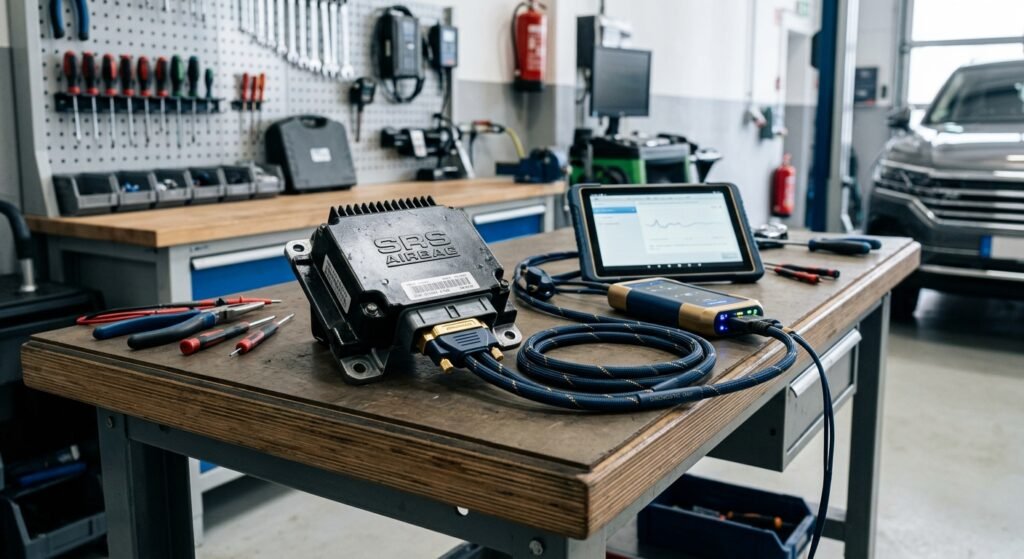
What professionals check that most DIYers skip
A qualified technician performs a sequence of diagnostic and verification steps that protect safety and compliance. Typical checks include:
- Full scan of the SRS module for stored crash data and fault codes with OEM-level tools.
- Visual inspection of deployed airbags, pretensioners, seat belt buckles, and sensor mounts.
- Resistance and continuity checks on clock springs, seat belt circuits, and impact sensors.
- Programming or re-flashing the module to the correct VIN and calibration data when needed.
- Confirming the airbag system passes a post-service self-test before clearing codes permanently.
A quick comparison: DIY vs. Professional SRS module reset
| Issue | DIY | Professional service |
|---|---|---|
| Safety verification | Usually skipped or incomplete | Full post-reset system self-test and component verification |
| Correct root-cause diagnosis | Often not performed | Complete diagnostic scan and component checks |
| Data handling | Crash data may be erased incorrectly | Crash history is reviewed and reset only when appropriate |
| Compliance & documentation | Minimal | Written confirmation and VIN-programming as needed |
When is a reset appropriate — and when is replacement required?
Resetting the SRS module is appropriate when the module’s crash data has been logged but all deployed pyrotechnic components (airbags, pretensioners, buckles) have been replaced and the vehicle’s sensors and wiring are intact. Resetting is NOT a substitute for replacing fired airbags or pretensioners — those are single‑use components that must be replaced.
If you’re not sure whether parts were replaced correctly after a crash, do not attempt a DIY reset. A professional will inspect and confirm every safety component before clearing crash data.
How a responsible shop documents and returns the vehicle to service
Good technicians leave a clear paper trail: diagnostic scan reports, replaced-part lists, VIN programming notes, and a final test showing the SRS light is off because the system reports no faults. This documentation matters for future owners and for insurance or legal reviews.
How to choose a safe, qualified SRS module reset service
- Verify the provider uses OEM-level scan tools and follows manufacturer procedures.
- Ask what they do to confirm deployed components were replaced and sensors are working.
- Confirm they won’t “repair” pyrotechnic devices — replacement is the only safe fix for deployed airbags or fired pretensioners.
- Consider a specialist who offers both module services and system inspections, like an SRS-focused provider.
LockNCal provides a nationwide mail-in airbag module reset with free shipping, and mobile services in the Dallas–Fort Worth area; see our full vehicle safety system services for details. If module programming is required after diagnostics, we also provide professional module programming.
FAQ
Q: Can I safely reset my airbag light with a generic code reader?
A: No. A generic code reader may clear the light but won’t verify sensors, pretensioners, or crash data integrity. Clearing codes without a full diagnostic risks leaving the restraint system unsafe.
Q: Is erasing crash data illegal?
A: Erasing crash data is not illegal per se, but doing so without proper documentation or while concealing a prior crash can create legal and insurance problems. Always document repairs and replacements before a reset.
Q: My airbag deployed and was replaced — do I still need a module reset?
A: Yes. After airbags or pretensioners are replaced, the SRS module often needs a professional reset or reprogramming so the system recognizes the new components and clears stored crash flags.
Q: Can a skilled DIYer follow a shop procedure and do the reset safely?
A: Only if you have OEM-level tools, the right training, and you replace all fired components correctly. For most owners, the safest option is a qualified service that documents the work and verifies system integrity.
Q: What should I do right now if my airbag light is on after an accident?
A: Don’t attempt a quick DIY erase. Get a full diagnostic to confirm which parts need replacement or programming. For nationwide service options, consider a mail-in SRS module reset or contact a mobile technician for an on-vehicle inspection.
Need help you can trust? If you want a safe, documented fix without guessing, consider LockNCal’s nationwide mail-in airbag module reset or schedule a professional inspection. Call (469) 277-7277 or book an appointment to see your exact service options.


