 Skip to content

U1000 GMC CAN Bus Code — Causes & Fix
What U1000 means: CAN communication bus fault. It is a module communication code.
Does LockNCal handle this? No — module communication faults aren’t part of our mobile safety-systems service, so this one is best diagnosed by a qualified repair shop. If the same scan also shows airbag/SRS, ADAS, or key & immobilizer codes, those we do handle — call or text (469) 277-7277.
Direct answer: U1000 GMC means a CAN communication bus fault – a general controller area network communication error. The cure is diagnostic: verify connectors, wiring and grounding, isolate the segment or module causing the drop, then repair or replace the failed wiring or module and reprogram/reset any modules that lost network messages.
Key Takeaways
- U1000 GMC = “CAN communication bus fault – a general controller area network communication error.”
- It’s a network/communication problem, not a single sensor fault — think wiring, connectors, or a misbehaving module.
- Diagnosis is stepwise: full scan, targeted network trace, connector/wiring inspection, and module substitution/isolation.
- Common on older GMC Envoy, Sierra, and Duramax trucks where corrosion, chafing, or poor grounds break CAN nodes.
- LockNCal routes network/code work to module programming, diagnostics, or SRS services as appropriate — book an appointment to confirm next steps.
What U1000 Means, Plain English
On GMC vehicles the U1000 code reports: “CAN communication bus fault – a general controller area network communication error.” That means one or more modules on the vehicle’s CAN bus stopped exchanging messages the way the rest of the modules expect. It’s not a specific sensor — it’s the network that links modules together (ECM/PCM, BCM, instrument cluster, ABS, SRS/airbag module, etc.).
Why this matters
When a module can’t see expected messages it may go into limp/backup mode or disable features. For example, if the airbag (SRS) module loses communication with other systems you may see multiple airbag or restraint-related codes, or an illuminated SRS light — which is a safety issue. Similarly, loss of instrument cluster messages can cause misreported gauges or drivability limits.
Common causes by vehicle/application
U1000 appears across GMC SUVs and trucks. Some patterns technicians see:
- GMC Envoy (2002–2009): corrosion at connectors behind the dash, loose ground at the left kick panel.
- GMC Sierra (2003–2007): chafed CAN halves in the engine bay harness, battery terminal corrosion, or a faulty BCM.
- Duramax-equipped trucks: additional modules (turbo, emissions) add nodes — a single failed module can pull the whole bus down.
Quick reference table: common causes and first checks
| Symptom | Likely cause | Initial check |
|---|---|---|
| Multiple modules show comm faults | Bus short/open or ground failure | Battery voltage, main ground straps, fusebox grounds |
| SRS/Airbag light + U1000 | Loss of message to airbag module or module fault | Scan SRS module, check connectors near passenger knee/center console |
| Cluster dead or intermittent | Broken CAN high/low to cluster | Inspect harness behind dash and steering column connectors |
Step-by-step diagnosis (what a technician actually does)
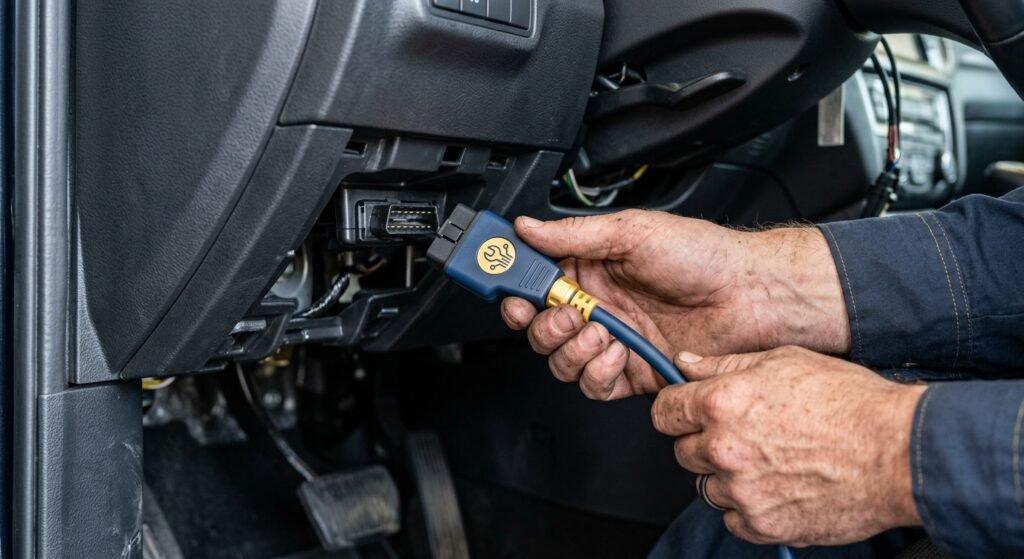
Diagnosing U1000 is methodical. Here’s the order of checks most technicians use; you’ll need a good OBD-II scan tool that can read manufacturer modules and a digital multimeter. Advanced shops use a CAN bus oscilloscope or breakout harness for live bus tracing.
- Full system scan. Read all modules (BCM, ECM/PCM, ABS, SRS, TCM, instrument cluster). Note which modules report U1000 or other U-codes, and which modules are missing entirely from the scan—missing modules point to a segment failure.
- Check battery and grounds. Low voltage or poor grounds cause erratic comms. Clean battery terminals and primary chassis/engine grounds and re-scan.
- Inspect physical connectors and harness routes. Pay attention to areas that move (doors, steering column) and areas exposed to heat/corrosion (engine bay, windshield cowl). Look for chafing, bent pins, or water intrusion.
- Measure CAN bus voltages. With ignition on but engine off, CAN High should be near ~2.5–3.5V and CAN Low ~1–1.5V when idle (manufacturer variation exists). Use a meter or scope to confirm both wires are present and not shorted to ground or battery.
- Isolate by disconnecting modules. If a specific module is failing and dragging the bus, disconnecting it can restore communication to the rest of the network and identify the bad node. Always follow manufacturer safety steps, especially with SRS/electrical components.
- Software and programming checks. If a module recently came from another vehicle or lost programming (after replacement, battery disconnect, or module reset) it may not talk correctly. Reprogramming or re-flashing to the correct VIN/configuration may restore comms.
- Replace or repair wiring / module as needed. If a connector or harness is damaged, the correct fix is to replace that wiring or the faulty module. For SRS/airbag modules, resetting crash data or programming replacement modules must be done with qualified tools — LockNCal offers module programming and reset services.
When U1000 is related to SRS (airbag) systems
If U1000 shows alongside airbag or occupant-sensing codes, treat it as a safety priority. A missed or lost SRS message can prevent deployment or keep the restraint system disabled. LockNCal handles SRS module reset and programming: for many U1000/SRS cases the solution is module reprogramming or, if crash data is present, a module reset. We provide mobile module programming and nationwide mail-in airbag module reset options depending on the module and vehicle.
How long does diagnosis and fix usually take?
Diagnosis time varies with how obvious the fault is. A simple ground or connector clean can be found and cleared in under an hour. Intermittent wiring faults, or cases requiring module replacement and programming, can take several hours. If SRS module reset is required and you choose the mail-in option, most modules return quickly — check our mail-in airbag module reset service for details.
Safety: is it safe to drive with U1000?
It depends. If U1000 affects critical systems (SRS/airbag, ABS, engine control), it is not safe to ignore — stop driving and have the vehicle diagnosed. If the code is isolated to a non-critical module (some comfort or convenience modules), you may be able to drive carefully to a shop, but get it checked promptly. When in doubt, don’t risk it.
Model-specific notes and examples
- 2003 GMC Envoy U1000: often found with dash connectors and BCM issues after water intrusion behind the glovebox or from a leaking cowl.
- 2004 GMC Sierra U1000 / 2005 GMC Sierra code U1000: common on trucks with aftermarket accessories that tie into the battery or chassis grounds without proper filtering; aftermarket modules can load the bus.
- U1000 GMC Duramax: additional electronic controllers on diesel trucks increase failure points — turbo actuators, emissions modules, and transmission controllers should be included in the initial scan.
When to call a professional
Call a qualified technician if:
- You see U1000 with SRS/airbag warnings.
- Multiple modules are missing on a scan.
- Electrical work or module programming is needed. Module programming and reconfiguration require factory-level tools and correct vehicle data.
For module programming and reprogramming needs, see our mobile module programming service and the broader vehicle safety system services pages for SRS-specific work.
FAQ
Q: What exactly does U1000 GMC mean?
A: U1000 GMC means “CAN communication bus fault – a general controller area network communication error.” It indicates messages on the vehicle network are not getting through between modules.
Q: Can I clear U1000 myself?
A: You can clear the code with a scan tool, but clearing it doesn’t fix the root cause. If the underlying wiring or module problem remains, the code will return and critical systems could remain impaired.
Q: Is U1000 dangerous?
A: U1000 itself is a communication fault. It becomes dangerous when the affected modules are safety-critical (airbags, ABS, engine). If the SRS light or ABS light is on along with U1000, do not delay diagnosis.
Q: Will replacing the battery fix U1000?
A: Replacing or reconnecting a weak battery or cleaning battery terminals can restore proper voltage and resolve intermittent comm issues, but only if the battery/ground was the true cause. Always scan before and after battery work.
Q: How does LockNCal help with U1000 on GMC vehicles?
A: LockNCal provides diagnostic and module programming services. For SRS-related U1000 codes we offer mobile module programming and nationwide mail-in airbag module reset options when a module needs reprogramming or crash data clearing.
Next steps
If you have U1000 on your GMC (Envoy, Sierra, Duramax or other) start with a full scan and battery/ground check. For module programming, SRS module reset, or on-site diagnostics book an appointment and we’ll walk you through the exact scope and next steps. Schedule online or call (469) 277-7277 to discuss your vehicle and get a clear plan.
Mobile module programming services | Vehicle safety system services
Schedule an appointment or call (469) 277-7277 for help diagnosing U1000 on your GMC.


