 Skip to content

Airbag Module Part Number — How to Find & What It Means
Direct answer: The airbag module part number is the alphanumeric code printed on the SRS (airbag) control module that identifies the exact hardware and software variant used by your vehicle. You’ll need it to confirm compatibility for programming, module resets, replacements, or when ordering a correct replacement or mail-in reset service.
Not near Dallas–Fort Worth? Mail us your airbag / SRS module.
We reset most airbag control modules by mail — free 2-way shipping and a fast turnaround. We clear the crash data, restore factory settings, and ship it right back, anywhere in the U.S.
Key Takeaways
- The part number is printed on the airbag/SRS module label and is the single best way to confirm compatibility.
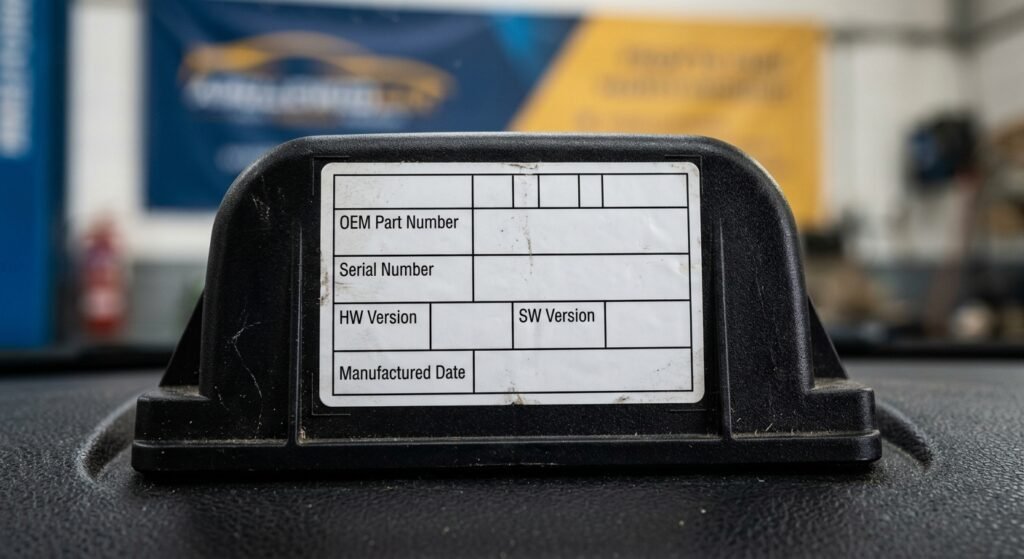
- Labels usually include OEM part number, serial number, hardware and software versions, and manufacturing date.
- You need the right part number for module programming, resetting crash data, and ordering replacements.
- Deployments and fired pretensioners require replacement — they are single-use and not a candidate for “repair.”
What exactly is an airbag module part number?
An airbag (SRS) module part number is a manufacturer-assigned code printed on the module housing or label that uniquely identifies that module’s design — the physical connectors, internal hardware, and the software image it runs. It’s not just a catalog code: the part number determines whether a module can be programmed to work with your vehicle’s airbag, seat belt, and occupant-sensing systems.
Where to find the part number on the module
Common locations where technicians read the part number:
- On the metal or plastic housing of the SRS (airbag) control module — often beneath the driver’s or passenger’s seat, under the center console, or behind the glovebox.
- On a printed barcode label that includes additional fields: serial number (SN), hardware version (HW), software version (SW), and manufacture date.
- Vehicle documentation: sometimes the OEM part number appears on the vehicle build sheet, dealer paperwork, or parts catalogs.
How to read the label
Labels vary by maker, but you’ll usually see these fields:
- OEM Part Number – the main identifier used for ordering parts.
- Serial Number – unique to that physical unit.
- HW/SW Versions – important for compatibility during programming.
- Manufacture Date or Lot Code.
- Security/lock flag – indicates if the module uses a secured coding scheme.
Typical label fields (what they mean)
| Label Field | What it tells you |
|---|---|
| OEM Part Number | Main ID used to match replacement modules and verify compatibility. |
| Serial Number (SN) | Unique unit ID — needed if a module has been programmed or locked to a VIN. |
| HW / SW Version | Shows hardware revision and software image; mismatches can prevent programming or cause errors. |
| Manufacture Date / Lot | Useful when identifying recalls or warranty coverage windows. |
| Connector / Pin Count | Physical confirmation the module will fit the vehicle harness. |
Why the part number matters for resets, programming, and replacements
Airbag modules are safety-critical modules. Using the wrong part number or an incompatible software revision can leave the restraint system inoperative or trigger persistent fault codes. Specific reasons the part number matters:
- Programming tools and OEM software check the part number before allowing coding to a vehicle.
- Resetting crash data or clearing an SRS code may require a module with matching hardware and software capabilities.
- Some modules are “secured” or VIN-locked — the label/part number plus serial may determine whether the unit can be reset or must be replaced and reprogrammed.
How to safely get a part number without guessing
If you’re not a technician, don’t guess. Common safe options:
- Ask a technician to read the label directly — they’ll note OEM part number, SN, and HW/SW revisions.
- Use the VIN and an OEM parts catalog or dealer to confirm the correct part number for your car’s build.
- Use diagnostic scan tools that report module part numbers and software versions when the module is connected.
Common pitfalls and what to avoid
- Don’t assume two modules that look the same are interchangeable — the part number and software versions matter.
- A part number alone doesn’t tell you whether a module contains crash data or is VIN-locked; read the serial and use a scan tool.
- If an airbag or pretensioner has deployed, the correct action is replacement — these are single-use pyrotechnic devices, not repairable.
When the part number points to a “secured” module
Some modules are marked or behave as “secured” or VIN-locked. That means an external tool (or OEM service) must authenticate or reprogram the module to the vehicle’s VIN before the SRS system will function correctly. If you see fields like a hexadecimal security code, or if a scan shows authentication errors, treat the module as secured and consult a qualified service.
What LockNCal can do
If you need the module read, confirmed, or cleared, LockNCal offers nationwide mail-in SRS airbag module reset and crash data deletion as well as mobile service in DFW. For modules that must be reprogrammed or programmed to a vehicle, we provide module programming and on-site services where available. For national, fast mail-in resets see our mail-in airbag module reset service: https://lockncal.com/mail-in-airbag-module-reset-service-free-shipping/. For a broader view of vehicle safety work see https://lockncal.com/vehicle-safety-system-services/.
Practical workflow a technician uses to confirm compatibility
- Visually locate and photograph the module label (part number, SN, HW/SW).
- Scan the SRS system with an OEM-level or advanced diagnostic tool to read live data and fault codes.
- Check the OEM parts catalog or dealer data to match part number to the vehicle’s build VIN.
- Verify if the module is secured or contains crash data; if so, determine if reset or replacement is required.
- Proceed with reset, programming, or order a correct replacement as indicated.
Table: Quick checklist before ordering or resetting a module
| Item | Yes / No | Why it matters |
|---|---|---|
| Do you have the OEM part number? | Yes/No | Confirms physical and software compatibility. |
| Is the module showing crash data? | Yes/No | Crash data must be cleared before SRS will function normally. |
| Is the module VIN-locked or secured? | Yes/No | Secured units may need authenticated programming or a specific reset process. |
| Are connectors and pin count matching? | Yes/No | Prevents physical mismatch and wiring errors. |
Next steps if you only have a VIN
If you only have the VIN and can’t access the module label, use the VIN with an OEM parts catalog or contact a dealer for the exact OEM part number. You can also upload a photo or VIN through a service booking form to get a technician to confirm the part number and the correct next step. For national mail-in options that handle many common modules quickly, see our mail-in service listing above or learn more about our mail-in services: https://lockncal.com/mail-in-services/.
Safety note: deployed airbags and fired pretensioners
Deployed airbags and fired seat belt pretensioners are single-use pyrotechnic devices. They must be replaced — do not accept “repair kits” or splicing as a safe fix. The SRS module itself may be reset if it is not physically damaged and the module type supports reset; a qualified technician will confirm based on the part number and scan data.
FAQ
How do I find my airbag module part number?
Locate the SRS module (under the seat, center console, or behind the glovebox), and read the OEM part number printed on the label. If you can’t access it, use the VIN with an OEM parts catalog or ask a technician to read it for you.
Does the part number tell me if a module can be reset?
Part number plus serial and HW/SW version helps determine if a module supports reset or is VIN-locked. A diagnostic scan is usually required to confirm whether crash data exists or whether the unit is secured.
Can I use a different part number if it looks the same?
No — visual similarity isn’t enough. The OEM part number and software/hardware versions must match to ensure the module will program and function correctly.
My airbag deployed—can the module be repaired?
If an airbag deployed, the correct action is replacement of deployed airbags and any fired pretensioners. The SRS module may sometimes be reset if it’s not physically damaged, but a qualified technician must confirm this based on the part number and scan.
What if the module is secured or VIN-locked?
Secured modules require authenticated programming or a reset method specific to that module. A technician will check the part number and scan data to decide whether a reset, reprogramming, or replacement is needed.
If you need help reading a label, confirming a part number, or resetting crash data, our nationwide mail-in SRS airbag module reset service handles most modules quickly and includes free two-way shipping. Learn more or book a mail-in reset here: https://lockncal.com/mail-in-airbag-module-reset-service-free-shipping/. For hands-on vehicle safety work, see our broader vehicle safety system services at https://lockncal.com/vehicle-safety-system-services/. Call (469) 277-7277 if you’d prefer to talk it through.


