 Skip to content

Seat Belt Buckle Repair Kit: Safe Fixes & When to Replace
Direct answer: A seat belt buckle repair kit can sometimes fix simple mechanical latch problems (sticky debris or a broken plastic tongue), but it cannot make a deployed pretensioner or a faulty buckle sensor safe again. Most safety-system faults require replacement and module diagnostics/programming to restore correct SRS behavior.
If your seat belt needs replacing, our mobile seat belt replacement restores it to factory condition, mobile across DFW.
Key Takeaways
- “Repair kits” may help with latch-only problems but never with pyrotechnic pretensioners or sensor faults.
- Seat belt sensor faults often require module diagnostics and a reset or reprogramming, not a buckle DIY fix.
- LockNCal performs seat belt replacement, module programming/diagnostics, and airbag/SRS module reset (mobile and mail-in).
- For model-specific issues (Audi, Chevy, Ford F-150) you may need a replacement assembly plus programming.
What is a “seat belt buckle repair kit”?
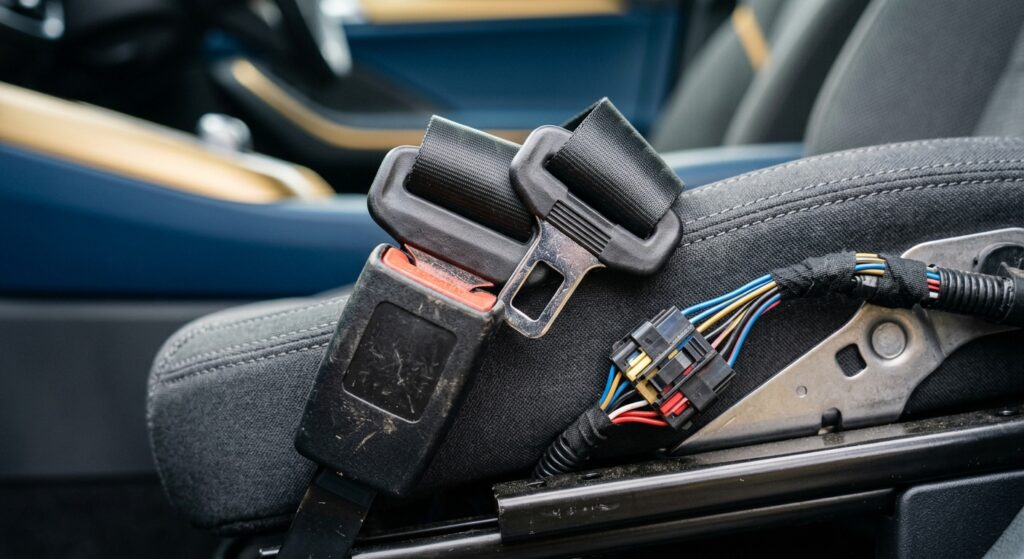
A seat belt buckle repair kit is usually a set of small mechanical parts: replacement plastic housings, springs, latch tongues, and sometimes clips. Vendors market them for common latch problems — for example, a buckle that won’t latch, won’t release, or is noisy. Kits do not contain or address pyrotechnic components (pretensioners) or the buckle’s electrical sensor circuitry in a way that restores original safety performance.
When a kit can help
- Foreign object or debris lodged in the latch that prevents the tongue from seating.
- Worn or broken plastic pieces that cause the release button to stick (non-pyrotechnic parts).
- Cosmetic fixes where the buckle functions but looks damaged.
When a kit is not appropriate
- Any buckle that contains a pretensioner that has fired (pyrotechnic device) — replacement is required.
- Electrical faults: intermittent or permanent seat belt buckle sensor errors or SRS warning lights.
- Corrosion, water intrusion, or crushed wiring in the buckle harness.
How technicians actually diagnose a bad buckle
Real diagnosis follows clear steps — a checklist any technician should use before suggesting a kit or replacement:
- Visual inspection: check the buckle, wiring harness, connector, and mounting point for obvious damage or corrosion.
- Functional test: insert and release the tongue repeatedly; note whether failure is mechanical or electrical.
- Scan for SRS codes with a professional scan tool — the SRS module will report buckle circuit faults, open/short conditions, or pretensioner deployment history.
- Backprobe the buckle connector: measure continuity and the buckle switch voltage while buckling/unbuckling (we explain plain numbers to vehicle owners during diagnosis).
- If codes indicate deployment or a seat belt circuit fault that can’t be cleared, plan for replacement and module reset/programming as needed.
Plain-English note on SRS codes
SRS error messages often say things like “seat belt buckle circuit open” or “buckle switch fault.” That’s shorthand for the module not seeing the expected on/off signal from the buckle. It doesn’t tell you whether the problem is a dirty latch, a cut wire, or a buckled pretensioner — the physical tests above determine that.
Why “repair” language is risky — and what the correct fix is
Many online searches use the word “repair” (for example, “seat belt buckle repair” or “seat belt buckle repair kit”). It’s important to be precise: a deployed pretensioner or a damaged buckle sensor is a safety-critical failure that cannot be safely repaired. Those components are single-use or integral to the vehicle’s restraint system.
The correct, manufacturer-approved fixes are:
- Replacement of the seat belt assembly or buckle assembly when the pretensioner has fired or the buckle sensor is defective.
- Diagnostic and module work: after replacement, the SRS/airbag module often needs a reset, crash data cleared, or new module programming so the system recognizes the new part.
LockNCal does not sell or install “repair kits” for pyrotechnic parts, and we do not rebuild pretensioners or airbags. We do replace seat belts, replace buckles when needed, and perform the required module programming, diagnostics, and SRS resets (mobile in DFW and nationwide by mail-in for module work).
Model-specific notes: Audi, Chevy, Ford F-150
Certain models have nuances technicians must know:
- Audi: Buckle sensors are often integrated and CAN/SRS messaging can be sensitive — replacing the buckle frequently requires a module scan and sometimes programming.
- Chevy: Many GM vehicles use thin, integrated buckle harnesses that corrode at the connector; the harness or entire assembly usually needs replacement rather than a one-off kit.
- Ford F-150: F-150 buckles can include both sensor and pretensioner options depending on trim/year; a deployed pretensioner calls for a full replacement and module reset.
When you search “audi seat belt buckle repair” or “ford f150 seat belt buckle repair” it’s best to plan for diagnostic verification first — that’s what separates a safe fix from a risky DIY attempt.
Quick comparison: repair kit vs. replacement vs. professional service
| Problem | Repair kit useful? | Correct professional action |
|---|---|---|
| Debris or stuck latch | Yes — cleaning or new plastic parts can restore function | Technician cleaning and functional check |
| Broken plastic release or non-electrical wear | Sometimes — mechanical parts can be replaced if not integral | Replace buckle assembly if wear is severe |
| Seat belt buckle sensor fault / SRS light | No — kits do not restore electrical safety performance | Diagnostics, wiring repair or buckle replacement, module reset/programming |
| Pretensioner fired (post-crash) | No — single-use pyrotechnic device | Replace belt or buckle assembly and reset/clear crash data |
What LockNCal can do for you
We follow the safety-first approach: diagnose first, then replace or reset as required. Relevant services we provide include:
- Seat belt replacement, including belts whose pretensioner has fired.
- Module programming and diagnostics so new buckles or belts are recognized by the SRS system: mobile module programming services.
- SRS/airbag module reset and crash data deletion — mobile in the DFW area or nationwide by mail-in: mail-in airbag module reset (nationwide, free shipping).
- Full vehicle safety system service and inspections: vehicle safety system services.
How to decide next steps (owner checklist)
- Don’t install a kit if the SRS light is on or the belt pretensioner may have fired.
- Try a visual clean: remove obvious debris from the latch and test function.
- If the buckle still behaves incorrectly, get a professional SRS scan before buying parts online.
- If SRS codes or wiring faults appear, plan for replacement and module work — the safety system must be verified after any repair.
FAQ
Can I use a seat belt buckle repair kit to fix the SRS light?
No. Repair kits address mechanical latch issues only. An SRS light indicates an electrical or crash-data issue that requires diagnostics, possible buckle or belt replacement, and module reset/programming.
Are seat belt buckle repair kits safe?
They can be safe for minor mechanical fixes, but they do not restore the electrical or pyrotechnic safety functions of a buckle. When in doubt, have a technician inspect the buckle and read SRS codes.
How much does seat belt buckle repair cost?
Costs vary by vehicle and the exact fix. LockNCal can give an exact price for your year, make, and model — call (469) 277-7277 for a quote.
Can you repair a buckle on an Audi / Chevy / Ford F-150?
We diagnose any vehicle. Many Audi, Chevy, and Ford F-150 buckles require replacement plus module diagnostics or programming; we provide those services and will explain the safest option after inspection.
Do you offer mobile service or mail-in options?
Yes. We provide mobile services in the DFW area and nationwide mail-in SRS module reset services — see our mail-in option for details.
Final notes and next steps
Searching for “seat belt buckle repair near me” is a good first step, but the safest course is diagnosis by a qualified technician rather than guessing with a kit. If your vehicle shows an SRS light, has a deployed pretensioner, or the buckle shows wiring damage, the correct fix is replacement plus module diagnostics/programming.
For professional help, diagnostics, and safe replacement, visit our vehicle safety system page: https://lockncal.com/vehicle-safety-system-services/. To schedule service or to get a price for your vehicle call (469) 277-7277 or schedule an appointment.


