 Skip to content

Toyota U0100 Code — Expert Guide (Critical)
Direct answer: The Toyota U0100 code means “Lost Communication With ECM/PCM – the network cannot reach the engine control module.” It points to a network/communication fault between modules (often CAN bus, power or ground, or a failed module). Proper diagnosis is required—module programming and vehicle diagnostics, not guesses, fix the problem.
Not near Dallas–Fort Worth? Mail us your airbag / SRS module.
We reset most airbag control modules by mail, with free 2-way shipping and a fast turnaround. We clear the crash data, restore factory settings, and ship it right back, anywhere in the U.S. Book online and you’ll see your firm price in about 60 seconds.
Key Takeaways
- The Toyota U0100 code means exactly: “Lost Communication With ECM/PCM – the network cannot reach the engine control module.”
- Common causes are wiring/CAN faults, blown fuses, low battery voltage, or a non-responsive ECM/PCM.
- Start diagnosis with a full scan, check battery & fuses, then inspect CAN wiring, grounds, and module presence.
- The correct fix is targeted diagnostics and module programming or replacement as determined—module programming services or diagnostics are the right route.
What the Toyota U0100 code means
Technically the Toyota U0100 code is stored when modules on the vehicle’s data network cannot communicate with the engine control module (ECM/PCM). Use the verified definition exactly as written: “Lost Communication With ECM/PCM – the network cannot reach the engine control module.” That means the vehicle’s on-board network (often the CAN bus) didn’t get a response from the ECM when another module asked for it.
Why this matters
The ECM/PCM controls critical engine functions. If it becomes unreachable to other systems, you may see drivability problems, limp-home modes, or instrument cluster warnings. Treat the code as a communication and diagnostics problem first—don’t replace parts at random.
Common causes of a U0100 on Toyota vehicles
- Weak or dying battery / poor battery voltage or charging system issues.
- Blown or corroded power/ignition fuses that feed the ECM/PCM (EFI, ECU, or IG fuses).
- CAN bus wiring faults: open, short to ground, short to battery, or damaged twisted-pair harness.
- Loose, corroded, or water-damaged module connectors—ECM connector or other module connectors.
- A failed ECM/PCM or a recently replaced module that hasn’t been correctly programmed or is incompatible.
- Intermittent faults from aftermarket electronics, poor grounds, or body control module problems that disrupt the network.
Symptoms you might notice
- Check Engine light or multiple communications-related fault lights on the dash.
- Engine may be in limp mode, reduced power, or not start at all.
- Instruments or gauges may act erratically if the cluster can’t talk to the ECM.
- Other modules log related U-codes (communication errors) at the same time.
Tools you’ll need for accurate diagnosis
- Professional OBD-II scan tool that shows module presence and live CAN data.
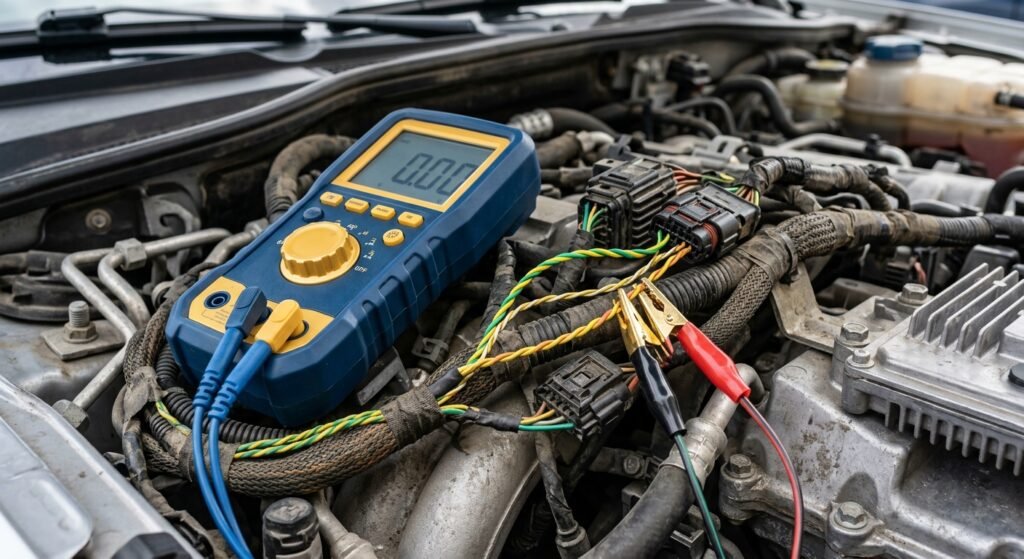
- Digital multimeter (voltage, continuity, and resistance checks).
- Backprobe leads and connector pinout reference for the vehicle (service manual).
- Wiring diagrams (factory service info) or an online subscription to confirm harness routing.
- Good battery or jumper pack—unstable voltage will confuse diagnostics.
Step-by-step technician diagnosis (recommended order)
Follow this ordered checklist to avoid wasted parts swaps and find the true cause.
- Verify and record codes: Use a professional scan tool and save all U-codes and present modules.
- Check battery & charging: Confirm stable battery voltage (12.4–12.8V resting) and charging while running (~13.5–14.8V).
- Inspect fuses & relays: Check EFI/ECU/IG fuses and relay sockets for continuity and proper voltage.
- Confirm module presence: From the scan tool, does the ECM/PCM show up? If it’s missing, the network can’t see it.
- Check grounds & power feeds: Measure voltage at the ECM connector power pins and verify chassis grounds are solid.
- Verify CAN high/low: With the ignition on, measure CAN bus voltages (typical idle voltages ~2.5V each; look for the differential signal with an oscilloscope if available).
- Inspect connectors & harness: Look for corrosion, water intrusion, bent pins, or rodent damage in the ECM connector and nearby harness sections.
- Isolate the fault: Disconnect modules one at a time (where safe) to see if a particular module causes bus errors; inspect modules recently serviced or replaced.
- Programming & compatibility: If the ECM was recently replaced, confirm it has correct programming and immobilizer pairing—mismatched programming can cause communication failures.
- Final test: Clear codes and road-test; if the code returns, use freeze-frame and live data to pinpoint the failing circuit or module.
Diagnostic steps table — what to test and why
| Step | What to check | Expected result | How it helps |
|---|---|---|---|
| Scan | All modules & U-codes | ECM listed and no network errors | Shows if ECM is present and what other modules report |
| Battery/Charging | Resting & charging voltage | 12.4–12.8V resting; ~13.5–14.8V charging | Eliminates low-voltage false errors |
| Fuses | EFI/ECU/IG circuits | Continuity & proper feed voltage | Power faults cause module silence |
| CAN wiring | Continuity; short to Vbatt or ground | No shorts; twisted-pair continuity | Identifies physical network faults |
When the ECM/PCM is the problem
After ruling out wiring, power, and connector faults, a non-responsive ECM/PCM may be the root cause. On Toyota vehicles, a replaced or reprogrammed module often needs correct calibration, immobilizer pairing, or vehicle-specific programming to communicate on the network. In many cases, module programming, reflashing, or proper pairing restores communication—this is a job for diagnostics and programming tools, not guesswork.
What NOT to do
- Don’t replace the ECM/PCM without first proving it is at fault—wiring faults create the same symptoms.
- Don’t rely on generic scan apps or simple code readers for network diagnostics; they may not show module presence or CAN errors.
- Avoid random parts swapping. The correct fix is targeted diagnostics and programming.
How a professional handles a U0100
A trained technician with the right tools will run a full module scan, test power & ground at the ECM connector, inspect the CAN bus, and confirm module software levels and immobilizer pairing. If programming or re-flashing is required, they will use factory-level or equivalent programming equipment to restore proper communication and then re-test the network under load.
If the issue is a communication code or programming mismatch, module programming and vehicle diagnostics services are the correct next step; LockNCal offers on-site mobile module programming and diagnostics for network and communication faults — see our mobile module programming services for details.
More reading
For background on the Controller Area Network used in most modern vehicles, see this CAN bus overview: CAN bus (Controller Area Network) overview.
FAQ
Q: Can I clear a U0100 and drive safely?
A: Clearing the code may temporarily remove the warning, but it doesn’t fix the underlying communication issue. If the ECM is truly unreachable, you might experience limp mode or drivability issues. Diagnose promptly.
Q: Will replacing the ECM fix U0100?
A: Only if the ECM itself is verified faulty. Replacing the ECM without checking fuses, wiring, grounds, and programming can waste time and money. Proper programming and pairing are often needed after replacement.
Q: Could a weak battery cause a U0100?
A: Yes. Low voltage or poor charging can cause modules to drop off the network and report communication faults. Always check battery and charging first.
Q: Are U0100 codes related to airbags or braking systems?
A: U0100 is a powertrain/network communication code for the ECM/PCM. It isn’t an airbag code, though multiple systems can be affected if the network is down. For airbag or SRS issues, see LockNCal’s vehicle safety system services.
Q: How much does module programming cost?
A: Mobile diagnostics and module programming costs vary by vehicle and service needed. To confirm price and schedule, use our booking form for an exact quote.
Direct diagnostics and module programming are the right path for a Toyota U0100 code—if you want professional help, book a service or learn more about our mobile module programming services and scheduling options.
Book module programming and diagnostics or call (469) 277-7277 for help identifying and fixing Toyota U0100 code communication faults.
Additional relevant services and resources: learn about our on-site mobile services overview and how mail-in services work for other modules and systems.
On-site mobile services overview | Mail-in services overview


