 Skip to content

Subaru B0010 Expert Guide — Proven & Safe
Direct answer: The Subaru B0010 code means Passenger Frontal Stage 1 Deployment Control — a fault in the passenger airbag deployment circuit. Fixing B0010 requires a professional SRS diagnosis: scan for stored events, verify wiring/squib continuity and occupant classification input, and then perform a certified SRS airbag module reset or module programming to clear true crash data.
Key Takeaways
- Subaru B0010 identifies a passenger airbag deployment circuit fault — treat it as a safety-critical issue.
- Diagnosis must start with a full SRS/airbag scan and visual inspection of the passenger airbag, connectors, and occupant detection system.
- The correct fix is module reset/programming or component replacement (airbag, seat belt pretensioner, occupant module) — not a DIY board-level “repair.”
- Driving with an active B0010 may disable the passenger airbag or leave the system unreliable; check safety before driving.
What Subaru B0010 means
The code Subaru B0010 is defined as: Passenger Frontal Stage 1 Deployment Control – a fault in the passenger airbag deployment circuit. That means the vehicle’s SRS (Supplemental Restraint System) detected a problem specifically with the circuits that control the stage‑1 firing of the passenger frontal airbag.
Not near Dallas–Fort Worth? Mail us your airbag / SRS module.
We reset most airbag control modules by mail — free 2-way shipping and a fast turnaround. We clear the crash data, restore factory settings, and ship it right back, anywhere in the U.S.
Plain-English breakdown
Automakers use staged deployments to control how forcefully airbags deploy. A “stage 1” event is typically the initial, lower‑force deployment for certain impacts. B0010 shows that the SRS system detected a wiring, squib (airbag igniter), connector, occupant sensing input, or module-level problem that would prevent a correct stage‑1 deployment for the passenger seat.
Common causes of Subaru B0010
- Disconnected, corroded, or damaged airbag squib connector at the passenger airbag.
- Open or short in the passenger airbag deployment circuit wiring harness (after a crash or from wear).
- Faulty passenger occupant detection / classification module sending invalid input.
- Stored crash data or deployed flag in the SRS airbag control module requiring a reset or reprogramming.
- Previous improper repairs or aftermarket front‑seat work (seat covers, heated seats) that disturbed wiring or sensors.
Symptoms you might notice
- Illuminated airbag/SRS warning lamp on the dash (steady, not flashing).
- Passenger airbag status light showing OFF when someone is seated and heavier than the occupant-detection threshold.
- Loss of passenger airbag function or inconsistent passenger airbag ON/OFF behavior.
- Sometimes associated seat belt pretensioner or occupant detection faults stored in the SRS module.
Step-by-step technician diagnosis (recommended order)
Diagnosing B0010 requires trained technicians and the correct tools. This is an overview of the correct order and tools used by pros.
- Visual inspection: check passenger seat, airbag housing, glove box area, and connectors for visible damage or deployment signs.
- Scan the vehicle with a professional SRS-capable OBD2 scanner that shows SRS codes and freeze frame data. Record all SRS-related codes and timestamps.
- Confirm whether crash data or a deployed flag is present in the SRS module — a common reason the module will set B0010.
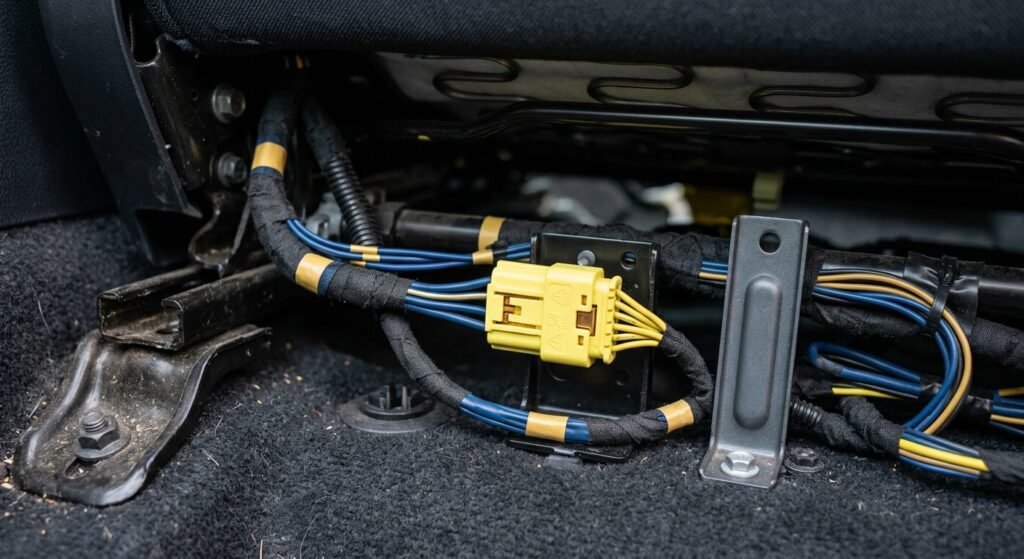
- Inspect the passenger airbag squib connector and wiring continuity with a multimeter. Do not short-circuit squib connectors — use recommended pin‑out checks and low‑voltage continuity tests only.
- Check the occupant classification system (occupant detection module) inputs and seat sensor wiring if the vehicle uses weight-based classification for the passenger airbag.
- If wiring and sensors test good, check for module communication errors between the SRS control module and other modules (body, BCM). Use module programming tools if necessary to confirm firmware/status.
Correct fix — what actually restores safety
Because B0010 concerns the passenger deployment circuit and possibly stored deployment events, the correct fixes (in order of least to most invasive) are:
- Clear false codes after confirming wiring and sensors are good using an SRS scan tool, then reset or reprogram the SRS airbag module if the manufacturer allows. LockNCal provides both mail‑in SRS airbag module reset and mobile module programming when appropriate.
- Replace any non‑serviceable safety components that have been deployed or are single‑use (passenger airbag, pretensioner, seat belt pretensioner). These parts must be replaced — they are single‑use pyrotechnic devices.
- If the occupant classification module is faulty, replace or reprogram it and then perform the required SRS relearn or reset procedures per manufacturer instructions.
Important: do not attempt board‑level repairs to airbag modules, squib connectors, pretensioners, or seat belts. These are safety-critical components; manufacturer procedures call for replacement or certified reset/programming only.
Quick diagnostic table: symptoms, probable cause, and the right fix
| Symptom | Probable cause | Correct fix |
|---|---|---|
| Dash airbag light on, passenger airbag OFF incorrectly | Occupant classification fault or squib circuit open | Scan SRS, test seat sensors and wiring, reset or reprogram module, replace occupant module if needed |
| Stored crash/deployed flag with B0010 | Previous crash event set deployment data | Certified SRS module reset/programming (or module replacement if damaged) |
| Intermittent airbag lamp resets after driving | Loose connector or intermittent wiring short | Inspect/secure connectors, continuity tests, then clear codes and verify |
When is it safe to drive with Subaru B0010?
Short answer: cautiously — but don’t assume full protection. An illuminated SRS light means the airbag system may not operate correctly. If B0010 is present, the passenger airbag could be disabled or could fail to deploy properly in a crash. If you must move the vehicle, drive carefully to a repair facility or use a trailer/flatbed for long distances.
If the passenger seat is regularly occupied (adult passenger), arrange the repair or module reset before normal driving. If a child or rear‑facing child seat is placed in the front (never recommended), do not drive — move the child rearward to a proper rear seat.
What a technician will NOT do (and why)
- No one should perform board‑level soldering or “repair” of airbag modules on a bench — this is not a manufacturer‑approved fix and may be dangerous.
- Do not reuse deployed airbags or pretensioners; they are single‑use and must be replaced.
- Do not ignore occupant detection faults; incorrect classification leads to improper deployment decisions.
How LockNCal helps with Subaru B0010
If B0010 stems from stored crash data or a programmable module fault, LockNCal offers a nationwide mail-in SRS airbag module reset that securely clears deployment events and crash flags where permitted by the manufacturer, or mobile module programming services when on-site programming is required. Find more on our vehicle safety system services and which option fits your situation at our vehicle safety page.
For a mail solution, our mail-in SRS service provides free 2-way shipping and a professional reset turnaround. If you’re local and the vehicle needs on-site programming or diagnostics, we offer mobile module programming and on-site options.
Relevant resources: official NHTSA airbag information is a good primer on how airbags are intended to function and the risks of incorrect service: NHTSA air bag information.
Further reading and internal resources
- Learn about our nationwide mail option for SRS module resets: Mail-in airbag module reset (free shipping).
- Overview of safety system services we provide: Vehicle safety system services (airbag, SRS, seat belt, clock spring).
- Ready to book? Get an exact price and schedule at: Schedule an appointment.
FAQ
Can I clear Subaru B0010 myself with a code reader?
Most basic OBD2 scanners cannot safely clear SRS crash data. Clearing codes without addressing the underlying fault or without a certified SRS reset may mask a dangerous condition. Have a trained technician confirm the cause before clearing.
Does B0010 always mean the airbag has deployed?
No. B0010 can be stored because of wiring, sensor, or module faults. It is often caused by stored deployment data after a crash, but it can also be caused by open or shorted squib circuits or occupant classification faults.
Will resetting the module fix the passenger airbag?
Resetting or reprogramming the SRS module restores proper system status only if the underlying components (squib, connectors, occupant module) are intact. If a part has been deployed or physically damaged, replacement is required.
Is it safe to drive with the passenger airbag disabled by this code?
Driving is possible for short trips to a qualified technician, but using the vehicle normally is not recommended. The passenger may not be protected in a crash; relocate passengers and avoid long drives until the system is fixed.
Do you fix the seat belt or airbag hardware?
LockNCal performs module resets, programming, diagnostics, and calibration, and can advise when component replacement is required, but we do not perform mechanical repairs or rebuilds of seat belts, airbags, or pretensioners.
If you have a Subaru showing code subaru b0010 and want a safe, manufacturer‑compliant SRS module reset or module programming, consider our mail-in SRS airbag module reset service at https://lockncal.com/mail-in-airbag-module-reset-service-free-shipping/ or call (469) 277-7277 to discuss options.


