 Skip to content

Nissan U0100 Code — Expert, Safe Fixes
Direct answer: The Nissan U0100 code means the vehicle’s network can’t communicate with the ECM/PCM “A” — the engine/powertrain control module. Fixing it requires systematic diagnostics (scan for related codes, confirm network presence, check power/grounds/fuses, inspect wiring and connectors) and often module programming or replacement when the module itself has failed.
Key Takeaways
- U0100 is a lost-communication code for the ECM/PCM “A” — confirm the exact definition with a full OEM scan.
- Common causes include dead or offline ECM, wiring/connector faults, blown fuses, low battery/charging issues, or CAN-bus problems.
- Diagnosis follows a strict order: scan, confirm network topology, check power/ground/fuses, inspect connectors and wiring, then test the module itself.
- LockNCal provides professional module programming and vehicle diagnostics (DFW, American & Asian 2008+); module replacement often requires programming to restore full function.
What the Nissan U0100 code means
The Nissan U0100 code (Lost Communication With ECM/PCM “A”) indicates that one or more modules on the vehicle’s network cannot talk to the engine or powertrain control module. The code is a network-level message — it doesn’t tell you whether the problem is the ECM hardware, its power feed, a connector, a fuse, or the wiring between modules. Manufacturer-specific subcodes and suffixes are vehicle-level details and must be confirmed in OEM service information for the exact model and year.
Not near Dallas–Fort Worth? Mail us your airbag / SRS module.
We reset most airbag control modules by mail, with free 2-way shipping and a fast turnaround. We clear the crash data, restore factory settings, and ship it right back, anywhere in the U.S. Book online and you’ll see your firm price in about 60 seconds.
Symptoms you might see
- Check Engine Light (CEL) or multiple network-related warning lights on the dash.
- No communication with the ECM from a generic scan tool (the scanner times out or shows the ECM offline).
- Engine may run poorly, go into limp mode, stall, or fail to start if the ECM is offline.
- Other modules (ABS, airbags, body control) reporting CAN-bus or lost-communication codes.
Before you start: safety and vehicle scope
If your Nissan is 2008 or newer, the vehicle falls into LockNCal’s supported model range for module programming services in DFW. Never attempt board-level module work or improvised wiring fixes; those are dealer-level or specialized shop tasks. If you suspect a safety system (airbag/SRS) is involved, note that LockNCal’s nationwide mail-in service covers SRS module resets and crash-data deletion for all makes 2008+.
Step-by-step diagnosis for a Nissan U0100 code
This is the correct technician order — do not jump to module replacement before confirming power, grounds, network presence, and wiring.
1. Capture codes and freeze-frame data
- Use an OEM-capable or professional scan tool to read stored and pending codes across all modules (not just the engine). Record freeze-frame data if present.
- Note related codes (e.g., CAN bus U codes, B or C network codes) — they point to where the communication break is happening.
2. Confirm network presence
With the scan tool try to communicate with the ECM. If the ECM is invisible, check whether other modules on the network can be reached. This narrows the fault to either the ECM itself or the wiring/can bus segment between modules.
3. Check battery, charging and power feeds
A weak battery or charging fault can cause modules to appear offline. Verify battery condition and that main power feeds and ignition-switched feeds to the ECM are present. Also check relevant fuses and fusible links that supply the ECM and CAN bus segments.
4. Inspect grounds, fuses and connectors
Poor grounds are a very common root cause. Visually and physically inspect ground points, harness connectors at the ECM, and any intermediate splice points. Look for corrosion, bent pins, oil or coolant contamination, or water intrusion.
5. Follow the wiring and look for physical damage
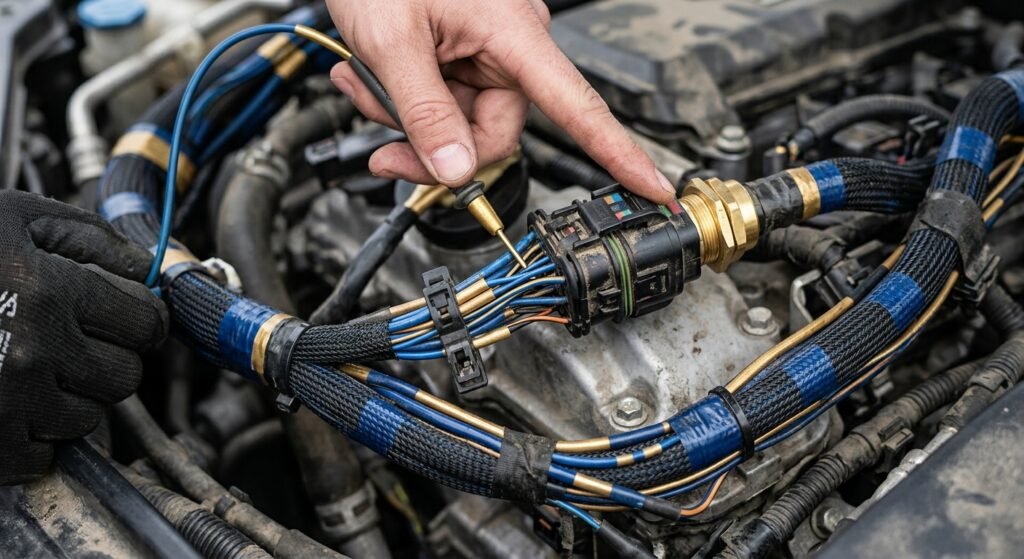
Trace the CAN-high/CAN-low wiring runs for physical damage, chafing, rodent chew marks, or repairs that could have left a poor splice. Pay special attention to areas that move (hinges), pass through bulkheads, or where harnesses are bundled with aftermarket devices.
6. Check for aftermarket interference
Aftermarket alarms, remote starters, audio amplifiers, or tuners can tie into communication lines or power feeds and cause intermittent network loss. If aftermarket gear is present, inspect its installation or disconnect it temporarily for testing.
7. Use advanced network tests
A technician will use an OEM-level scan tool that shows network node status and may perform CAN bus health checks. These tests verify whether the bus has proper node response timing and can indicate where a module stops responding. If available, test with a factory service scanner before replacing any module.
Common causes at a glance
| Cause | Typical initial test | Notes |
|---|---|---|
| Dead or failed ECM | No response from ECM with scan tool | Often requires replacement and programming; confirm power/grounds first |
| Blown fuse or fusible link | Inspect fuses visually and with test tool | Replace only after finding root cause for fuse blow |
| Poor ground or corroded connector | Wiggle test, visual inspection, clean/secure ground | Common, and often missed on first pass |
| Wiring damage or open/short on CAN bus | Visual trace and continuity tests | Look for chafe points and previous body work |
| Aftermarket device conflict | Disconnect aftermarket modules and retest | Remote starters are frequent culprits |
When the problem is the module itself
After technicians eliminate power, ground, fuse and wiring faults, the ECM/PCM may be the root cause — either a hardware failure or corrupted software. Modern modules often require OEM programming or re-flashing after replacement. LockNCal provides professional module programming in DFW for American and Asian vehicles 2008+ to restore proper network identity and functionality once a working module is installed.
Troubleshooting do’s and don’ts
- Do use a quality OEM or pro-level scan tool that shows module node status.
- Do trace and inspect wiring physically rather than assuming connectors are OK.
- Don’t assume the code means the ECM is bad — follow the diagnostic order above.
- Don’t perform board-level repairs or open a module — that’s not a safe or warranted field fix.
When it’s safe to drive
Safety depends on how the vehicle behaves: if the engine runs normally and no other critical lights (ABS, SRS) are present, short local driving to a trusted shop for diagnosis can be acceptable. If the engine won’t start, stalls, or the vehicle goes into limp mode, don’t drive — tow to a service location. Always address lost-communication issues promptly because they can mask other critical failures.
Resources and recalls
Check the VIN for open recalls with the NHTSA recall lookup before replacing modules — sometimes manufacturers issue software updates or service actions related to module behavior. You can check the VIN for open recalls at the NHTSA website.
How a professional can help
A professional diagnostic workflow saves time and avoids unnecessary replacement costs. LockNCal offers in-depth vehicle diagnostics for airbag/SRS and network/ADAS faults in DFW and can perform module programming when a replacement module or reflash is required. If you’re in DFW with a 2008+ Nissan showing U0100, a pro will follow the tests above, confirm the failed component, and program the new or repaired module so the vehicle’s network is restored correctly.
Need help quickly? Start with a thorough diagnostic from a pro who understands module-level faults and programming: our vehicle diagnostic service can identify whether the issue is wiring, power, or the module itself, and our module programming team performs OEM-level configuration when needed. You can schedule diagnostics and get an exact quote online.
FAQ
Q: Will clearing the code fix a Nissan U0100 code?
A: Clearing the code may temporarily remove the light, but it doesn’t fix the root cause. If the underlying fault remains (power, wiring, or failed module) the code will usually return. Proper diagnosis is required.
Q: Can a weak battery cause U0100?
A: Yes — low battery or charging faults can cause modules to appear offline. Always check battery and charging system condition early in the diagnosis.
Q: Is module replacement always required?
A: No. Many U0100 cases are wiring, fuse, or ground issues. Replace the module only after you’ve confirmed it’s the failed component; replacement modules often need programming to work correctly.
Q: Can aftermarket alarms cause this code?
A: Yes. Poorly-installed alarms or remote starters that tie into power or communication lines can disrupt the CAN bus and produce lost-communication codes.
For professional module programming and network diagnostics in DFW for American and Asian vehicles 2008+, schedule a service appointment or contact us at (469) 277-7277 to discuss your Nissan U0100 code and next steps: Module Programming.
Authoritative safety reference: NHTSA vehicle safety & recalls.


