 Skip to content

Direct answer: The Gmc P0420 code means the vehicle’s onboard diagnostics detected a catalyst system efficiency below threshold for Bank 1 — essentially the catalytic converter or its sensors aren’t working within expected limits. The correct approach is a step-by-step diagnosis (sensors, exhaust leaks, fuel trim, and catalytic substrate health) and repair or replacement based on test results.
Not near Dallas–Fort Worth? Mail us your airbag / SRS module.
We reset most airbag control modules by mail — free 2-way shipping and a fast turnaround. We clear the crash data, restore factory settings, and ship it right back, anywhere in the U.S.
Key Takeaways
- P0420 flags low catalytic converter efficiency on Bank 1, often caused by oxygen sensor or converter issues.
- Don’t guess: proper diagnosis uses live data (O2 sensors, fuel trims, temps) and smoke/pressure checks.
- Common fixes include O2 sensor replacement, exhaust leak repair, or catalytic converter replacement when the substrate is damaged.
- Clearing the code without fixing the cause will usually let it return; always confirm repair with a road test and re-scan.
What the Gmc P0420 code actually means
The code reads: Catalyst System Efficiency Below Threshold (Bank 1). Bank 1 refers to the side of the engine that contains cylinder 1. The engine control module (ECM) monitors oxygen sensors upstream and downstream of the catalytic converter. If the downstream sensor’s readings show the converter isn’t reducing emissions as expected, the ECM sets P0420.
Common causes of a P0420
- Failing downstream oxygen sensor (wrong readings or slow response).
- Damaged or clogged catalytic converter (substrate deterioration or melting).
- Exhaust leaks upstream of the downstream O2 sensor that let fresh air skew readings.
- Incorrect fuel trim or combustion issues (rich or lean conditions) that overload or underheat the converter.
- Wiring problems or poor ground at oxygen sensors or ECM connectors.
Symptoms drivers notice
- Check Engine Light (CEL) steady or flashing — P0420 is usually steady.
- Reduced fuel economy in some cases, or a rotten-egg smell if the converter is failing.
- Loss of low-end power or hesitation under load if the converter is clogged.
- Occasionally rough idle or misfire codes alongside P0420 (if combustion is poor).
How a good technician diagnoses Gmc P0420 code
Accurate diagnosis saves time and money. The correct order keeps the most common, simple fixes first.
- Confirm the code and freeze frame data with a quality scan tool that shows live PID data and logged values.
- Check for related codes (misfires, fuel trims, O2 sensor faults) and address those first — they can cause or mask P0420.
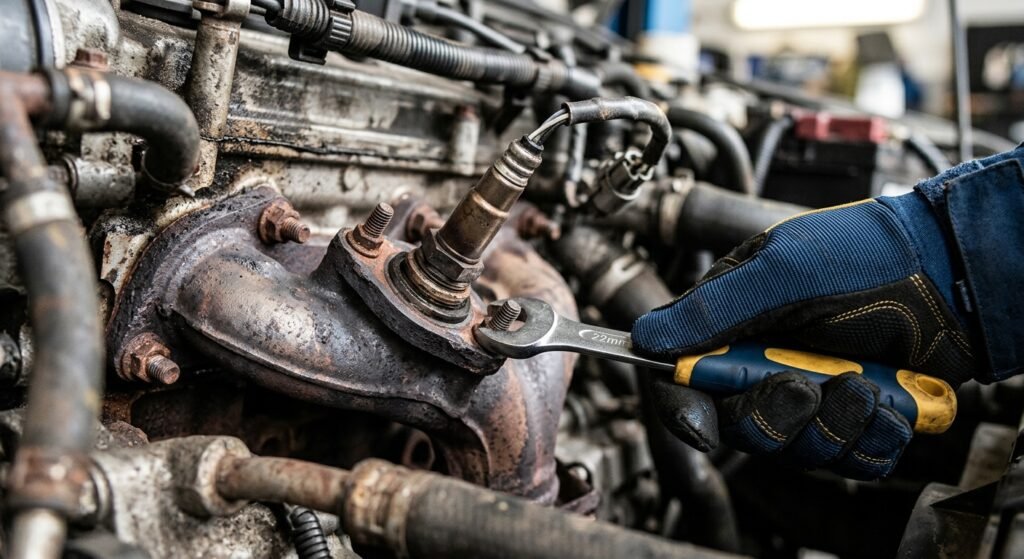
- Inspect exhaust for leaks, damaged pipes, or loose flanges upstream of the downstream oxygen sensor. A small leak can cause P0420.
- Compare upstream (pre-cat) and downstream (post-cat) oxygen sensor voltages and response times on a live graph. Normal behavior: pre-cat sensor switches frequently; post-cat sensor should be steadier and lower amplitude if the cat is working.
- Perform fuel trim and misfire analysis. Long-term and short-term trims that are strongly positive/negative point to combustion or fueling faults.
- Measure exhaust temperatures before and after the catalytic converter with infrared or thermocouple; a healthy converter shows a noticeable temperature rise under load.
- When uncertainty remains, use a backpressure test or remove the converter to inspect the substrate (visual signs of melting, clogging, or rattling indicate failure).
Quick diagnostic table: common cause → test → likely fix
| Cause | Best Quick Test | Likely Fix |
|---|---|---|
| Bad downstream O2 sensor | Compare live voltages; sensor slow or flat | Replace downstream O2 sensor |
| Exhaust leak upstream of sensor | Visual/smoke test, listen for hiss at idle | Repair or replace leaking pipe/flange/gasket |
| Failed catalytic converter | High backpressure, substrate damage, temp profile | Replace catalytic converter |
| Fuel/ignition issue | Fuel trim, misfire codes, fuel pressure check | Address fuel or ignition fault first |
When a sensor swap is the right move — and when it’s not
Technicians often replace the downstream oxygen sensor because it’s cheaper than a catalytic converter. That’s reasonable only if the sensor actually fails tests: slow response, out-of-range voltages, or wiring damage. If the sensor tests healthy, replacing it will not cure P0420 and just wastes time and parts.
Is it safe to drive with a P0420?
Usually yes for short trips. P0420 itself rarely causes an immediate safety hazard, but it can mean your vehicle emits more pollution and, in the case of a clogged converter, may overheat or reduce engine performance. Don’t delay diagnosis if you notice power loss, stalling, or a rotten-egg smell. Always get a proper scan and inspection to determine the next steps.
Common diagnostic mistakes to avoid
- Replacing the catalytic converter first without checking sensors, wiring, exhaust leaks, and fuel/ignition systems.
- Clearing the code and assuming the problem is fixed — P0420 often returns quickly if the root cause isn’t corrected.
- Trusting only a generic code definition—vehicle-specific testing and live-data graphs are essential.
Tough cases and edge conditions
Some GMC models run richer or leaner under certain operating modes (cold start, open loop) and can temporarily trigger P0420 if the ECM expects a narrow band signal. Vehicles with aftermarket exhaust, engine modifications, or incorrect O2 sensor types are also more likely to throw this code. Always confirm OEM sensor types and proper placement when replacing parts.
How much will fixing P0420 cost?
Costs vary widely depending on the true fault. Simple O2 sensor replacement or exhaust gasket repair is relatively inexpensive; a catalytic converter replacement is significantly more. Get a detailed diagnosis from a trusted shop before authorizing parts. If you’re shopping for a used vehicle, consider a professional pre-purchase inspection to check for emission-system issues; LockNCal offers a pre-purchase vehicle inspection that includes a scan and visual systems check.
For information on federal emission standards and the role of on-board diagnostics, visit the EPA’s overview of the Clean Air Act and vehicle standards: EPA — Clean Air Act overview.
When to see a mechanic
- If the CEL is on with P0420 plus misfire or fuel-trim codes.
- If you have poor performance, overheating, or a strong sulfur smell.
- When diagnostics (O2 voltages, temp rise, backpressure) point to a bad catalytic converter.
If you’re buying a used GMC with a suspected emissions issue, schedule a professional inspection before purchase; a trained technician will avoid common misdiagnosis and confirm whether the issue is a sensor, leak, or converter failure.
Resources and related services
If your vehicle’s CEL points at safety-related modules instead of emissions (airbag, seat belt pretensioners, occupant detection, ADAS), LockNCal handles those systems professionally — see our vehicle safety system services for resets and replacements: Vehicle safety system services (airbag, SRS, seat belt, clock spring). For module programming or mobile calibration after parts replacement, check our module programming and ADAS calibration pages.
FAQ
Q: What exactly does the Gmc P0420 code mean?
A: It means the engine control module has detected the catalytic converter on Bank 1 is not operating efficiently enough — either the converter, oxygen sensors, or upstream conditions are causing the issue.
Q: Can I clear the code myself and drive on?
A: You can clear the code, but if the underlying problem remains the code will usually return. Clearing is only a temporary step; proper diagnosis is required to fix the root cause.
Q: Will replacing the downstream O2 sensor always fix P0420?
A: No. Replace the downstream O2 sensor only if testing shows it is slow, out of range, or has wiring faults. If the converter itself is degraded, sensor replacement alone won’t solve the problem.
Q: Is a failed catalytic converter dangerous?
A: Not usually immediately dangerous, but a clogged converter can cause overheating and loss of power. A damaged converter also increases emissions. Have it diagnosed promptly if you notice performance issues.
Q: How do I know whether to repair or replace parts?
A: Follow tests: inspect for leaks, compare O2 sensor live data, check temps and backpressure. Repair leaks or fuel/ignition faults first; replace sensors if faulty; replace the converter only if substrate damage or persistent failure remains after other fixes.
If you want a professional inspection, or need help confirming emission system issues before buying or repairing a vehicle, schedule an appointment through our online form at https://lockncal.com/schedule-your-service-appointment/ or call (469) 277-7277.


