 Skip to content

Direct answer: The Cadillac P0420 code means “Catalyst System Efficiency Below Threshold (Bank 1)” — the engine computer has detected that the catalytic converter (bank 1) is not reaching expected efficiency. Fixing it usually requires diagnosing oxygen sensors, exhaust leaks, fuel trim, or catalytic converter health and then replacing faulty hardware; have the vehicle professionally scanned and inspected.
Not near Dallas–Fort Worth? Mail us your airbag / SRS module.
We reset most airbag control modules by mail — free 2-way shipping and a fast turnaround. We clear the crash data, restore factory settings, and ship it right back, anywhere in the U.S.
Key Takeaways
- P0420 = Catalyst System Efficiency Below Threshold (Bank 1) — it’s an emissions/OBD-II fault, not an airbag or safety system issue.
- Common causes: failing catalytic converter, bad downstream O2 sensor, exhaust leaks, or engine misfires that contaminate the cat.
- Start with a proper live-data scan: compare upstream vs downstream O2 waveforms and check fuel trims and freeze frame data.
- Many fixes require part replacement (O2 sensors, exhaust components, or catalytic converter); consult a trusted mechanic for emissions repairs.
- LockNCal focuses on vehicle safety and security systems (airbags, ADAS, keys); this code should be handled by an emissions-capable technician.
Understanding the Cadillac P0420 code
The Cadillac P0420 code is a generic OBD-II trouble code defined as “Catalyst System Efficiency Below Threshold (Bank 1).” When the PCM sees the downstream oxygen sensor signal behave too similarly to the upstream sensor for too long, it concludes the catalytic converter isn’t doing enough to reduce emissions. This is a detection of reduced catalytic efficiency, not a precise statement about a specific failed component.
What “Bank 1” means
Bank 1 refers to the side of the engine that contains cylinder 1. On V6 and V8 Cadillacs this determines which catalytic converter and downstream O2 sensor the code points to. For inline engines Bank 1 is simply the side with cylinder 1.
Why this matters
A failing catalytic converter increases tailpipe emissions, can cause failed state inspections, and often reduces fuel economy. Leaving the root cause unaddressed can allow engine issues (like misfires) to damage a replacement catalytic converter later, so accurate diagnosis matters.
Common causes of P0420 on Cadillacs
- Worn or contaminated catalytic converter (age, catalytic substrate deterioration, or contamination from engine oil or coolant).
- Faulty downstream oxygen sensor (O2 sensor after the cat) giving incorrect readings.
- Exhaust leaks between the upstream O2 sensor and catalytic converter or at the manifold flange.
- Rich or lean running condition (fuel trim issues, bad injectors, or vacuum leaks) causing catalyst to underperform.
- Ignition misfires or burning oil/coolant that contaminate the cat.
- Damaged wiring/connectors to O2 sensors or PCM communication errors.
Symptoms drivers notice
- Check Engine Light (CEL) illuminated — often steady, sometimes flashing if misfires are present.
- Failed emissions test or increased tailpipe smell of fuel.
- Reduced fuel economy or slight loss of power in some cases.
- Rattling from underneath at idle (if the catalytic substrate is physically damaged).
How a technician diagnoses Cadillac P0420 code — step by step
Proper diagnosis avoids unnecessary catalytic converter replacement. A good technician will follow this logical order:
- Read freeze-frame and pending data with a full OBD-II scanner capable of live data and O2 sensor graphs.
- Inspect for obvious exhaust leaks, damaged wiring to O2 sensors, or visible damage to the converter.
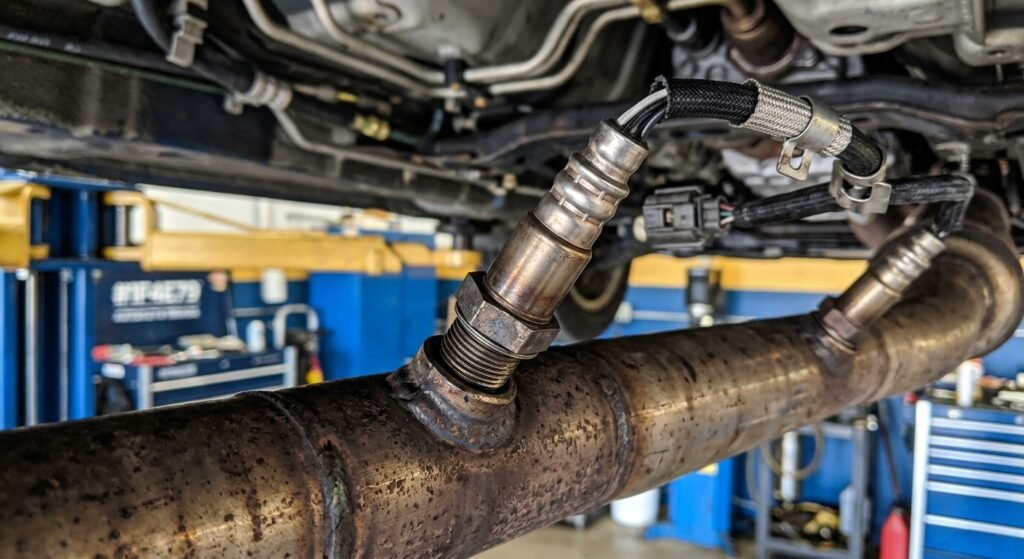
- Compare upstream (pre‑cat) and downstream (post‑cat) oxygen sensor waveforms during warm idle and under load. The upstream sensor should switch rich/lean rapidly; the downstream sensor should be a steadier signal if the cat is working.
- Check short-term and long-term fuel trims and look for misfires in live data. Correct any engine performance issues first (misfires, vacuum leaks, fuel system problems).
- Measure O2 sensor voltages and heater draws; confirm sensors heat and respond to induced rich/lean conditions (propane or starter fluid tests are common but should be done safely).
- If sensors and engine operation are good, perform an emissions or temperature test across the converter (using an infrared thermometer or tailpipe temperature probe) or backpressure test to detect internal obstruction.
- Replace only the failed component(s): O2 sensor(s), repair exhaust leaks, or replace the catalytic converter if degraded.
Quick diagnostic table
| Observed symptom or test result | Likely cause | Usual next step |
|---|---|---|
| Downstream O2 mirrors upstream O2 (no damping) | Degraded catalytic converter | Check temps, backpressure; if confirmed, replace catalytic converter |
| Downstream O2 stuck/high or low voltage | Bad downstream O2 sensor or wiring | Inspect wiring, test sensor, replace sensor if faulty |
| High short-term fuel trims / misfire codes | Engine running rich/lean causing cat damage | Fix misfire or fuel issue, clear codes, retest after repairs |
| Exhaust leak near upstream/downstream O2 | False sensor readings | Repair leak, then retest O2 behavior |
When is it safe or unsafe to keep driving?
With a steady P0420 (no misfire, no drivability loss) it is usually possible to drive to a repair shop — it’s primarily an emissions concern. However, if the Check Engine Light is flashing, or you have misfires, rough running, or overheating, stop driving and get it inspected right away because those conditions can damage the catalytic converter or other engine components.
Repair vs. replacement vs. sensor service
Many search for “Catalytic converter repair” or “P0420 repair” — understand that catalytic converters are emissions devices and often must be replaced, not repaired, to meet manufacturer standards. Replacing a failed O2 sensor or fixing leaks can sometimes clear the code without replacing the converter. Always confirm the root cause with live-data and physical tests before replacing expensive parts.
If you want a second opinion about an emissions diagnosis or need help getting an accurate live-data scan, your best next step is to have the car scanned and inspected by an emissions-capable technician. For federal guidance on vehicle emissions and why the catalytic converter matters, see the EPA’s summary of vehicle air pollution and control programs: EPA: Vehicle air pollution.
Cost considerations and parts
Costs vary widely by model and whether you replace just an O2 sensor or the catalytic converter. Aftermarket converters exist, but some states require CARB-compliant units on certain vehicles — confirm local regulations with your repair facility. Always fix any underlying engine issues first; replacing a catalytic converter while misfires continue will likely lead to a second failure.
How to talk to your mechanic (what to ask)
- Request live-data logs for upstream and downstream O2 sensors and fuel trims.
- Ask whether they inspected for exhaust leaks, backpressure, and O2 sensor heater operation.
- If they recommend replacing the cat, ask to see temperature or backpressure evidence and whether a diagnostic confirmed sensor health first.
- Confirm parts are emissions-compliant for your state (CARB vs federal) if applicable.
Other resources and related services
If your Cadillac also needs safety-system work (airbag module reset, occupant module, clock spring, seat belt reset/replacement) or you simply want a specialist for SRS/airbag issues, LockNCal handles vehicle safety and security systems; see our vehicle safety services overview for details: vehicle safety system services. For nationwide mail-in SRS module resets, see our mail-in services overview.
FAQ
A: It means the PCM has compared readings from the upstream and downstream oxygen sensors and determined the catalytic converter on bank 1 is not reducing emissions as expected.
Q: Can a bad O2 sensor cause P0420?
A: Yes. A faulty downstream O2 sensor or its wiring can produce false readings that trigger P0420; sensors are cheaper to replace than converters, so they are commonly checked first.
Q: Will clearing the code make it stay away?
A: Clearing the code without fixing the root cause only hides the issue temporarily; if the underlying fault remains, the code will return after the car completes readiness cycles.
Q: Is it legal to drive with P0420?
A: Legality depends on local inspection laws. From a safety standpoint, a steady P0420 usually doesn’t create an immediate hazard, but underlying causes like misfires can be dangerous and should be fixed promptly.
Q: Should I replace the catalytic converter myself?
A: Catalytic converter replacement involves exhaust work and emissions compliance concerns. Unless you have the right tools and knowledge of local regulations, it’s best handled by a qualified shop.
If you’d like an emissions-capable shop to scan and diagnose your Cadillac P0420 code, schedule an appointment online and speak with a technician at (469) 277-7277: Schedule an appointment.


