 Skip to content

Direct answer: The Buick P0420 code means “Catalyst System Efficiency Below Threshold (Bank 1)” — the engine computer sees the catalytic converter isn’t doing enough pollution cleanup. Fixing it requires proper diagnosis (O2 sensor data, fuel trims, exhaust leaks) and usually replacing a failing catalyst or O2 sensor rather than guessing.
Key Takeaways
- P0420 points to the catalytic converter (Bank 1) not meeting efficiency thresholds, but the cause can be upstream or downstream of the converter.
- Common causes: bad O2 sensor, damaged catalytic converter, exhaust leaks, rich/lean fueling, or failed fuel trim strategies.
- Don’t automatically replace the cat — run live-data tests, oxygen sensor tests, and an exhaust leak check first.
- If you plan to buy a used Buick with a P0420, get a pre-purchase vehicle inspection to avoid surprise expenses.
What the Buick P0420 code means
The code P0420 is a generic OBD-II trouble code defined as “Catalyst System Efficiency Below Threshold (Bank 1).” For a Buick, Bank 1 is the engine bank that contains cylinder #1. The powertrain control module (PCM) compares readings from the upstream and downstream oxygen sensors; when the downstream sensor shows too little difference versus upstream over time, the PCM concludes the catalytic converter isn’t working efficiently and sets P0420.
Common causes of a P0420 on a Buick
P0420 is a symptom, not a single-fix diagnosis. Common root causes include:
- Failing downstream O2 sensor (false readings).
- A physically damaged or clogged catalytic converter (wear, overheating, melted substrate).
- Exhaust leaks between the upstream sensor and the converter or near a sensor bung.
- Incorrect air/fuel mixture — persistent rich or lean conditions can poison or overheat the cat.
- Failed engine management components (fuel injectors, ignition misfire, EGR faults) that change exhaust composition.
- Aftermarket exhaust or sensor relocation that changes sensor readings.
Symptoms you’ll notice
- Check Engine Light (CEL) illuminated — P0420 is one of the most common causes.
- Possible reduced fuel economy if fueling issues are present.
- Failed emissions test or readiness monitors not setting to “ready.”
- Rarely, rough idle or drivability problems when the underlying cause is a misfire or fuel issue.
How a technician diagnoses Buick P0420: step-by-step
Good diagnosis follows data, not guesswork. A qualified shop will typically follow these steps in order:
- Record freeze frame and confirm the P0420 with a scanner that shows live O2 sensor data and long-term/short-term fuel trims.
- Perform a visual inspection for exhaust damage, holes, or loose heat shields and check for aftermarket parts or previous work near sensors.
- Check for related codes — misfire codes (P0300–P0306), fuel trim anomalies, or O2 sensor-specific codes change the priority of tests.
- Using live data, compare upstream (pre-cat) vs downstream (post-cat) O2 sensor waveforms: the upstream should switch rich/lean frequently; the downstream should be much steadier if the cat is working.
- If both sensors mirror each other closely, suspect a failed cat or a sensor problem.
- If upstream shows switching but downstream also switches wildly, the converter may be degraded.
- Check fuel trims and look for signs of a rich or lean condition that could damage the catalyst over time.
- Perform an exhaust leak test (smoke or feel for leaks) especially between the upstream O2 sensor and the converter; leaks can fool downstream readings.
- Test the downstream O2 sensor heater and response time; a slow or dead heater will cause bad data under cold conditions.
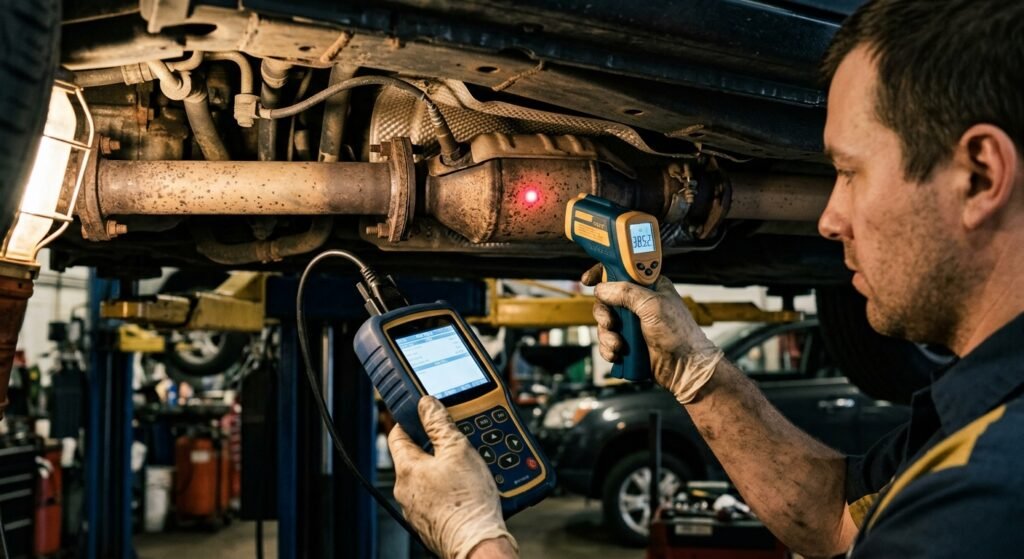
- If needed, perform a temperature test across the converter (infrared or thermocouple): a working catalyst will be hotter downstream than upstream under load.
- Only after these tests should the tech recommend replacement: upstream/downstream O2 sensors, catalytic converter, or further engine repairs to resolve underlying fueling or misfires.
Tools and measurements technicians use
Here are the real tools and readings a professional uses — not guesswork:
- OEM-capable scan tool with live data and O2 sensor graphing.
- Digital multimeter for heater and sensor voltage checks.
- Smoke machine or pressure kit to find exhaust leaks.
- Infrared thermometer or thermocouples for converter temperature differential.
- Fuel pressure gauge and fuel system diagnostics when trims look abnormal.
Quick reference: causes, how they look, and the test
| Probable cause | How it looks | Best initial test |
|---|---|---|
| Bad downstream O2 sensor | Downstream voltage mirrors upstream or is stuck | Compare live waveforms; test heater with DMM |
| Damaged/clogged catalytic converter | Downstream sensor shows small change vs upstream; high backpressure; heat signature | Temp check across converter; backpressure test; visual inspection |
| Exhaust leak | Hissing, visible holes; codes intermittent | Smoke test or pressurize exhaust between manifold and cat |
| Engine misfires / fuel issues | P030x codes, odd fuel trims, poor economy | Scan for misfire codes, fuel pressure, injector balance |
When you can drive and when you should stop
P0420 alone usually won’t make a Buick unsafe to drive right away. If you have no drivability problems (no misfire, no loss of power, no overheating), short trips to a shop for diagnosis are generally acceptable. However, if the code is accompanied by rough running, loss of power, or engine overheating, stop driving and get it inspected — those symptoms indicate deeper engine problems that can damage the converter or leave you stranded.
Common missteps to avoid
- Don’t replace the catalytic converter first. Many P0420 cases are solved by replacing an O2 sensor or fixing an exhaust leak.
- Don’t clear the code and drive without diagnosing — the PCM may set the code again and you’ll fail emissions testing.
- Avoid low-quality aftermarket converters that don’t match OEM flow and substrate — they can trigger readiness monitors or fail quickly.
For a used Buick with a P0420, get a thorough pre-purchase vehicle inspection to quantify repair risk and expected costs; a trained inspector will include emission system checks in their report and help you avoid surprises. You can learn more about that service here: pre-purchase vehicle inspection.
If you need professional help with safety-related modules (airbags, occupant detection, belt pretensioners) after an incident, LockNCal handles vehicle safety system services and module programming — those systems are separate from emissions but critically important: vehicle safety system services.
Official background on OBD-II monitoring and why these codes matter can be found at the EPA’s OBD-II overview for consumers and technicians.
FAQ
Q: Will replacing the oxygen sensors fix a P0420 on my Buick?
A: Sometimes. If the downstream O2 sensor is giving incorrect readings or the heater circuit is bad, replacing that sensor can clear P0420. But if the converter is physically damaged or there are fueling/misfire issues, sensor replacement alone won’t fix the root cause.
Q: Can I drive my Buick with a P0420 code?
A: Usually yes for short trips if you have no drivability issues. But if you also have misfires, loss of power, or overheating, stop driving and get it checked — continuing to drive can damage the catalytic converter or leave you stranded.
Q: Will fixing a P0420 affect emissions testing?
A: Yes. Fixing the underlying issue and then allowing the PCM to complete readiness monitors is required before passing an emissions test. Simply clearing codes without repair will usually leave monitors incomplete and lead to a test failure.
Q: How much does it cost to fix a P0420 on a Buick?
A: Costs vary widely depending on the cause — O2 sensor replacement, exhaust work, or catalytic converter replacement have very different price ranges. Get a diagnostic scan first to identify the root cause and a shop estimate for parts and labor.
Q: Can a bad catalytic converter cause other codes?
A: Yes. A failing converter can lead to increased misfires, poor fuel trims, or downstream O2 sensor codes. Conversely, persistent misfires and rich running can damage the converter, so diagnosing the sequence is important.
If you’re buying a used Buick or need a thorough safety systems check as part of a service plan, schedule a pre-purchase inspection or contact LockNCal for vehicle safety system services. To set up an appointment, visit https://lockncal.com/schedule-your-service-appointment/ or call (469) 277-7277.
Authoritative safety reference: NHTSA vehicle safety & recalls.


