 Skip to content

Direct answer: The Hyundai P0420 code means “Catalyst System Efficiency Below Threshold (Bank 1).” It usually points to a failing catalytic converter, but can also be caused by a bad oxygen sensor, exhaust leaks, or engine issues that create unburned fuel. Confirm with a scan and targeted diagnosis before replacing the converter.
Not near Dallas–Fort Worth? Mail us your airbag / SRS module.
We reset most airbag control modules by mail — free 2-way shipping and a fast turnaround. We clear the crash data, restore factory settings, and ship it right back, anywhere in the U.S.
Key Takeaways
- P0420 Hyundai means the catalytic converter on Bank 1 is not performing to OBD-II standards.
- Common causes include a failing catalytic converter, faulty upstream/downstream O2 sensors, exhaust leaks, or rich/lean engine conditions.
- Diagnosis should follow a specific order: live-data O2 comparison, visual exhaust check, fuel/ignition system check, and catalytic temperature/readings.
- Replacement of the catalytic converter is often required, but sensor or engine fixes can clear the code.
- If you’re not sure, get a professional scan and diagnosis — don’t replace parts blindly.
What the Hyundai P0420 code actually means
The OBD-II code P0420 stands for “Catalyst System Efficiency Below Threshold (Bank 1).” Bank 1 is the side of the engine that contains cylinder 1. Modern vehicles use two oxygen sensors around the catalytic converter: an upstream (pre-cat) sensor and a downstream (post-cat) sensor. The PCM compares their readings to decide whether the catalytic converter is doing its job reducing emissions. When the downstream sensor reading tracks the upstream too closely for too long, the PCM thinks the converter isn’t cleaning up the exhaust and sets P0420.
Why P0420 appears on Hyundai models (Veloster, Accent, Elantra, Santa Fe…)
P0420 is common across many Hyundai models: Veloster, Accent, Elantra, Santa Fe and others can all show the code. Common reasons Hyundai owners see this code include age-related converter degradation, contaminated catalyst from oil or antifreeze consumption, failed oxygen sensors, or engine conditions that send incorrect air/fuel into the exhaust.
Typical causes
- Failing catalytic converter (mechanical or chemical breakdown).
- Faulty upstream or downstream O2 sensor (slow, stuck, or out-of-spec).
- Exhaust leaks between the engine and the downstream O2 sensor.
- Rich-running condition (fuel trim, leaking injector, leaking fuel pressure regulator).
- Lean-running condition (vacuum leak, MAF sensor fault, low fuel pressure).
- Contamination from coolant or oil entering the exhaust (head gasket, piston rings).
- Wiring or connector problems to O2 sensors or related circuits.
Symptoms drivers notice
- Check Engine Light (CEL) illuminated — P0420 logged on scan.
- No major drivability symptoms initially; sometimes reduced fuel economy or sluggish performance with advanced catalyst failure.
- Rotten-egg or sulfur smell from the exhaust if the converter is failing.
- Failed emissions test (smog) even if the car runs normally.
Step-by-step Hyundai P0420 diagnosis (technician-level)
Do the following checks in order. This order minimizes unnecessary parts replacement and pinpoints the true cause.
- Verify the code and freeze frame data: Use a capable scanner to confirm P0420 and note conditions when it set (engine temp, load, rpm).
- Check for related codes: Look for O2 sensor codes (P0130–P0167), misfires, fuel trim codes, or coolant/oil consumption codes.
- Live data O2 sensor comparison: With a scan tool view both upstream and downstream O2 voltages or short-term fuel trim behavior. Upstream should switch rich/lean rapidly; downstream should be steadier and show lower amplitude. If both mirror each other, suspect the converter or an exhaust leak upstream of the downstream sensor.
- Inspect wiring and connectors: Visually inspect O2 sensor wiring, connectors, and grounds for damage or corrosion.
- Check for exhaust leaks: Visually and physically inspect the exhaust from the manifold/header past the downstream sensor. Small leaks near the front of the system can fool the downstream O2 sensor.
- Catalyst temperature test: Measure temperature upstream and downstream of the converter (infrared gun). A working cat will be significantly hotter downstream. Small or no differential suggests reduced conversion efficiency.
- Fuel and ignition system checks: Confirm no misfires, proper fuel pressure, and that fuel trims are within reasonable limits. An engine running rich or lean can damage the converter or trigger P0420.
- Sensor substitution or bench testing: If suspect, swap a known-good O2 sensor or bench-test the sensor to confirm performance before replacing the catalytic converter.
- Confirm with a road test and scan: After fixes, clear codes, perform the required drive cycle and verify the P0420 does not return.
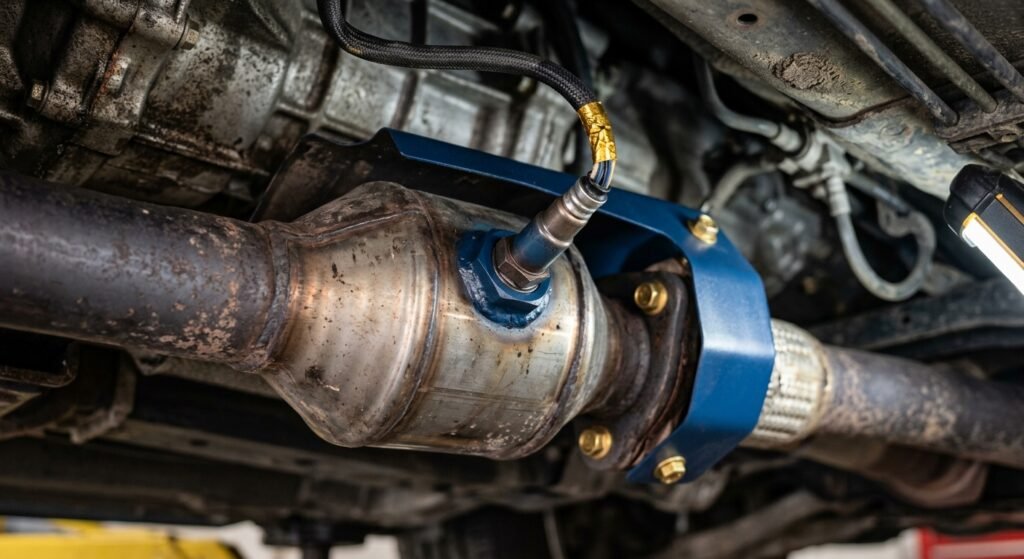
Table: Common causes, tests, and likely next steps
| Probable Cause | Quick test | Likely next step |
|---|---|---|
| Bad catalytic converter | Low temp differential; downstream O2 mirrors upstream | Confirm with diagnostics; replace converter if confirmed |
| Faulty O2 sensor (downstream or upstream) | Slow or flat O2 readings; scanner shows sensor fault codes | Replace sensor and re-test before replacing cat |
| Exhaust leak upstream of downstream sensor | Audible leak, soot, or smoke; downstream behaves like upstream | Repair leak and re-check O2 data |
| Engine problems (rich/lean, misfire) | Abnormal fuel trims, misfire codes, or fuel pressure faults | Fix engine faults; replace cat only if still needed |
When is it safe to keep driving?
If your vehicle shows P0420 but otherwise runs normally (no misfires, no overheating, normal oil/coolant levels), short trips are usually safe for a limited time. However, a failing catalytic converter can become clogged and reduce performance or cause overheating in the exhaust system. If you smell sulfur, have poor fuel economy, or see additional engine codes, stop driving and get a scan and diagnosis promptly.
Replacement vs. other fixes
For many Hyundais with P0420 the final fix is catalytic converter replacement. However, replacing the converter without a full diagnostic is wasteful. Often the real culprit is a bad O2 sensor, an exhaust leak, or an engine condition that must be corrected first. Use the diagnostic steps above to confirm the converter is the root cause.
Cost and emissions testing considerations
Catalytic converter replacement can be expensive and emissions testing failures commonly trace back to P0420. If your vehicle fails a state inspection because of P0420, present the diagnostic data to your technician and ask for targeted fixes. Some regions and models have manufacturer coverage or partial assistance — check with your dealer and keep records of diagnostics and repairs.
Useful official resource
For an overview of OBD-II and how emissions monitoring works, see the NHTSA’s OBD-II information: NHTSA OBD-II overview.
Model-specific notes (Hyundai Veloster, Accent, Elantra, Santa Fe)
While the P0420 diagnosis steps are the same across models, keep these model-specific hints in mind:
- Hyundai Veloster: compact exhaust routing can make heat differentials smaller; verify sensor placement in data logs.
- Hyundai Accent: older models may have simpler diagnostics but are still sensitive to exhaust leaks near the manifold.
- Hyundai Elantra: watch for owners reporting oxygen sensor failures after aftermarket exhaust work.
- Hyundai Santa Fe: larger V6 engines have Bank 1 identification details—confirm cylinder 1 side before ordering parts.
For extra help with safety systems or if you see any airbag, seat belt, or steering/ADAS messages while diagnosing other repairs, LockNCal handles airbag/SRS module resets, module programming, and ADAS calibration — trusted work for safety and security systems only.
FAQ
Q: Will replacing the oxygen sensor fix P0420 on my Hyundai?
A: Sometimes. If diagnostics show a slow or failed O2 sensor, replacing it can clear P0420. Always confirm with live-data testing before replacing sensors to avoid unnecessary parts costs.
Q: Can a software update or module reflash fix P0420?
A: Rarely. P0420 usually indicates a hardware/emissions issue. In a few cases a manufacturer TSB or PCM reflash can change adaptive strategy or thresholds; check dealer service bulletins before replacing parts.
Q: My Hyundai passed inspection but then P0420 returned—what next?
A: Intermittent P0420 often points to intermittent exhaust leaks, a failing O2 sensor, or incomplete catalyst conversion under certain driving conditions. Re-run the diagnostic sequence focusing on live data and heat differentials.
Q: Is it legal to drive with P0420?
A: Legally you can drive with P0420 in most states, but you may fail emissions testing. From a safety standpoint it’s usually not an immediate hazard unless related engine faults exist.
Q: Could aftermarket parts cause P0420 on my Hyundai?
A: Yes. Aftermarket exhaust components or oxygen sensors with different characteristics, or poor-quality replacements, can trigger P0420. Use quality parts and verify performance with a scan tool after installation.
If you need professional diagnostics or want help confirming a catalytic converter, O2 sensor, or engine cause, get the vehicle scanned by a trusted mechanic and gather live-data logs. When you’re ready to book professional work for any safety or module service, schedule an appointment here: https://lockncal.com/schedule-your-service-appointment/ or call (469) 277-7277.
Helpful LockNCal links: our mail-in SRS airbag module reset service is at https://lockncal.com/mail-in-airbag-module-reset-service-free-shipping/ and our module programming overview is at https://lockncal.com/mobile-module-programming-services/.


