 Skip to content

Direct answer: The Dodge P0420 code means “Catalyst System Efficiency Below Threshold (Bank 1)” — the car’s emission control system says the catalytic converter isn’t bringing downstream oxygen sensor readings into expected range. Fixing it requires a proper diagnosis (O2 sensors, exhaust leaks, fuel trims, or a failing converter) and, if needed, catalytic replacement by a qualified shop.
Not near Dallas–Fort Worth? Mail us your airbag / SRS module.
We reset most airbag control modules by mail — free 2-way shipping and a fast turnaround. We clear the crash data, restore factory settings, and ship it right back, anywhere in the U.S.
Key Takeaways
- The Dodge P0420 code = Catalyst System Efficiency Below Threshold (Bank 1).
- Common causes: failing catalytic converter, bad O2 sensor(s), exhaust leaks, or engine misfire/fuel trim issues.
- Diagnosis uses an OBD-II scan, live O2 sensor data, fuel-trim checks, and visual/exhaust tests — follow a strict test order.
- It’s usually safe to drive short-term but you should confirm and correct the root cause to avoid damage or failed emissions tests.
Dodge P0420 code — what it means
By definition, the Dodge P0420 code reads exactly as: “Catalyst System Efficiency Below Threshold (Bank 1).” Bank 1 is the side of the engine containing cylinder 1. The onboard diagnostics compare upstream (pre-catalyst) and downstream (post-catalyst) oxygen sensor signals — when the downstream sensor follows the upstream too closely or the expected signal difference disappears, the PCM logs P0420.
What drivers notice
- Check Engine light illuminated (steady, usually).
- Possible reduced fuel economy or slight performance loss.
- Vehicle may fail state emissions or smog tests.
- Rarely will the engine run rough from P0420 alone unless a related misfire or sensor fault is present.
Common causes of P0420 on a Dodge
- Worn or damaged catalytic converter (age, overheating, contamination).
- Faulty downstream oxygen sensor or upstream O2 sensor providing bad data.
- Exhaust leaks between the engine and the catalytic converter (manifold/header gaskets, cracks).
- Engine issues that affect catalyst efficiency: misfires, rich/lean running, oil or coolant contamination of the cat.
- Failed catalytic convertor temperature or backpressure anomalies (clogged or melted substrate).
How a technician diagnoses Dodge P0420 code (recommended order)
Follow this sequence to avoid misdiagnosis. Do not replace the catalytic converter first without confirming other causes.
- Read freeze-frame and full scan tool data. Confirm P0420 is current and note fuel trims, long-term (LTFT) and short-term (STFT) fuel trims, and any stored misfire codes.
- Check for related codes for oxygen sensors (P013X/P015X family), misfires (P0300–P0306), or fuel system issues.
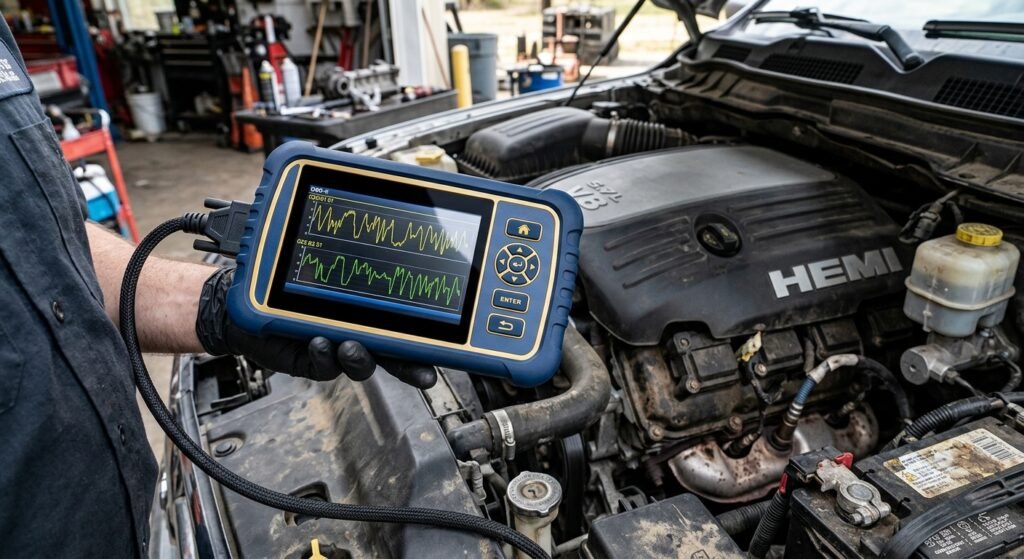
- Inspect wiring and connectors for both upstream and downstream O2 sensors; backprobe sensor signals with a quality scan tool and compare waveforms.
- With the engine at operating temperature, view live O2 data: upstream should switch frequently; downstream should be steadier if the cat is working. If downstream mirrors upstream, catalytic efficiency is compromised or sensor is bad.
- Perform a visual exhaust inspection and a smoke test to find leaks between the exhaust ports and the catalytic converter.
- Check for symptoms of engine problems: compression test or cylinder balance test for misfires, inspect for oil or coolant in the intake, and check fuel pressure if trims are extreme.
- Measure catalytic converter temperature (front vs rear) with an infrared pyrometer — a working converter usually shows a 100°F+ delta under load. Low delta suggests a failing converter.
- As a final confirmation, many shops will perform a backpressure test or emissions analyzer test (if available) before replacing hardware.
Quick tests you can do (basic tools)
- Scan for codes and freeze frame with an OBD-II scanner.
- Listen for exhaust leaks and inspect visible pipes/manifolds for damage.
- Check recent service history: has the engine been burning oil, or has a head gasket failed recently?
Causes, diagnostic hints, and what each test tells you
| Suspected Cause | Useful Test | What a Positive Result Means |
|---|---|---|
| Bad downstream O2 sensor | Compare upstream vs downstream O2 waveforms / scan tool live data | Downstream that switches like upstream suggests sensor or wiring fault, not the cat |
| Exhaust leak ahead of cat | Smoke test or visual inspection | Any leak can skew O2 readings and trigger P0420 |
| Engine misfire or rich/lean condition | Check fuel trims, misfire codes, compression | Correct engine running issues first — they damage converters |
| Failing catalytic converter | Temp delta, backpressure, emissions analyzer | Low temp delta / high backpressure = likely converter replacement |
When is it safe to keep driving?
Most vehicles with a P0420 code will run normally for a while. Short-term driving is usually safe for the driver, but be aware:
- A failed catalytic converter can increase emissions and cause a vehicle to fail state inspections.
- If the underlying cause is an active misfire or coolant/oil contamination, continued driving can damage the new converter or other engine components.
- If you see severe performance loss, overheating, heavy smoke, or repeated misfires, stop driving and get it checked immediately.
Common replacement and repair notes
Do not replace parts blindly. Replacing oxygen sensors or a catalytic converter without confirming the root cause wastes money. If diagnostics confirm a bad converter, replacement is the correct remedy — catalytic substrates are single-use, and the OEM or high-quality aftermarket replacement that matches emissions requirements is important.
Cost & emissions tests
A vehicle with P0420 will commonly fail a state emissions test. Costs for parts and labor vary widely by model and location; get a complete diagnosis and an estimate from a trusted repair shop. If you are buying a used Dodge with a P0420, consider a professional pre-purchase inspection to avoid surprises: Pre-purchase vehicle inspection.
Troubleshooting checklist for DIYers
- Start with a known-good scan tool and clear codes to see if P0420 returns.
- Inspect O2 sensor wiring for damage and corrosion; test heater circuits if the sensor has one.
- Look for exhaust leaks and repair them before replacing sensors/catalytic converters.
- If you replace the downstream O2 sensor, confirm the replacement is the correct OEM or equivalent part for your Dodge.
When to call a pro
If the code persists after initial checks, if you lack tools for live-data analysis, or if you find engine misfires or fuel-trim extremes, have a professional technician complete the diagnostic sequence. They have tools for waveform analysis, backpressure testing, and emissions measurement that are necessary for a reliable fix.
Where LockNCal fits (safety & security systems)
LockNCal specializes in the vehicle’s safety and security systems — airbags/SRS module resets, ADAS calibration, keys and immobilizers — rather than engine or emissions repairs. If you ever need help with those systems after an incident, see our vehicle safety services: Vehicle safety system services.
FAQ
Q: Will clearing the code make the Check Engine light stay off?
A: Clearing the code can turn off the Check Engine light temporarily, but if the root cause remains the light will return when conditions re-create the fault. Always follow up with diagnosis.
Q: Can a bad O2 sensor cause P0420?
A: Yes. A failing downstream oxygen sensor (or faulty wiring) can produce readings that mimic a bad catalytic converter and trigger P0420.
Q: Does P0420 mean the catalytic converter must be replaced?
A: Not always. P0420 means catalytic efficiency is below threshold, but causes can include sensors, exhaust leaks, or engine problems. Confirm with diagnostics before replacing the converter.
Q: Will P0420 fail an emissions test?
A: Most likely yes. A P0420 often indicates increased emissions and commonly results in a failed state smog test until the underlying issue is corrected.
Q: Is it safe to drive with P0420?
A: Short-term driving is usually safe, but if you detect smoke, severe performance loss, engine misfire, or overheating, stop and get inspected — continuing to drive can worsen damage.
For a proper diagnosis and to schedule an inspection, book a professional evaluation at our scheduling page and call (469) 277-7277 for questions: Schedule an appointment. For more on how OBD-II tracks emissions systems, see the NHTSA OBD-II overview: NHTSA OBD-II overview.


