 Skip to content

Direct answer: The Jeep P0420 code means exactly what the scan tool reports: Catalyst System Efficiency Below Threshold (Bank 1). It usually points to a failing catalytic converter, a bad oxygen sensor, or related drivability problems (misfire, exhaust leaks, fuel issues). Confirm with live-data O2 readings, fuel-trim checks, and a physical inspection before replacing parts.
Key Takeaways
- P0420 = Catalyst System Efficiency Below Threshold (Bank 1) — the catalytic converter on the Bank 1 side isn’t doing its job.
- Common causes: worn catalytic converter, bad downstream O2 sensor, exhaust leak, misfire, or fuel trim problems.
- Diagnosis order matters: scan for other codes, review live O2 and fuel-trim data, check for exhaust leaks and misfires, test sensors and catalytic temperature.
- Don’t replace the catalytic converter until you’ve ruled out sensors, wiring, and engine faults that can damage a new cat.
What the code means in plain English
When your Jeep reports P0420, the vehicle’s engine control module (ECM) has compared signals from the upstream (pre-cat) and downstream (post-cat) oxygen sensors and decided that the catalytic converter isn’t reducing emissions efficiently on Bank 1. The verified definition is: Catalyst System Efficiency Below Threshold (Bank 1).
Bank 1 refers to the side of the engine that contains cylinder number 1. On V6 and V8 engines this is important; on inline engines there is only one bank.
Common causes
- Worn or clogged catalytic converter (age, overheating, contamination)
- Faulty downstream O2 sensor (slow, out of spec, heater failure)
- Exhaust leaks near the downstream sensor or manifold leaking
- Persistent misfires or rich/lean running (contaminates the cat)
- Fuel system issues or incorrect fuel pressure causing abnormal fuel trims
- Wiring or connector problems on the O2 sensor circuit
- ECM software or rare sensor calibration issues (less common)
Typical symptoms Jeep owners notice
- Check Engine Light (CEL) illuminated — often steady, sometimes flashing if misfires are present
- Failed emissions test
- Reduced fuel economy or rough idle if underlying condition exists
- Occasionally a sulfur/rotten-egg smell from the exhaust if the cat is failing
Step-by-step diagnostic checklist (good order to follow)
Have a professional-grade OBD-II scanner with live-data and freeze-frame, and if possible a lab-style graphing tool for O2 sensor traces. Here’s a practical workflow:
- Read codes and freeze-frame. Note other codes (P0300-P030x misfires, fuel-trim codes, O2 sensor codes) — these must be addressed first.
- Check readiness monitors and freeze-frame data to see when the code ran and under what load/temperature conditions.
- Inspect for exhaust leaks at the manifold, gaskets, and downstream sensor threads — even a small leak upstream of the downstream sensor will cause false P0420 triggers.
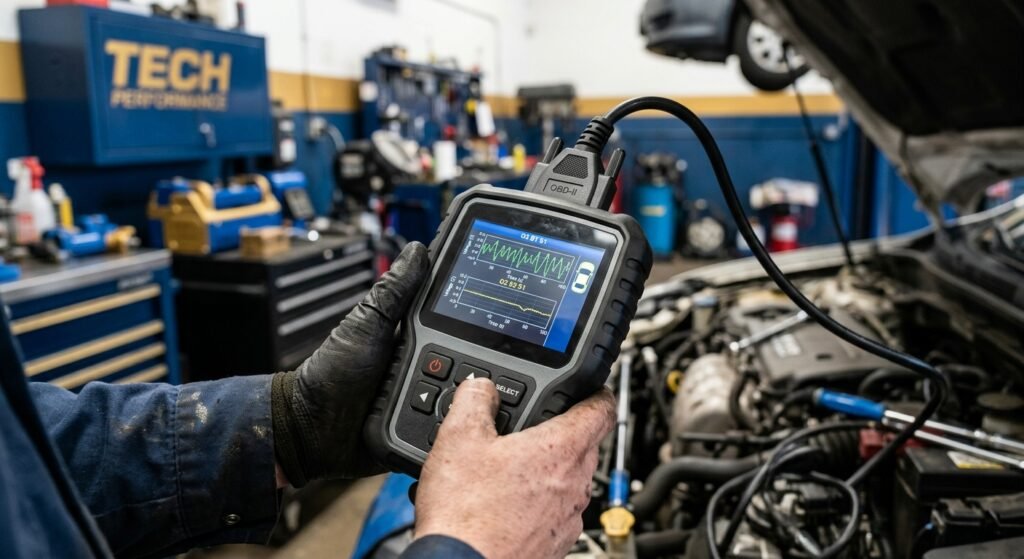
- Use live data: monitor upstream (B1S1) and downstream (B1S2) O2 voltages. Upstream should switch rapidly between ~0.1–0.9V; downstream should be much steadier and not mirror upstream if the cat is working.
- Check short-term and long-term fuel trims (STFT/ LTFT). Large trims (>±10–15%) indicate fueling issues that can foul a catalytic converter or confuse sensor readings.
- Scan for misfire counts and perform a compression or relative compression test if misfires are present.
- Test downstream O2 sensor heater circuit and wiring for voltage and resistance faults. A slow or dead heater can give bad data until the sensor reaches operating temperature.
- Measure exhaust temperature upstream and downstream of the catalytic converter. A healthy cat will run significantly hotter on the outlet side under load; a small handheld infrared pyrometer helps here.
- If all else checks out but the downstream trace follows upstream closely and fuel trims and misfires are normal, the catalytic converter is likely degraded and needs replacement.
| Symptom | Most likely cause | Quick test |
|---|---|---|
| Downstream O2 mirrors upstream | Failed catalytic converter | Compare live O2 sensor graphs under steady cruise |
| Large LTFT / STFT values | Fuel system issue (fuel pressure, injector leak, vacuum leak) | Check fuel pressure, smoke test for vacuum/exhaust leaks |
| Random misfires and CEL | Misfire fouling the cat | Scan misfire counters, compression test, coil/plug swap |
| Downstream O2 heater fault | Sensor heating/open circuit | Check heater fuse, measure sensor heater resistance |
When to suspect the O2 sensor vs. the catalytic converter
O2 sensors fail more often than cats. If the downstream sensor is slow to respond, shows no heater current, or has wiring damage, replace or bench-test it first. However, don’t keep replacing sensors if live data consistently shows the downstream sensor tracking the upstream sensor after the engine is warmed and fuel trims are normal — that pattern is classic for a worn catalytic converter.
How to test the catalytic converter without removing it
- Temperature differential: with the engine at steady moderate load, measure catalytic inlet vs outlet temperature with an infrared thermometer. A healthy converter often shows the outlet hotter than the inlet by 100°F (varies by design).
- Backpressure test: measure exhaust backpressure at the O2 sensor bung or with a gauge — excessive backpressure indicates clogging.
- O2 sensor response test: graph upstream and downstream sensors during rich/lean transitions (snap throttle) to see if the cat is smoothing the signal.
Do-it-yourself limits and safety notes
If you are comfortable with an OBD-II scanner, smoke machine, and infrared thermometer, you can rule out many causes. But catalytic converter diagnosis can require shop-only tools (backpressure gauge, oscilloscope, or lab-quality scanner) and professional judgment — especially when emissions testing and legal compliance are at stake.
If your Jeep is newer and still under warranty or emission control warranty, document everything and consult a dealer. If you’re buying a used Jeep and see P0420, consider a thorough inspection or a pre-purchase check that includes emissions and OBD tests; our service page on pre-purchase vehicle inspection explains what to look for when buying used.
Costs and replacement considerations
Catalytic converters can be expensive, and on some models replacing them is costly. Before replacing the cat, ensure the engine runs correctly and sensors/wiring are good — replacing a cat while the root cause remains (misfire or fuel issue) risks wrecking the new converter quickly.
When it’s safe to keep driving
- Short-term driving with a steady P0420 (no misfires, no loss of power) is usually safe, but you may fail an emissions inspection.
- If the CEL is flashing or you have misfires, stop driving until the misfire is fixed; continued driving can overheat and permanently damage the catalytic converter and increase fire risk.
Real-world troubleshooting checklist for Jeep P0420
- Scan for codes and note freeze-frame data.
- Check for misfires, fuel trim extremes, or other O2 sensor codes — address those first.
- Visually inspect O2 sensor wiring and exhaust for leaks or damage.
- Graph upstream and downstream O2 sensors at operating temperature.
- Test downstream sensor heater circuit and resistance.
- Measure inlet/outlet cat temperature under load.
- Perform backpressure test if available, or consult a trusted mechanic for cat inspection.
Why some aftermarket ‘fixes’ fail
Avoid quick fixes like sensor blenders, electrical trickery, or cleaning additives that promise to “restore” the catalytic converter. These are often temporary or ineffective and can make diagnosis harder. If the cat is contaminated or physically degraded, replacement is the correct solution. Also avoid jumping straight to replacing the catalytic converter without checking upstream causes first.
Note: LockNCal specializes in vehicle safety and security systems (airbag/SRS module resets, seat belt and occupant system services, ADAS calibration, and keys). If your Jeep also needs work on those systems we can help, but P0420 itself is an emissions/engine matter best handled by an engine specialist or trusted mechanic.
FAQ
Can I clear the P0420 code and keep driving?
You can clear the code temporarily, but if the underlying problem remains the code will likely return after the vehicle completes readiness cycles. Clearing the code does not fix the cause and may leave you failing an emissions test.
Will replacing the downstream O2 sensor fix P0420?
Sometimes. If the downstream sensor is slow, has a bad heater, or reports impossible values, replacing it can solve the issue. But if the catalytic converter is truly degraded, replacing the sensor alone won’t help.
Does a P0420 mean my catalytic converter is broken?
Not always. It means the converter isn’t meeting efficiency thresholds. That could be caused by the converter itself or by upstream issues (misfire, fuel problems, sensor failure) that make the converter perform poorly.
Can a vacuum leak cause P0420?
Direct vacuum leaks usually affect fuel trims and can indirectly lead to conditions that make the cat inefficient. Exhaust leaks near sensors are a more common cause of false P0420 triggers.
How urgent is it to fix a P0420 on a Jeep?
Address it promptly if you need to pass emissions or if you notice misfires, poor fuel economy, or reduced power. If the CEL is flashing due to misfires, stop driving and repair immediately.
For a professional evaluation and to schedule service, visit our scheduling page or call (469) 277-7277 to discuss next steps.


